 Add to Chrome
 Add to Firefox
 Add to Edge
ABot-N1: Toward a General Visual Language Navigation Foundation Model
Jul 14, 2026
Visual Language Navigation foundation models aim to unify deep reasoning for grounded spatial decisions with broad versatility for diverse embodied tasks. Current approaches typically achieve this integration via monolithic policies that map observations directly to actions, yet they often suffer from coordinate drift and poor handling of long-tail semantics. Furthermore, these black-box mappings lack interpretability, hindering the simultaneous achievement of generality, robustness, and transparency. We present ABot-N1, a step toward a general Visual Language Navigation foundation model, that addresses these challenges by decoupling cognition from control via a slow-fast architecture guided by dual visual-language signals. More specifically, a slow vision-language reasoner performs explicit Chain-of-Thought reasoning while producing a pixel goal. This compact set of image-space anchor points serves as a universal interface for diverse tasks, including point-goal, object-goal, poi-goal, instruction-following, and person-following. Subsequently, a fast action expert leverages both the textual cues and the pixel guidance to generate continuous waypoints at the native control frequency. By bridging high-level intents and low-level control through pixel-grounded anchors paired with explicit linguistic traces, our approach ensures robust, generalizable, and interpretable navigation across simulation and real-world benchmarks. ABot-N1 establishes new state-of-the-art records, delivering massive gains specifically in urban-scale navigation: boosting POI arrival by 35.0% (to 77.3%) and achieving 95.4%/92.9% SR in complex indoor and outdoor scenes. It also maintains superior robustness across object-reaching, person-following, and instruction-following tasks. New Point-Goal/POI-Goal benchmarks are released as open source to advance the field of urban-scale navigation.

ABot-AgentOS: A General Robotic Agent OS with Lifelong Multi-modal Memory
Jul 11, 2026Recent VLM and VLA systems have improved robotic perception and action prediction, yet long-horizon embodied agents still require a general runtime layer for reasoning, memory, tool use, verification, and cross-embodiment execution. We present ABot-AgentOS, a general robotic Agent Operating System that sits above low-level controllers and provides a deliberative agent layer for scene-conditioned planning, context-isolated skill execution, multi-stage verification, multi-modal memory, and edge-cloud collaboration. To evaluate such systems, we introduce EmbodiedWorldBench, an executable benchmark with 16 indoor, outdoor, and hybrid scenes, four difficulty levels, and over 200 tasks involving navigation, object search, NPC dialogue, dynamic events, and trace-grounded scoring. ABot-AgentOS further introduces Universal Multi-modal Graph Memory, a persistent source-grounded substrate that converts dialogue, visual observations, spatial context, temporal relations, and task traces into typed nodes and edges. A failure-driven self-evolution loop converts diagnosed memory failures into gated runtime evo-assets that are promoted only to later evaluation splits, preventing current-split ground-truth leakage while enabling continual improvement. On an initial EmbodiedWorldBench subset, ABot-AgentOS improves over a single-controller baseline in both task success and goal completion. Across memory benchmarks, ABot-AgentOS Static achieves 87.5 on LoCoMo, 59.9 on OpenEQA EM-EQA, 88.6 on Mem-Gallery, and 76.5 Acc@All on NExT-QA; self-evolution further improves LoCoMo to 88.7, OpenEQA to 60.4, and Mem-Gallery to 89.0. These results suggest that a general Agent OS layer can improve long-horizon embodied execution while providing persistent, auditable memory for continual interaction.
ABot-N0: Technical Report on the VLA Foundation Model for Versatile Embodied Navigation
Feb 12, 2026Embodied navigation has long been fragmented by task-specific architectures. We introduce ABot-N0, a unified Vision-Language-Action (VLA) foundation model that achieves a ``Grand Unification'' across 5 core tasks: Point-Goal, Object-Goal, Instruction-Following, POI-Goal, and Person-Following. ABot-N0 utilizes a hierarchical ``Brain-Action'' architecture, pairing an LLM-based Cognitive Brain for semantic reasoning with a Flow Matching-based Action Expert for precise, continuous trajectory generation. To support large-scale learning, we developed the ABot-N0 Data Engine, curating 16.9M expert trajectories and 5.0M reasoning samples across 7,802 high-fidelity 3D scenes (10.7 $\text{km}^2$). ABot-N0 achieves new SOTA performance across 7 benchmarks, significantly outperforming specialized models. Furthermore, our Agentic Navigation System integrates a planner with hierarchical topological memory, enabling robust, long-horizon missions in dynamic real-world environments.
OpenNDD: Open Set Recognition for Neurodevelopmental Disorders Detection
Jun 28, 2023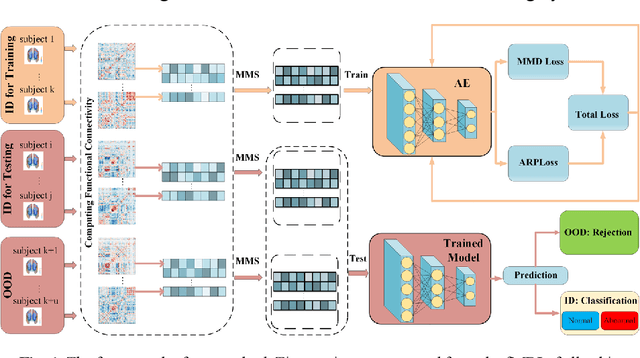
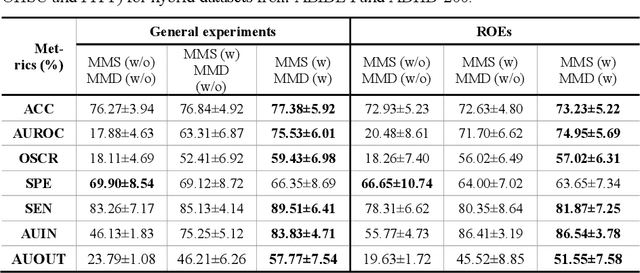
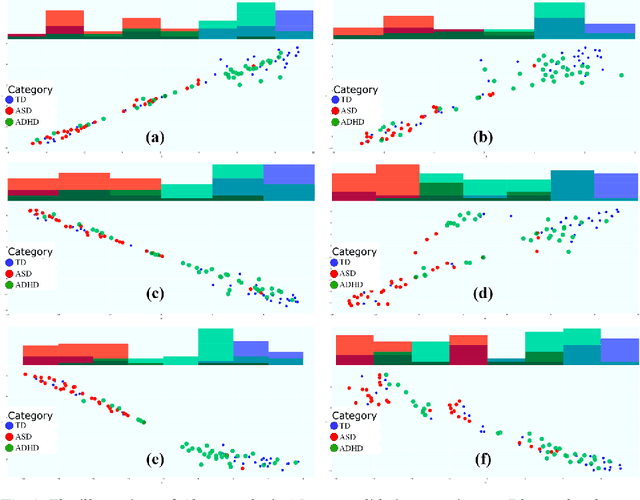
Neurodevelopmental disorders (NDDs) are a highly prevalent group of disorders and represent strong clinical behavioral similarities, and that make it very challenging for accurate identification of different NDDs such as autism spectrum disorder (ASD) and attention-deficit hyperactivity disorder (ADHD). Moreover, there is no reliable physiological markers for NDDs diagnosis and it solely relies on psychological evaluation criteria. However, it is crucial to prevent misdiagnosis and underdiagnosis by intelligent assisted diagnosis, which is closely related to the follow-up corresponding treatment. In order to relieve these issues, we propose a novel open set recognition framework for NDDs screening and detection, which is the first application of open set recognition in this field. It combines auto encoder and adversarial reciprocal points open set recognition to accurately identify known classes as well as recognize classes never encountered. And considering the strong similarities between different subjects, we present a joint scaling method called MMS to distinguish unknown disorders. To validate the feasibility of our presented method, we design a reciprocal opposition experiment protocol on the hybrid datasets from Autism Brain Imaging Data Exchange I (ABIDE I) and THE ADHD-200 SAMPLE (ADHD-200) with 791 samples from four sites and the results demonstrate the superiority on various metrics. Our OpenNDD has achieved promising performance, where the accuracy is 77.38%, AUROC is 75.53% and the open set classification rate is as high as 59.43%.
MC-UNet Multi-module Concatenation based on U-shape Network for Retinal Blood Vessels Segmentation
Apr 07, 2022

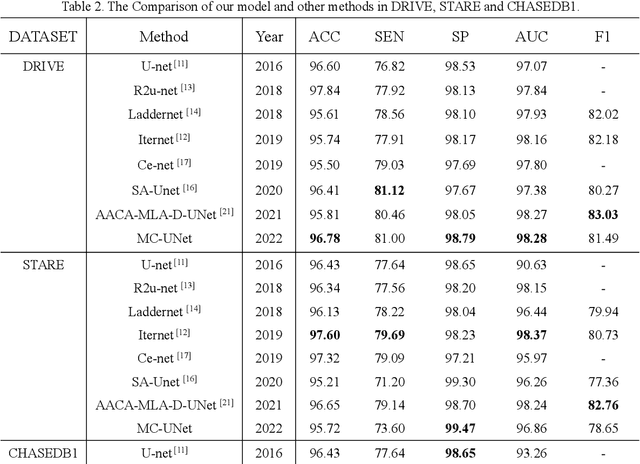
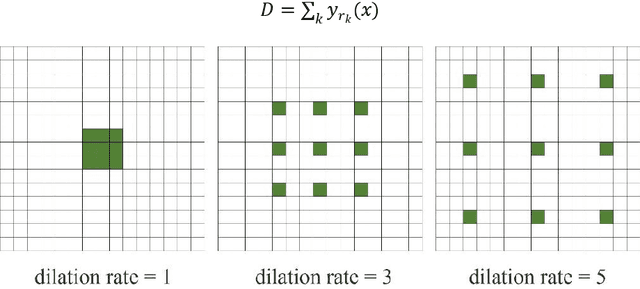
Accurate segmentation of the blood vessels of the retina is an important step in clinical diagnosis of ophthalmic diseases. Many deep learning frameworks have come up for retinal blood vessels segmentation tasks. However, the complex vascular structure and uncertain pathological features make the blood vessel segmentation still very challenging. A novel U-shaped network named Multi-module Concatenation which is based on Atrous convolution and multi-kernel pooling is put forward to retinal vessels segmentation in this paper. The proposed network structure retains three layers the essential structure of U-Net, in which the atrous convolution combining the multi-kernel pooling blocks are designed to obtain more contextual information. The spatial attention module is concatenated with dense atrous convolution module and multi-kernel pooling module to form a multi-module concatenation. And different dilation rates are selected by cascading to acquire a larger receptive field in atrous convolution. Adequate comparative experiments are conducted on these public retinal datasets: DRIVE, STARE and CHASE_DB1. The results show that the proposed method is effective, especially for microvessels. The code will be put out at https://github.com/Rebeccala/MC-UNet