 Add to Chrome
 Add to Firefox
 Add to Edge
MIRTH: Mutual-Information Reasoning with Temporal Hubs for Vision-Language-Action Agents
Jun 30, 2026
VLA models have emerged as a powerful paradigm for transferring semantic knowledge from web-scale data to physical robotic control. However, current single-frame architectures suffer from intrinsic limitations: temporal myopia that discards historical dynamics, reasoning gaps between high-level instructions and low-level motor commands, and inference inefficiency due to autoregressive scalar decoding. In this work, we propose MIRTH, a unified framework designed to address these challenges. MIRTH augments a pretrained VLA backbone with three key innovations: (1) dual-scale temporal memory hubs that compress long-term scene evolution and short-term motion trends into compact embeddings; (2) latent reasoning tokens optimized via a mutual-information objective carving out a semantic plan space to align multimodal context with action trajectories; and (3) a parallel action decoding scheme that replaces autoregressive generation with vector-wise prediction to maximize control throughput. Extensive evaluations on the LIBERO simulation benchmark and a real-world LeRobot platform demonstrate that MIRTH achieves state-of-the-art performance and exhibiting emergent error recovery capabilities. The codes and collected datasets are released at http://github.com/kiva12138/mirth.

SurgFed: Language-guided Multi-Task Federated Learning for Surgical Video Understanding
Mar 10, 2026Surgical scene Multi-Task Federated Learning (MTFL) is essential for robot-assisted minimally invasive surgery (RAS) but remains underexplored in surgical video understanding due to two key challenges: (1) Tissue Diversity: Local models struggle to adapt to site-specific tissue features, limiting their effectiveness in heterogeneous clinical environments and leading to poor local predictions. (2) Task Diversity: Server-side aggregation, relying solely on gradient-based clustering, often produces suboptimal or incorrect parameter updates due to inter-site task heterogeneity, resulting in inaccurate localization. In light of these two issues, we propose SurgFed, a multi-task federated learning framework, enabling federated learning for surgical scene segmentation and depth estimation across diverse surgical types. SurgFed is powered by two appealing designs, i.e., Language-guided Channel Selection (LCS) and Language-guided Hyper Aggregation (LHA), to address the challenge of fully exploration on corss-site and cross-task. Technically, the LCS is first designed a lightweight personalized channel selection network that enhances site-specific adaptation using pre-defined text inputs, which optimally the local model learn the specific embeddings. We further introduce the LHA that employs a layer-wise cross-attention mechanism with pre-defined text inputs to model task interactions across sites and guide a hypernetwork for personalized parameter updates. Extensive empirical evidence shows that SurgFed yields improvements over the state-of-the-art methods in five public datasets across four surgical types. The code is available at https://anonymous.4open.science/r/SurgFed-070E/.
CG-DMER: Hybrid Contrastive-Generative Framework for Disentangled Multimodal ECG Representation Learning
Feb 24, 2026Accurate interpretation of electrocardiogram (ECG) signals is crucial for diagnosing cardiovascular diseases. Recent multimodal approaches that integrate ECGs with accompanying clinical reports show strong potential, but they still face two main concerns from a modality perspective: (1) intra-modality: existing models process ECGs in a lead-agnostic manner, overlooking spatial-temporal dependencies across leads, which restricts their effectiveness in modeling fine-grained diagnostic patterns; (2) inter-modality: existing methods directly align ECG signals with clinical reports, introducing modality-specific biases due to the free-text nature of the reports. In light of these two issues, we propose CG-DMER, a contrastive-generative framework for disentangled multimodal ECG representation learning, powered by two key designs: (1) Spatial-temporal masked modeling is designed to better capture fine-grained temporal dynamics and inter-lead spatial dependencies by applying masking across both spatial and temporal dimensions and reconstructing the missing information. (2) A representation disentanglement and alignment strategy is designed to mitigate unnecessary noise and modality-specific biases by introducing modality-specific and modality-shared encoders, ensuring a clearer separation between modality-invariant and modality-specific representations. Experiments on three public datasets demonstrate that CG-DMER achieves state-of-the-art performance across diverse downstream tasks.
MedVAR: Towards Scalable and Efficient Medical Image Generation via Next-scale Autoregressive Prediction
Feb 16, 2026Medical image generation is pivotal in applications like data augmentation for low-resource clinical tasks and privacy-preserving data sharing. However, developing a scalable generative backbone for medical imaging requires architectural efficiency, sufficient multi-organ data, and principled evaluation, yet current approaches leave these aspects unresolved. Therefore, we introduce MedVAR, the first autoregressive-based foundation model that adopts the next-scale prediction paradigm to enable fast and scale-up-friendly medical image synthesis. MedVAR generates images in a coarse-to-fine manner and produces structured multi-scale representations suitable for downstream use. To support hierarchical generation, we curate a harmonized dataset of around 440,000 CT and MRI images spanning six anatomical regions. Comprehensive experiments across fidelity, diversity, and scalability show that MedVAR achieves state-of-the-art generative performance and offers a promising architectural direction for future medical generative foundation models.
EPIC: Efficient Prompt Interaction for Text-Image Classification
Jul 10, 2025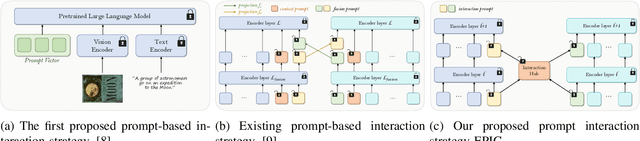
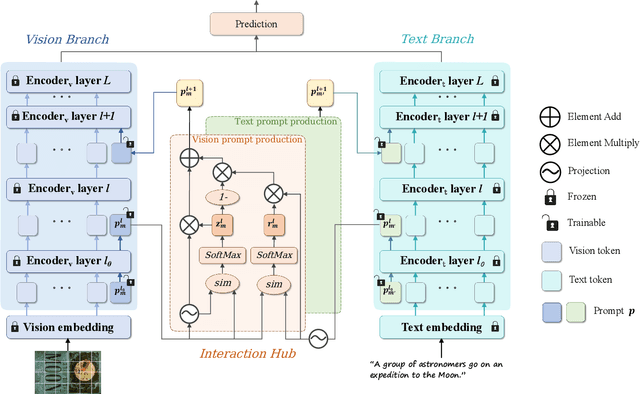
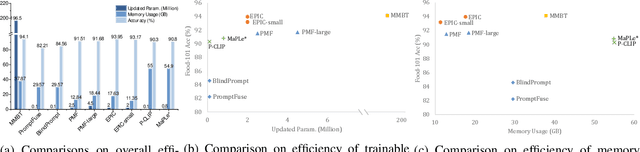

In recent years, large-scale pre-trained multimodal models (LMMs) generally emerge to integrate the vision and language modalities, achieving considerable success in multimodal tasks, such as text-image classification. The growing size of LMMs, however, results in a significant computational cost for fine-tuning these models for downstream tasks. Hence, prompt-based interaction strategy is studied to align modalities more efficiently. In this context, we propose a novel efficient prompt-based multimodal interaction strategy, namely Efficient Prompt Interaction for text-image Classification (EPIC). Specifically, we utilize temporal prompts on intermediate layers, and integrate different modalities with similarity-based prompt interaction, to leverage sufficient information exchange between modalities. Utilizing this approach, our method achieves reduced computational resource consumption and fewer trainable parameters (about 1\% of the foundation model) compared to other fine-tuning strategies. Furthermore, it demonstrates superior performance on the UPMC-Food101 and SNLI-VE datasets, while achieving comparable performance on the MM-IMDB dataset.
SemSim: Revisiting Weak-to-Strong Consistency from a Semantic Similarity Perspective for Semi-supervised Medical Image Segmentation
Oct 17, 2024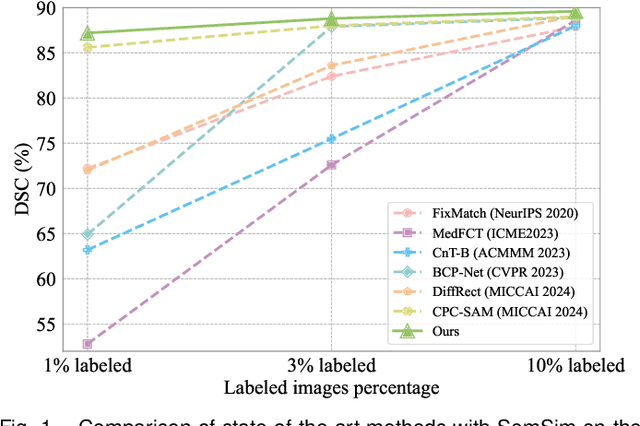


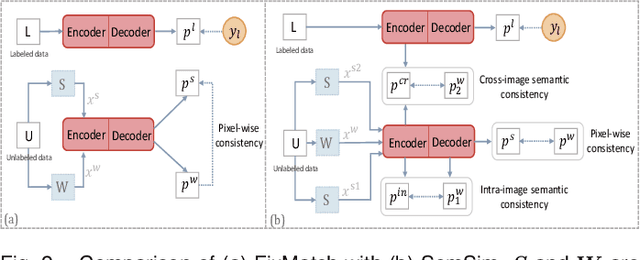
Semi-supervised learning (SSL) for medical image segmentation is a challenging yet highly practical task, which reduces reliance on large-scale labeled dataset by leveraging unlabeled samples. Among SSL techniques, the weak-to-strong consistency framework, popularized by FixMatch, has emerged as a state-of-the-art method in classification tasks. Notably, such a simple pipeline has also shown competitive performance in medical image segmentation. However, two key limitations still persist, impeding its efficient adaptation: (1) the neglect of contextual dependencies results in inconsistent predictions for similar semantic features, leading to incomplete object segmentation; (2) the lack of exploitation of semantic similarity between labeled and unlabeled data induces considerable class-distribution discrepancy. To address these limitations, we propose a novel semi-supervised framework based on FixMatch, named SemSim, powered by two appealing designs from semantic similarity perspective: (1) rectifying pixel-wise prediction by reasoning about the intra-image pair-wise affinity map, thus integrating contextual dependencies explicitly into the final prediction; (2) bridging labeled and unlabeled data via a feature querying mechanism for compact class representation learning, which fully considers cross-image anatomical similarities. As the reliable semantic similarity extraction depends on robust features, we further introduce an effective spatial-aware fusion module (SFM) to explore distinctive information from multiple scales. Extensive experiments show that SemSim yields consistent improvements over the state-of-the-art methods across three public segmentation benchmarks.
HSVLT: Hierarchical Scale-Aware Vision-Language Transformer for Multi-Label Image Classification
Jul 23, 2024


The task of multi-label image classification involves recognizing multiple objects within a single image. Considering both valuable semantic information contained in the labels and essential visual features presented in the image, tight visual-linguistic interactions play a vital role in improving classification performance. Moreover, given the potential variance in object size and appearance within a single image, attention to features of different scales can help to discover possible objects in the image. Recently, Transformer-based methods have achieved great success in multi-label image classification by leveraging the advantage of modeling long-range dependencies, but they have several limitations. Firstly, existing methods treat visual feature extraction and cross-modal fusion as separate steps, resulting in insufficient visual-linguistic alignment in the joint semantic space. Additionally, they only extract visual features and perform cross-modal fusion at a single scale, neglecting objects with different characteristics. To address these issues, we propose a Hierarchical Scale-Aware Vision-Language Transformer (HSVLT) with two appealing designs: (1)~A hierarchical multi-scale architecture that involves a Cross-Scale Aggregation module, which leverages joint multi-modal features extracted from multiple scales to recognize objects of varying sizes and appearances in images. (2)~Interactive Visual-Linguistic Attention, a novel attention mechanism module that tightly integrates cross-modal interaction, enabling the joint updating of visual, linguistic and multi-modal features. We have evaluated our method on three benchmark datasets. The experimental results demonstrate that HSVLT surpasses state-of-the-art methods with lower computational cost.
* 10 pages, 6 figures
Spatio-Temporal Fluid Dynamics Modeling via Physical-Awareness and Parameter Diffusion Guidance
Mar 18, 2024This paper proposes a two-stage framework named ST-PAD for spatio-temporal fluid dynamics modeling in the field of earth sciences, aiming to achieve high-precision simulation and prediction of fluid dynamics through spatio-temporal physics awareness and parameter diffusion guidance. In the upstream stage, we design a vector quantization reconstruction module with temporal evolution characteristics, ensuring balanced and resilient parameter distribution by introducing general physical constraints. In the downstream stage, a diffusion probability network involving parameters is utilized to generate high-quality future states of fluids, while enhancing the model's generalization ability by perceiving parameters in various physical setups. Extensive experiments on multiple benchmark datasets have verified the effectiveness and robustness of the ST-PAD framework, which showcase that ST-PAD outperforms current mainstream models in fluid dynamics modeling and prediction, especially in effectively capturing local representations and maintaining significant advantages in OOD generations.
A Survey on Domain Generalization for Medical Image Analysis
Feb 13, 2024Medical Image Analysis (MedIA) has emerged as a crucial tool in computer-aided diagnosis systems, particularly with the advancement of deep learning (DL) in recent years. However, well-trained deep models often experience significant performance degradation when deployed in different medical sites, modalities, and sequences, known as a domain shift issue. In light of this, Domain Generalization (DG) for MedIA aims to address the domain shift challenge by generalizing effectively and performing robustly across unknown data distributions. This paper presents the a comprehensive review of substantial developments in this area. First, we provide a formal definition of domain shift and domain generalization in medical field, and discuss several related settings. Subsequently, we summarize the recent methods from three viewpoints: data manipulation level, feature representation level, and model training level, and present some algorithms in detail for each viewpoints. Furthermore, we introduce the commonly used datasets. Finally, we summarize existing literature and present some potential research topics for the future. For this survey, we also created a GitHub project by collecting the supporting resources, at the link: https://github.com/Ziwei-Niu/DG_for_MedIA
Memory-Inspired Temporal Prompt Interaction for Text-Image Classification
Jan 26, 2024In recent years, large-scale pre-trained multimodal models (LMM) generally emerge to integrate the vision and language modalities, achieving considerable success in various natural language processing and computer vision tasks. The growing size of LMMs, however, results in a significant computational cost for fine-tuning these models for downstream tasks. Hence, prompt-based interaction strategy is studied to align modalities more efficiently. In this contex, we propose a novel prompt-based multimodal interaction strategy inspired by human memory strategy, namely Memory-Inspired Temporal Prompt Interaction (MITP). Our proposed method involves in two stages as in human memory strategy: the acquiring stage, and the consolidation and activation stage. We utilize temporal prompts on intermediate layers to imitate the acquiring stage, leverage similarity-based prompt interaction to imitate memory consolidation, and employ prompt generation strategy to imitate memory activation. The main strength of our paper is that we interact the prompt vectors on intermediate layers to leverage sufficient information exchange between modalities, with compressed trainable parameters and memory usage. We achieve competitive results on several datasets with relatively small memory usage and 2.0M of trainable parameters (about 1% of the pre-trained foundation model).