 Add to Chrome
 Add to Firefox
 Add to Edge
Cross-modal Medical Image Generation Based on Pyramid Convolutional Attention Network
Nov 26, 2024



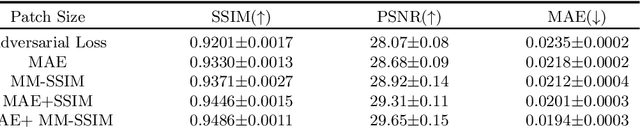
The integration of multimodal medical imaging can provide complementary and comprehensive information for the diagnosis of Alzheimer's disease (AD). However, in clinical practice, since positron emission tomography (PET) is often missing, multimodal images might be incomplete. To address this problem, we propose a method that can efficiently utilize structural magnetic resonance imaging (sMRI) image information to generate high-quality PET images. Our generation model efficiently utilizes pyramid convolution combined with channel attention mechanism to extract multi-scale local features in sMRI, and injects global correlation information into these features using self-attention mechanism to ensure the restoration of the generated PET image on local texture and global structure. Additionally, we introduce additional loss functions to guide the generation model in producing higher-quality PET images. Through experiments conducted on publicly available ADNI databases, the generated images outperform previous research methods in various performance indicators (average absolute error: 0.0194, peak signal-to-noise ratio: 29.65, structural similarity: 0.9486) and are close to real images. In promoting AD diagnosis, the generated images combined with their corresponding sMRI also showed excellent performance in AD diagnosis tasks (classification accuracy: 94.21 %), and outperformed previous research methods of the same type. The experimental results demonstrate that our method outperforms other competing methods in quantitative metrics, qualitative visualization, and evaluation criteria.

An Evaluation-Driven Approach to Designing LLM Agents: Process and Architecture
Nov 21, 2024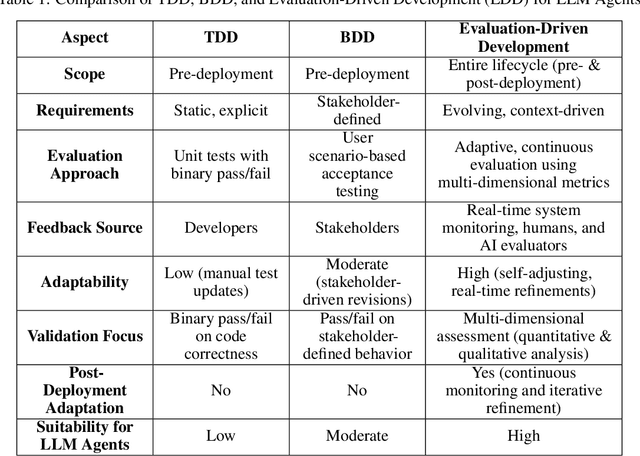
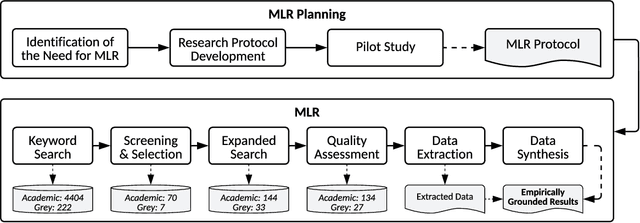
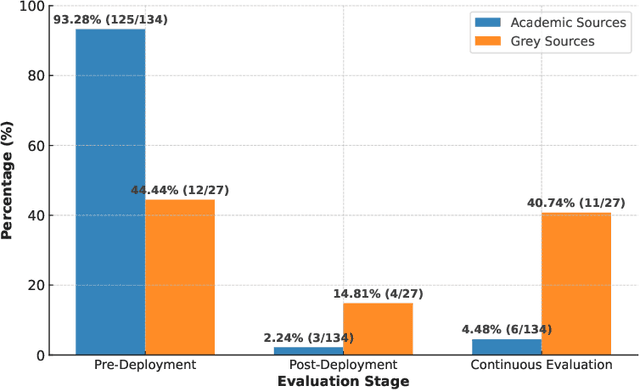
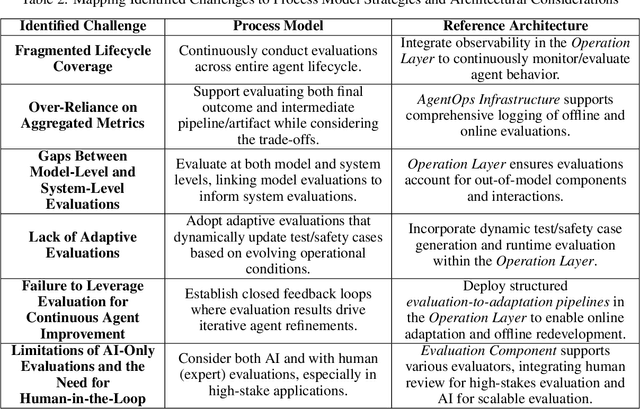
The advent of Large Language Models (LLMs) has enabled the development of LLM agents capable of autonomously achieving under-specified goals and continuously evolving through post-deployment improvement, sometimes without requiring code or model updates. Conventional approaches, such as pre-defined test cases and code/model redevelopment pipelines, are inadequate for addressing the unique challenges of LLM agent development, particularly in terms of quality and risk control. This paper introduces an evaluation-driven design approach, inspired by test-driven development, to address these challenges. Through a multivocal literature review (MLR), we synthesize existing LLM evaluation methods and propose a novel process model and reference architecture specifically designed for LLM agents. The proposed approach integrates online and offline evaluations to support adaptive runtime adjustments and systematic offline redevelopment, improving runtime pipelines, artifacts, system architecture, and LLMs by continuously incorporating evaluation results, including fine-grained feedback from human and AI evaluators.
DINO-X: A Unified Vision Model for Open-World Object Detection and Understanding
Nov 21, 2024


In this paper, we introduce DINO-X, which is a unified object-centric vision model developed by IDEA Research with the best open-world object detection performance to date. DINO-X employs the same Transformer-based encoder-decoder architecture as Grounding DINO 1.5 to pursue an object-level representation for open-world object understanding. To make long-tailed object detection easy, DINO-X extends its input options to support text prompt, visual prompt, and customized prompt. With such flexible prompt options, we develop a universal object prompt to support prompt-free open-world detection, making it possible to detect anything in an image without requiring users to provide any prompt. To enhance the model's core grounding capability, we have constructed a large-scale dataset with over 100 million high-quality grounding samples, referred to as Grounding-100M, for advancing the model's open-vocabulary detection performance. Pre-training on such a large-scale grounding dataset leads to a foundational object-level representation, which enables DINO-X to integrate multiple perception heads to simultaneously support multiple object perception and understanding tasks, including detection, segmentation, pose estimation, object captioning, object-based QA, etc. Experimental results demonstrate the superior performance of DINO-X. Specifically, the DINO-X Pro model achieves 56.0 AP, 59.8 AP, and 52.4 AP on the COCO, LVIS-minival, and LVIS-val zero-shot object detection benchmarks, respectively. Notably, it scores 63.3 AP and 56.5 AP on the rare classes of LVIS-minival and LVIS-val benchmarks, both improving the previous SOTA performance by 5.8 AP. Such a result underscores its significantly improved capacity for recognizing long-tailed objects.
Text-DiFuse: An Interactive Multi-Modal Image Fusion Framework based on Text-modulated Diffusion Model
Oct 31, 2024


Existing multi-modal image fusion methods fail to address the compound degradations presented in source images, resulting in fusion images plagued by noise, color bias, improper exposure, \textit{etc}. Additionally, these methods often overlook the specificity of foreground objects, weakening the salience of the objects of interest within the fused images. To address these challenges, this study proposes a novel interactive multi-modal image fusion framework based on the text-modulated diffusion model, called Text-DiFuse. First, this framework integrates feature-level information integration into the diffusion process, allowing adaptive degradation removal and multi-modal information fusion. This is the first attempt to deeply and explicitly embed information fusion within the diffusion process, effectively addressing compound degradation in image fusion. Second, by embedding the combination of the text and zero-shot location model into the diffusion fusion process, a text-controlled fusion re-modulation strategy is developed. This enables user-customized text control to improve fusion performance and highlight foreground objects in the fused images. Extensive experiments on diverse public datasets show that our Text-DiFuse achieves state-of-the-art fusion performance across various scenarios with complex degradation. Moreover, the semantic segmentation experiment validates the significant enhancement in semantic performance achieved by our text-controlled fusion re-modulation strategy. The code is publicly available at https://github.com/Leiii-Cao/Text-DiFuse.
Long$^2$RAG: Evaluating Long-Context & Long-Form Retrieval-Augmented Generation with Key Point Recall
Oct 31, 2024Retrieval-augmented generation (RAG) is a promising approach to address the limitations of fixed knowledge in large language models (LLMs). However, current benchmarks for evaluating RAG systems suffer from two key deficiencies: (1) they fail to adequately measure LLMs' capability in handling long-context retrieval due to a lack of datasets that reflect the characteristics of retrieved documents, and (2) they lack a comprehensive evaluation method for assessing LLMs' ability to generate long-form responses that effectively exploits retrieved information. To address these shortcomings, we introduce the Long$^2$RAG benchmark and the Key Point Recall (KPR) metric. Long$^2$RAG comprises 280 questions spanning 10 domains and across 8 question categories, each associated with 5 retrieved documents with an average length of 2,444 words. KPR evaluates the extent to which LLMs incorporate key points extracted from the retrieved documents into their generated responses, providing a more nuanced assessment of their ability to exploit retrieved information.
Unsupervised Modality Adaptation with Text-to-Image Diffusion Models for Semantic Segmentation
Oct 29, 2024

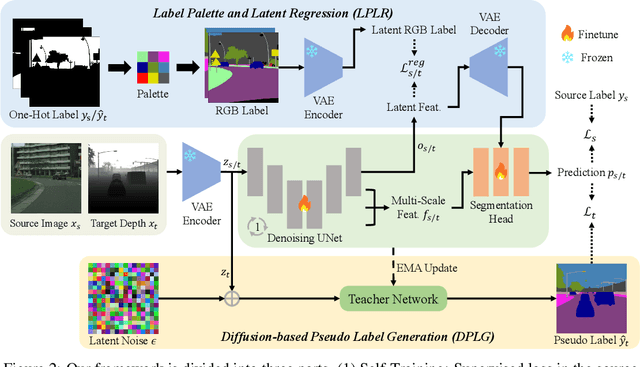
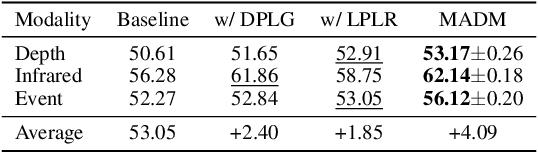
Despite their success, unsupervised domain adaptation methods for semantic segmentation primarily focus on adaptation between image domains and do not utilize other abundant visual modalities like depth, infrared and event. This limitation hinders their performance and restricts their application in real-world multimodal scenarios. To address this issue, we propose Modality Adaptation with text-to-image Diffusion Models (MADM) for semantic segmentation task which utilizes text-to-image diffusion models pre-trained on extensive image-text pairs to enhance the model's cross-modality capabilities. Specifically, MADM comprises two key complementary components to tackle major challenges. First, due to the large modality gap, using one modal data to generate pseudo labels for another modality suffers from a significant drop in accuracy. To address this, MADM designs diffusion-based pseudo-label generation which adds latent noise to stabilize pseudo-labels and enhance label accuracy. Second, to overcome the limitations of latent low-resolution features in diffusion models, MADM introduces the label palette and latent regression which converts one-hot encoded labels into the RGB form by palette and regresses them in the latent space, thus ensuring the pre-trained decoder for up-sampling to obtain fine-grained features. Extensive experimental results demonstrate that MADM achieves state-of-the-art adaptation performance across various modality tasks, including images to depth, infrared, and event modalities. We open-source our code and models at https://github.com/XiaRho/MADM.
Neuroevolution Neural Architecture Search for Evolving RNNs in Stock Return Prediction and Portfolio Trading
Oct 22, 2024Stock return forecasting is a major component of numerous finance applications. Predicted stock returns can be incorporated into portfolio trading algorithms to make informed buy or sell decisions which can optimize returns. In such portfolio trading applications, the predictive performance of a time series forecasting model is crucial. In this work, we propose the use of the Evolutionary eXploration of Augmenting Memory Models (EXAMM) algorithm to progressively evolve recurrent neural networks (RNNs) for stock return predictions. RNNs are evolved independently for each stocks and portfolio trading decisions are made based on the predicted stock returns. The portfolio used for testing consists of the 30 companies in the Dow-Jones Index (DJI) with each stock have the same weight. Results show that using these evolved RNNs and a simple daily long-short strategy can generate higher returns than both the DJI index and the S&P 500 Index for both 2022 (bear market) and 2023 (bull market).
Learning to Generate and Evaluate Fact-checking Explanations with Transformers
Oct 21, 2024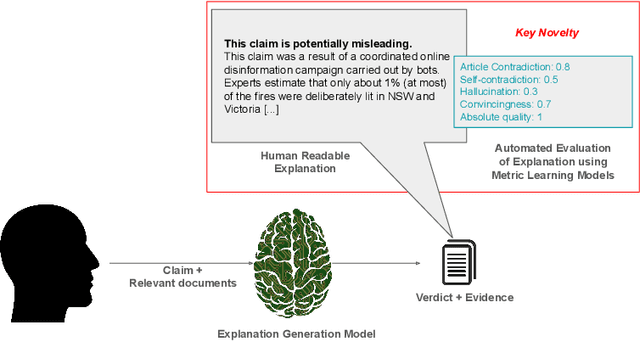
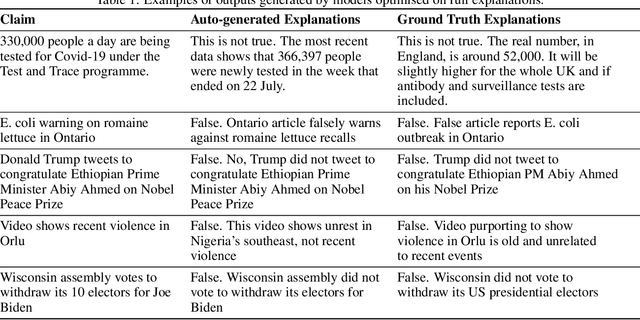
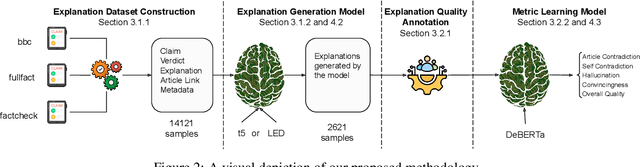
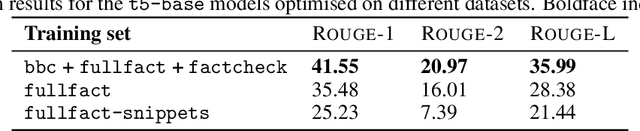
In an era increasingly dominated by digital platforms, the spread of misinformation poses a significant challenge, highlighting the need for solutions capable of assessing information veracity. Our research contributes to the field of Explainable Artificial Antelligence (XAI) by developing transformer-based fact-checking models that contextualise and justify their decisions by generating human-accessible explanations. Importantly, we also develop models for automatic evaluation of explanations for fact-checking verdicts across different dimensions such as \texttt{(self)-contradiction}, \texttt{hallucination}, \texttt{convincingness} and \texttt{overall quality}. By introducing human-centred evaluation methods and developing specialised datasets, we emphasise the need for aligning Artificial Intelligence (AI)-generated explanations with human judgements. This approach not only advances theoretical knowledge in XAI but also holds practical implications by enhancing the transparency, reliability and users' trust in AI-driven fact-checking systems. Furthermore, the development of our metric learning models is a first step towards potentially increasing efficiency and reducing reliance on extensive manual assessment. Based on experimental results, our best performing generative model \textsc{ROUGE-1} score of 47.77, demonstrating superior performance in generating fact-checking explanations, particularly when provided with high-quality evidence. Additionally, the best performing metric learning model showed a moderately strong correlation with human judgements on objective dimensions such as \texttt{(self)-contradiction and \texttt{hallucination}, achieving a Matthews Correlation Coefficient (MCC) of around 0.7.}
ClearSR: Latent Low-Resolution Image Embeddings Help Diffusion-Based Real-World Super Resolution Models See Clearer
Oct 18, 2024


We present ClearSR, a new method that can better take advantage of latent low-resolution image (LR) embeddings for diffusion-based real-world image super-resolution (Real-ISR). Previous Real-ISR models mostly focus on how to activate more generative priors of text-to-image diffusion models to make the output high-resolution (HR) images look better. However, since these methods rely too much on the generative priors, the content of the output images is often inconsistent with the input LR ones. To mitigate the above issue, in this work, we explore using latent LR embeddings to constrain the control signals from ControlNet, and extract LR information at both detail and structure levels. We show that the proper use of latent LR embeddings can produce higher-quality control signals, which enables the super-resolution results to be more consistent with the LR image and leads to clearer visual results. In addition, we also show that latent LR embeddings can be used to control the inference stage, allowing for the improvement of fidelity and generation ability simultaneously. Experiments demonstrate that our model can achieve better performance across multiple metrics on several test sets and generate more consistent SR results with LR images than existing methods. Our code will be made publicly available.
ConsisSR: Delving Deep into Consistency in Diffusion-based Image Super-Resolution
Oct 17, 2024
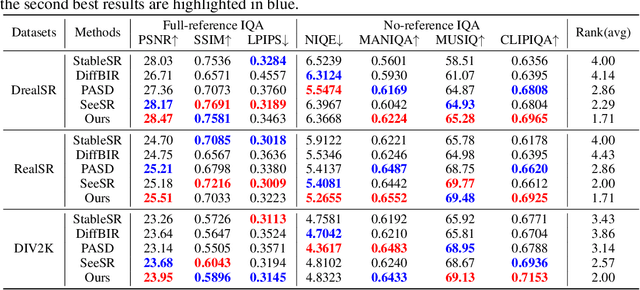

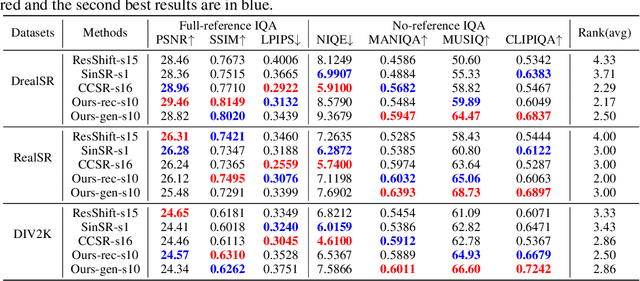
Real-world image super-resolution (Real-ISR) aims at restoring high-quality (HQ) images from low-quality (LQ) inputs corrupted by unknown and complex degradations. In particular, pretrained text-to-image (T2I) diffusion models provide strong generative priors to reconstruct credible and intricate details. However, T2I generation focuses on semantic consistency while Real-ISR emphasizes pixel-level reconstruction, which hinders existing methods from fully exploiting diffusion priors. To address this challenge, we introduce ConsisSR to handle both semantic and pixel-level consistency. Specifically, compared to coarse-grained text prompts, we exploit the more powerful CLIP image embedding and effectively leverage both modalities through our Hybrid Prompt Adapter (HPA) for semantic guidance. Secondly, we introduce Time-aware Latent Augmentation (TALA) to mitigate the inherent gap between T2I generation and Real-ISR consistency requirements. By randomly mixing LQ and HQ latent inputs, our model not only handle timestep-specific diffusion noise but also refine the accumulated latent representations. Last but not least, our GAN-Embedding strategy employs the pretrained Real-ESRGAN model to refine the diffusion start point. This accelerates the inference process to 10 steps while preserving sampling quality, in a training-free manner. Our method demonstrates state-of-the-art performance among both full-scale and accelerated models. The code will be made publicly available.