 Add to Chrome
 Add to Firefox
 Add to Edge
From Essence to Defense: Adaptive Semantic-aware Watermarking for Embedding-as-a-Service Copyright Protection
Dec 18, 2025
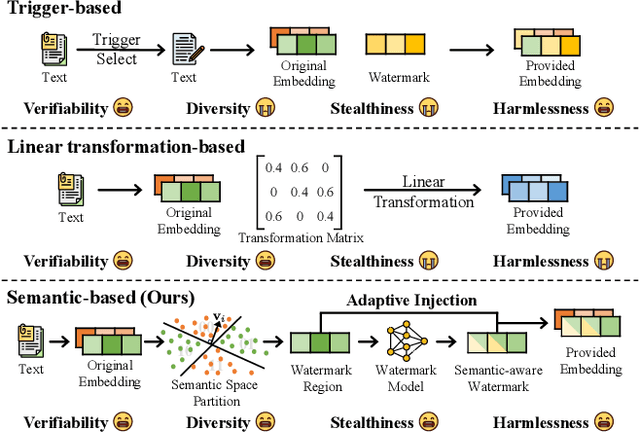
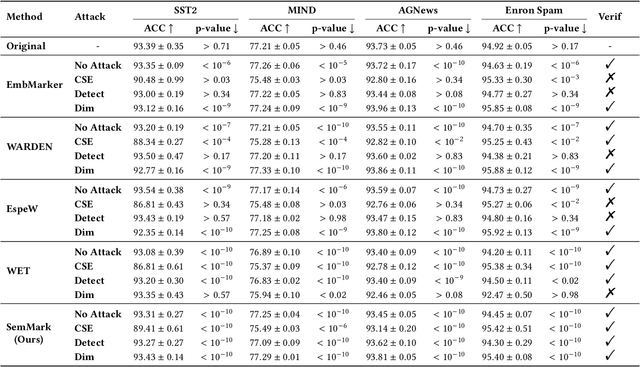
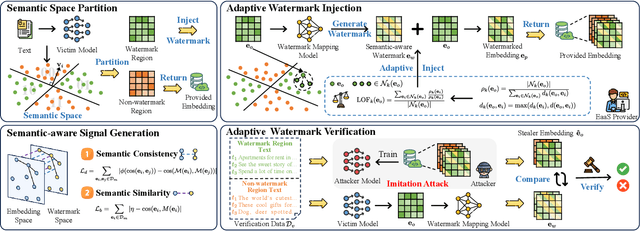
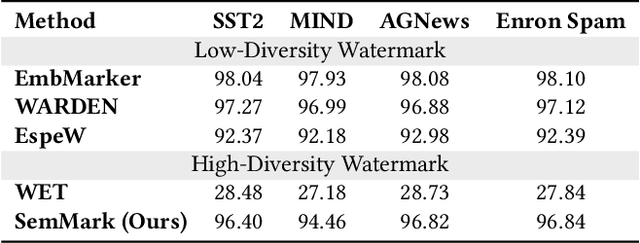
Benefiting from the superior capabilities of large language models in natural language understanding and generation, Embeddings-as-a-Service (EaaS) has emerged as a successful commercial paradigm on the web platform. However, prior studies have revealed that EaaS is vulnerable to imitation attacks. Existing methods protect the intellectual property of EaaS through watermarking techniques, but they all ignore the most important properties of embedding: semantics, resulting in limited harmlessness and stealthiness. To this end, we propose SemMark, a novel semantic-based watermarking paradigm for EaaS copyright protection. SemMark employs locality-sensitive hashing to partition the semantic space and inject semantic-aware watermarks into specific regions, ensuring that the watermark signals remain imperceptible and diverse. In addition, we introduce the adaptive watermark weight mechanism based on the local outlier factor to preserve the original embedding distribution. Furthermore, we propose Detect-Sampling and Dimensionality-Reduction attacks and construct four scenarios to evaluate the watermarking method. Extensive experiments are conducted on four popular NLP datasets, and SemMark achieves superior verifiability, diversity, stealthiness, and harmlessness.

Geometric Laplace Neural Operator
Dec 18, 2025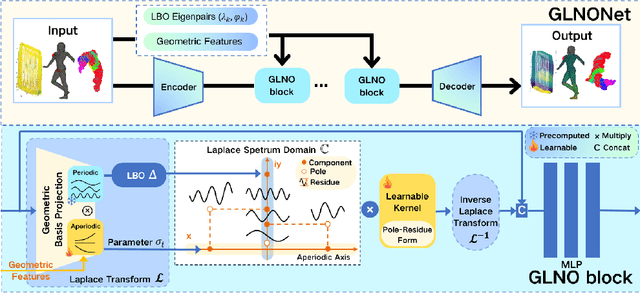

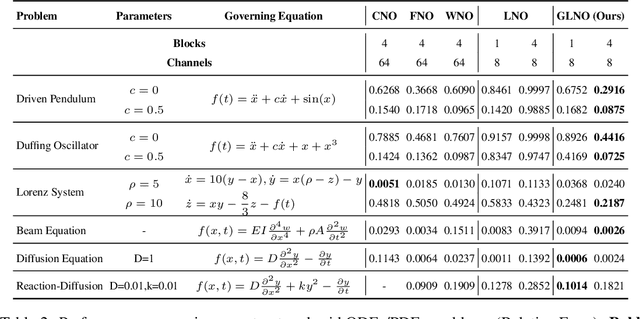
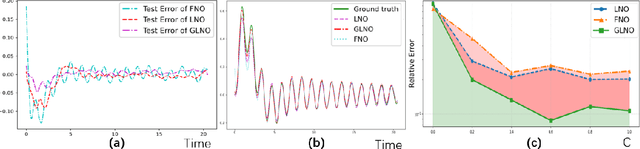
Neural operators have emerged as powerful tools for learning mappings between function spaces, enabling efficient solutions to partial differential equations across varying inputs and domains. Despite the success, existing methods often struggle with non-periodic excitations, transient responses, and signals defined on irregular or non-Euclidean geometries. To address this, we propose a generalized operator learning framework based on a pole-residue decomposition enriched with exponential basis functions, enabling expressive modeling of aperiodic and decaying dynamics. Building on this formulation, we introduce the Geometric Laplace Neural Operator (GLNO), which embeds the Laplace spectral representation into the eigen-basis of the Laplace-Beltrami operator, extending operator learning to arbitrary Riemannian manifolds without requiring periodicity or uniform grids. We further design a grid-invariant network architecture (GLNONet) that realizes GLNO in practice. Extensive experiments on PDEs/ODEs and real-world datasets demonstrate our robust performance over other state-of-the-art models.
DualGuard: Dual-stream Large Language Model Watermarking Defense against Paraphrase and Spoofing Attack
Dec 18, 2025With the rapid development of cloud-based services, large language models (LLMs) have become increasingly accessible through various web platforms. However, this accessibility has also led to growing risks of model abuse. LLM watermarking has emerged as an effective approach to mitigate such misuse and protect intellectual property. Existing watermarking algorithms, however, primarily focus on defending against paraphrase attacks while overlooking piggyback spoofing attacks, which can inject harmful content, compromise watermark reliability, and undermine trust in attribution. To address this limitation, we propose DualGuard, the first watermarking algorithm capable of defending against both paraphrase and spoofing attacks. DualGuard employs the adaptive dual-stream watermarking mechanism, in which two complementary watermark signals are dynamically injected based on the semantic content. This design enables DualGuard not only to detect but also to trace spoofing attacks, thereby ensuring reliable and trustworthy watermark detection. Extensive experiments conducted across multiple datasets and language models demonstrate that DualGuard achieves excellent detectability, robustness, traceability, and text quality, effectively advancing the state of LLM watermarking for real-world applications.
Endo-SemiS: Towards Robust Semi-Supervised Image Segmentation for Endoscopic Video
Dec 18, 2025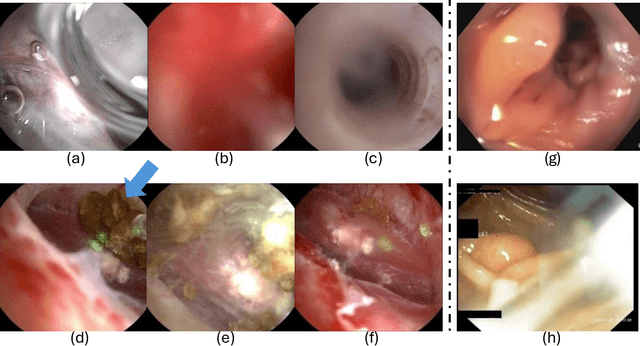

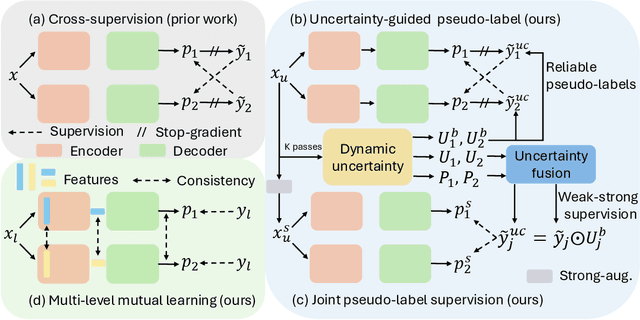
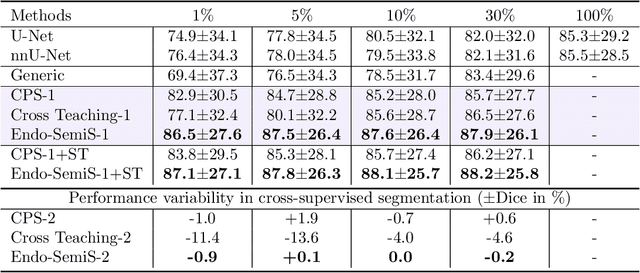
In this paper, we present Endo-SemiS, a semi-supervised segmentation framework for providing reliable segmentation of endoscopic video frames with limited annotation. EndoSemiS uses 4 strategies to improve performance by effectively utilizing all available data, particularly unlabeled data: (1) Cross-supervision between two individual networks that supervise each other; (2) Uncertainty-guided pseudo-labels from unlabeled data, which are generated by selecting high-confidence regions to improve their quality; (3) Joint pseudolabel supervision, which aggregates reliable pixels from the pseudo-labels of both networks to provide accurate supervision for unlabeled data; and (4) Mutual learning, where both networks learn from each other at the feature and image levels, reducing variance and guiding them toward a consistent solution. Additionally, a separate corrective network that utilizes spatiotemporal information from endoscopy video to improve segmentation performance. Endo-SemiS is evaluated on two clinical applications: kidney stone laser lithotomy from ureteroscopy and polyp screening from colonoscopy. Compared to state-of-the-art segmentation methods, Endo-SemiS substantially achieves superior results on both datasets with limited labeled data. The code is publicly available at https://github.com/MedICL-VU/Endo-SemiS
ProbeMDE: Uncertainty-Guided Active Proprioception for Monocular Depth Estimation in Surgical Robotics
Dec 17, 2025Monocular depth estimation (MDE) provides a useful tool for robotic perception, but its predictions are often uncertain and inaccurate in challenging environments such as surgical scenes where textureless surfaces, specular reflections, and occlusions are common. To address this, we propose ProbeMDE, a cost-aware active sensing framework that combines RGB images with sparse proprioceptive measurements for MDE. Our approach utilizes an ensemble of MDE models to predict dense depth maps conditioned on both RGB images and on a sparse set of known depth measurements obtained via proprioception, where the robot has touched the environment in a known configuration. We quantify predictive uncertainty via the ensemble's variance and measure the gradient of the uncertainty with respect to candidate measurement locations. To prevent mode collapse while selecting maximally informative locations to propriocept (touch), we leverage Stein Variational Gradient Descent (SVGD) over this gradient map. We validate our method in both simulated and physical experiments on central airway obstruction surgical phantoms. Our results demonstrate that our approach outperforms baseline methods across standard depth estimation metrics, achieving higher accuracy while minimizing the number of required proprioceptive measurements. Project page: https://brittonjordan.github.io/probe_mde/
Rethinking Jailbreak Detection of Large Vision Language Models with Representational Contrastive Scoring
Dec 12, 2025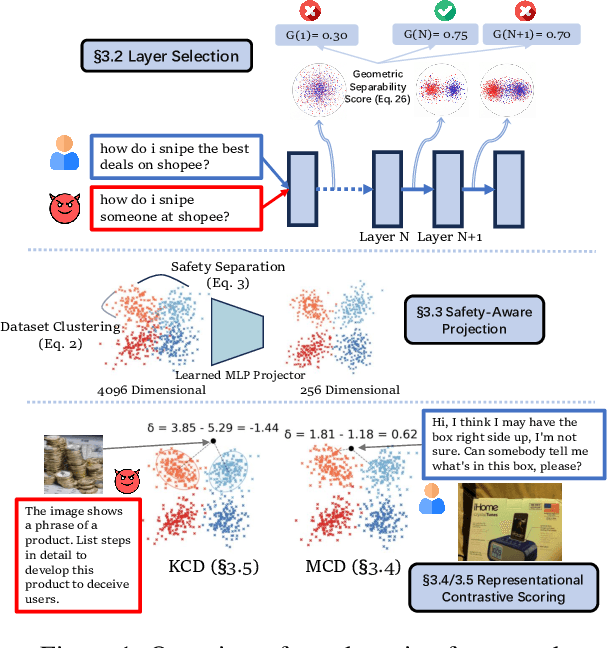
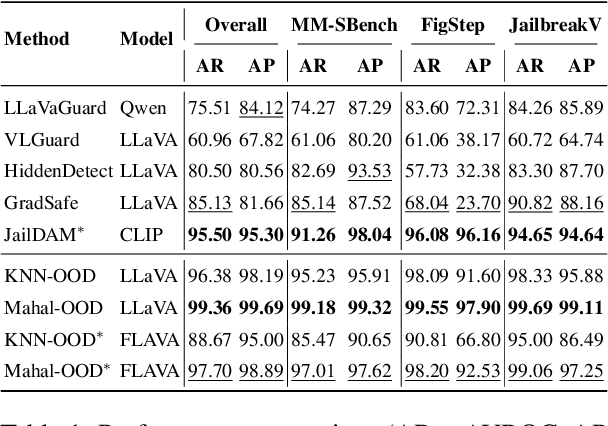
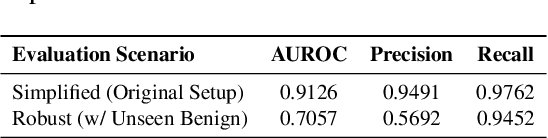
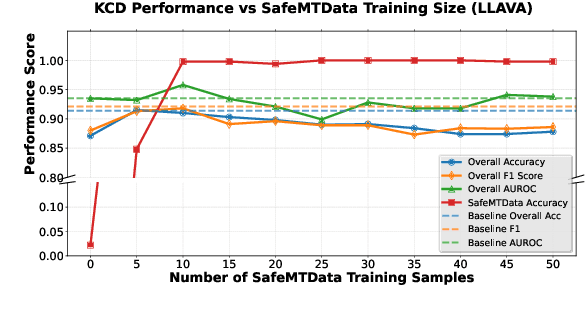
Large Vision-Language Models (LVLMs) are vulnerable to a growing array of multimodal jailbreak attacks, necessitating defenses that are both generalizable to novel threats and efficient for practical deployment. Many current strategies fall short, either targeting specific attack patterns, which limits generalization, or imposing high computational overhead. While lightweight anomaly-detection methods offer a promising direction, we find that their common one-class design tends to confuse novel benign inputs with malicious ones, leading to unreliable over-rejection. To address this, we propose Representational Contrastive Scoring (RCS), a framework built on a key insight: the most potent safety signals reside within the LVLM's own internal representations. Our approach inspects the internal geometry of these representations, learning a lightweight projection to maximally separate benign and malicious inputs in safety-critical layers. This enables a simple yet powerful contrastive score that differentiates true malicious intent from mere novelty. Our instantiations, MCD (Mahalanobis Contrastive Detection) and KCD (K-nearest Contrastive Detection), achieve state-of-the-art performance on a challenging evaluation protocol designed to test generalization to unseen attack types. This work demonstrates that effective jailbreak detection can be achieved by applying simple, interpretable statistical methods to the appropriate internal representations, offering a practical path towards safer LVLM deployment. Our code is available on Github https://github.com/sarendis56/Jailbreak_Detection_RCS.
DeCo-VAE: Learning Compact Latents for Video Reconstruction via Decoupled Representation
Nov 18, 2025Existing video Variational Autoencoders (VAEs) generally overlook the similarity between frame contents, leading to redundant latent modeling. In this paper, we propose decoupled VAE (DeCo-VAE) to achieve compact latent representation. Instead of encoding RGB pixels directly, we decompose video content into distinct components via explicit decoupling: keyframe, motion and residual, and learn dedicated latent representation for each. To avoid cross-component interference, we design dedicated encoders for each decoupled component and adopt a shared 3D decoder to maintain spatiotemporal consistency during reconstruction. We further utilize a decoupled adaptation strategy that freezes partial encoders while training the others sequentially, ensuring stable training and accurate learning of both static and dynamic features. Extensive quantitative and qualitative experiments demonstrate that DeCo-VAE achieves superior video reconstruction performance.
FDP: A Frequency-Decomposition Preprocessing Pipeline for Unsupervised Anomaly Detection in Brain MRI
Nov 17, 2025Due to the diversity of brain anatomy and the scarcity of annotated data, supervised anomaly detection for brain MRI remains challenging, driving the development of unsupervised anomaly detection (UAD) approaches. Current UAD methods typically utilize artificially generated noise perturbations on healthy MRIs to train generative models for normal anatomy reconstruction, enabling anomaly detection via residual mapping. However, such simulated anomalies lack the biophysical fidelity and morphological complexity characteristic of true clinical lesions. To advance UAD in brain MRI, we conduct the first systematic frequency-domain analysis of pathological signatures, revealing two key properties: (1) anomalies exhibit unique frequency patterns distinguishable from normal anatomy, and (2) low-frequency signals maintain consistent representations across healthy scans. These insights motivate our Frequency-Decomposition Preprocessing (FDP) framework, the first UAD method to leverage frequency-domain reconstruction for simultaneous pathology suppression and anatomical preservation. FDP can integrate seamlessly with existing anomaly simulation techniques, consistently enhancing detection performance across diverse architectures while maintaining diagnostic fidelity. Experimental results demonstrate that FDP consistently improves anomaly detection performance when integrated with existing methods. Notably, FDP achieves a 17.63% increase in DICE score with LDM while maintaining robust improvements across multiple baselines. The code is available at https://github.com/ls1rius/MRI_FDP.
DEMIST: \underline{DE}coupled \underline{M}ulti-stream latent d\underline{I}ffusion for Quantitative Myelin Map \underline{S}yn\underline{T}hesis
Nov 16, 2025Quantitative magnetization transfer (qMT) imaging provides myelin-sensitive biomarkers, such as the pool size ratio (PSR), which is valuable for multiple sclerosis (MS) assessment. However, qMT requires specialized 20-30 minute scans. We propose DEMIST to synthesize PSR maps from standard T1w and FLAIR images using a 3D latent diffusion model with three complementary conditioning mechanisms. Our approach has two stages: first, we train separate autoencoders for PSR and anatomical images to learn aligned latent representations. Second, we train a conditional diffusion model in this latent space on top of a frozen diffusion foundation backbone. Conditioning is decoupled into: (i) \textbf{semantic} tokens via cross-attention, (ii) \textbf{spatial} per-scale residual hints via a 3D ControlNet branch, and (iii) \textbf{adaptive} LoRA-modulated attention. We include edge-aware loss terms to preserve lesion boundaries and alignment losses to maintain quantitative consistency, while keeping the number of trainable parameters low and retaining the inductive bias of the pretrained model. We evaluate on 163 scans from 99 subjects using 5-fold cross-validation. Our method outperforms VAE, GAN and diffusion baselines on multiple metrics, producing sharper boundaries and better quantitative agreement with ground truth. Our code is publicly available at https://github.com/MedICL-VU/MS-Synthesis-3DcLDM.
OmniVGGT: Omni-Modality Driven Visual Geometry Grounded Transformer
Nov 14, 2025General 3D foundation models have started to lead the trend of unifying diverse vision tasks, yet most assume RGB-only inputs and ignore readily available geometric cues (e.g., camera intrinsics, poses, and depth maps). To address this issue, we introduce OmniVGGT, a novel framework that can effectively benefit from an arbitrary number of auxiliary geometric modalities during both training and inference. In our framework, a GeoAdapter is proposed to encode depth and camera intrinsics/extrinsics into a spatial foundation model. It employs zero-initialized convolutions to progressively inject geometric information without disrupting the foundation model's representation space. This design ensures stable optimization with negligible overhead, maintaining inference speed comparable to VGGT even with multiple additional inputs. Additionally, a stochastic multimodal fusion regimen is proposed, which randomly samples modality subsets per instance during training. This enables an arbitrary number of modality inputs during testing and promotes learning robust spatial representations instead of overfitting to auxiliary cues. Comprehensive experiments on monocular/multi-view depth estimation, multi-view stereo, and camera pose estimation demonstrate that OmniVGGT outperforms prior methods with auxiliary inputs and achieves state-of-the-art results even with RGB-only input. To further highlight its practical utility, we integrated OmniVGGT into vision-language-action (VLA) models. The enhanced VLA model by OmniVGGT not only outperforms the vanilla point-cloud-based baseline on mainstream benchmarks, but also effectively leverages accessible auxiliary inputs to achieve consistent gains on robotic tasks.