 Add to Chrome
 Add to Firefox
 Add to Edge
Stable Curves, Unstable Items: Item-Level Scaling Heterogeneity in Video LLMs
Aug 07, 2026
Aggregate scaling curves suggest that Video LLMs improve smoothly or saturate as visual budgets grow. We show that this view can conceal large, opposing changes at the item level. We represent each frozen model--item pair by its response trajectory under controlled visual budgets and derive matched-grid measures of configuration complementarity, harmful transitions, and text overwrite. Across five open Video LLMs from three architecture families, four multiple-choice benchmark splits, open-ended QA and summarization, and fixed-history dialogue generation, no single budget serves all items. On the four-model matched MCQA grid, item-level oracle headroom spans $8.8$--$18.9$ accuracy points and $12.5$--$25.5\%$ of items are correct at a lower budget but wrong at a higher one. Task-appropriate continuous metrics show the same complementarity beyond multiple choice: Token-F1 oracle gaps are $2.7$--$3.7$ score points on MLVU generation and $3.8$--$4.8$ points on AVSD current-turn generation, even when mean quality improves with budget. The effect persists across frame count, spatial resolution, sampling policy, temporal--spatial allocation, and independently executed raw-video and cached pipelines, with per-item rates and membership tracking protocol choices. A controlled sampling intervention recovers $29.0\%$ of terminal regressions, and a structured frame audit identifies several recurring evidence pathways. We release per-item trajectories, protocol provenance, derived annotations, and reproducible analysis code as an auditing artifact. A confidence cascade matches fixed-$128f$ accuracy while reducing average shared frame cost by $31.7\%$, illustrating one operational use of the response matrix.

Holo-World: Unified Camera, Object and Weather Control for Video World Model
Jun 18, 2026Video world models are moving toward preserving an observed world under controllable camera and object motion while allowing its environmental state to change. Yet these controls remain isolated, and weather generation typically relies on a source video or reconstructed scene that already specifies future structure. We study a first-frame-anchored source-to-state setting, where the model starts from a single image and follows explicit camera and object controls and an optional weather instruction, then generates a video that either preserves the source world or transfers it to a target weather state. To address these challenges, we first build HoloStateData, a state video dataset that turns diverse videos into unified control samples for camera, object, and weather supervision. Second, we introduce Holo-World, a unified controllable video world model that jointly controls scene from a single image. Its Unified Scene Adapter factorizes world preservation and weather transfer into distinct parameter subspaces, using rendered background, geometry buffers, and object controls to maintain controlled scene structure while modeling weather-dependent appearance and particle effects. Additionally, Scene-Weather Decomposed CFG guides scene and weather residuals separately, strengthening target weather effects without over-amplifying the full condition. Quantitative and qualitative experiments demonstrate that Holo-World maintains precise camera and object control with consistent scene structure while transferring scenes into diverse target weather state, outperforming video-to-video weather editing baselines on weather-state generation. Our project page is available at \url{https://xiangchenyin.github.io/Holo-World/}.
Preserve, Reveal, Expand: Faithful 4D Video Editing with Region-Aware Conditioning
May 20, 2026Existing 4D-driven video diffusion models primarily target plausible generation, but faithful 4D editing requires preserving source-observed regions while synthesizing disoccluded or out-of-view content. We identify Evidence-Role Mismatch: reliable source-backed evidence, unreliable rendered cues, and unsupported regions are entangled in a single conditioning signal, causing preservation drift, ghosting, and unstable extrapolation. We propose PREX (Preserve, Reveal, Expand), a region-aware framework that decomposes the target spatiotemporal volume into Preserve, Reveal, and Expand roles according to observation support and scene extent. PREX builds observation-backed appearance cues with calibrated confidence and injects them into a frozen video diffusion backbone through a region-aware adapter, trained with proxy tasks without requiring paired edited videos. We further introduce PREBench, a diagnostic benchmark with curated edits, region-role masks, and human-aligned metrics that complement global video-quality and 4D-control evaluations. Experiments show that PREX reduces region-structured failures while maintaining strong visual quality and 4D edit control capability. Project Page: https://ricepastem.github.io/PREX-Open
RiO-DETR: DETR for Real-time Oriented Object Detection
Mar 10, 2026We present RiO-DETR: DETR for Real-time Oriented Object Detection, the first real-time oriented detection transformer to the best of our knowledge. Adapting DETR to oriented bounding boxes (OBBs) poses three challenges: semantics-dependent orientation, angle periodicity that breaks standard Euclidean refinement, and an enlarged search space that slows convergence. RiO-DETR resolves these issues with task-native designs while preserving real-time efficiency. First, we propose Content-Driven Angle Estimation by decoupling angle from positional queries, together with Rotation-Rectified Orthogonal Attention to capture complementary cues for reliable orientation. Second, Decoupled Periodic Refinement combines bounded coarse-to-fine updates with a Shortest-Path Periodic Loss for stable learning across angular seams. Third, Oriented Dense O2O injects angular diversity into dense supervision to speed up angle convergence at no extra cost. Extensive experiments on DOTA-1.0, DIOR-R, and FAIR-1M-2.0 demonstrate RiO-DETR establishes a new speed--accuracy trade-off for real-time oriented detection. Code will be made publicly available.
DeCo-VAE: Learning Compact Latents for Video Reconstruction via Decoupled Representation
Nov 18, 2025Existing video Variational Autoencoders (VAEs) generally overlook the similarity between frame contents, leading to redundant latent modeling. In this paper, we propose decoupled VAE (DeCo-VAE) to achieve compact latent representation. Instead of encoding RGB pixels directly, we decompose video content into distinct components via explicit decoupling: keyframe, motion and residual, and learn dedicated latent representation for each. To avoid cross-component interference, we design dedicated encoders for each decoupled component and adopt a shared 3D decoder to maintain spatiotemporal consistency during reconstruction. We further utilize a decoupled adaptation strategy that freezes partial encoders while training the others sequentially, ensuring stable training and accurate learning of both static and dynamic features. Extensive quantitative and qualitative experiments demonstrate that DeCo-VAE achieves superior video reconstruction performance.
Structure-guided Diffusion Transformer for Low-Light Image Enhancement
Apr 21, 2025While the diffusion transformer (DiT) has become a focal point of interest in recent years, its application in low-light image enhancement remains a blank area for exploration. Current methods recover the details from low-light images while inevitably amplifying the noise in images, resulting in poor visual quality. In this paper, we firstly introduce DiT into the low-light enhancement task and design a novel Structure-guided Diffusion Transformer based Low-light image enhancement (SDTL) framework. We compress the feature through wavelet transform to improve the inference efficiency of the model and capture the multi-directional frequency band. Then we propose a Structure Enhancement Module (SEM) that uses structural prior to enhance the texture and leverages an adaptive fusion strategy to achieve more accurate enhancement effect. In Addition, we propose a Structure-guided Attention Block (SAB) to pay more attention to texture-riched tokens and avoid interference from noisy areas in noise prediction. Extensive qualitative and quantitative experiments demonstrate that our method achieves SOTA performance on several popular datasets, validating the effectiveness of SDTL in improving image quality and the potential of DiT in low-light enhancement tasks.
GRPose: Learning Graph Relations for Human Image Generation with Pose Priors
Aug 29, 2024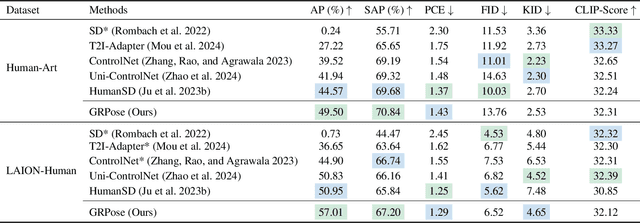
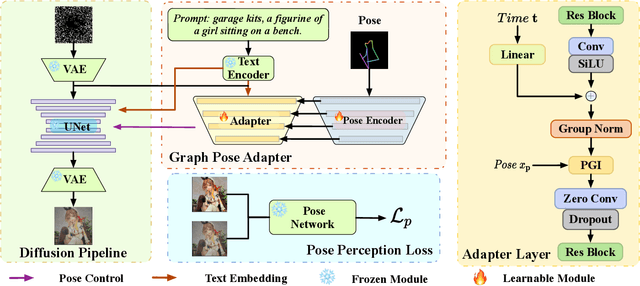
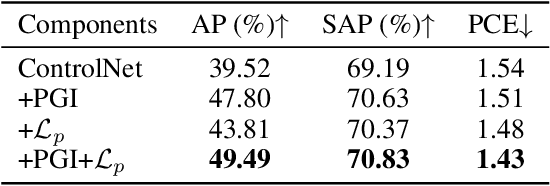
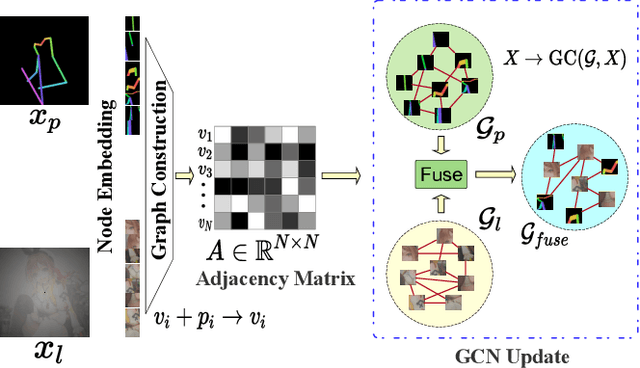
Recent methods using diffusion models have made significant progress in human image generation with various additional controls such as pose priors. However, existing approaches still struggle to generate high-quality images with consistent pose alignment, resulting in unsatisfactory outputs. In this paper, we propose a framework delving into the graph relations of pose priors to provide control information for human image generation. The main idea is to establish a graph topological structure between the pose priors and latent representation of diffusion models to capture the intrinsic associations between different pose parts. A Progressive Graph Integrator (PGI) is designed to learn the spatial relationships of the pose priors with the graph structure, adopting a hierarchical strategy within an Adapter to gradually propagate information across different pose parts. A pose perception loss is further introduced based on a pretrained pose estimation network to minimize the pose differences. Extensive qualitative and quantitative experiments conducted on the Human-Art and LAION-Human datasets demonstrate that our model achieves superior performance, with a 9.98% increase in pose average precision compared to the latest benchmark model. The code is released on *******.
DEFormer: DCT-driven Enhancement Transformer for Low-light Image and Dark Vision
Sep 13, 2023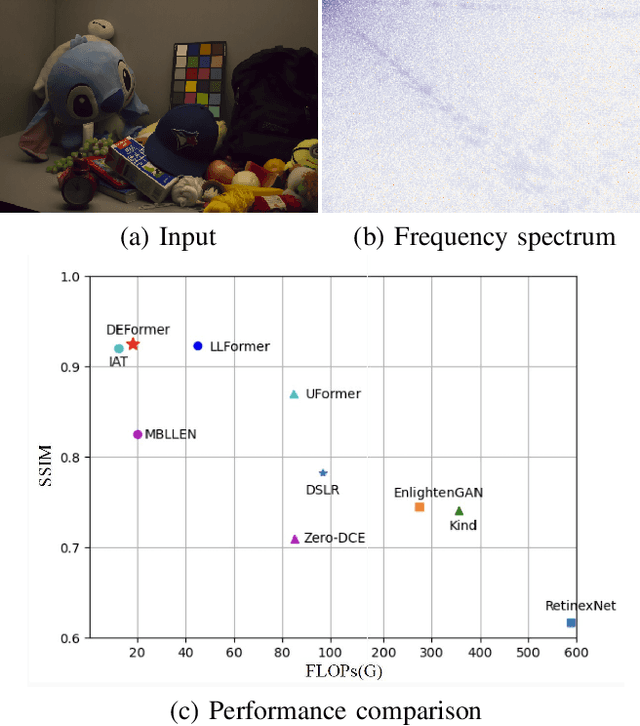
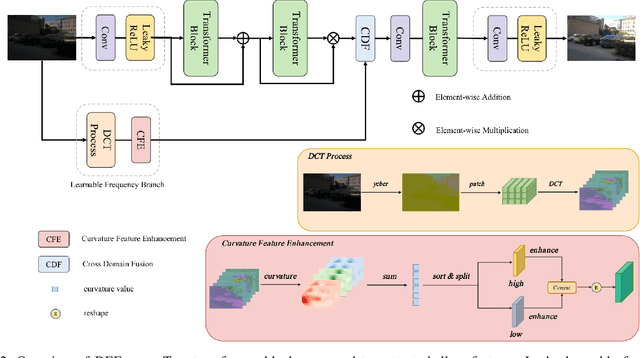
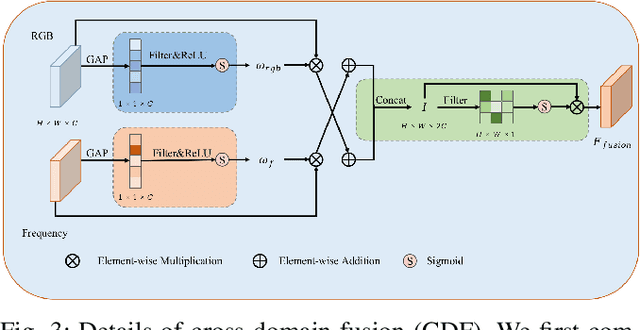
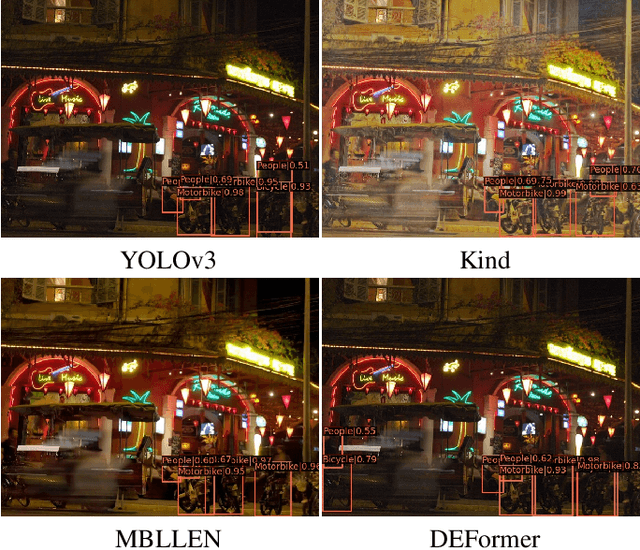
The goal of low-light image enhancement is to restore the color and details of the image and is of great significance for high-level visual tasks in autonomous driving. However, it is difficult to restore the lost details in the dark area by relying only on the RGB domain. In this paper we introduce frequency as a new clue into the network and propose a novel DCT-driven enhancement transformer (DEFormer). First, we propose a learnable frequency branch (LFB) for frequency enhancement contains DCT processing and curvature-based frequency enhancement (CFE). CFE calculates the curvature of each channel to represent the detail richness of different frequency bands, then we divides the frequency features, which focuses on frequency bands with richer textures. In addition, we propose a cross domain fusion (CDF) for reducing the differences between the RGB domain and the frequency domain. We also adopt DEFormer as a preprocessing in dark detection, DEFormer effectively improves the performance of the detector, bringing 2.1% and 3.4% improvement in ExDark and DARK FACE datasets on mAP respectively.
PE-YOLO: Pyramid Enhancement Network for Dark Object Detection
Jul 20, 2023Current object detection models have achieved good results on many benchmark datasets, detecting objects in dark conditions remains a large challenge. To address this issue, we propose a pyramid enhanced network (PENet) and joint it with YOLOv3 to build a dark object detection framework named PE-YOLO. Firstly, PENet decomposes the image into four components of different resolutions using the Laplacian pyramid. Specifically we propose a detail processing module (DPM) to enhance the detail of images, which consists of context branch and edge branch. In addition, we propose a low-frequency enhancement filter (LEF) to capture low-frequency semantics and prevent high-frequency noise. PE-YOLO adopts an end-to-end joint training approach and only uses normal detection loss to simplify the training process. We conduct experiments on the low-light object detection dataset ExDark to demonstrate the effectiveness of ours. The results indicate that compared with other dark detectors and low-light enhancement models, PE-YOLO achieves the advanced results, achieving 78.0% in mAP and 53.6 in FPS, respectively, which can adapt to object detection under different low-light conditions. The code is available at https://github.com/XiangchenYin/PE-YOLO.