 Add to Chrome
 Add to Firefox
 Add to Edge
PinPoint: Monocular Needle Pose Estimation for Robotic Suturing via Stein Variational Newton and Geometric Residuals
Mar 24, 2026
Reliable estimation of surgical needle 3D position and orientation is essential for autonomous robotic suturing, yet existing methods operate almost exclusively under stereoscopic vision. In monocular endoscopic settings, common in transendoscopic and intraluminal procedures, depth ambiguity and rotational symmetry render needle pose estimation inherently ill-posed, producing a multimodal distribution over feasible configurations, rather than a single, well-grounded estimate. We present PinPoint, a probabilistic variational inference framework that treats this ambiguity directly, maintaining a distribution of pose hypotheses rather than suppressing it. PinPoint combines monocular image observations with robot-grasp constraints through analytical geometric likelihoods with closed-form Jacobians. This framework enables efficient Gauss-Newton preconditioning in a Stein Variational Newton inference, where second-order particle transport deterministically moves particles toward high-probability regions while kernel-based repulsion preserves diversity in the multimodal structure. On real needle-tracking sequences, PinPoint reduces mean translational error by 80% (down to 1.00 mm) and rotational error by 78% (down to 13.80°) relative to a particle-filter baseline, with substantially better-calibrated uncertainty. On induced-rotation sequences, where monocular ambiguity is most severe, PinPoint maintains a bimodal posterior 84% of the time, almost three times the rate of the particle filter baseline, correctly preserving the alternative hypothesis rather than committing prematurely to one mode. Suturing experiments in ex vivo tissue demonstrate stable tracking through intermittent occlusion, with average errors during occlusion of 1.34 mm in translation and 19.18° in rotation, even when the needle is fully embedded.

EndoStreamDepth: Temporally Consistent Monocular Depth Estimation for Endoscopic Video Streams
Dec 20, 2025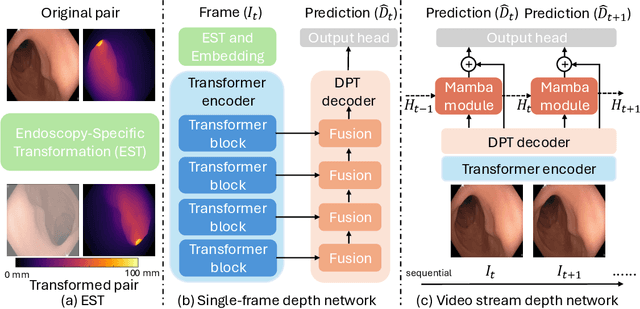
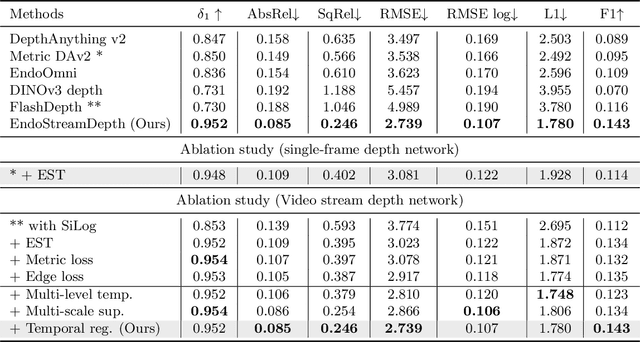
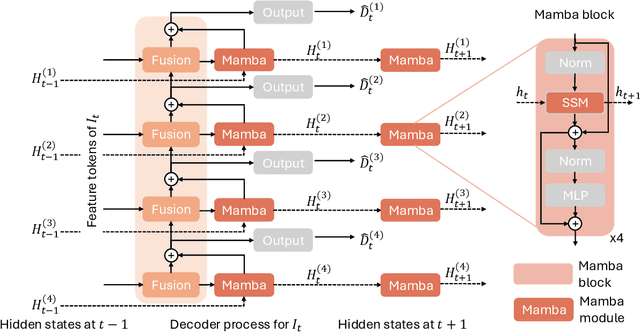
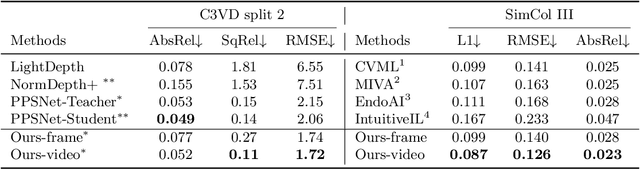
This work presents EndoStreamDepth, a monocular depth estimation framework for endoscopic video streams. It provides accurate depth maps with sharp anatomical boundaries for each frame, temporally consistent predictions across frames, and real-time throughput. Unlike prior work that uses batched inputs, EndoStreamDepth processes individual frames with a temporal module to propagate inter-frame information. The framework contains three main components: (1) a single-frame depth network with endoscopy-specific transformation to produce accurate depth maps, (2) multi-level Mamba temporal modules that leverage inter-frame information to improve accuracy and stabilize predictions, and (3) a hierarchical design with comprehensive multi-scale supervision, where complementary loss terms jointly improve local boundary sharpness and global geometric consistency. We conduct comprehensive evaluations on two publicly available colonoscopy depth estimation datasets. Compared to state-of-the-art monocular depth estimation methods, EndoStreamDepth substantially improves performance, and it produces depth maps with sharp, anatomically aligned boundaries, which are essential to support downstream tasks such as automation for robotic surgery. The code is publicly available at https://github.com/MedICL-VU/EndoStreamDepth
ProbeMDE: Uncertainty-Guided Active Proprioception for Monocular Depth Estimation in Surgical Robotics
Dec 17, 2025Monocular depth estimation (MDE) provides a useful tool for robotic perception, but its predictions are often uncertain and inaccurate in challenging environments such as surgical scenes where textureless surfaces, specular reflections, and occlusions are common. To address this, we propose ProbeMDE, a cost-aware active sensing framework that combines RGB images with sparse proprioceptive measurements for MDE. Our approach utilizes an ensemble of MDE models to predict dense depth maps conditioned on both RGB images and on a sparse set of known depth measurements obtained via proprioception, where the robot has touched the environment in a known configuration. We quantify predictive uncertainty via the ensemble's variance and measure the gradient of the uncertainty with respect to candidate measurement locations. To prevent mode collapse while selecting maximally informative locations to propriocept (touch), we leverage Stein Variational Gradient Descent (SVGD) over this gradient map. We validate our method in both simulated and physical experiments on central airway obstruction surgical phantoms. Our results demonstrate that our approach outperforms baseline methods across standard depth estimation metrics, achieving higher accuracy while minimizing the number of required proprioceptive measurements. Project page: https://brittonjordan.github.io/probe_mde/
A Supervised Autonomous Resection and Retraction Framework for Transurethral Enucleation of the Prostatic Median Lobe
Nov 11, 2025Concentric tube robots (CTRs) offer dexterous motion at millimeter scales, enabling minimally invasive procedures through natural orifices. This work presents a coordinated model-based resection planner and learning-based retraction network that work together to enable semi-autonomous tissue resection using a dual-arm transurethral concentric tube robot (the Virtuoso). The resection planner operates directly on segmented CT volumes of prostate phantoms, automatically generating tool trajectories for a three-phase median lobe resection workflow: left/median trough resection, right/median trough resection, and median blunt dissection. The retraction network, PushCVAE, trained on surgeon demonstrations, generates retractions according to the procedural phase. The procedure is executed under Level-3 (supervised) autonomy on a prostate phantom composed of hydrogel materials that replicate the mechanical and cutting properties of tissue. As a feasibility study, we demonstrate that our combined autonomous system achieves a 97.1% resection of the targeted volume of the median lobe. Our study establishes a foundation for image-guided autonomy in transurethral robotic surgery and represents a first step toward fully automated minimally-invasive prostate enucleation.