 Add to Chrome
 Add to Firefox
 Add to Edge
Automated Assessment of Kidney Ureteroscopy Exploration for Training
Feb 17, 2026
Purpose: Kidney ureteroscopic navigation is challenging with a steep learning curve. However, current clinical training has major deficiencies, as it requires one-on-one feedback from experts and occurs in the operating room (OR). Therefore, there is a need for a phantom training system with automated feedback to greatly \revision{expand} training opportunities. Methods: We propose a novel, purely ureteroscope video-based scope localization framework that automatically identifies calyces missed by the trainee in a phantom kidney exploration. We use a slow, thorough, prior exploration video of the kidney to generate a reference reconstruction. Then, this reference reconstruction can be used to localize any exploration video of the same phantom. Results: In 15 exploration videos, a total of 69 out of 74 calyces were correctly classified. We achieve < 4mm camera pose localization error. Given the reference reconstruction, the system takes 10 minutes to generate the results for a typical exploration (1-2 minute long). Conclusion: We demonstrate a novel camera localization framework that can provide accurate and automatic feedback for kidney phantom explorations. We show its ability as a valid tool that enables out-of-OR training without requiring supervision from an expert.

Endo-SemiS: Towards Robust Semi-Supervised Image Segmentation for Endoscopic Video
Dec 18, 2025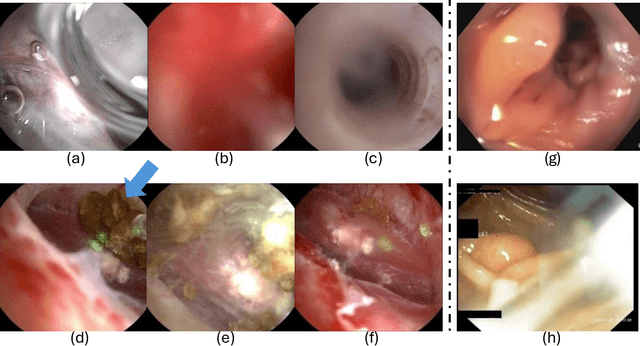

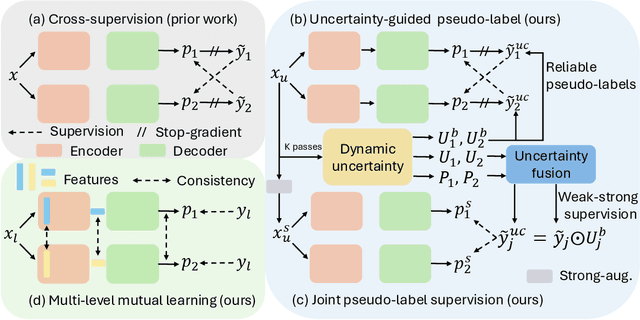
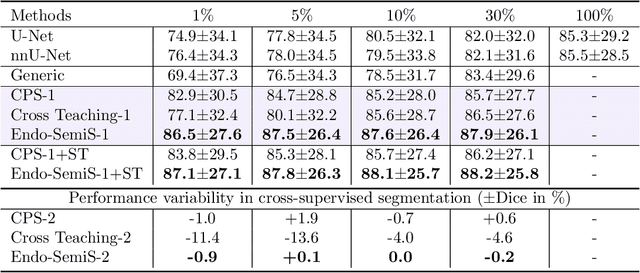
In this paper, we present Endo-SemiS, a semi-supervised segmentation framework for providing reliable segmentation of endoscopic video frames with limited annotation. EndoSemiS uses 4 strategies to improve performance by effectively utilizing all available data, particularly unlabeled data: (1) Cross-supervision between two individual networks that supervise each other; (2) Uncertainty-guided pseudo-labels from unlabeled data, which are generated by selecting high-confidence regions to improve their quality; (3) Joint pseudolabel supervision, which aggregates reliable pixels from the pseudo-labels of both networks to provide accurate supervision for unlabeled data; and (4) Mutual learning, where both networks learn from each other at the feature and image levels, reducing variance and guiding them toward a consistent solution. Additionally, a separate corrective network that utilizes spatiotemporal information from endoscopy video to improve segmentation performance. Endo-SemiS is evaluated on two clinical applications: kidney stone laser lithotomy from ureteroscopy and polyp screening from colonoscopy. Compared to state-of-the-art segmentation methods, Endo-SemiS substantially achieves superior results on both datasets with limited labeled data. The code is publicly available at https://github.com/MedICL-VU/Endo-SemiS
MeshBrush: Painting the Anatomical Mesh with Neural Stylization for Endoscopy
Apr 03, 2024


Style transfer is a promising approach to close the sim-to-real gap in medical endoscopy. Rendering realistic endoscopic videos by traversing pre-operative scans (such as MRI or CT) can generate realistic simulations as well as ground truth camera poses and depth maps. Although image-to-image (I2I) translation models such as CycleGAN perform well, they are unsuitable for video-to-video synthesis due to the lack of temporal consistency, resulting in artifacts between frames. We propose MeshBrush, a neural mesh stylization method to synthesize temporally consistent videos with differentiable rendering. MeshBrush uses the underlying geometry of patient imaging data while leveraging existing I2I methods. With learned per-vertex textures, the stylized mesh guarantees consistency while producing high-fidelity outputs. We demonstrate that mesh stylization is a promising approach for creating realistic simulations for downstream tasks such as training and preoperative planning. Although our method is tested and designed for ureteroscopy, its components are transferable to general endoscopic and laparoscopic procedures.