 Add to Chrome
 Add to Firefox
 Add to Edge
FLSL: Feature-level Self-supervised Learning
Jun 09, 2023
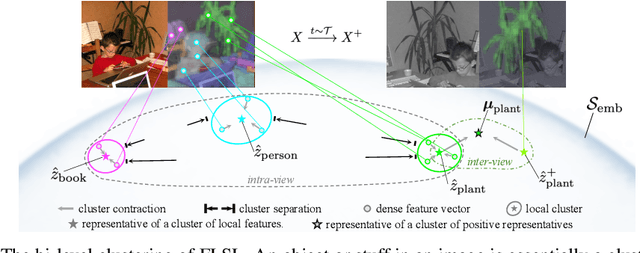
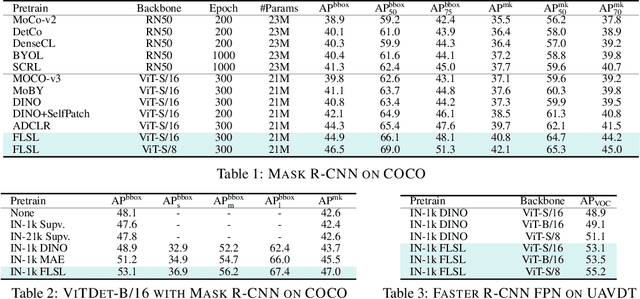
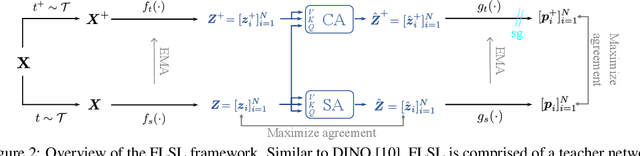
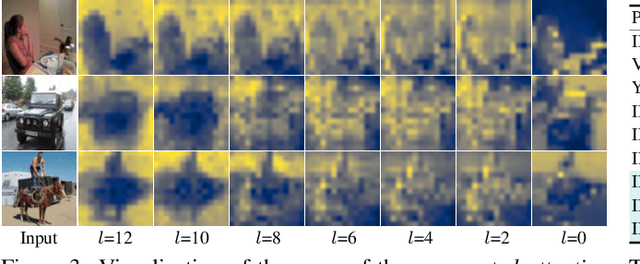
Current self-supervised learning (SSL) methods (e.g., SimCLR, DINO, VICReg, MOCOv3) target primarily on representations at instance level and do not generalize well to dense prediction tasks, such as object detection and segmentation. Towards aligning SSL with dense predictions, this paper demonstrates for the first time the underlying mean-shift clustering process of Vision Transformers (ViT), which aligns well with natural image semantics (e.g., a world of objects and stuffs). By employing transformer for joint embedding and clustering, we propose a two-level feature clustering SSL method, coined Feature-Level Self-supervised Learning (FLSL). We present the formal definition of the FLSL problem and construct the objectives from the mean-shift and k-means perspectives. We show that FLSL promotes remarkable semantic cluster representations and learns an embedding scheme amenable to intra-view and inter-view feature clustering. Experiments show that FLSL yields significant improvements in dense prediction tasks, achieving 44.9 (+2.8)% AP and 46.5% AP in object detection, as well as 40.8 (+2.3)% AP and 42.1% AP in instance segmentation on MS-COCO, using Mask R-CNN with ViT-S/16 and ViT-S/8 as backbone, respectively. FLSL consistently outperforms existing SSL methods across additional benchmarks, including UAV object detection on UAVDT, and video instance segmentation on DAVIS 2017. We conclude by presenting visualization and various ablation studies to better 20 understand the success of FLSL.

SIO: Synthetic In-Distribution Data Benefits Out-of-Distribution Detection
Mar 25, 2023Building up reliable Out-of-Distribution (OOD) detectors is challenging, often requiring the use of OOD data during training. In this work, we develop a data-driven approach which is distinct and complementary to existing works: Instead of using external OOD data, we fully exploit the internal in-distribution (ID) training set by utilizing generative models to produce additional synthetic ID images. The classifier is then trained using a novel objective that computes weighted loss on real and synthetic ID samples together. Our training framework, which is termed SIO, serves as a "plug-and-play" technique that is designed to be compatible with existing and future OOD detection algorithms, including the ones that leverage available OOD training data. Our experiments on CIFAR-10, CIFAR-100, and ImageNet variants demonstrate that SIO consistently improves the performance of nearly all state-of-the-art (SOTA) OOD detection algorithms. For instance, on the challenging CIFAR-10 v.s. CIFAR-100 detection problem, SIO improves the average OOD detection AUROC of 18 existing methods from 86.25\% to 89.04\% and achieves a new SOTA of 92.94\% according to the OpenOOD benchmark. Code is available at https://github.com/zjysteven/SIO.
3D Masked Autoencoding and Pseudo-labeling for Domain Adaptive Segmentation of Heterogeneous Infant Brain MRI
Mar 16, 2023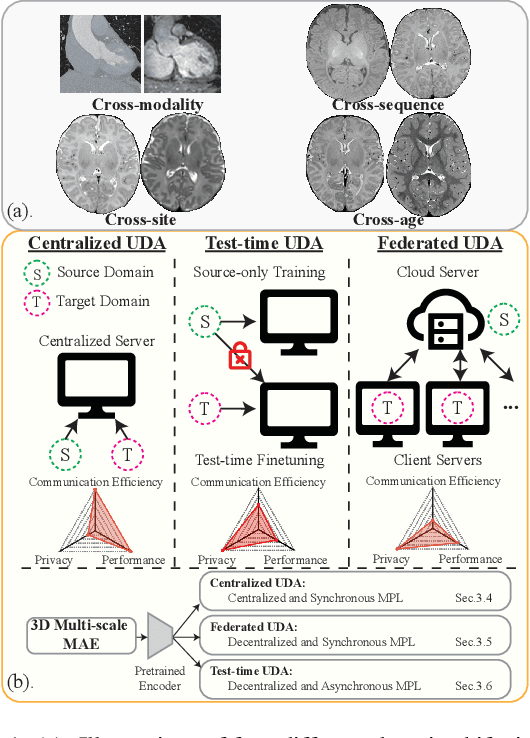
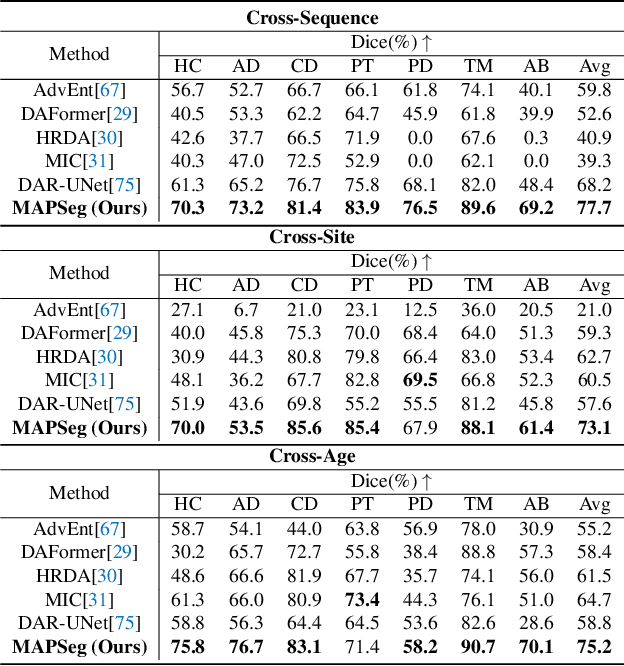
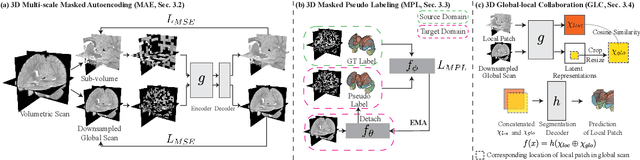
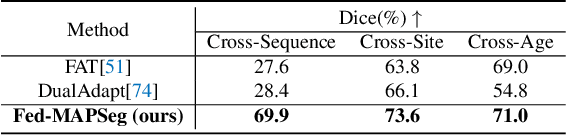
Robust segmentation of infant brain MRI across multiple ages, modalities, and sites remains challenging due to the intrinsic heterogeneity caused by different MRI scanners, vendors, or acquisition sequences, as well as varying stages of neurodevelopment. To address this challenge, previous studies have explored domain adaptation (DA) algorithms from various perspectives, including feature alignment, entropy minimization, contrast synthesis (style transfer), and pseudo-labeling. This paper introduces a novel framework called MAPSeg (Masked Autoencoding and Pseudo-labelling Segmentation) to address the challenges of cross-age, cross-modality, and cross-site segmentation of subcortical regions in infant brain MRI. Utilizing 3D masked autoencoding as well as masked pseudo-labeling, the model is able to jointly learn from labeled source domain data and unlabeled target domain data. We evaluated our framework on expert-annotated datasets acquired from different ages and sites. MAPSeg consistently outperformed other methods, including previous state-of-the-art supervised baselines, domain generalization, and domain adaptation frameworks in segmenting subcortical regions regardless of age, modality, or acquisition site. The code and pretrained encoder will be publicly available at https://github.com/XuzheZ/MAPSeg
Disentangling Learning Representations with Density Estimation
Feb 08, 2023Disentangled learning representations have promising utility in many applications, but they currently suffer from serious reliability issues. We present Gaussian Channel Autoencoder (GCAE), a method which achieves reliable disentanglement via flexible density estimation of the latent space. GCAE avoids the curse of dimensionality of density estimation by disentangling subsets of its latent space with the Dual Total Correlation (DTC) metric, thereby representing its high-dimensional latent joint distribution as a collection of many low-dimensional conditional distributions. In our experiments, GCAE achieves highly competitive and reliable disentanglement scores compared with state-of-the-art baselines.
GDOD: Effective Gradient Descent using Orthogonal Decomposition for Multi-Task Learning
Jan 31, 2023Multi-task learning (MTL) aims at solving multiple related tasks simultaneously and has experienced rapid growth in recent years. However, MTL models often suffer from performance degeneration with negative transfer due to learning several tasks simultaneously. Some related work attributed the source of the problem is the conflicting gradients. In this case, it is needed to select useful gradient updates for all tasks carefully. To this end, we propose a novel optimization approach for MTL, named GDOD, which manipulates gradients of each task using an orthogonal basis decomposed from the span of all task gradients. GDOD decomposes gradients into task-shared and task-conflict components explicitly and adopts a general update rule for avoiding interference across all task gradients. This allows guiding the update directions depending on the task-shared components. Moreover, we prove the convergence of GDOD theoretically under both convex and non-convex assumptions. Experiment results on several multi-task datasets not only demonstrate the significant improvement of GDOD performed to existing MTL models but also prove that our algorithm outperforms state-of-the-art optimization methods in terms of AUC and Logloss metrics.
HCE: Improving Performance and Efficiency with Heterogeneously Compressed Neural Network Ensemble
Jan 18, 2023Ensemble learning has gain attention in resent deep learning research as a way to further boost the accuracy and generalizability of deep neural network (DNN) models. Recent ensemble training method explores different training algorithms or settings on multiple sub-models with the same model architecture, which lead to significant burden on memory and computation cost of the ensemble model. Meanwhile, the heurtsically induced diversity may not lead to significant performance gain. We propose a new prespective on exploring the intrinsic diversity within a model architecture to build efficient DNN ensemble. We make an intriguing observation that pruning and quantization, while both leading to efficient model architecture at the cost of small accuracy drop, leads to distinct behavior in the decision boundary. To this end, we propose Heterogeneously Compressed Ensemble (HCE), where we build an efficient ensemble with the pruned and quantized variants from a pretrained DNN model. An diversity-aware training objective is proposed to further boost the performance of the HCE ensemble. Experiemnt result shows that HCE achieves significant improvement in the efficiency-accuracy tradeoff comparing to both traditional DNN ensemble training methods and previous model compression methods.
Adaptive Neural Network Backstepping Control Method for Aerial Manipulator Based on Variable Inertia Parameter Modeling
Dec 08, 2022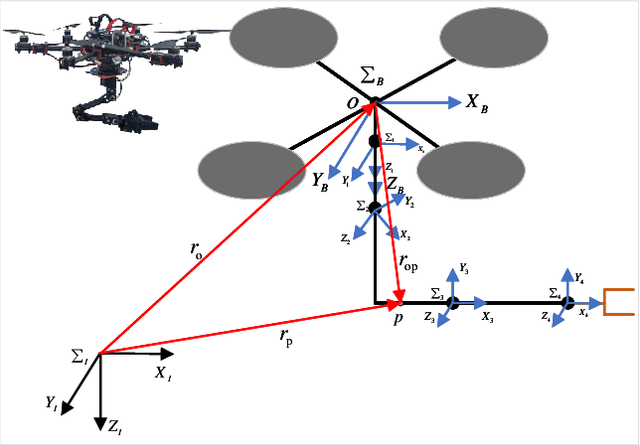


For the aerial manipulator that performs aerial work tasks, the actual operating environment it faces is very complex, and it is affected by internal and external multi-source disturbances. In this paper, to effectively improve the anti-disturbance control performance of the aerial manipulator, an adaptive neural network backstepping control method based on variable inertia parameter modeling is proposed. Firstly, for the intense internal coupling disturbance, we analyze and model it from the perspective of the generation mechanism of the coupling disturbance, and derive the dynamics model of the aerial manipulator system and the coupling disturbance model based on the variable inertia parameters. Through the proposed coupling disturbance model, we can compensate the strong coupling disturbance in a way of feedforward. Then, the adaptive neural network is proposed and applid to estimate and compensate the additional disturbances, and the closed-loop controller is designed based on the backstepping control method. Finally, we verify the correctness of the proposed coupling disturbance model through physical experiment under a large range motion of the manipulator. Two sets of comparative simulation results also prove the accurate estimation of the proposed adaptive neural network for additional disturbances and the effectiveness and superiority of the proposed control method.
PIDS: Joint Point Interaction-Dimension Search for 3D Point Cloud
Nov 28, 2022The interaction and dimension of points are two important axes in designing point operators to serve hierarchical 3D models. Yet, these two axes are heterogeneous and challenging to fully explore. Existing works craft point operator under a single axis and reuse the crafted operator in all parts of 3D models. This overlooks the opportunity to better combine point interactions and dimensions by exploiting varying geometry/density of 3D point clouds. In this work, we establish PIDS, a novel paradigm to jointly explore point interactions and point dimensions to serve semantic segmentation on point cloud data. We establish a large search space to jointly consider versatile point interactions and point dimensions. This supports point operators with various geometry/density considerations. The enlarged search space with heterogeneous search components calls for a better ranking of candidate models. To achieve this, we improve the search space exploration by leveraging predictor-based Neural Architecture Search (NAS), and enhance the quality of prediction by assigning unique encoding to heterogeneous search components based on their priors. We thoroughly evaluate the networks crafted by PIDS on two semantic segmentation benchmarks, showing ~1% mIOU improvement on SemanticKITTI and S3DIS over state-of-the-art 3D models.
More Generalized and Personalized Unsupervised Representation Learning In A Distributed System
Nov 11, 2022Discriminative unsupervised learning methods such as contrastive learning have demonstrated the ability to learn generalized visual representations on centralized data. It is nonetheless challenging to adapt such methods to a distributed system with unlabeled, private, and heterogeneous client data due to user styles and preferences. Federated learning enables multiple clients to collectively learn a global model without provoking any privacy breach between local clients. On the other hand, another direction of federated learning studies personalized methods to address the local heterogeneity. However, work on solving both generalization and personalization without labels in a decentralized setting remains unfamiliar. In this work, we propose a novel method, FedStyle, to learn a more generalized global model by infusing local style information with local content information for contrastive learning, and to learn more personalized local models by inducing local style information for downstream tasks. The style information is extracted by contrasting original local data with strongly augmented local data (Sobel filtered images). Through extensive experiments with linear evaluations in both IID and non-IID settings, we demonstrate that FedStyle outperforms both the generalization baseline methods and personalization baseline methods in a stylized decentralized setting. Through comprehensive ablations, we demonstrate our design of style infusion and stylized personalization improve performance significantly.
Preserving background sound in noise-robust voice conversion via multi-task learning
Nov 06, 2022Background sound is an informative form of art that is helpful in providing a more immersive experience in real-application voice conversion (VC) scenarios. However, prior research about VC, mainly focusing on clean voices, pay rare attention to VC with background sound. The critical problem for preserving background sound in VC is inevitable speech distortion by the neural separation model and the cascade mismatch between the source separation model and the VC model. In this paper, we propose an end-to-end framework via multi-task learning which sequentially cascades a source separation (SS) module, a bottleneck feature extraction module and a VC module. Specifically, the source separation task explicitly considers critical phase information and confines the distortion caused by the imperfect separation process. The source separation task, the typical VC task and the unified task shares a uniform reconstruction loss constrained by joint training to reduce the mismatch between the SS and VC modules. Experimental results demonstrate that our proposed framework significantly outperforms the baseline systems while achieving comparable quality and speaker similarity to the VC models trained with clean data.