 Add to Chrome
 Add to Firefox
 Add to Edge
Efficient Analytic Uncertainty Quantification for Multi-Modal Regression
Jun 23, 2026
Efficient uncertainty quantification (UQ) is essential for trustworthy large-scale learning. Existing UQ methods for regression tasks mainly operate under the assumption that the conditional label marginal satisfies single-peak parametric models, e.g., Gaussians, where the negative log-likelihood function simplifies to the mean square error. However, such single-peak assumptions fail in regression tasks featuring multi-modal distributions. On the other hand, semi-parametric methods which achieve strong regression performance for multi-modal distributions often lack efficient quantification on their prediction variances. In this work, we extend UQ techniques based on Variational Bayesian Inference (VBI) to two widely used semi-parametric regression models that yield histogram-like reconstructions of the conditional label densities: Quantile Regression (QR) and Classification Restoration (CR). Our approach introduces a unified, distribution-agnostic framework that simultaneously achieves accurate estimation of complex conditional distributions and highly efficient UQ. Theoretically, our method is grounded in novel formulations of QR and CR within the VBI framework, yielding analytic Evidence Lower Bounds (ELBO) to streamline training and a closed-form or analytically approximated predictive density for efficient inference. Empirically, we evaluate our methods on three large-scale regression benchmarks with multi-modal label distributions. Our framework outperforms state-of-the-art multi-modal regression baselines, and even matches predictive performance of computationally expensive ensemble models. Furthermore, by leveraging epistemic uncertainty estimation, our approach enables highly data-efficient active learning strategies.

OSR-ViT: A Simple and Modular Framework for Open-Set Object Detection and Discovery
Apr 16, 2024An object detector's ability to detect and flag \textit{novel} objects during open-world deployments is critical for many real-world applications. Unfortunately, much of the work in open object detection today is disjointed and fails to adequately address applications that prioritize unknown object recall \textit{in addition to} known-class accuracy. To close this gap, we present a new task called Open-Set Object Detection and Discovery (OSODD) and as a solution propose the Open-Set Regions with ViT features (OSR-ViT) detection framework. OSR-ViT combines a class-agnostic proposal network with a powerful ViT-based classifier. Its modular design simplifies optimization and allows users to easily swap proposal solutions and feature extractors to best suit their application. Using our multifaceted evaluation protocol, we show that OSR-ViT obtains performance levels that far exceed state-of-the-art supervised methods. Our method also excels in low-data settings, outperforming supervised baselines using a fraction of the training data.
SIO: Synthetic In-Distribution Data Benefits Out-of-Distribution Detection
Mar 25, 2023Building up reliable Out-of-Distribution (OOD) detectors is challenging, often requiring the use of OOD data during training. In this work, we develop a data-driven approach which is distinct and complementary to existing works: Instead of using external OOD data, we fully exploit the internal in-distribution (ID) training set by utilizing generative models to produce additional synthetic ID images. The classifier is then trained using a novel objective that computes weighted loss on real and synthetic ID samples together. Our training framework, which is termed SIO, serves as a "plug-and-play" technique that is designed to be compatible with existing and future OOD detection algorithms, including the ones that leverage available OOD training data. Our experiments on CIFAR-10, CIFAR-100, and ImageNet variants demonstrate that SIO consistently improves the performance of nearly all state-of-the-art (SOTA) OOD detection algorithms. For instance, on the challenging CIFAR-10 v.s. CIFAR-100 detection problem, SIO improves the average OOD detection AUROC of 18 existing methods from 86.25\% to 89.04\% and achieves a new SOTA of 92.94\% according to the OpenOOD benchmark. Code is available at https://github.com/zjysteven/SIO.
Fine-grain Inference on Out-of-Distribution Data with Hierarchical Classification
Sep 09, 2022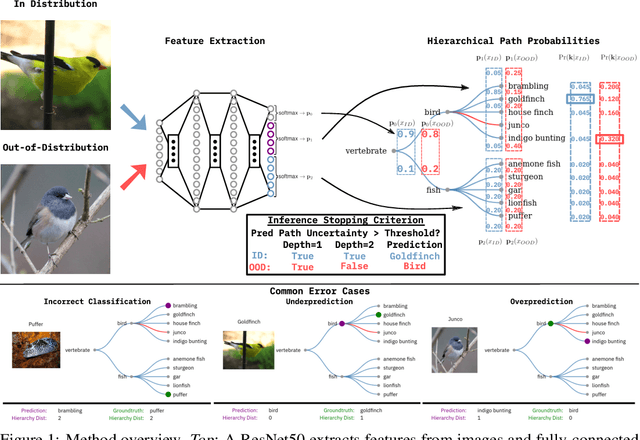
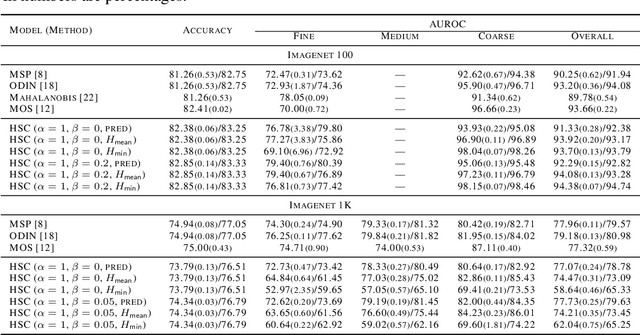
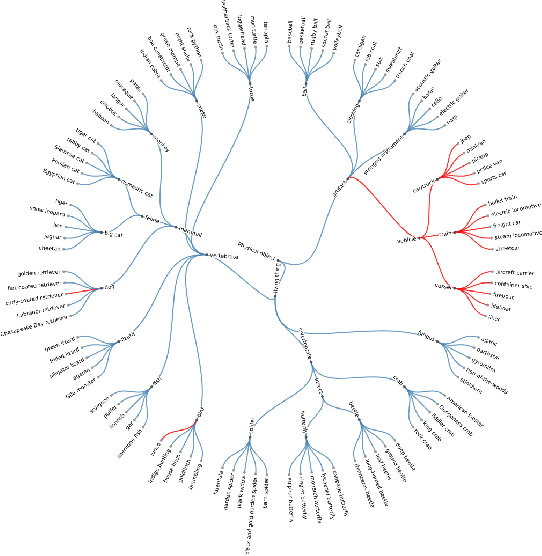
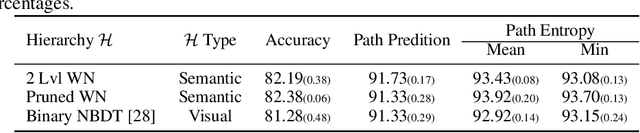
Machine learning methods must be trusted to make appropriate decisions in real-world environments, even when faced with out-of-distribution (OOD) samples. Many current approaches simply aim to detect OOD examples and alert the user when an unrecognized input is given. However, when the OOD sample significantly overlaps with the training data, a binary anomaly detection is not interpretable or explainable, and provides little information to the user. We propose a new model for OOD detection that makes predictions at varying levels of granularity as the inputs become more ambiguous, the model predictions become coarser and more conservative. Consider an animal classifier that encounters an unknown bird species and a car. Both cases are OOD, but the user gains more information if the classifier recognizes that its uncertainty over the particular species is too large and predicts bird instead of detecting it as OOD. Furthermore, we diagnose the classifiers performance at each level of the hierarchy improving the explainability and interpretability of the models predictions. We demonstrate the effectiveness of hierarchical classifiers for both fine- and coarse-grained OOD tasks.