 Add to Chrome
 Add to Firefox
 Add to Edge
EfficientPENet: Real-Time Depth Completion from Sparse LiDAR via Lightweight Multi-Modal Fusion
Apr 20, 2026
Depth completion from sparse LiDAR measurements and corresponding RGB images is a prerequisite for accurate 3D perception in robotic systems. Existing methods achieve high accuracy on standard benchmarks but rely on heavy backbone architectures that preclude real-time deployment on embedded hardware. We present EfficientPENet, a two-branch depth completion network that replaces the conventional ResNet encoder with a modernized ConvNeXt backbone, introduces sparsity-invariant convolutions for the depth stream, and refines predictions through a Convolutional Spatial Propagation Network (CSPN). The RGB branch leverages ImageNet-pretrained ConvNeXt blocks with Layer Normalization, 7x7 depthwise convolutions, and stochastic depth regularization. Features from both branches are merged via late fusion and decoded through a multi-scale deep supervision strategy. We further introduce a position-aware test-time augmentation scheme that corrects coordinate tensors during horizontal flipping, yielding consistent error reduction at inference. On the KITTI depth completion benchmark, EfficientPENet achieves an RMSE of 631.94 mm with 36.24M parameters and a latency of 20.51 ms, operating at 48.76 FPS. This represents a 3.7 times reduction in parameters and a 23 times speedup relative to BP-Net, while maintaining competitive accuracy. These results establish EfficientPENet as a practical solution for real-time depth completion on resource-constrained edge platforms such as the NVIDIA Jetson.

VeloxNet: Efficient Spatial Gating for Lightweight Embedded Image Classification
Mar 19, 2026Deploying deep learning models on embedded devices for tasks such as aerial disaster monitoring and infrastructure inspection requires architectures that balance accuracy with strict constraints on model size, memory, and latency. This paper introduces VeloxNet, a lightweight CNN architecture that replaces SqueezeNet's fire modules with gated multi-layer perceptron (gMLP) blocks for embedded image classification. Each gMLP block uses a spatial gating unit (SGU) that applies learned spatial projections and multiplicative gating, enabling the network to capture spatial dependencies across the full feature map in a single layer. Unlike fire modules, which are limited to local receptive fields defined by small convolutional kernels, the SGU provides global spatial modeling at each layer with fewer parameters. We evaluate VeloxNet on three aerial image datasets: the Aerial Image Database for Emergency Response (AIDER), the Comprehensive Disaster Dataset (CDD), and the Levee Defect Dataset (LDD), comparing against eleven baselines including MobileNet variants, ShuffleNet, EfficientNet, and recent vision transformers. VeloxNet reduces the parameter count by 46.1% relative to SqueezeNet (from 740,970 to 399,366) while improving weighted F1 scores by 6.32% on AIDER, 30.83% on CDD, and 2.51% on LDD. These results demonstrate that substituting local convolutional modules with spatial gating blocks can improve both classification accuracy and parameter efficiency for resource-constrained deployment. The source code will be made publicly available upon acceptance of the paper.
Many-RRT*: Robust Joint-Space Trajectory Planning for Serial Manipulators
Mar 04, 2026The rapid advancement of high degree-of-freedom (DoF) serial manipulators necessitates the use of swift, sampling-based motion planners for high-dimensional spaces. While sampling-based planners like the Rapidly-Exploring Random Tree (RRT) are widely used, planning in the manipulator's joint space presents significant challenges due to non-invertible forward kinematics. A single task-space end-effector pose can correspond to multiple configuration-space states, creating a multi-arm bandit problem for the planner. In complex environments, simply choosing the wrong joint space goal can result in suboptimal trajectories or even failure to find a viable plan. To address this planning problem, we propose Many-RRT*: an extension of RRT*-Connect that plans to multiple goals in parallel. By generating multiple IK solutions and growing independent trees from these goal configurations simultaneously alongside a single start tree, Many-RRT* ensures that computational effort is not wasted on suboptimal IK solutions. This approach maintains robust convergence and asymptotic optimality. Experimental evaluations across robot morphologies and diverse obstacle environments demonstrate that Many-RRT* provides higher quality trajectories (44.5% lower cost in the same runtime) with a significantly higher success rate (100% vs. the next best of 1.6%) than previous RRT iterations without compromising on runtime performance.
BRNES: Enabling Security and Privacy-aware Experience Sharing in Multiagent Robotic and Autonomous Systems
Aug 02, 2023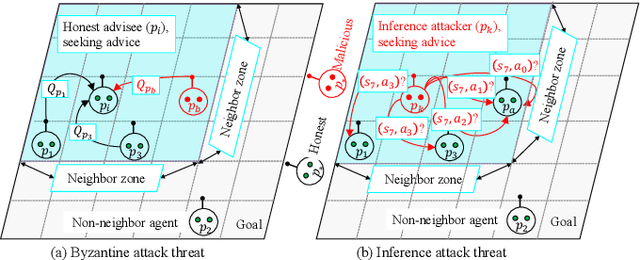

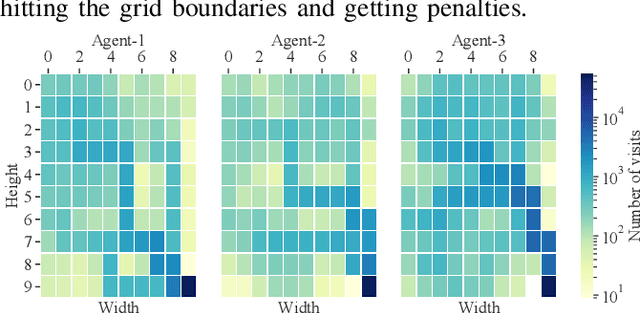
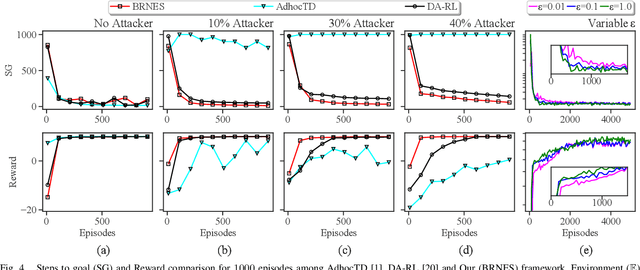
Although experience sharing (ES) accelerates multiagent reinforcement learning (MARL) in an advisor-advisee framework, attempts to apply ES to decentralized multiagent systems have so far relied on trusted environments and overlooked the possibility of adversarial manipulation and inference. Nevertheless, in a real-world setting, some Byzantine attackers, disguised as advisors, may provide false advice to the advisee and catastrophically degrade the overall learning performance. Also, an inference attacker, disguised as an advisee, may conduct several queries to infer the advisors' private information and make the entire ES process questionable in terms of privacy leakage. To address and tackle these issues, we propose a novel MARL framework (BRNES) that heuristically selects a dynamic neighbor zone for each advisee at each learning step and adopts a weighted experience aggregation technique to reduce Byzantine attack impact. Furthermore, to keep the agent's private information safe from adversarial inference attacks, we leverage the local differential privacy (LDP)-induced noise during the ES process. Our experiments show that our framework outperforms the state-of-the-art in terms of the steps to goal, obtained reward, and time to goal metrics. Particularly, our evaluation shows that the proposed framework is 8.32x faster than the current non-private frameworks and 1.41x faster than the private frameworks in an adversarial setting.
FLSL: Feature-level Self-supervised Learning
Jun 09, 2023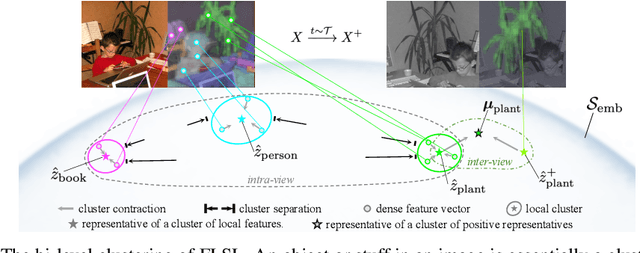
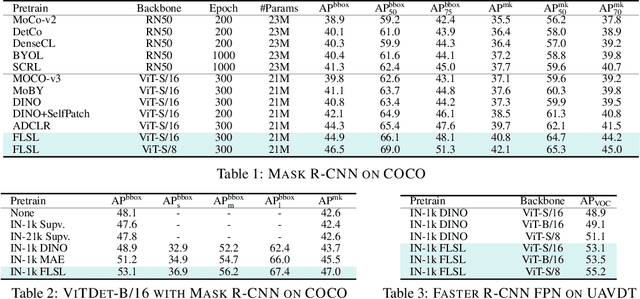
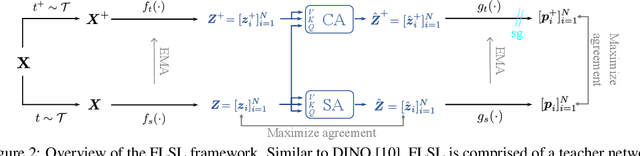
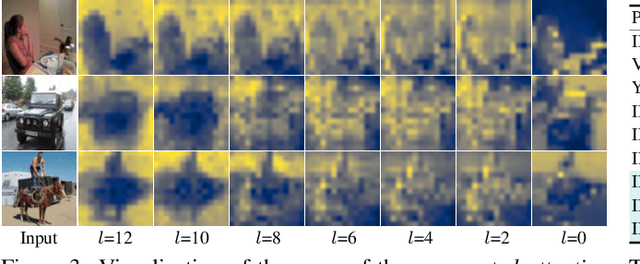
Current self-supervised learning (SSL) methods (e.g., SimCLR, DINO, VICReg, MOCOv3) target primarily on representations at instance level and do not generalize well to dense prediction tasks, such as object detection and segmentation. Towards aligning SSL with dense predictions, this paper demonstrates for the first time the underlying mean-shift clustering process of Vision Transformers (ViT), which aligns well with natural image semantics (e.g., a world of objects and stuffs). By employing transformer for joint embedding and clustering, we propose a two-level feature clustering SSL method, coined Feature-Level Self-supervised Learning (FLSL). We present the formal definition of the FLSL problem and construct the objectives from the mean-shift and k-means perspectives. We show that FLSL promotes remarkable semantic cluster representations and learns an embedding scheme amenable to intra-view and inter-view feature clustering. Experiments show that FLSL yields significant improvements in dense prediction tasks, achieving 44.9 (+2.8)% AP and 46.5% AP in object detection, as well as 40.8 (+2.3)% AP and 42.1% AP in instance segmentation on MS-COCO, using Mask R-CNN with ViT-S/16 and ViT-S/8 as backbone, respectively. FLSL consistently outperforms existing SSL methods across additional benchmarks, including UAV object detection on UAVDT, and video instance segmentation on DAVIS 2017. We conclude by presenting visualization and various ablation studies to better 20 understand the success of FLSL.