 Add to Chrome
 Add to Firefox
 Add to Edge
RPBA-Net: An Interpretable Residual Pyramid Bilateral Affine Network for RAW-Domain ISP Enhancement
May 05, 2026
To address module fragmentation, uninterpretable mappings, and deployment constraints in RAW-domain demosaicing, color correction, and detail enhancement, this paper proposes RPBA-Net, an interpretable residual pyramid bilateral affine network for RAW-domain ISP enhancement. Given packed RAW as input, the method performs residual affine base reconstruction by estimating a base RGB representation and learning identity-guided residual affine corrections, thereby unifying demosaicing and enhancement. It further builds pyramid bilateral affine grids and combines guide-driven autoregressive adaptive slicing with adaptive cross-layer fusion to hierarchically model global tone restoration and local texture enhancement. In addition, smoothness, cross-scale consistency, and magnitude regularization terms are introduced to improve model stability, controllability, and structural interpretability. Extensive experiments demonstrate that RPBA-Net surpasses representative RAW-to-sRGB methods and achieves state-of-the-art performance in reconstruction fidelity and perceptual quality, while maintaining low model complexity and strong deployment potential for mobile and embedded platforms.

GDOD: Effective Gradient Descent using Orthogonal Decomposition for Multi-Task Learning
Jan 31, 2023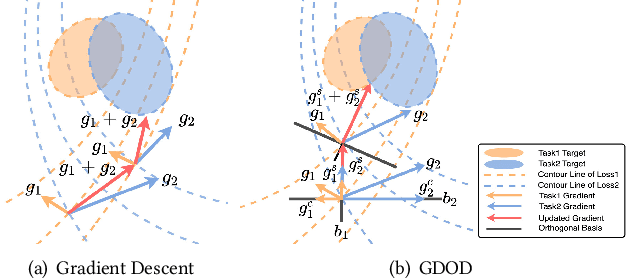
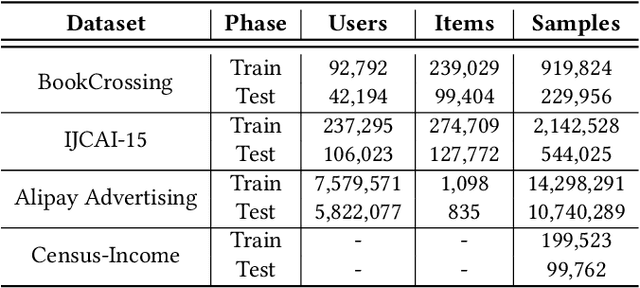
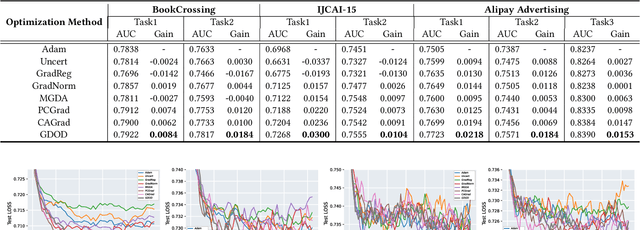
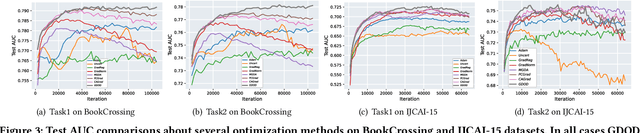
Multi-task learning (MTL) aims at solving multiple related tasks simultaneously and has experienced rapid growth in recent years. However, MTL models often suffer from performance degeneration with negative transfer due to learning several tasks simultaneously. Some related work attributed the source of the problem is the conflicting gradients. In this case, it is needed to select useful gradient updates for all tasks carefully. To this end, we propose a novel optimization approach for MTL, named GDOD, which manipulates gradients of each task using an orthogonal basis decomposed from the span of all task gradients. GDOD decomposes gradients into task-shared and task-conflict components explicitly and adopts a general update rule for avoiding interference across all task gradients. This allows guiding the update directions depending on the task-shared components. Moreover, we prove the convergence of GDOD theoretically under both convex and non-convex assumptions. Experiment results on several multi-task datasets not only demonstrate the significant improvement of GDOD performed to existing MTL models but also prove that our algorithm outperforms state-of-the-art optimization methods in terms of AUC and Logloss metrics.