 Add to Chrome
 Add to Firefox
 Add to Edge
FedCure: Mitigating Participation Bias in Semi-Asynchronous Federated Learning with Non-IID Data
Nov 13, 2025
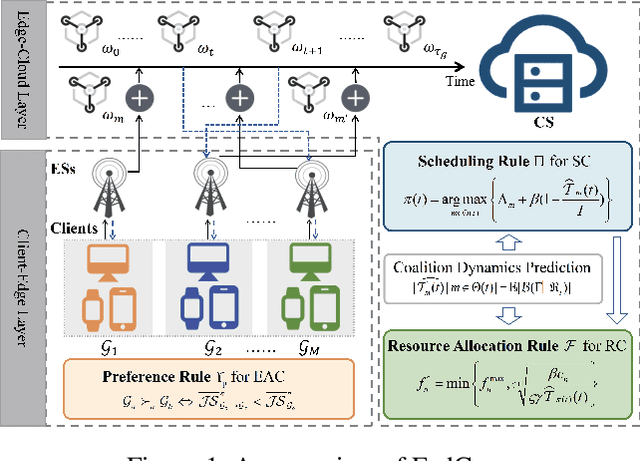
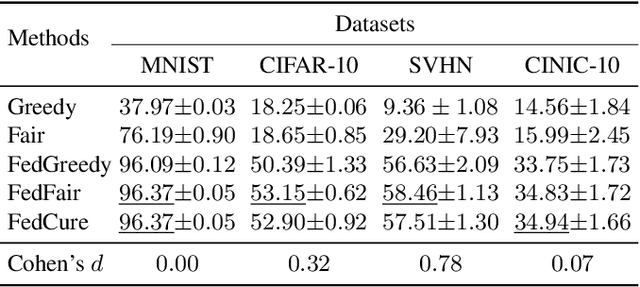
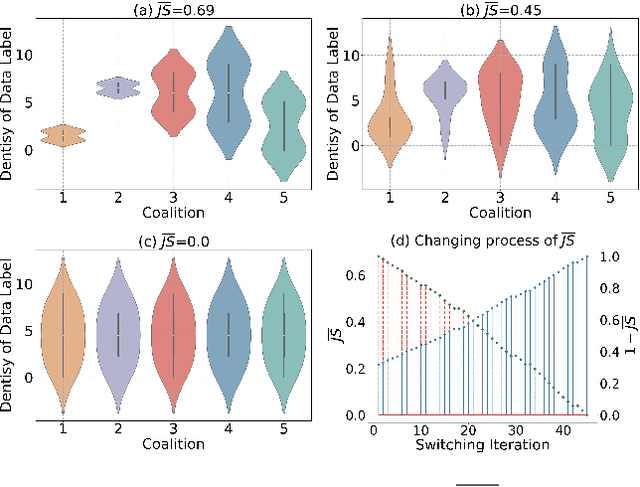
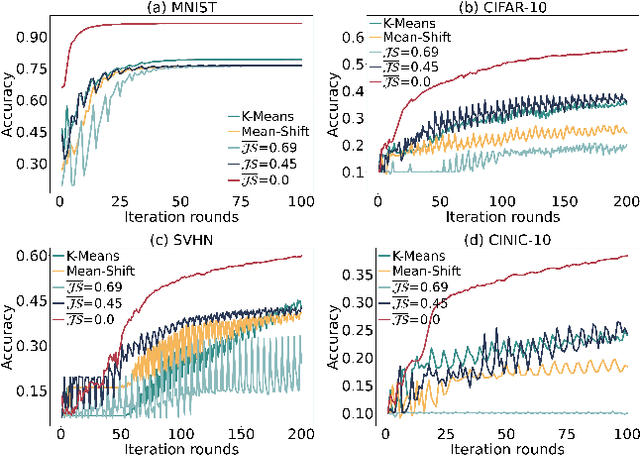
While semi-asynchronous federated learning (SAFL) combines the efficiency of synchronous training with the flexibility of asynchronous updates, it inherently suffers from participation bias, which is further exacerbated by non-IID data distributions. More importantly, hierarchical architecture shifts participation from individual clients to client groups, thereby further intensifying this issue. Despite notable advancements in SAFL research, most existing works still focus on conventional cloud-end architectures while largely overlooking the critical impact of non-IID data on scheduling across the cloud-edge-client hierarchy. To tackle these challenges, we propose FedCure, an innovative semi-asynchronous Federated learning framework that leverages coalition construction and participation-aware scheduling to mitigate participation bias with non-IID data. Specifically, FedCure operates through three key rules: (1) a preference rule that optimizes coalition formation by maximizing collective benefits and establishing theoretically stable partitions to reduce non-IID-induced performance degradation; (2) a scheduling rule that integrates the virtual queue technique with Bayesian-estimated coalition dynamics, mitigating efficiency loss while ensuring mean rate stability; and (3) a resource allocation rule that enhances computational efficiency by optimizing client CPU frequencies based on estimated coalition dynamics while satisfying delay requirements. Comprehensive experiments on four real-world datasets demonstrate that FedCure improves accuracy by up to 5.1x compared with four state-of-the-art baselines, while significantly enhancing efficiency with the lowest coefficient of variation 0.0223 for per-round latency and maintaining long-term balance across diverse scenarios.

FLYINGTRUST: A Benchmark for Quadrotor Navigation Across Scenarios and Vehicles
Oct 30, 2025Visual navigation algorithms for quadrotors often exhibit a large variation in performance when transferred across different vehicle platforms and scene geometries, which increases the cost and risk of field deployment. To support systematic early-stage evaluation, we introduce FLYINGTRUST, a high-fidelity, configurable benchmarking framework that measures how platform kinodynamics and scenario structure jointly affect navigation robustness. FLYINGTRUST models vehicle capability with two compact, physically interpretable indicators: maximum thrust-to-weight ratio and axis-wise maximum angular acceleration. The benchmark pairs a diverse scenario library with a heterogeneous set of real and virtual platforms and prescribes a standardized evaluation protocol together with a composite scoring method that balances scenario importance, platform importance and performance stability. We use FLYINGTRUST to compare representative optimization-based and learning-based navigation approaches under identical conditions, performing repeated trials per platform-scenario combination and reporting uncertainty-aware metrics. The results reveal systematic patterns: navigation success depends predictably on platform capability and scene geometry, and different algorithms exhibit distinct preferences and failure modes across the evaluated conditions. These observations highlight the practical necessity of incorporating both platform capability and scenario structure into algorithm design, evaluation, and selection, and they motivate future work on methods that remain robust across diverse platforms and scenarios.
DRPO: Efficient Reasoning via Decoupled Reward Policy Optimization
Oct 06, 2025Recent large reasoning models (LRMs) driven by reinforcement learning algorithms (e.g., GRPO) have achieved remarkable performance on challenging reasoning tasks. However, these models suffer from overthinking, generating unnecessarily long and redundant reasoning even for simple questions, which substantially increases computational cost and response latency. While existing methods incorporate length rewards to GRPO to promote concise reasoning, they incur significant performance degradation. We identify the root cause: when rewards for correct but long rollouts are penalized, GRPO's group-relative advantage function can assign them negative advantages, actively discouraging valid reasoning. To overcome this, we propose Decoupled Reward Policy Optimization (DRPO), a novel framework that decouples the length-based learning signal of correct rollouts from incorrect ones. DRPO ensures that reward signals for correct rollouts are normalized solely within the positive group, shielding them from interference by negative samples. The DRPO's objective is grounded in integrating an optimized positive data distribution, which maximizes length-based rewards under a KL regularization, into a discriminative objective. We derive a closed-form solution for this distribution, enabling efficient computation of the objective and its gradients using only on-policy data and importance weighting. Of independent interest, this formulation is general and can incorporate other preference rewards of positive data beyond length. Experiments on mathematical reasoning tasks demonstrate DRPO's significant superiority over six efficient reasoning baselines. Notably, with a 1.5B model, our method achieves 77\% length reduction with only 1.1\% performance loss on simple questions like GSM8k dataset, while the follow-up baseline sacrifices 4.3\% for 68\% length reduction.
Learn the Ropes, Then Trust the Wins: Self-imitation with Progressive Exploration for Agentic Reinforcement Learning
Sep 26, 2025
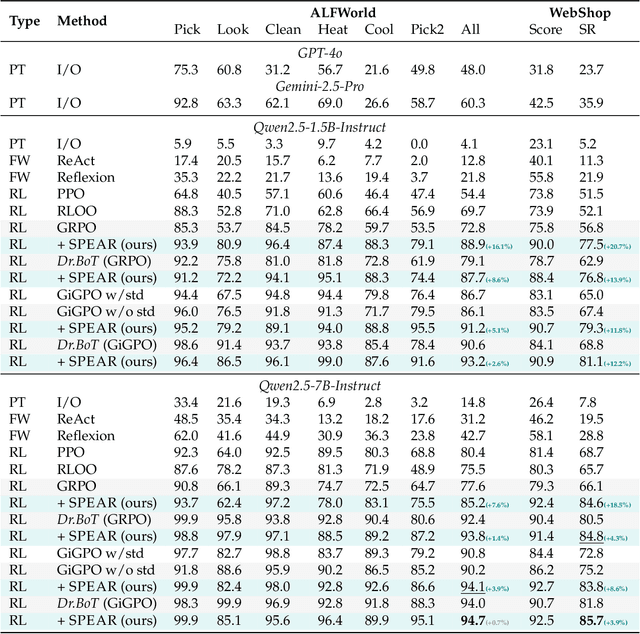
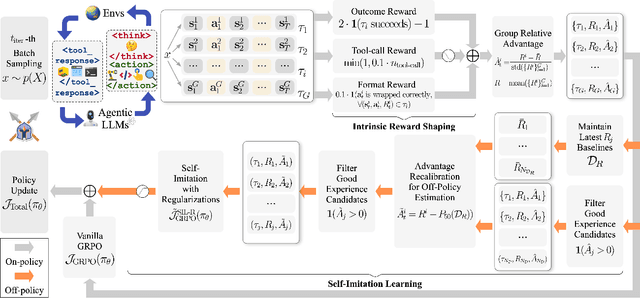
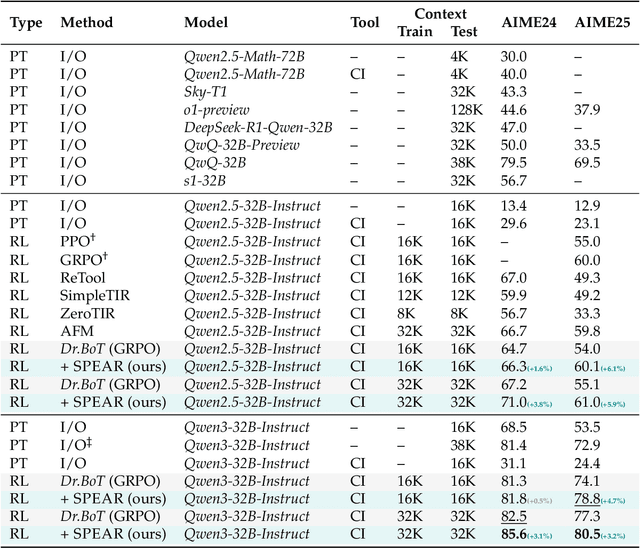
Reinforcement learning (RL) is the dominant paradigm for sharpening strategic tool use capabilities of LLMs on long-horizon, sparsely-rewarded agent tasks, yet it faces a fundamental challenge of exploration-exploitation trade-off. Existing studies stimulate exploration through the lens of policy entropy, but such mechanical entropy maximization is prone to RL training instability due to the multi-turn distribution shifting. In this paper, we target the progressive exploration-exploitation balance under the guidance of the agent own experiences without succumbing to either entropy collapsing or runaway divergence. We propose SPEAR, a curriculum-based self-imitation learning (SIL) recipe for training agentic LLMs. It extends the vanilla SIL framework, where a replay buffer stores self-generated promising trajectories for off-policy update, by gradually steering the policy evolution within a well-balanced range of entropy across stages. Specifically, our approach incorporates a curriculum to manage the exploration process, utilizing intrinsic rewards to foster skill-level exploration and facilitating action-level exploration through SIL. At first, the auxiliary tool call reward plays a critical role in the accumulation of tool-use skills, enabling broad exposure to the unfamiliar distributions of the environment feedback with an upward entropy trend. As training progresses, self-imitation gets strengthened to exploit existing successful patterns from replayed experiences for comparative action-level exploration, accelerating solution iteration without unbounded entropy growth. To further stabilize training, we recalibrate the advantages of experiences in the replay buffer to address the potential policy drift. Reugularizations such as the clipping of tokens with high covariance between probability and advantage are introduced to the trajectory-level entropy control to curb over-confidence.
SpeechForensics: Audio-Visual Speech Representation Learning for Face Forgery Detection
Aug 13, 2025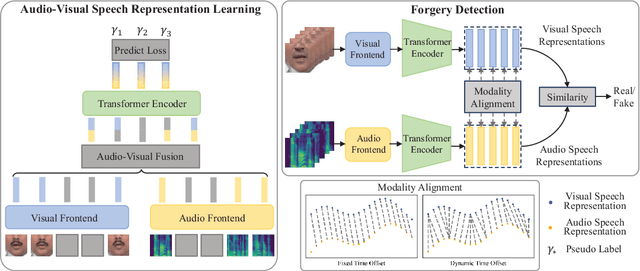
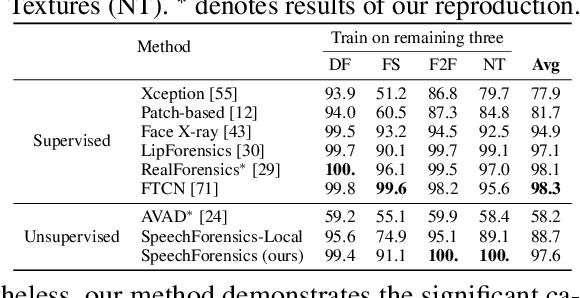
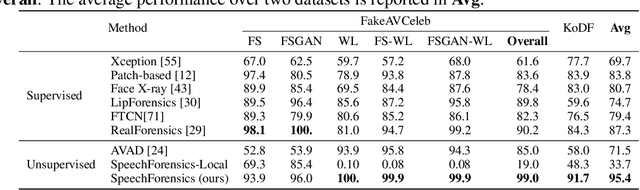
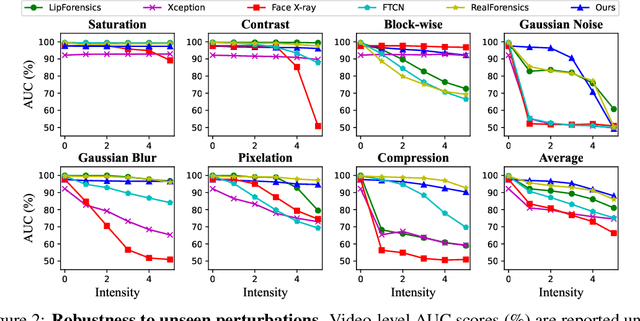
Detection of face forgery videos remains a formidable challenge in the field of digital forensics, especially the generalization to unseen datasets and common perturbations. In this paper, we tackle this issue by leveraging the synergy between audio and visual speech elements, embarking on a novel approach through audio-visual speech representation learning. Our work is motivated by the finding that audio signals, enriched with speech content, can provide precise information effectively reflecting facial movements. To this end, we first learn precise audio-visual speech representations on real videos via a self-supervised masked prediction task, which encodes both local and global semantic information simultaneously. Then, the derived model is directly transferred to the forgery detection task. Extensive experiments demonstrate that our method outperforms the state-of-the-art methods in terms of cross-dataset generalization and robustness, without the participation of any fake video in model training. Code is available at https://github.com/Eleven4AI/SpeechForensics.
* Accepted by NeurIPS 2024
Hybrid Long and Short Range Flows for Point Cloud Filtering
Aug 12, 2025Point cloud capture processes are error-prone and introduce noisy artifacts that necessitate filtering/denoising. Recent filtering methods often suffer from point clustering or noise retaining issues. In this paper, we propose Hybrid Point Cloud Filtering ($\textbf{HybridPF}$) that considers both short-range and long-range filtering trajectories when removing noise. It is well established that short range scores, given by $\nabla_{x}\log p(x_t)$, may provide the necessary displacements to move noisy points to the underlying clean surface. By contrast, long range velocity flows approximate constant displacements directed from a high noise variant patch $x_0$ towards the corresponding clean surface $x_1$. Here, noisy patches $x_t$ are viewed as intermediate states between the high noise variant and the clean patches. Our intuition is that long range information from velocity flow models can guide the short range scores to align more closely with the clean points. In turn, score models generally provide a quicker convergence to the clean surface. Specifically, we devise two parallel modules, the ShortModule and LongModule, each consisting of an Encoder-Decoder pair to respectively account for short-range scores and long-range flows. We find that short-range scores, guided by long-range features, yield filtered point clouds with good point distributions and convergence near the clean surface. We design a joint loss function to simultaneously train the ShortModule and LongModule, in an end-to-end manner. Finally, we identify a key weakness in current displacement based methods, limitations on the decoder architecture, and propose a dynamic graph convolutional decoder to improve the inference process. Comprehensive experiments demonstrate that our HybridPF achieves state-of-the-art results while enabling faster inference speed.
MiDashengLM: Efficient Audio Understanding with General Audio Captions
Aug 06, 2025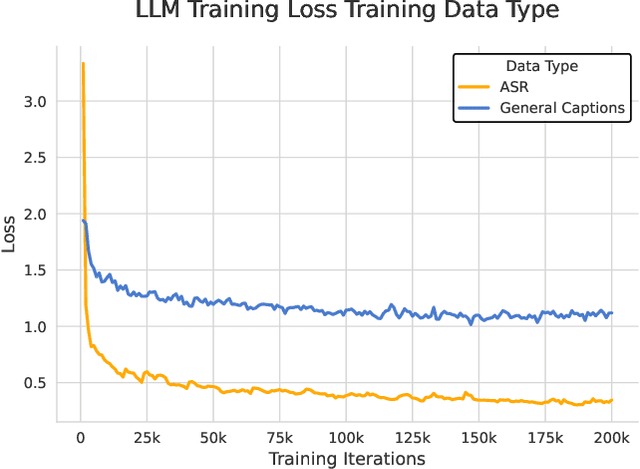
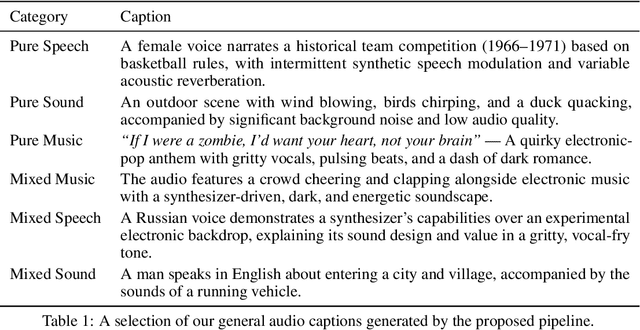
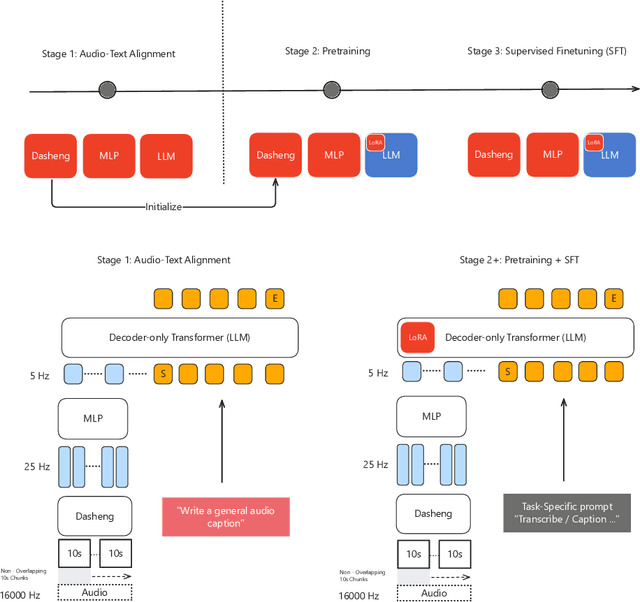
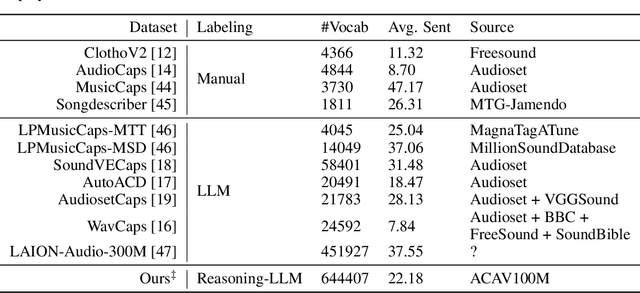
Current approaches for large audio language models (LALMs) often rely on closed data sources or proprietary models, limiting their generalization and accessibility. This paper introduces MiDashengLM, a novel open audio-language model designed for efficient and comprehensive audio understanding through the use of general audio captions using our novel ACAVCaps training dataset. MiDashengLM exclusively relies on publicly available pretraining and supervised fine-tuning (SFT) datasets, ensuring full transparency and reproducibility. At its core, MiDashengLM integrates Dasheng, an open-source audio encoder, specifically engineered to process diverse auditory information effectively. Unlike previous works primarily focused on Automatic Speech Recognition (ASR) based audio-text alignment, our strategy centers on general audio captions, fusing speech, sound and music information into one textual representation, enabling a holistic textual representation of complex audio scenes. Lastly, MiDashengLM provides an up to 4x speedup in terms of time-to-first-token (TTFT) and up to 20x higher throughput than comparable models. Checkpoints are available online at https://huggingface.co/mispeech/midashenglm-7b and https://github.com/xiaomi-research/dasheng-lm.
GLAP: General contrastive audio-text pretraining across domains and languages
Jun 12, 2025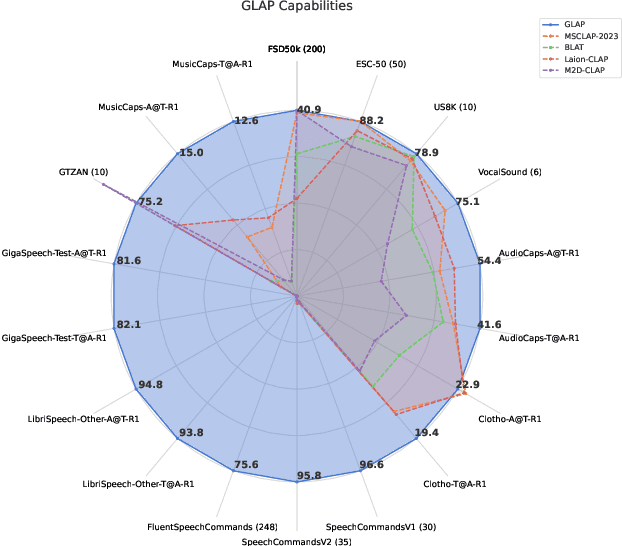
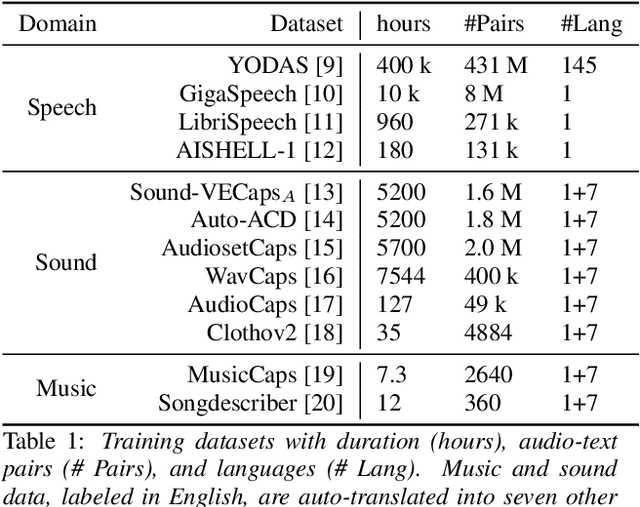
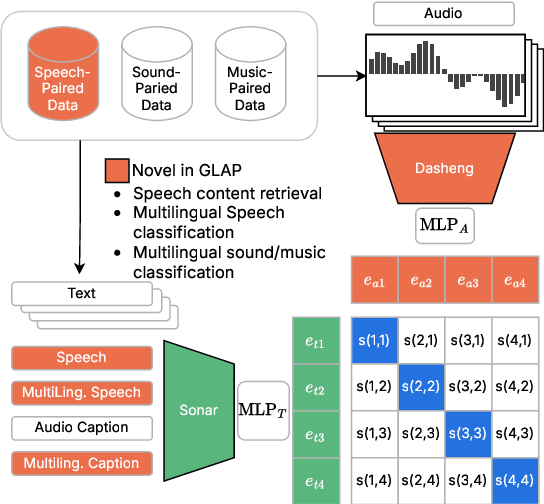
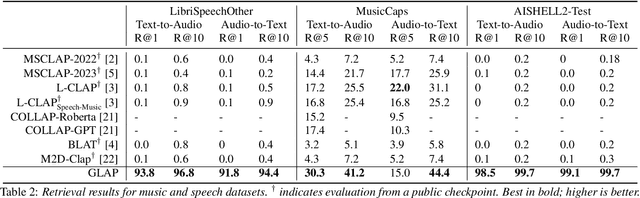
Contrastive Language Audio Pretraining (CLAP) is a widely-used method to bridge the gap between audio and text domains. Current CLAP methods enable sound and music retrieval in English, ignoring multilingual spoken content. To address this, we introduce general language audio pretraining (GLAP), which expands CLAP with multilingual and multi-domain abilities. GLAP demonstrates its versatility by achieving competitive performance on standard audio-text retrieval benchmarks like Clotho and AudioCaps, while significantly surpassing existing methods in speech retrieval and classification tasks. Additionally, GLAP achieves strong results on widely used sound-event zero-shot benchmarks, while simultaneously outperforming previous methods on speech content benchmarks. Further keyword spotting evaluations across 50 languages emphasize GLAP's advanced multilingual capabilities. Finally, multilingual sound and music understanding is evaluated across four languages. Checkpoints and Source: https://github.com/xiaomi-research/dasheng-glap.
Incentivizing Truthful Language Models via Peer Elicitation Games
May 19, 2025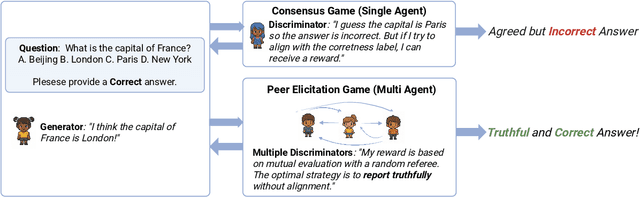
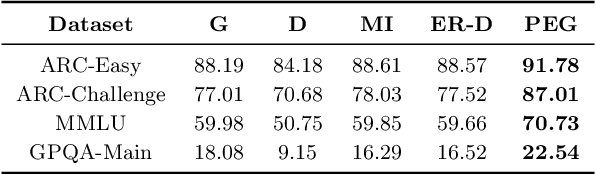
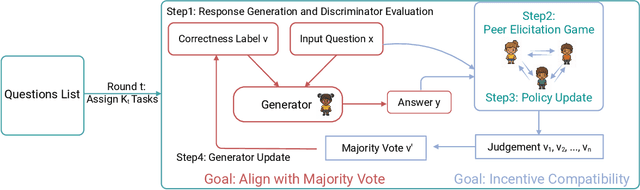

Large Language Models (LLMs) have demonstrated strong generative capabilities but remain prone to inconsistencies and hallucinations. We introduce Peer Elicitation Games (PEG), a training-free, game-theoretic framework for aligning LLMs through a peer elicitation mechanism involving a generator and multiple discriminators instantiated from distinct base models. Discriminators interact in a peer evaluation setting, where rewards are computed using a determinant-based mutual information score that provably incentivizes truthful reporting without requiring ground-truth labels. We establish theoretical guarantees showing that each agent, via online learning, achieves sublinear regret in the sense their cumulative performance approaches that of the best fixed truthful strategy in hindsight. Moreover, we prove last-iterate convergence to a truthful Nash equilibrium, ensuring that the actual policies used by agents converge to stable and truthful behavior over time. Empirical evaluations across multiple benchmarks demonstrate significant improvements in factual accuracy. These results position PEG as a practical approach for eliciting truthful behavior from LLMs without supervision or fine-tuning.
DisCO: Reinforcing Large Reasoning Models with Discriminative Constrained Optimization
May 18, 2025The recent success and openness of DeepSeek-R1 have brought widespread attention to Group Relative Policy Optimization (GRPO) as a reinforcement learning method for large reasoning models (LRMs). In this work, we analyze the GRPO objective under a binary reward setting and reveal an inherent limitation of question-level difficulty bias. We also identify a connection between GRPO and traditional discriminative methods in supervised learning. Motivated by these insights, we introduce a new Discriminative Constrained Optimization (DisCO) framework for reinforcing LRMs, grounded in the principle of discriminative learning. The main differences between DisCO and GRPO and its recent variants are: (1) it replaces the group relative objective with a discriminative objective defined by a scoring function; (2) it abandons clipping-based surrogates in favor of non-clipping RL surrogate objectives used as scoring functions; (3) it employs a simple yet effective constrained optimization approach to enforce the KL divergence constraint, ensuring stable training. As a result, DisCO offers notable advantages over GRPO and its variants: (i) it completely eliminates difficulty bias by adopting discriminative objectives; (ii) it addresses the entropy instability in GRPO and its variants through the use of non-clipping scoring functions and a constrained optimization approach; (iii) it allows the incorporation of advanced discriminative learning techniques to address data imbalance, where a significant number of questions have more negative than positive generated answers during training. Our experiments on enhancing the mathematical reasoning capabilities of SFT-finetuned models show that DisCO significantly outperforms GRPO and its improved variants such as DAPO, achieving average gains of 7\% over GRPO and 6\% over DAPO across six benchmark tasks for an 1.5B model.