 Add to Chrome
 Add to Firefox
 Add to Edge
CCDP: Composition of Conditional Diffusion Policies with Guided Sampling
Mar 19, 2025
Imitation Learning offers a promising approach to learn directly from data without requiring explicit models, simulations, or detailed task definitions. During inference, actions are sampled from the learned distribution and executed on the robot. However, sampled actions may fail for various reasons, and simply repeating the sampling step until a successful action is obtained can be inefficient. In this work, we propose an enhanced sampling strategy that refines the sampling distribution to avoid previously unsuccessful actions. We demonstrate that by solely utilizing data from successful demonstrations, our method can infer recovery actions without the need for additional exploratory behavior or a high-level controller. Furthermore, we leverage the concept of diffusion model decomposition to break down the primary problem (which may require long-horizon history to manage failures) into multiple smaller, more manageable sub-problems in learning, data collection, and inference, thereby enabling the system to adapt to variable failure counts. Our approach yields a low-level controller that dynamically adjusts its sampling space to improve efficiency when prior samples fall short. We validate our method across several tasks, including door opening with unknown directions, object manipulation, and button-searching scenarios, demonstrating that our approach outperforms traditional baselines.

C2D-ISR: Optimizing Attention-based Image Super-resolution from Continuous to Discrete Scales
Mar 17, 2025In recent years, attention mechanisms have been exploited in single image super-resolution (SISR), achieving impressive reconstruction results. However, these advancements are still limited by the reliance on simple training strategies and network architectures designed for discrete up-sampling scales, which hinder the model's ability to effectively capture information across multiple scales. To address these limitations, we propose a novel framework, \textbf{C2D-ISR}, for optimizing attention-based image super-resolution models from both performance and complexity perspectives. Our approach is based on a two-stage training methodology and a hierarchical encoding mechanism. The new training methodology involves continuous-scale training for discrete scale models, enabling the learning of inter-scale correlations and multi-scale feature representation. In addition, we generalize the hierarchical encoding mechanism with existing attention-based network structures, which can achieve improved spatial feature fusion, cross-scale information aggregation, and more importantly, much faster inference. We have evaluated the C2D-ISR framework based on three efficient attention-based backbones, SwinIR-L, SRFormer-L and MambaIRv2-L, and demonstrated significant improvements over the other existing optimization framework, HiT, in terms of super-resolution performance (up to 0.2dB) and computational complexity reduction (up to 11%). The source code will be made publicly available at www.github.com.
Code-Driven Inductive Synthesis: Enhancing Reasoning Abilities of Large Language Models with Sequences
Mar 17, 2025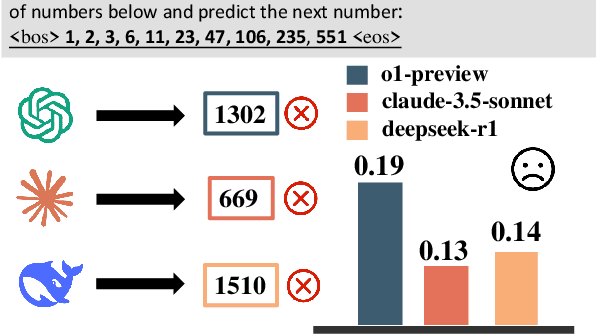
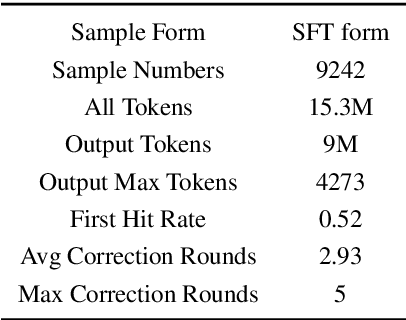
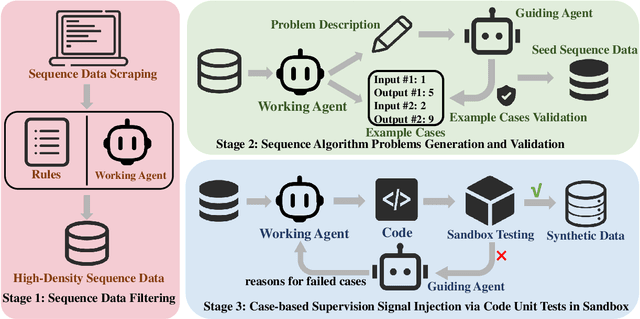
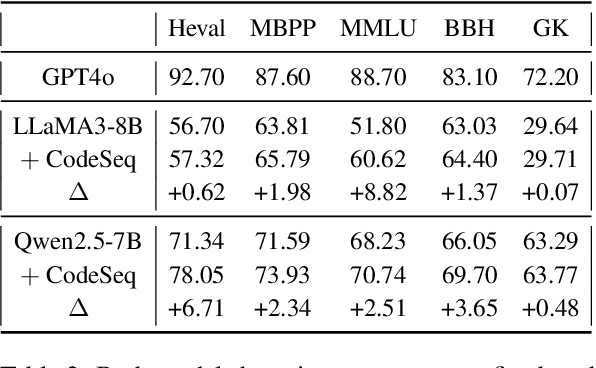
Large language models make remarkable progress in reasoning capabilities. Existing works focus mainly on deductive reasoning tasks (e.g., code and math), while another type of reasoning mode that better aligns with human learning, inductive reasoning, is not well studied. We attribute the reason to the fact that obtaining high-quality process supervision data is challenging for inductive reasoning. Towards this end, we novelly employ number sequences as the source of inductive reasoning data. We package sequences into algorithmic problems to find the general term of each sequence through a code solution. In this way, we can verify whether the code solution holds for any term in the current sequence, and inject case-based supervision signals by using code unit tests. We build a sequence synthetic data pipeline and form a training dataset CodeSeq. Experimental results show that the models tuned with CodeSeq improve on both code and comprehensive reasoning benchmarks.
Dialogue Injection Attack: Jailbreaking LLMs through Context Manipulation
Mar 11, 2025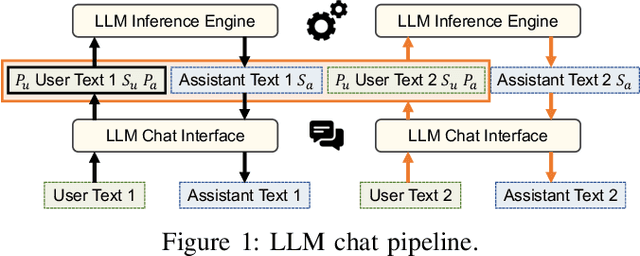

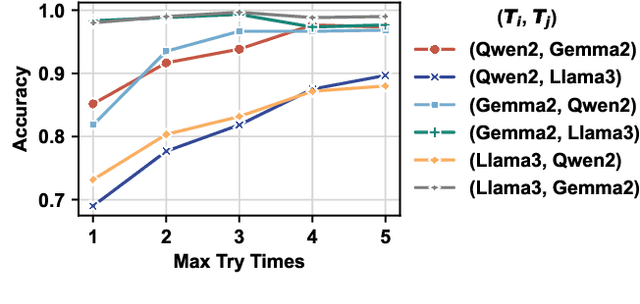
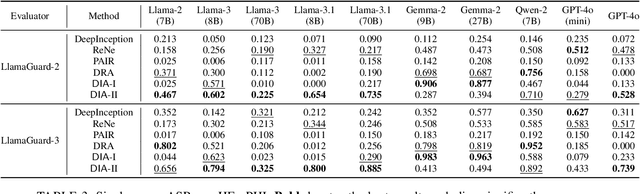
Large language models (LLMs) have demonstrated significant utility in a wide range of applications; however, their deployment is plagued by security vulnerabilities, notably jailbreak attacks. These attacks manipulate LLMs to generate harmful or unethical content by crafting adversarial prompts. While much of the current research on jailbreak attacks has focused on single-turn interactions, it has largely overlooked the impact of historical dialogues on model behavior. In this paper, we introduce a novel jailbreak paradigm, Dialogue Injection Attack (DIA), which leverages the dialogue history to enhance the success rates of such attacks. DIA operates in a black-box setting, requiring only access to the chat API or knowledge of the LLM's chat template. We propose two methods for constructing adversarial historical dialogues: one adapts gray-box prefilling attacks, and the other exploits deferred responses. Our experiments show that DIA achieves state-of-the-art attack success rates on recent LLMs, including Llama-3.1 and GPT-4o. Additionally, we demonstrate that DIA can bypass 5 different defense mechanisms, highlighting its robustness and effectiveness.
Blind Video Super-Resolution based on Implicit Kernels
Mar 10, 2025Blind video super-resolution (BVSR) is a low-level vision task which aims to generate high-resolution videos from low-resolution counterparts in unknown degradation scenarios. Existing approaches typically predict blur kernels that are spatially invariant in each video frame or even the entire video. These methods do not consider potential spatio-temporal varying degradations in videos, resulting in suboptimal BVSR performance. In this context, we propose a novel BVSR model based on Implicit Kernels, BVSR-IK, which constructs a multi-scale kernel dictionary parameterized by implicit neural representations. It also employs a newly designed recurrent Transformer to predict the coefficient weights for accurate filtering in both frame correction and feature alignment. Experimental results have demonstrated the effectiveness of the proposed BVSR-IK, when compared with four state-of-the-art BVSR models on three commonly used datasets, with BVSR-IK outperforming the second best approach, FMA-Net, by up to 0.59 dB in PSNR. Source code will be available at https://github.com.
DeepNuParc: A Novel Deep Clustering Framework for Fine-scale Parcellation of Brain Nuclei Using Diffusion MRI Tractography
Mar 10, 2025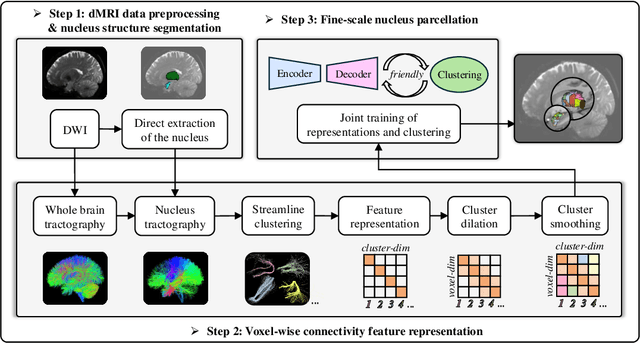
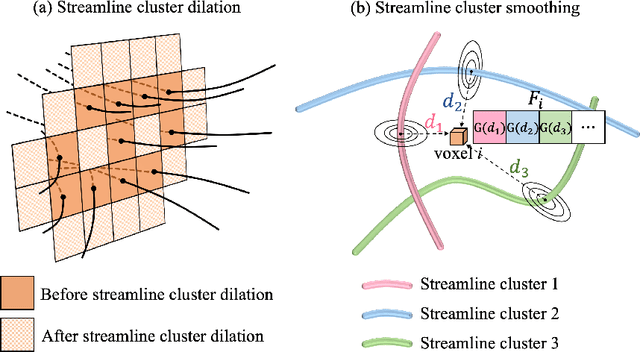
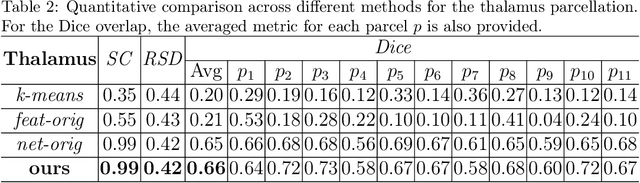
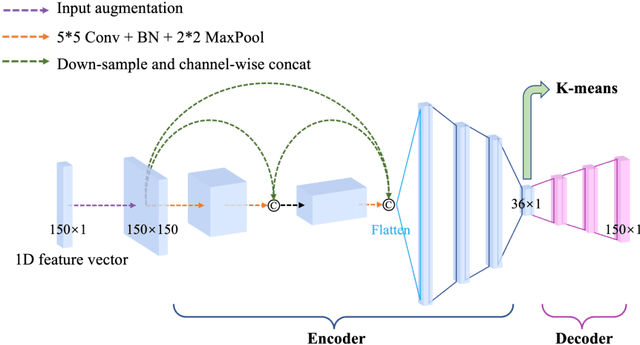
Brain nuclei are clusters of anatomically distinct neurons that serve as important hubs for processing and relaying information in various neural circuits. Fine-scale parcellation of the brain nuclei is vital for a comprehensive understanding of its anatomico-functional correlations. Diffusion MRI tractography is an advanced imaging technique that can estimate the brain's white matter structural connectivity to potentially reveal the topography of the nuclei of interest for studying its subdivisions. In this work, we present a deep clustering pipeline, namely DeepNuParc, to perform automated, fine-scale parcellation of brain nuclei using diffusion MRI tractography. First, we incorporate a newly proposed deep learning approach to enable accurate segmentation of the nuclei of interest directly on the dMRI data. Next, we design a novel streamline clustering-based structural connectivity feature for a robust representation of voxels within the nuclei. Finally, we improve the popular joint dimensionality reduction and k-means clustering approach to enable nuclei parcellation at a finer scale. We demonstrate DeepNuParc on two important brain structures, i.e. the amygdala and the thalamus, that are known to have multiple anatomically and functionally distinct nuclei subdivisions. Experimental results show that DeepNuParc enables consistent parcellation of the nuclei into multiple parcels across multiple subjects and achieves good correspondence with the widely used coarse-scale atlases. Our codes are available at https://github.com/HarlandZZC/deep_nuclei_parcellation.
MultiCo3D: Multi-Label Voxel Contrast for One-Shot Incremental Segmentation of 3D Neuroimages
Mar 09, 20253D neuroimages provide a comprehensive view of brain structure and function, aiding in precise localization and functional connectivity analysis. Segmentation of white matter (WM) tracts using 3D neuroimages is vital for understanding the brain's structural connectivity in both healthy and diseased states. One-shot Class Incremental Semantic Segmentation (OCIS) refers to effectively segmenting new (novel) classes using only a single sample while retaining knowledge of old (base) classes without forgetting. Voxel-contrastive OCIS methods adjust the feature space to alleviate the feature overlap problem between the base and novel classes. However, since WM tract segmentation is a multi-label segmentation task, existing single-label voxel contrastive-based methods may cause inherent contradictions. To address this, we propose a new multi-label voxel contrast framework called MultiCo3D for one-shot class incremental tract segmentation. Our method utilizes uncertainty distillation to preserve base tract segmentation knowledge while adjusting the feature space with multi-label voxel contrast to alleviate feature overlap when learning novel tracts and dynamically weighting multi losses to balance overall loss. We compare our method against several state-of-the-art (SOTA) approaches. The experimental results show that our method significantly enhances one-shot class incremental tract segmentation accuracy across five different experimental setups on HCP and Preto datasets.
DDCSR: A Novel End-to-End Deep Learning Framework for Cortical Surface Reconstruction from Diffusion MRI
Mar 05, 2025Diffusion MRI (dMRI) plays a crucial role in studying brain white matter connectivity. Cortical surface reconstruction (CSR), including the inner whiter matter (WM) and outer pial surfaces, is one of the key tasks in dMRI analyses such as fiber tractography and multimodal MRI analysis. Existing CSR methods rely on anatomical T1-weighted data and map them into the dMRI space through inter-modality registration. However, due to the low resolution and image distortions of dMRI data, inter-modality registration faces significant challenges. This work proposes a novel end-to-end learning framework, DDCSR, which for the first time enables CSR directly from dMRI data. DDCSR consists of two major components, including: (1) an implicit learning module to predict a voxel-wise intermediate surface representation, and (2) an explicit learning module to predict the 3D mesh surfaces. Compared to several baseline and advanced CSR methods, we show that the proposed DDCSR can largely increase both accuracy and efficiency. Furthermore, we demonstrate a high generalization ability of DDCSR to data from different sources, despite the differences in dMRI acquisitions and populations.
A Novel Streamline-based diffusion MRI Tractography Registration Method with Probabilistic Keypoint Detection
Mar 04, 2025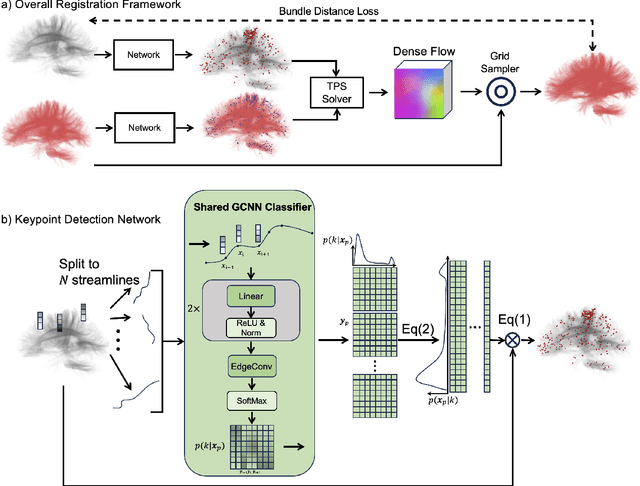
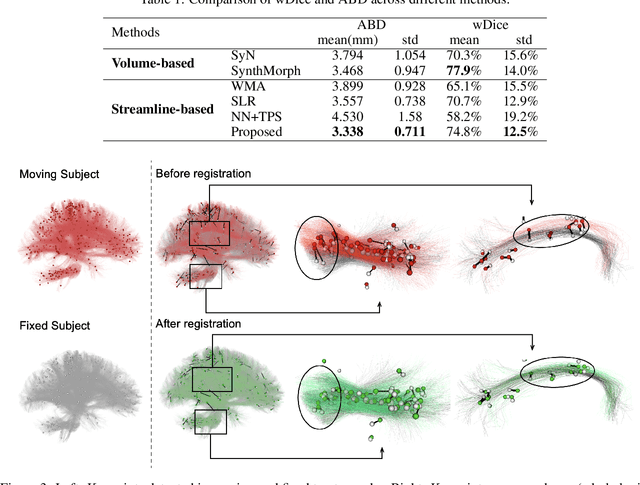
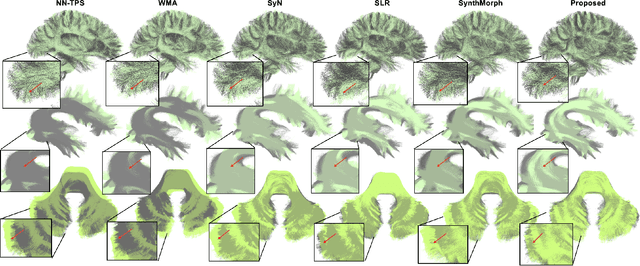
Registration of diffusion MRI tractography is an essential step for analyzing group similarities and variations in the brain's white matter (WM). Streamline-based registration approaches can leverage the 3D geometric information of fiber pathways to enable spatial alignment after registration. Existing methods usually rely on the optimization of the spatial distances to identify the optimal transformation. However, such methods overlook point connectivity patterns within the streamline itself, limiting their ability to identify anatomical correspondences across tractography datasets. In this work, we propose a novel unsupervised approach using deep learning to perform streamline-based dMRI tractography registration. The overall idea is to identify corresponding keypoint pairs across subjects for spatial alignment of tractography datasets. We model tractography as point clouds to leverage the graph connectivity along streamlines. We propose a novel keypoint detection method for streamlines, framed as a probabilistic classification task to identify anatomically consistent correspondences across unstructured streamline sets. In the experiments, we compare several existing methods and show highly effective and efficient tractography registration performance.
TractCloud-FOV: Deep Learning-based Robust Tractography Parcellation in Diffusion MRI with Incomplete Field of View
Feb 28, 2025Tractography parcellation classifies streamlines reconstructed from diffusion MRI into anatomically defined fiber tracts for clinical and research applications. However, clinical scans often have incomplete fields of view (FOV) where brain regions are partially imaged, leading to partial or truncated fiber tracts. To address this challenge, we introduce TractCloud-FOV, a deep learning framework that robustly parcellates tractography under conditions of incomplete FOV. We propose a novel training strategy, FOV-Cut Augmentation (FOV-CA), in which we synthetically cut tractograms to simulate a spectrum of real-world inferior FOV cutoff scenarios. This data augmentation approach enriches the training set with realistic truncated streamlines, enabling the model to achieve superior generalization. We evaluate the proposed TractCloud-FOV on both synthetically cut tractography and two real-life datasets with incomplete FOV. TractCloud-FOV significantly outperforms several state-of-the-art methods on all testing datasets in terms of streamline classification accuracy, generalization ability, tract anatomical depiction, and computational efficiency. Overall, TractCloud-FOV achieves efficient and consistent tractography parcellation in diffusion MRI with incomplete FOV.