 Add to Chrome
 Add to Firefox
 Add to Edge
A-MAR: Agent-based Multimodal Art Retrieval for Fine-Grained Artwork Understanding
Apr 21, 2026
Understanding artworks requires multi-step reasoning over visual content and cultural, historical, and stylistic context. While recent multimodal large language models show promise in artwork explanation, they rely on implicit reasoning and internalized knowl- edge, limiting interpretability and explicit evidence grounding. We propose A-MAR, an Agent-based Multimodal Art Retrieval framework that explicitly conditions retrieval on structured reasoning plans. Given an artwork and a user query, A-MAR first decomposes the task into a structured reasoning plan that specifies the goals and evidence requirements for each step. Retrieval is then conditionedon this plan, enabling targeted evidence selection and supporting step-wise, grounded explanations. To evaluate agent-based multi- modal reasoning within the art domain, we introduce ArtCoT-QA. This diagnostic benchmark features multi-step reasoning chains for diverse art-related queries, enabling a granular analysis that extends beyond simple final answer accuracy. Experiments on SemArt and Artpedia show that A-MAR consistently outperforms static, non planned retrieval and strong MLLM baselines in final explanation quality, while evaluations on ArtCoT-QA further demonstrate its advantages in evidence grounding and multi-step reasoning ability. These results highlight the importance of reasoning-conditioned retrieval for knowledge-intensive multimodal understanding and position A-MAR as a step toward interpretable, goal-driven AI systems, with particular relevance to cultural industries. The code and data are available at: https://github.com/ShuaiWang97/A-MAR.

The Fourth Challenge on Image Super-Resolution ($\times$4) at NTIRE 2026: Benchmark Results and Method Overview
Apr 16, 2026This paper presents the NTIRE 2026 image super-resolution ($\times$4) challenge, one of the associated competitions of the NTIRE 2026 Workshop at CVPR 2026. The challenge aims to reconstruct high-resolution (HR) images from low-resolution (LR) inputs generated through bicubic downsampling with a $\times$4 scaling factor. The objective is to develop effective super-resolution solutions and analyze recent advances in the field. To reflect the evolving objectives of image super-resolution, the challenge includes two tracks: (1) a restoration track, which emphasizes pixel-wise fidelity and ranks submissions based on PSNR; and (2) a perceptual track, which focuses on visual realism and evaluates results using a perceptual score. A total of 194 participants registered for the challenge, with 31 teams submitting valid entries. This report summarizes the challenge design, datasets, evaluation protocol, main results, and methods of participating teams. The challenge provides a unified benchmark and offers insights into current progress and future directions in image super-resolution.
The Second Challenge on Real-World Face Restoration at NTIRE 2026: Methods and Results
Apr 12, 2026This paper provides a review of the NTIRE 2026 challenge on real-world face restoration, highlighting the proposed solutions and the resulting outcomes. The challenge focuses on generating natural and realistic outputs while maintaining identity consistency. Its goal is to advance state-of-the-art solutions for perceptual quality and realism, without imposing constraints on computational resources or training data. Performance is evaluated using a weighted image quality assessment (IQA) score and employs the AdaFace model as an identity checker. The competition attracted 96 registrants, with 10 teams submitting valid models; ultimately, 9 teams achieved valid scores in the final ranking. This collaborative effort advances the performance of real-world face restoration while offering an in-depth overview of the latest trends in the field.
NTIRE 2026 Challenge on Short-form UGC Video Restoration in the Wild with Generative Models: Datasets, Methods and Results
Apr 12, 2026This paper presents an overview of the NTIRE 2026 Challenge on Short-form UGC Video Restoration in the Wild with Generative Models. This challenge utilizes a new short-form UGC (S-UGC) video restoration benchmark, termed KwaiVIR, which is contributed by USTC and Kuaishou Technology. It contains both synthetically distorted videos and real-world short-form UGC videos in the wild. For this edition, the released data include 200 synthetic training videos, 48 wild training videos, 11 validation videos, and 20 testing videos. The primary goal of this challenge is to establish a strong and practical benchmark for restoring short-form UGC videos under complex real-world degradations, especially in the emerging paradigm of generative-model-based S-UGC video restoration. This challenge has two tracks: (i) the primary track is a subjective track, where the evaluation is based on a user study; (ii) the second track is an objective track. These two tracks enable a comprehensive assessment of restoration quality. In total, 95 teams have registered for this competition. And 12 teams submitted valid final solutions and fact sheets for the testing phase. The submitted methods achieved strong performance on the KwaiVIR benchmark, demonstrating encouraging progress in short-form UGC video restoration in the wild.
SAM3-LiteText: An Anatomical Study of the SAM3 Text Encoder for Efficient Vision-Language Segmentation
Feb 12, 2026Vision-language segmentation models such as SAM3 enable flexible, prompt-driven visual grounding, but inherit large, general-purpose text encoders originally designed for open-ended language understanding. In practice, segmentation prompts are short, structured, and semantically constrained, leading to substantial over-provisioning in text encoder capacity and persistent computational and memory overhead. In this paper, we perform a large-scale anatomical analysis of text prompting in vision-language segmentation, covering 404,796 real prompts across multiple benchmarks. Our analysis reveals severe redundancy: most context windows are underutilized, vocabulary usage is highly sparse, and text embeddings lie on low-dimensional manifold despite high-dimensional representations. Motivated by these findings, we propose SAM3-LiteText, a lightweight text encoding framework that replaces the original SAM3 text encoder with a compact MobileCLIP student that is optimized by knowledge distillation. Extensive experiments on image and video segmentation benchmarks show that SAM3-LiteText reduces text encoder parameters by up to 88%, substantially reducing static memory footprint, while maintaining segmentation performance comparable to the original model. Code: https://github.com/SimonZeng7108/efficientsam3/tree/sam3_litetext.
Compressed Video Super-Resolution based on Hierarchical Encoding
Jun 17, 2025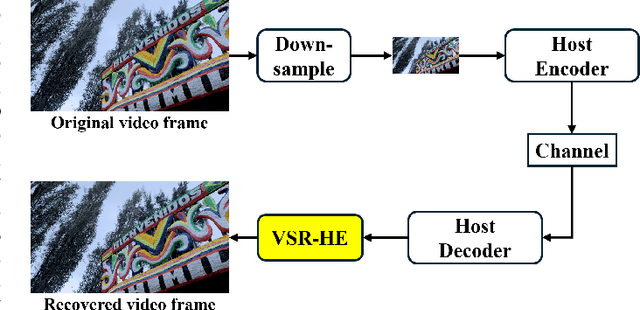
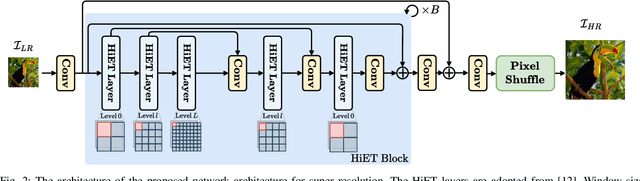
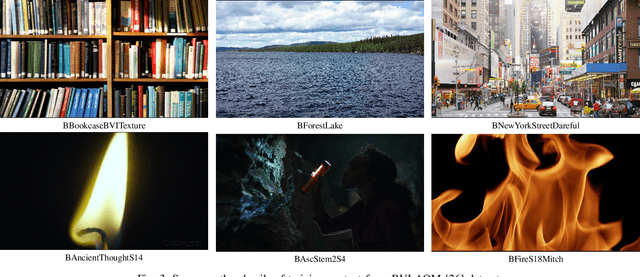
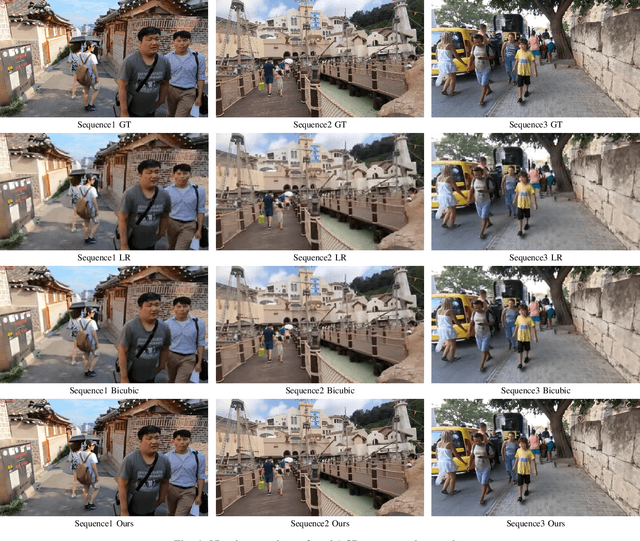
This paper presents a general-purpose video super-resolution (VSR) method, dubbed VSR-HE, specifically designed to enhance the perceptual quality of compressed content. Targeting scenarios characterized by heavy compression, the method upscales low-resolution videos by a ratio of four, from 180p to 720p or from 270p to 1080p. VSR-HE adopts hierarchical encoding transformer blocks and has been sophisticatedly optimized to eliminate a wide range of compression artifacts commonly introduced by H.265/HEVC encoding across various quantization parameter (QP) levels. To ensure robustness and generalization, the model is trained and evaluated under diverse compression settings, allowing it to effectively restore fine-grained details and preserve visual fidelity. The proposed VSR-HE has been officially submitted to the ICME 2025 Grand Challenge on VSR for Video Conferencing (Team BVI-VSR), under both the Track 1 (General-Purpose Real-World Video Content) and Track 2 (Talking Head Videos).
Agglomerating Large Vision Encoders via Distillation for VFSS Segmentation
Apr 03, 2025The deployment of foundation models for medical imaging has demonstrated considerable success. However, their training overheads associated with downstream tasks remain substantial due to the size of the image encoders employed, and the inference complexity is also significantly high. Although lightweight variants have been obtained for these foundation models, their performance is constrained by their limited model capacity and suboptimal training strategies. In order to achieve an improved tradeoff between complexity and performance, we propose a new framework to improve the performance of low complexity models via knowledge distillation from multiple large medical foundation models (e.g., MedSAM, RAD-DINO, MedCLIP), each specializing in different vision tasks, with the goal to effectively bridge the performance gap for medical image segmentation tasks. The agglomerated model demonstrates superior generalization across 12 segmentation tasks, whereas specialized models require explicit training for each task. Our approach achieved an average performance gain of 2\% in Dice coefficient compared to simple distillation.
C2D-ISR: Optimizing Attention-based Image Super-resolution from Continuous to Discrete Scales
Mar 17, 2025In recent years, attention mechanisms have been exploited in single image super-resolution (SISR), achieving impressive reconstruction results. However, these advancements are still limited by the reliance on simple training strategies and network architectures designed for discrete up-sampling scales, which hinder the model's ability to effectively capture information across multiple scales. To address these limitations, we propose a novel framework, \textbf{C2D-ISR}, for optimizing attention-based image super-resolution models from both performance and complexity perspectives. Our approach is based on a two-stage training methodology and a hierarchical encoding mechanism. The new training methodology involves continuous-scale training for discrete scale models, enabling the learning of inter-scale correlations and multi-scale feature representation. In addition, we generalize the hierarchical encoding mechanism with existing attention-based network structures, which can achieve improved spatial feature fusion, cross-scale information aggregation, and more importantly, much faster inference. We have evaluated the C2D-ISR framework based on three efficient attention-based backbones, SwinIR-L, SRFormer-L and MambaIRv2-L, and demonstrated significant improvements over the other existing optimization framework, HiT, in terms of super-resolution performance (up to 0.2dB) and computational complexity reduction (up to 11%). The source code will be made publicly available at www.github.com.
Tuning Vision Foundation Model via Test-Time Prompt-Guided Training for VFSS Segmentations
Jan 30, 2025
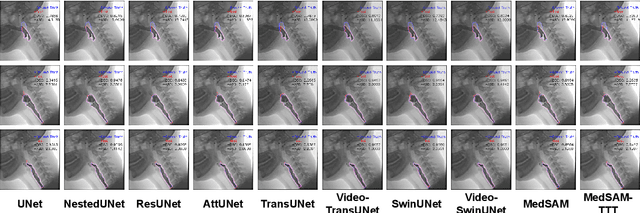
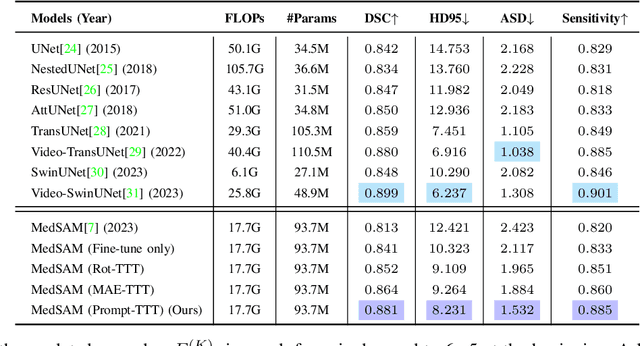
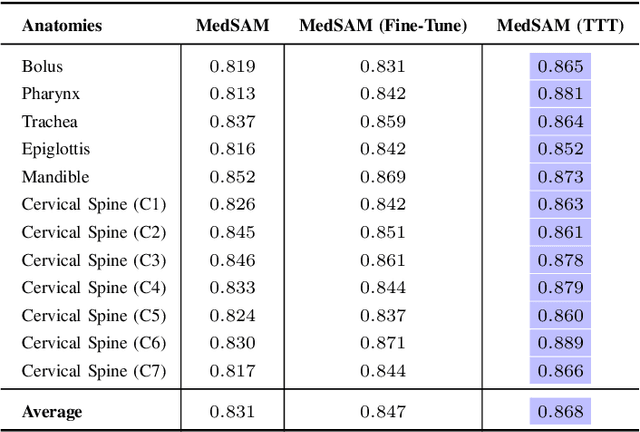
Vision foundation models have demonstrated exceptional generalization capabilities in segmentation tasks for both generic and specialized images. However, a performance gap persists between foundation models and task-specific, specialized models. Fine-tuning foundation models on downstream datasets is often necessary to bridge this gap. Unfortunately, obtaining fully annotated ground truth for downstream datasets is both challenging and costly. To address this limitation, we propose a novel test-time training paradigm that enhances the performance of foundation models on downstream datasets without requiring full annotations. Specifically, our method employs simple point prompts to guide a test-time semi-self-supervised training task. The model learns by resolving the ambiguity of the point prompt through various augmentations. This approach directly tackles challenges in the medical imaging field, where acquiring annotations is both time-intensive and expensive. We conducted extensive experiments on our new Videofluoroscopy dataset (VFSS-5k) for the instance segmentation task, achieving an average Dice coefficient of 0.868 across 12 anatomies with a single model.
RBF-PINN: Non-Fourier Positional Embedding in Physics-Informed Neural Networks
Feb 13, 2024While many recent Physics-Informed Neural Networks (PINNs) variants have had considerable success in solving Partial Differential Equations, the empirical benefits of feature mapping drawn from the broader Neural Representations research have been largely overlooked. We highlight the limitations of widely used Fourier-based feature mapping in certain situations and suggest the use of the conditionally positive definite Radial Basis Function. The empirical findings demonstrate the effectiveness of our approach across a variety of forward and inverse problem cases. Our method can be seamlessly integrated into coordinate-based input neural networks and contribute to the wider field of PINNs research.