 Add to Chrome
 Add to Firefox
 Add to Edge
ActCam: Zero-Shot Joint Camera and 3D Motion Control for Video Generation
May 07, 2026
For artistic applications, video generation requires fine-grained control over both performance and cinematography, i.e., the actor's motion and the camera trajectory. We present ActCam, a zero-shot method for video generation that jointly transfers character motion from a driving video into a new scene and enables per-frame control of intrinsic and extrinsic camera parameters. ActCam builds on any pretrained image-to-video diffusion model that accepts conditioning in terms of scene depth and character pose. Given a source video with a moving character and a target camera motion, ActCam generates pose and depth conditions that remain geometrically consistent across frames. We then run a single sampling process with a two-phase conditioning schedule: early denoising steps condition on both pose and sparse depth to enforce scene structure, after which depth is dropped and pose-only guidance refines high-frequency details without over-constraining the generation. We evaluate ActCam on multiple benchmarks spanning diverse character motions and challenging viewpoint changes. We find that, compared to pose-only control and other pose and camera methods, ActCam improves camera adherence and motion fidelity, and is preferred in human evaluations, especially under large viewpoint changes. Our results highlight that careful camera-consistent conditioning and staged guidance can enable strong joint camera and motion control without training. Project page: https://elkhomar.github.io/actcam/.

LongCoT: Benchmarking Long-Horizon Chain-of-Thought Reasoning
Apr 15, 2026As language models are increasingly deployed for complex autonomous tasks, their ability to reason accurately over longer horizons becomes critical. An essential component of this ability is planning and managing a long, complex chain-of-thought (CoT). We introduce LongCoT, a scalable benchmark of 2,500 expert-designed problems spanning chemistry, mathematics, computer science, chess, and logic to isolate and directly measure the long-horizon CoT reasoning capabilities of frontier models. Problems consist of a short input with a verifiable answer; solving them requires navigating a graph of interdependent steps that span tens to hundreds of thousands of reasoning tokens. Each local step is individually tractable for frontier models, so failures reflect long-horizon reasoning limitations. At release, the best models achieve <10% accuracy (GPT 5.2: 9.8%; Gemini 3 Pro: 6.1%) on LongCoT, revealing a substantial gap in current capabilities. Overall, LongCoT provides a rigorous measure of long-horizon reasoning, tracking the ability of frontier models to reason reliably over extended periods.
ActionParty: Multi-Subject Action Binding in Generative Video Games
Apr 02, 2026Recent advances in video diffusion have enabled the development of "world models" capable of simulating interactive environments. However, these models are largely restricted to single-agent settings, failing to control multiple agents simultaneously in a scene. In this work, we tackle a fundamental issue of action binding in existing video diffusion models, which struggle to associate specific actions with their corresponding subjects. For this purpose, we propose ActionParty, an action controllable multi-subject world model for generative video games. It introduces subject state tokens, i.e. latent variables that persistently capture the state of each subject in the scene. By jointly modeling state tokens and video latents with a spatial biasing mechanism, we disentangle global video frame rendering from individual action-controlled subject updates. We evaluate ActionParty on the Melting Pot benchmark, demonstrating the first video world model capable of controlling up to seven players simultaneously across 46 diverse environments. Our results show significant improvements in action-following accuracy and identity consistency, while enabling robust autoregressive tracking of subjects through complex interactions.
MessyKitchens: Contact-rich object-level 3D scene reconstruction
Mar 17, 2026Monocular 3D scene reconstruction has recently seen significant progress. Powered by the modern neural architectures and large-scale data, recent methods achieve high performance in depth estimation from a single image. Meanwhile, reconstructing and decomposing common scenes into individual 3D objects remains a hard challenge due to the large variety of objects, frequent occlusions and complex object relations. Notably, beyond shape and pose estimation of individual objects, applications in robotics and animation require physically-plausible scene reconstruction where objects obey physical principles of non-penetration and realistic contacts. In this work we advance object-level scene reconstruction along two directions. First, we introduceMessyKitchens, a new dataset with real-world scenes featuring cluttered environments and providing high-fidelity object-level ground truth in terms of 3D object shapes, poses and accurate object contacts. Second, we build on the recent SAM 3D approach for single-object reconstruction and extend it with Multi-Object Decoder (MOD) for joint object-level scene reconstruction. To validate our contributions, we demonstrate MessyKitchens to significantly improve previous datasets in registration accuracy and inter-object penetration. We also compare our multi-object reconstruction approach on three datasets and demonstrate consistent and significant improvements of MOD over the state of the art. Our new benchmark, code and pre-trained models will become publicly available on our project website: https://messykitchens.github.io/.
PhysMoDPO: Physically-Plausible Humanoid Motion with Preference Optimization
Mar 16, 2026Recent progress in text-conditioned human motion generation has been largely driven by diffusion models trained on large-scale human motion data. Building on this progress, recent methods attempt to transfer such models for character animation and real robot control by applying a Whole-Body Controller (WBC) that converts diffusion-generated motions into executable trajectories. While WBC trajectories become compliant with physics, they may expose substantial deviations from original motion. To address this issue, we here propose PhysMoDPO, a Direct Preference Optimization framework. Unlike prior work that relies on hand-crafted physics-aware heuristics such as foot-sliding penalties, we integrate WBC into our training pipeline and optimize diffusion model such that the output of WBC becomes compliant both with physics and original text instructions. To train PhysMoDPO we deploy physics-based and task-specific rewards and use them to assign preference to synthesized trajectories. Our extensive experiments on text-to-motion and spatial control tasks demonstrate consistent improvements of PhysMoDPO in both physical realism and task-related metrics on simulated robots. Moreover, we demonstrate that PhysMoDPO results in significant improvements when applied to zero-shot motion transfer in simulation and for real-world deployment on a G1 humanoid robot.
BLAZER: Bootstrapping LLM-based Manipulation Agents with Zero-Shot Data Generation
Oct 09, 2025Scaling data and models has played a pivotal role in the remarkable progress of computer vision and language. Inspired by these domains, recent efforts in robotics have similarly focused on scaling both data and model size to develop more generalizable and robust policies. However, unlike vision and language, robotics lacks access to internet-scale demonstrations across diverse robotic tasks and environments. As a result, the scale of existing datasets typically suffers from the need for manual data collection and curation. To address this problem, here we propose BLAZER, a framework that learns manipulation policies from automatically generated training data. We build on the zero-shot capabilities of LLM planners and automatically generate demonstrations for diverse manipulation tasks in simulation. Successful examples are then used to finetune an LLM and to improve its planning capabilities without human supervision. Notably, while BLAZER training requires access to the simulator's state, we demonstrate direct transfer of acquired skills to sensor-based manipulation. Through extensive experiments, we show BLAZER to significantly improve zero-shot manipulation in both simulated and real environments. Moreover, BLAZER improves on tasks outside of its training pool and enables downscaling of LLM models. Our code and data will be made publicly available on the project page.
Learning to Generate Object Interactions with Physics-Guided Video Diffusion
Oct 02, 2025Recent models for video generation have achieved remarkable progress and are now deployed in film, social media production, and advertising. Beyond their creative potential, such models also hold promise as world simulators for robotics and embodied decision making. Despite strong advances, however, current approaches still struggle to generate physically plausible object interactions and lack physics-grounded control mechanisms. To address this limitation, we introduce KineMask, an approach for physics-guided video generation that enables realistic rigid body control, interactions, and effects. Given a single image and a specified object velocity, our method generates videos with inferred motions and future object interactions. We propose a two-stage training strategy that gradually removes future motion supervision via object masks. Using this strategy we train video diffusion models (VDMs) on synthetic scenes of simple interactions and demonstrate significant improvements of object interactions in real scenes. Furthermore, KineMask integrates low-level motion control with high-level textual conditioning via predictive scene descriptions, leading to effective support for synthesis of complex dynamical phenomena. Extensive experiments show that KineMask achieves strong improvements over recent models of comparable size. Ablation studies further highlight the complementary roles of low- and high-level conditioning in VDMs. Our code, model, and data will be made publicly available.
Towards Reliable Identification of Diffusion-based Image Manipulations
Jun 05, 2025Changing facial expressions, gestures, or background details may dramatically alter the meaning conveyed by an image. Notably, recent advances in diffusion models greatly improve the quality of image manipulation while also opening the door to misuse. Identifying changes made to authentic images, thus, becomes an important task, constantly challenged by new diffusion-based editing tools. To this end, we propose a novel approach for ReliAble iDentification of inpainted AReas (RADAR). RADAR builds on existing foundation models and combines features from different image modalities. It also incorporates an auxiliary contrastive loss that helps to isolate manipulated image patches. We demonstrate these techniques to significantly improve both the accuracy of our method and its generalisation to a large number of diffusion models. To support realistic evaluation, we further introduce BBC-PAIR, a new comprehensive benchmark, with images tampered by 28 diffusion models. Our experiments show that RADAR achieves excellent results, outperforming the state-of-the-art in detecting and localising image edits made by both seen and unseen diffusion models. Our code, data and models will be publicly available at alex-costanzino.github.io/radar.
PSyDUCK: Training-Free Steganography for Latent Diffusion
Jan 31, 2025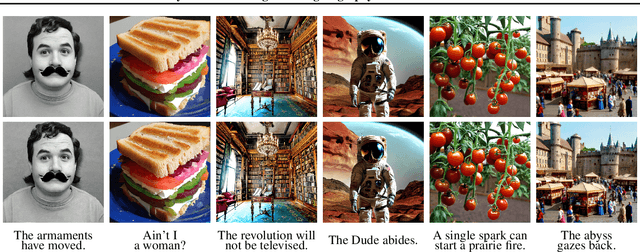


Recent advances in AI-generated steganography highlight its potential for safeguarding the privacy of vulnerable democratic actors, including aid workers, journalists, and whistleblowers operating in oppressive regimes. In this work, we address current limitations and establish the foundations for large-throughput generative steganography. We introduce a novel approach that enables secure and efficient steganography within latent diffusion models. We show empirically that our methods perform well across a variety of open-source latent diffusion models, particularly in generative image and video tasks.
SafetyDPO: Scalable Safety Alignment for Text-to-Image Generation
Dec 13, 2024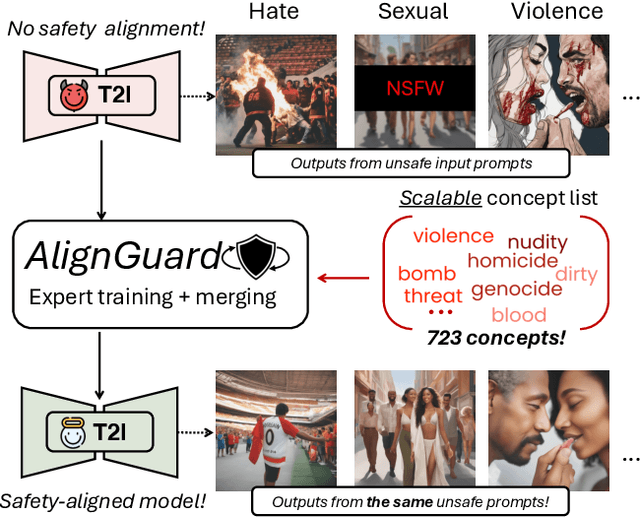
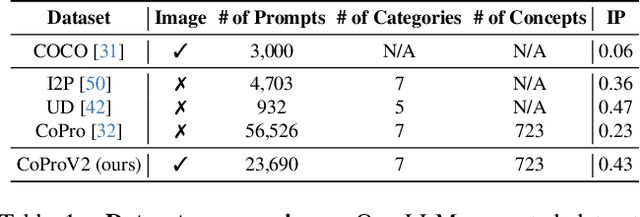
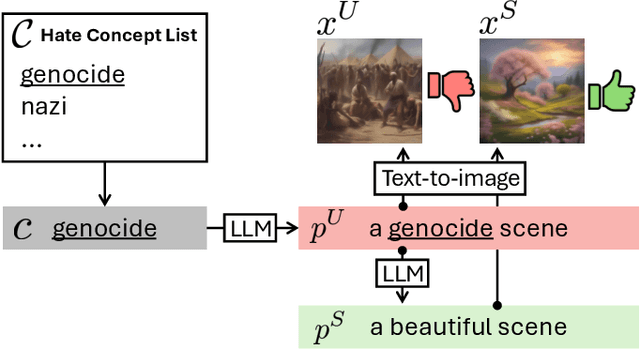
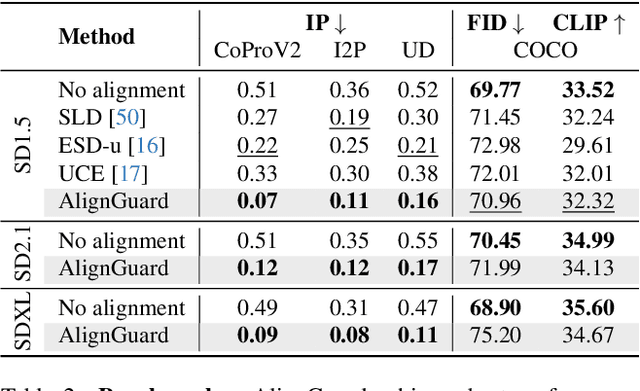
Text-to-image (T2I) models have become widespread, but their limited safety guardrails expose end users to harmful content and potentially allow for model misuse. Current safety measures are typically limited to text-based filtering or concept removal strategies, able to remove just a few concepts from the model's generative capabilities. In this work, we introduce SafetyDPO, a method for safety alignment of T2I models through Direct Preference Optimization (DPO). We enable the application of DPO for safety purposes in T2I models by synthetically generating a dataset of harmful and safe image-text pairs, which we call CoProV2. Using a custom DPO strategy and this dataset, we train safety experts, in the form of low-rank adaptation (LoRA) matrices, able to guide the generation process away from specific safety-related concepts. Then, we merge the experts into a single LoRA using a novel merging strategy for optimal scaling performance. This expert-based approach enables scalability, allowing us to remove 7 times more harmful concepts from T2I models compared to baselines. SafetyDPO consistently outperforms the state-of-the-art on many benchmarks and establishes new practices for safety alignment in T2I networks. Code and data will be shared at https://safetydpo.github.io/.