 Add to Chrome
 Add to Firefox
 Add to Edge
ActionParty: Multi-Subject Action Binding in Generative Video Games
Apr 02, 2026
Recent advances in video diffusion have enabled the development of "world models" capable of simulating interactive environments. However, these models are largely restricted to single-agent settings, failing to control multiple agents simultaneously in a scene. In this work, we tackle a fundamental issue of action binding in existing video diffusion models, which struggle to associate specific actions with their corresponding subjects. For this purpose, we propose ActionParty, an action controllable multi-subject world model for generative video games. It introduces subject state tokens, i.e. latent variables that persistently capture the state of each subject in the scene. By jointly modeling state tokens and video latents with a spatial biasing mechanism, we disentangle global video frame rendering from individual action-controlled subject updates. We evaluate ActionParty on the Melting Pot benchmark, demonstrating the first video world model capable of controlling up to seven players simultaneously across 46 diverse environments. Our results show significant improvements in action-following accuracy and identity consistency, while enabling robust autoregressive tracking of subjects through complex interactions.

One Model, Many Budgets: Elastic Latent Interfaces for Diffusion Transformers
Mar 12, 2026Diffusion transformers (DiTs) achieve high generative quality but lock FLOPs to image resolution, limiting principled latency-quality trade-offs, and allocate computation uniformly across input spatial tokens, wasting resource allocation to unimportant regions. We introduce Elastic Latent Interface Transformer (ELIT), a drop-in, DiT-compatible mechanism that decouples input image size from compute. Our approach inserts a latent interface, a learnable variable-length token sequence on which standard transformer blocks can operate. Lightweight Read and Write cross-attention layers move information between spatial tokens and latents and prioritize important input regions. By training with random dropping of tail latents, ELIT learns to produce importance-ordered representations with earlier latents capturing global structure while later ones contain information to refine details. At inference, the number of latents can be dynamically adjusted to match compute constraints. ELIT is deliberately minimal, adding two cross-attention layers while leaving the rectified flow objective and the DiT stack unchanged. Across datasets and architectures (DiT, U-ViT, HDiT, MM-DiT), ELIT delivers consistent gains. On ImageNet-1K 512px, ELIT delivers an average gain of $35.3\%$ and $39.6\%$ in FID and FDD scores. Project page: https://snap-research.github.io/elit/
S2DiT: Sandwich Diffusion Transformer for Mobile Streaming Video Generation
Jan 19, 2026Diffusion Transformers (DiTs) have recently improved video generation quality. However, their heavy computational cost makes real-time or on-device generation infeasible. In this work, we introduce S2DiT, a Streaming Sandwich Diffusion Transformer designed for efficient, high-fidelity, and streaming video generation on mobile hardware. S2DiT generates more tokens but maintains efficiency with novel efficient attentions: a mixture of LinConv Hybrid Attention (LCHA) and Stride Self-Attention (SSA). Based on this, we uncover the sandwich design via a budget-aware dynamic programming search, achieving superior quality and efficiency. We further propose a 2-in-1 distillation framework that transfers the capacity of large teacher models (e.g., Wan 2.2-14B) to the compact few-step sandwich model. Together, S2DiT achieves quality on par with state-of-the-art server video models, while streaming at over 10 FPS on an iPhone.
Omni-Attribute: Open-vocabulary Attribute Encoder for Visual Concept Personalization
Dec 11, 2025Visual concept personalization aims to transfer only specific image attributes, such as identity, expression, lighting, and style, into unseen contexts. However, existing methods rely on holistic embeddings from general-purpose image encoders, which entangle multiple visual factors and make it difficult to isolate a single attribute. This often leads to information leakage and incoherent synthesis. To address this limitation, we introduce Omni-Attribute, the first open-vocabulary image attribute encoder designed to learn high-fidelity, attribute-specific representations. Our approach jointly designs the data and model: (i) we curate semantically linked image pairs annotated with positive and negative attributes to explicitly teach the encoder what to preserve or suppress; and (ii) we adopt a dual-objective training paradigm that balances generative fidelity with contrastive disentanglement. The resulting embeddings prove effective for open-vocabulary attribute retrieval, personalization, and compositional generation, achieving state-of-the-art performance across multiple benchmarks.
AlcheMinT: Fine-grained Temporal Control for Multi-Reference Consistent Video Generation
Dec 11, 2025Recent advances in subject-driven video generation with large diffusion models have enabled personalized content synthesis conditioned on user-provided subjects. However, existing methods lack fine-grained temporal control over subject appearance and disappearance, which are essential for applications such as compositional video synthesis, storyboarding, and controllable animation. We propose AlcheMinT, a unified framework that introduces explicit timestamps conditioning for subject-driven video generation. Our approach introduces a novel positional encoding mechanism that unlocks the encoding of temporal intervals, associated in our case with subject identities, while seamlessly integrating with the pretrained video generation model positional embeddings. Additionally, we incorporate subject-descriptive text tokens to strengthen binding between visual identity and video captions, mitigating ambiguity during generation. Through token-wise concatenation, AlcheMinT avoids any additional cross-attention modules and incurs negligible parameter overhead. We establish a benchmark evaluating multiple subject identity preservation, video fidelity, and temporal adherence. Experimental results demonstrate that AlcheMinT achieves visual quality matching state-of-the-art video personalization methods, while, for the first time, enabling precise temporal control over multi-subject generation within videos. Project page is at https://snap-research.github.io/Video-AlcheMinT
OmniView: An All-Seeing Diffusion Model for 3D and 4D View Synthesis
Dec 11, 2025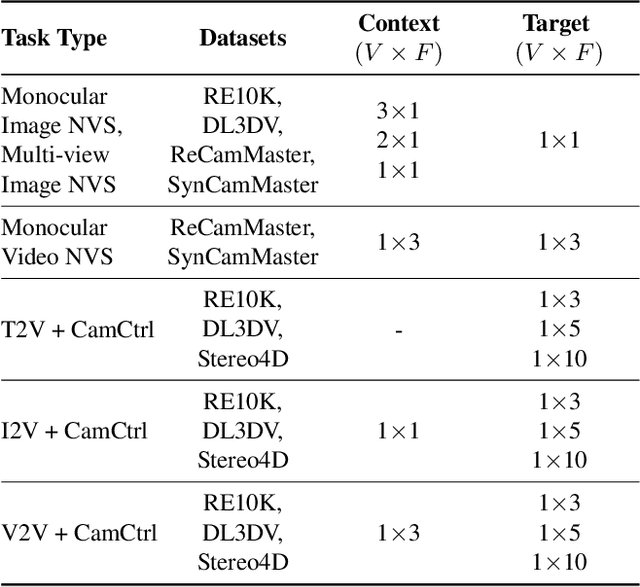
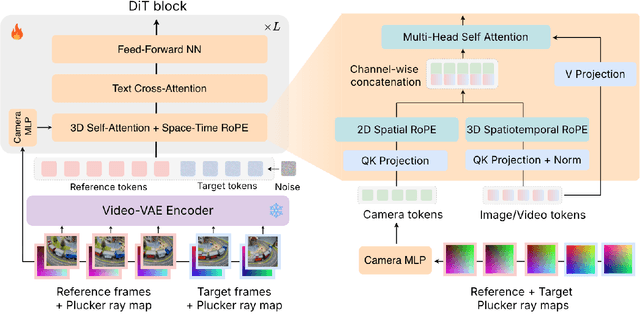
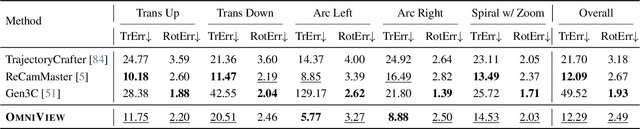
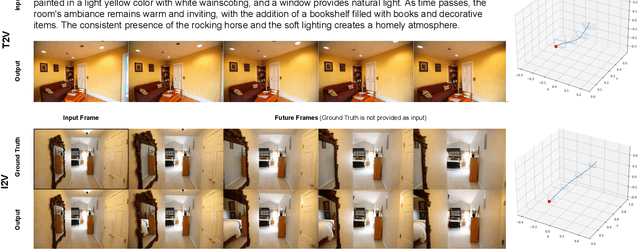
Prior approaches injecting camera control into diffusion models have focused on specific subsets of 4D consistency tasks: novel view synthesis, text-to-video with camera control, image-to-video, amongst others. Therefore, these fragmented approaches are trained on disjoint slices of available 3D/4D data. We introduce OmniView, a unified framework that generalizes across a wide range of 4D consistency tasks. Our method separately represents space, time, and view conditions, enabling flexible combinations of these inputs. For example, OmniView can synthesize novel views from static, dynamic, and multiview inputs, extrapolate trajectories forward and backward in time, and create videos from text or image prompts with full camera control. OmniView is competitive with task-specific models across diverse benchmarks and metrics, improving image quality scores among camera-conditioned diffusion models by up to 33\% in multiview NVS LLFF dataset, 60\% in dynamic NVS Neural 3D Video benchmark, 20\% in static camera control on RE-10K, and reducing camera trajectory errors by 4x in text-conditioned video generation. With strong generalizability in one model, OmniView demonstrates the feasibility of a generalist 4D video model. Project page is available at https://snap-research.github.io/OmniView/
AlphaFlow: Understanding and Improving MeanFlow Models
Oct 23, 2025MeanFlow has recently emerged as a powerful framework for few-step generative modeling trained from scratch, but its success is not yet fully understood. In this work, we show that the MeanFlow objective naturally decomposes into two parts: trajectory flow matching and trajectory consistency. Through gradient analysis, we find that these terms are strongly negatively correlated, causing optimization conflict and slow convergence. Motivated by these insights, we introduce $\alpha$-Flow, a broad family of objectives that unifies trajectory flow matching, Shortcut Model, and MeanFlow under one formulation. By adopting a curriculum strategy that smoothly anneals from trajectory flow matching to MeanFlow, $\alpha$-Flow disentangles the conflicting objectives, and achieves better convergence. When trained from scratch on class-conditional ImageNet-1K 256x256 with vanilla DiT backbones, $\alpha$-Flow consistently outperforms MeanFlow across scales and settings. Our largest $\alpha$-Flow-XL/2+ model achieves new state-of-the-art results using vanilla DiT backbones, with FID scores of 2.58 (1-NFE) and 2.15 (2-NFE).
Zero-Shot Dynamic Concept Personalization with Grid-Based LoRA
Jul 23, 2025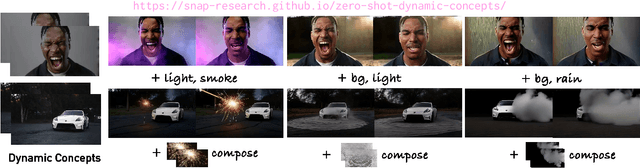
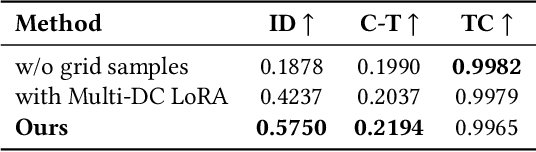
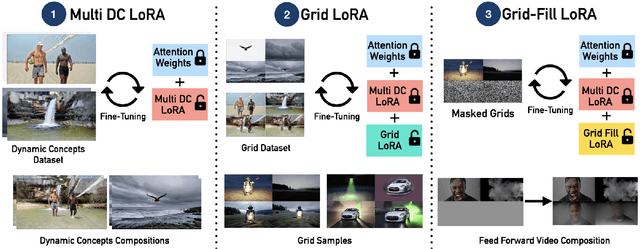
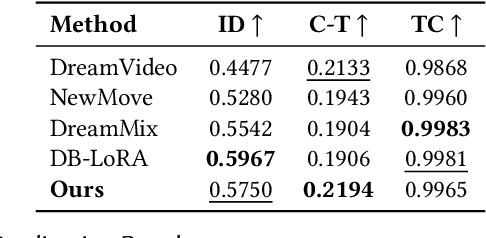
Recent advances in text-to-video generation have enabled high-quality synthesis from text and image prompts. While the personalization of dynamic concepts, which capture subject-specific appearance and motion from a single video, is now feasible, most existing methods require per-instance fine-tuning, limiting scalability. We introduce a fully zero-shot framework for dynamic concept personalization in text-to-video models. Our method leverages structured 2x2 video grids that spatially organize input and output pairs, enabling the training of lightweight Grid-LoRA adapters for editing and composition within these grids. At inference, a dedicated Grid Fill module completes partially observed layouts, producing temporally coherent and identity preserving outputs. Once trained, the entire system operates in a single forward pass, generalizing to previously unseen dynamic concepts without any test-time optimization. Extensive experiments demonstrate high-quality and consistent results across a wide range of subjects beyond trained concepts and editing scenarios.
Taming Diffusion Transformer for Real-Time Mobile Video Generation
Jul 17, 2025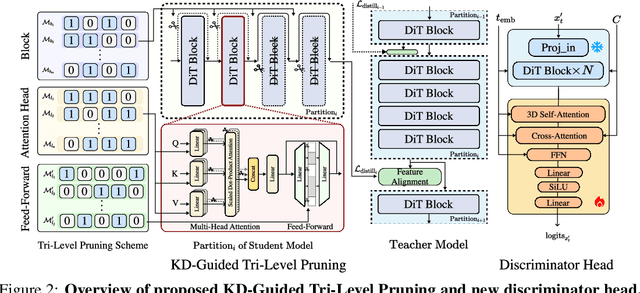
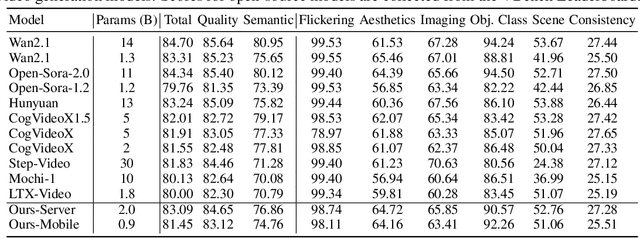

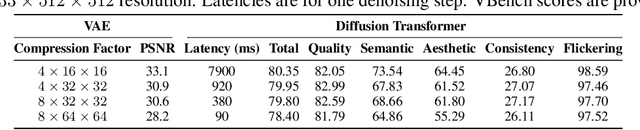
Diffusion Transformers (DiT) have shown strong performance in video generation tasks, but their high computational cost makes them impractical for resource-constrained devices like smartphones, and real-time generation is even more challenging. In this work, we propose a series of novel optimizations to significantly accelerate video generation and enable real-time performance on mobile platforms. First, we employ a highly compressed variational autoencoder (VAE) to reduce the dimensionality of the input data without sacrificing visual quality. Second, we introduce a KD-guided, sensitivity-aware tri-level pruning strategy to shrink the model size to suit mobile platform while preserving critical performance characteristics. Third, we develop an adversarial step distillation technique tailored for DiT, which allows us to reduce the number of inference steps to four. Combined, these optimizations enable our model to achieve over 10 frames per second (FPS) generation on an iPhone 16 Pro Max, demonstrating the feasibility of real-time, high-quality video generation on mobile devices.
Improving Progressive Generation with Decomposable Flow Matching
Jun 24, 2025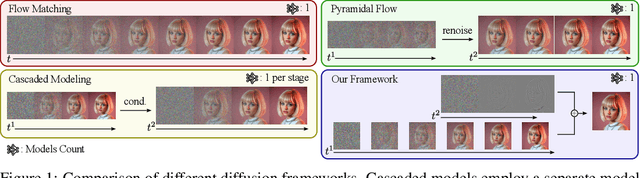
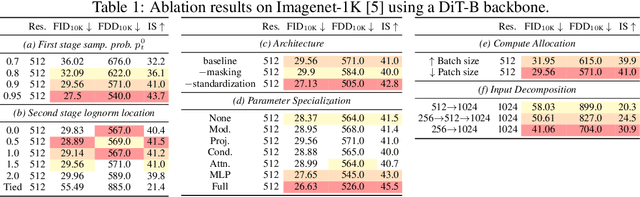
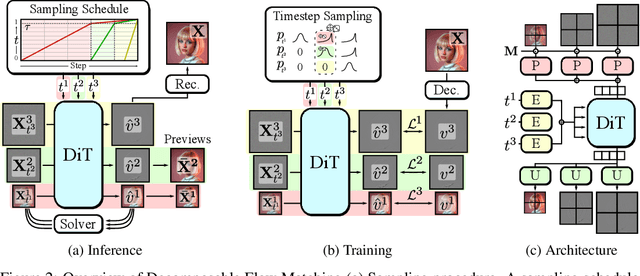
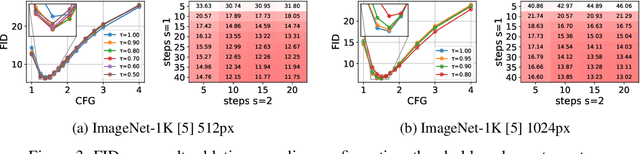
Generating high-dimensional visual modalities is a computationally intensive task. A common solution is progressive generation, where the outputs are synthesized in a coarse-to-fine spectral autoregressive manner. While diffusion models benefit from the coarse-to-fine nature of denoising, explicit multi-stage architectures are rarely adopted. These architectures have increased the complexity of the overall approach, introducing the need for a custom diffusion formulation, decomposition-dependent stage transitions, add-hoc samplers, or a model cascade. Our contribution, Decomposable Flow Matching (DFM), is a simple and effective framework for the progressive generation of visual media. DFM applies Flow Matching independently at each level of a user-defined multi-scale representation (such as Laplacian pyramid). As shown by our experiments, our approach improves visual quality for both images and videos, featuring superior results compared to prior multistage frameworks. On Imagenet-1k 512px, DFM achieves 35.2% improvements in FDD scores over the base architecture and 26.4% over the best-performing baseline, under the same training compute. When applied to finetuning of large models, such as FLUX, DFM shows faster convergence speed to the training distribution. Crucially, all these advantages are achieved with a single model, architectural simplicity, and minimal modifications to existing training pipelines.