 Add to Chrome
 Add to Firefox
 Add to Edge
DBGL: Decay-aware Bipartite Graph Learning for Irregular Medical Time Series Classification
Apr 12, 2026
Irregular Medical Time Series play a critical role in the clinical domain to better understand the patient's condition. However, inherent irregularity arising from heterogeneous sampling rates, asynchronous observations, and variable gaps poses key challenges for reliable modeling. Existing methods often distort temporal sampling irregularity and missingness patterns while failing to capture variable decay irregularity, resulting in suboptimal representations. To address these limitations, we introduce DBGL, Decay-Aware Bipartite Graph Learning for Irregular Medical Time Series. DBGL first introduces a patient-variable bipartite graph that simultaneously captures irregular sampling patterns without artificial alignment and adaptively models variable relationships for temporal sampling irregularity modeling, enhancing representation learning. To model variable decay irregularity, DBGL designs a novel node-specific temporal decay encoding mechanism that captures each variable's decay rates based on sampling interval, yielding a more accurate and faithful representation of irregular temporal dynamics. We evaluate the performance of DBGL on four publicly available datasets, and the results show that DBGL outperforms all baselines.

Hunyuan-DiT: A Powerful Multi-Resolution Diffusion Transformer with Fine-Grained Chinese Understanding
May 14, 2024
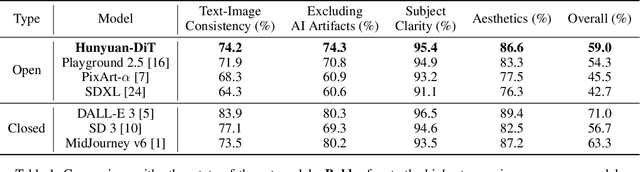

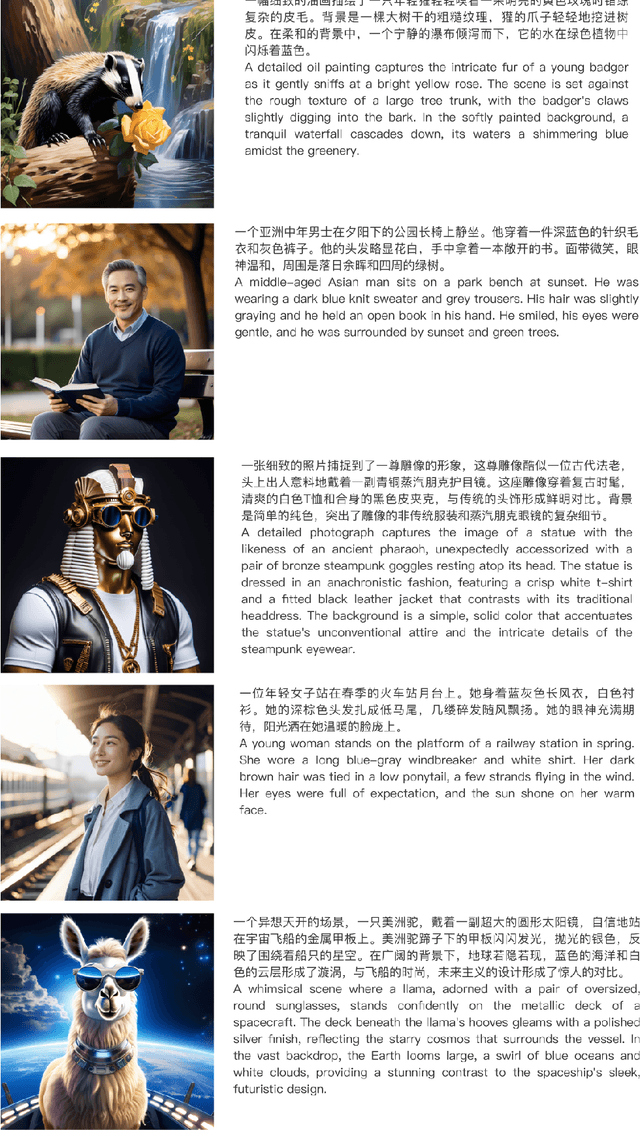
We present Hunyuan-DiT, a text-to-image diffusion transformer with fine-grained understanding of both English and Chinese. To construct Hunyuan-DiT, we carefully design the transformer structure, text encoder, and positional encoding. We also build from scratch a whole data pipeline to update and evaluate data for iterative model optimization. For fine-grained language understanding, we train a Multimodal Large Language Model to refine the captions of the images. Finally, Hunyuan-DiT can perform multi-turn multimodal dialogue with users, generating and refining images according to the context. Through our holistic human evaluation protocol with more than 50 professional human evaluators, Hunyuan-DiT sets a new state-of-the-art in Chinese-to-image generation compared with other open-source models. Code and pretrained models are publicly available at github.com/Tencent/HunyuanDiT