 Add to Chrome
 Add to Firefox
 Add to Edge
Vehicle routing problem using deep reinforcement learning - A case study about truck planning in the industry
Aug 07, 2026
As an important component of the supply chain industry, transportation has experienced rapid development in the past decade with the assistance of digital platforms and intelligent algorithms. Within the field of transportation research, Vehicle Routing Problem (VRP) has remained a persistent and enduring challenge. In the realm of management science, experts, and scholars from both the industrial and academic sectors have continuously explored optimization models and algorithms to effectively address routing problems, from the classical Traveling Salesman Problem to the more general Vehicle Routing Problem. These models and algorithms are applied in real-world industrial scenarios to achieve cost optimization and reduce carbon footprints. However, due to the complexity of real-world problems, numerous specific constraints are often added, and challenges such as information opacity, uncertainty, and irrational human behavior may arise. Therefore, deploying and optimizing mathematical models for VRP in practical scenarios while maintaining optimal results poses numerous challenges. This paper discusses and provides solutions for three different logistic use cases involving external truck network design. Through these industrial case study, the paper introduces how deep reinforcement learning-based vehicle routing optimization has been implemented. As a result, it can be observed that the routes optimized by reinforcement learning agent have over 10% total cost compared to baseline results. Furthermore, the paper proposes that in future research, DRL algorithms for vehicle routing problems could be generalized into more variations of VRP.

PathScale-R1: Cross-scale Reasoning for Pathological Image Analysis
Jul 26, 2026Pathological diagnosis is inherently multi-scale, requiring the integration of global tissue architecture at low magnification with cellular morphology at higher magnification. However, existing pathology benchmarks and vision-language models (VLMs) are still largely developed under single-scale settings, limiting their ability to learn clinically meaningful multi-magnification reasoning. Moreover, naively constructed visual question answering (VQA) tasks may be susceptible to text-only or superficial visual shortcuts, leading to unreliable assessments of visual understanding. To address these limitations, we introduce a benchmark and training framework for shortcut-resistant cross-scale pathology reasoning. We design an Adversarial Text-only Screening strategy for semantic reasoning questions and a Structure-controlled Distractor Sampling strategy for visual grounding questions, encouraging models to rely on cross-scale visual evidence. Based on this pipeline, we construct PathScale-VQA, a high-quality cross-scale pathology VQA benchmark with 10,373 multiple-choice questions grounded in 1,368 diagnostic paths across multiple magnification levels. Building on the semantic reasoning set, PathScale-R1 is optimized through Difficulty-driven Reasoning Distillation supervised fine-tuning followed by reinforcement learning with a Scale-aware Reasoning Structure reward, which encourages the use of evidence across magnifications. Extensive experiments demonstrate state-of-the-art performance of PathScale-R1 on cross-scale reasoning tasks and effective transfer to conventional single-scale pathology VQA. Our code is available at https://github.com/iMVR-PL/PathScale-R1.
Enhancing Pathological VLMs with Cross-scale Reasoning
Jun 17, 2026Pathological images are inherently multi-scale, requiring pathologists to integrate evidence from global tissue architecture at low magnification to cellular morphology at higher magnification for accurate diagnosis. While existing pathological datasets for vision-language model (VLM) include various scales, they often lack an explicit cross-scale reasoning objective. This limitation prevents VLMs from capturing essential cross-scale representations and learning evidence-based reasoning. To bridge this gap, we introduce the first cross-scale training and evaluation paradigm that formulates pathology interpretation as multi-magnification reasoning. However, creating such a task reveals a critical challenge: multi-image visual question answering (VQA) is prone to text-only shortcuts, which allow models to guess answers using magnification-dependent artifacts rather than visual evidence. To address this, we propose a leakage-aware curation pipeline that combines adversarial text-only screening with constraint-guided question design. Using this pipeline, we construct Scale-VQA, a high-quality benchmark with 4,685 multiple-choice questions grounded in 2,537 pathology images across multiple magnification levels. Finally, we present ScaleReasoner-R1, a model trained via reinforcement learning to optimize performance on the cross-scale VQA task. ScaleReasoner-R1 achieves state-of-the-art performance on our cross-scale reasoning benchmark and generalizes to SOTA performance on established single-scale benchmarks. Findings suggest that even the limited cross-scale supervision can significantly improve pathological understanding. The code and demos will be open-sourced.
Reinforced Curriculum Pre-Alignment for Domain-Adaptive VLMs
Feb 11, 2026Vision-Language Models (VLMs) demonstrate remarkable general-purpose capabilities but often fall short in specialized domains such as medical imaging or geometric problem-solving. Supervised Fine-Tuning (SFT) can enhance performance within a target domain, but it typically causes catastrophic forgetting, limiting its generalization. The central challenge, therefore, is to adapt VLMs to new domains while preserving their general-purpose capabilities. Continual pretraining is effective for expanding knowledge in Large Language Models (LLMs), but it is less feasible for VLMs due to prohibitive computational costs and the unavailability of pretraining data for most open-source models. This necessitates efficient post-training adaptation methods. Reinforcement learning (RL)-based approaches such as Group Relative Policy Optimization (GRPO) have shown promise in preserving general abilities, yet they often fail in domain adaptation scenarios where the model initially lacks sufficient domain knowledge, leading to optimization collapse. To bridge this gap, we propose Reinforced Curriculum Pre-Alignment (RCPA), a novel post-training paradigm that introduces a curriculum-aware progressive modulation mechanism. In the early phase, RCPA applies partial output constraints to safely expose the model to new domain concepts. As the model's domain familiarity increases, training gradually transitions to full generation optimization, refining responses and aligning them with domain-specific preferences. This staged adaptation balances domain knowledge acquisition with the preservation of general multimodal capabilities. Extensive experiments across specialized domains and general benchmarks validate the effectiveness of RCPA, establishing a practical pathway toward building high-performing and domain-adaptive VLMs.
SUGAR: Spherical Ultrafast Graph Attention Framework for Cortical Surface Registration
Jul 02, 2023
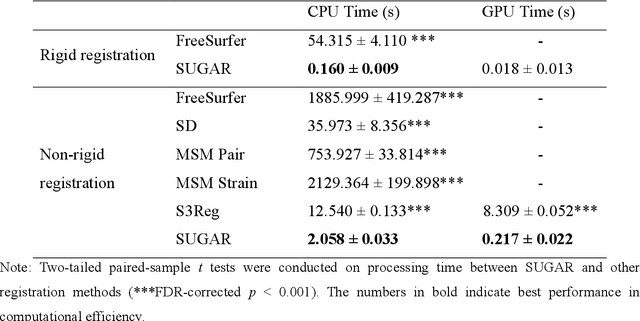

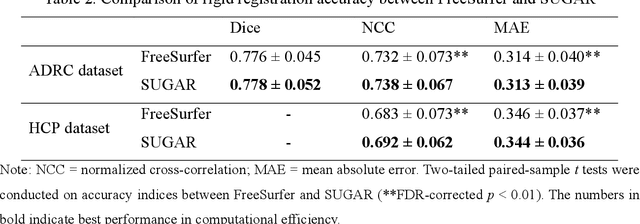
Cortical surface registration plays a crucial role in aligning cortical functional and anatomical features across individuals. However, conventional registration algorithms are computationally inefficient. Recently, learning-based registration algorithms have emerged as a promising solution, significantly improving processing efficiency. Nonetheless, there remains a gap in the development of a learning-based method that exceeds the state-of-the-art conventional methods simultaneously in computational efficiency, registration accuracy, and distortion control, despite the theoretically greater representational capabilities of deep learning approaches. To address the challenge, we present SUGAR, a unified unsupervised deep-learning framework for both rigid and non-rigid registration. SUGAR incorporates a U-Net-based spherical graph attention network and leverages the Euler angle representation for deformation. In addition to the similarity loss, we introduce fold and multiple distortion losses, to preserve topology and minimize various types of distortions. Furthermore, we propose a data augmentation strategy specifically tailored for spherical surface registration, enhancing the registration performance. Through extensive evaluation involving over 10,000 scans from 7 diverse datasets, we showed that our framework exhibits comparable or superior registration performance in accuracy, distortion, and test-retest reliability compared to conventional and learning-based methods. Additionally, SUGAR achieves remarkable sub-second processing times, offering a notable speed-up of approximately 12,000 times in registering 9,000 subjects from the UK Biobank dataset in just 32 minutes. This combination of high registration performance and accelerated processing time may greatly benefit large-scale neuroimaging studies.
Separating the EoR Signal with a Convolutional Denoising Autoencoder: A Deep-learning-based Method
Mar 14, 2019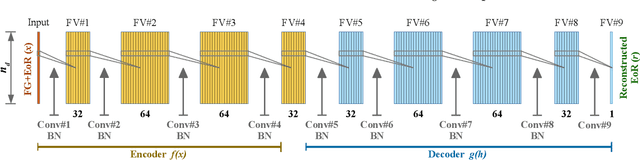
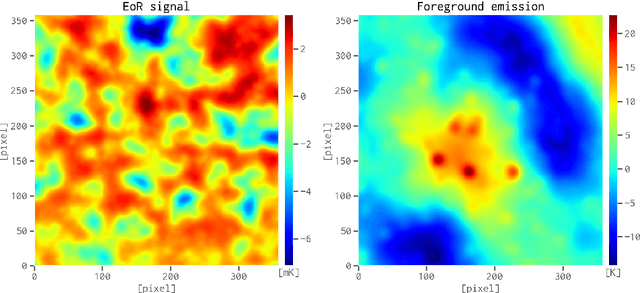
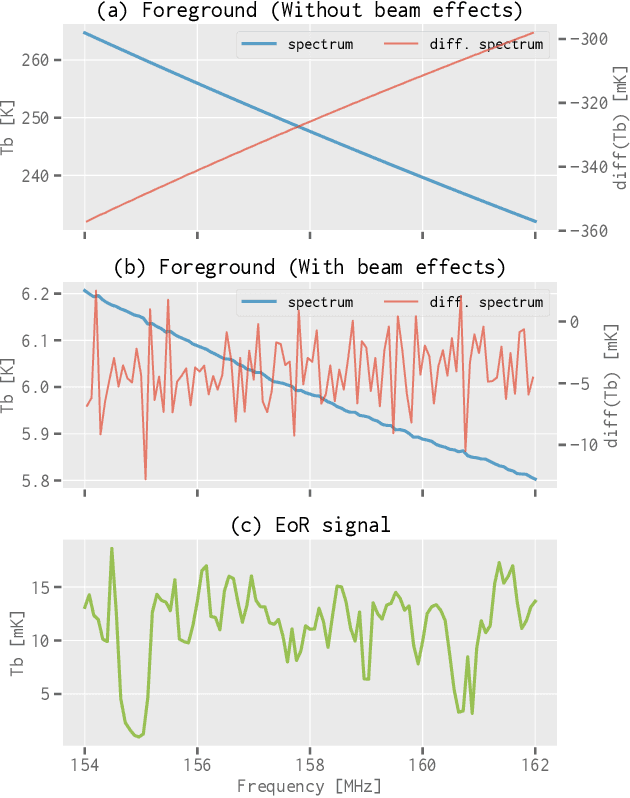
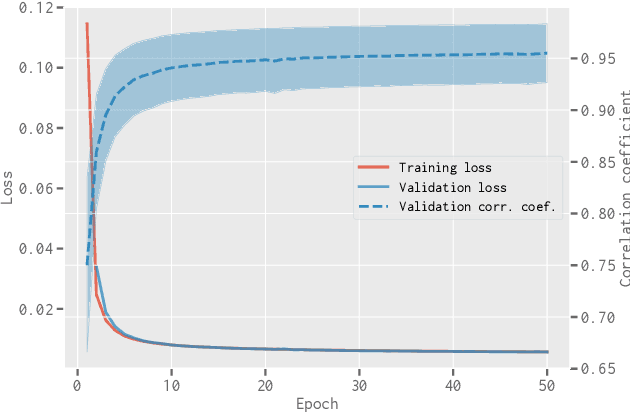
When applying the foreground removal methods to uncover the faint cosmological signal from the epoch of reionization (EoR), the foreground spectra are assumed to be smooth. However, this assumption can be seriously violated in practice since the unresolved or mis-subtracted foreground sources, which are further complicated by the frequency-dependent beam effects of interferometers, will generate significant fluctuations along the frequency dimension. To address this issue, we propose a novel deep-learning-based method that uses a 9-layer convolutional denoising autoencoder (CDAE) to separate the EoR signal. After being trained on the SKA images simulated with realistic beam effects, the CDAE achieves excellent performance as the mean correlation coefficient ($\bar{\rho}$) between the reconstructed and input EoR signals reaches $0.929 \pm 0.045$. In comparison, the two representative traditional methods, namely the polynomial fitting method and the continuous wavelet transform method, both have difficulties in modelling and removing the foreground emission complicated with the beam effects, yielding only $\bar{\rho}_{\text{poly}} = 0.296 \pm 0.121$ and $\bar{\rho}_{\text{cwt}} = 0.198 \pm 0.160$, respectively. We conclude that, by hierarchically learning sophisticated features through multiple convolutional layers, the CDAE is a powerful tool that can be used to overcome the complicated beam effects and accurately separate the EoR signal. Our results also exhibit the great potential of deep-learning-based methods in future EoR experiments.
* 10 pages, 9 figures; minor text updates to match the MNRAS published version