 Add to Chrome
 Add to Firefox
 Add to Edge
Semantic Item Graph Enhancement for Multimodal Recommendation
Aug 08, 2025
Multimodal recommendation systems have attracted increasing attention for their improved performance by leveraging items' multimodal information. Prior methods often build modality-specific item-item semantic graphs from raw modality features and use them as supplementary structures alongside the user-item interaction graph to enhance user preference learning. However, these semantic graphs suffer from semantic deficiencies, including (1) insufficient modeling of collaborative signals among items and (2) structural distortions introduced by noise in raw modality features, ultimately compromising performance. To address these issues, we first extract collaborative signals from the interaction graph and infuse them into each modality-specific item semantic graph to enhance semantic modeling. Then, we design a modulus-based personalized embedding perturbation mechanism that injects perturbations with modulus-guided personalized intensity into embeddings to generate contrastive views. This enables the model to learn noise-robust representations through contrastive learning, thereby reducing the effect of structural noise in semantic graphs. Besides, we propose a dual representation alignment mechanism that first aligns multiple semantic representations via a designed Anchor-based InfoNCE loss using behavior representations as anchors, and then aligns behavior representations with the fused semantics by standard InfoNCE, to ensure representation consistency. Extensive experiments on four benchmark datasets validate the effectiveness of our framework.

Energy Efficient Trajectory Control and Resource Allocation in Multi-UAV-assisted MEC via Deep Reinforcement Learning
Aug 01, 2025Mobile edge computing (MEC) is a promising technique to improve the computational capacity of smart devices (SDs) in Internet of Things (IoT). However, the performance of MEC is restricted due to its fixed location and limited service scope. Hence, we investigate an unmanned aerial vehicle (UAV)-assisted MEC system, where multiple UAVs are dispatched and each UAV can simultaneously provide computing service for multiple SDs. To improve the performance of system, we formulated a UAV-based trajectory control and resource allocation multi-objective optimization problem (TCRAMOP) to simultaneously maximize the offloading number of UAVs and minimize total offloading delay and total energy consumption of UAVs by optimizing the flight paths of UAVs as well as the computing resource allocated to served SDs. Then, consider that the solution of TCRAMOP requires continuous decision-making and the system is dynamic, we propose an enhanced deep reinforcement learning (DRL) algorithm, namely, distributed proximal policy optimization with imitation learning (DPPOIL). This algorithm incorporates the generative adversarial imitation learning technique to improve the policy performance. Simulation results demonstrate the effectiveness of our proposed DPPOIL and prove that the learned strategy of DPPOIL is better compared with other baseline methods.
Multibeam High Throughput Satellite: Hardware Foundation, Resource Allocation, and Precoding
Aug 01, 2025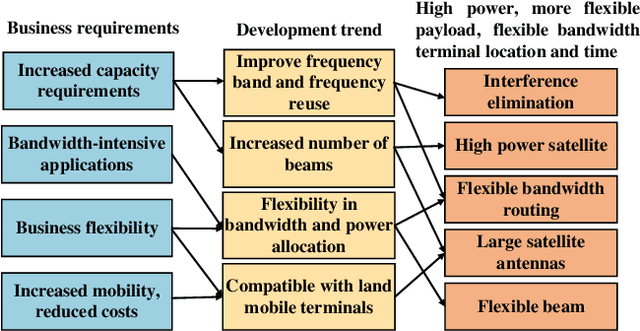
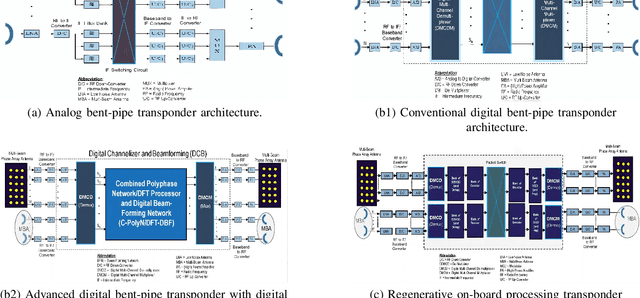
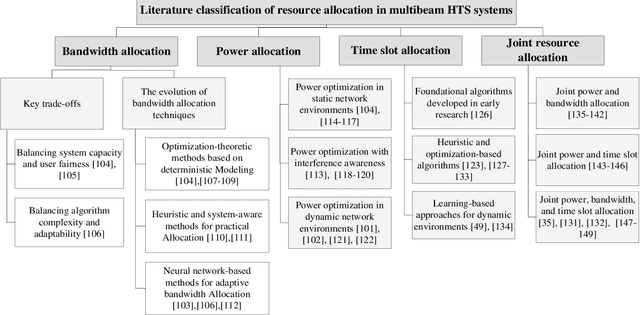
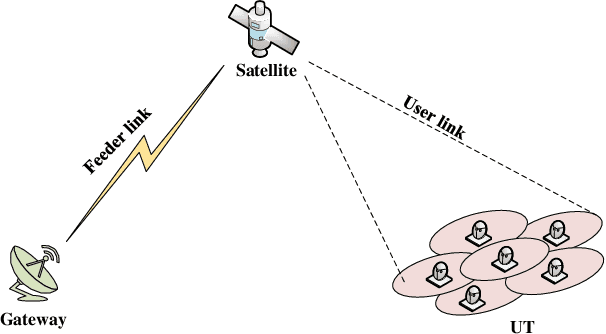
With its wide coverage and uninterrupted service, satellite communication is a critical technology for next-generation 6G communications. High throughput satellite (HTS) systems, utilizing multipoint beam and frequency multiplexing techniques, enable satellite communication capacity of up to Tbps to meet the growing traffic demand. Therefore, it is imperative to review the-state-of-the-art of multibeam HTS systems and identify their associated challenges and perspectives. Firstly, we summarize the multibeam HTS hardware foundations, including ground station systems, on-board payloads, and user terminals. Subsequently, we review the flexible on-board radio resource allocation approaches of bandwidth, power, time slot, and joint allocation schemes of HTS systems to optimize resource utilization and cater to non-uniform service demand. Additionally, we survey multibeam precoding methods for the HTS system to achieve full-frequency reuse and interference cancellation, which are classified according to different deployments such as single gateway precoding, multiple gateway precoding, on-board precoding, and hybrid on-board/on-ground precoding. Finally, we disscuss the challenges related to Q/V band link outage, time and frequency synchronization of gateways, the accuracy of channel state information (CSI), payload light-weight development, and the application of deep learning (DL). Research on these topics will contribute to enhancing the performance of HTS systems and finally delivering high-speed data to areas underserved by terrestrial networks.
Large AI Model-Enabled Secure Communications in Low-Altitude Wireless Networks: Concepts, Perspectives and Case Study
Aug 01, 2025Low-altitude wireless networks (LAWNs) have the potential to revolutionize communications by supporting a range of applications, including urban parcel delivery, aerial inspections and air taxis. However, compared with traditional wireless networks, LAWNs face unique security challenges due to low-altitude operations, frequent mobility and reliance on unlicensed spectrum, making it more vulnerable to some malicious attacks. In this paper, we investigate some large artificial intelligence model (LAM)-enabled solutions for secure communications in LAWNs. Specifically, we first explore the amplified security risks and important limitations of traditional AI methods in LAWNs. Then, we introduce the basic concepts of LAMs and delve into the role of LAMs in addressing these challenges. To demonstrate the practical benefits of LAMs for secure communications in LAWNs, we propose a novel LAM-based optimization framework that leverages large language models (LLMs) to generate enhanced state features on top of handcrafted representations, and to design intrinsic rewards accordingly, thereby improving reinforcement learning performance for secure communication tasks. Through a typical case study, simulation results validate the effectiveness of the proposed framework. Finally, we outline future directions for integrating LAMs into secure LAWN applications.
LLM Meets the Sky: Heuristic Multi-Agent Reinforcement Learning for Secure Heterogeneous UAV Networks
Jul 23, 2025This work tackles the physical layer security (PLS) problem of maximizing the secrecy rate in heterogeneous UAV networks (HetUAVNs) under propulsion energy constraints. Unlike prior studies that assume uniform UAV capabilities or overlook energy-security trade-offs, we consider a realistic scenario where UAVs with diverse payloads and computation resources collaborate to serve ground terminals in the presence of eavesdroppers. To manage the complex coupling between UAV motion and communication, we propose a hierarchical optimization framework. The inner layer uses a semidefinite relaxation (SDR)-based S2DC algorithm combining penalty functions and difference-of-convex (d.c.) programming to solve the secrecy precoding problem with fixed UAV positions. The outer layer introduces a Large Language Model (LLM)-guided heuristic multi-agent reinforcement learning approach (LLM-HeMARL) for trajectory optimization. LLM-HeMARL efficiently incorporates expert heuristics policy generated by the LLM, enabling UAVs to learn energy-aware, security-driven trajectories without the inference overhead of real-time LLM calls. The simulation results show that our method outperforms existing baselines in secrecy rate and energy efficiency, with consistent robustness across varying UAV swarm sizes and random seeds.
Generative Diffusion Models for Wireless Networks: Fundamental, Architecture, and State-of-the-Art
Jul 22, 2025With the rapid development of Generative Artificial Intelligence (GAI) technology, Generative Diffusion Models (GDMs) have shown significant empowerment potential in the field of wireless networks due to advantages, such as noise resistance, training stability, controllability, and multimodal generation. Although there have been multiple studies focusing on GDMs for wireless networks, there is still a lack of comprehensive reviews on their technological evolution. Motivated by this, we systematically explore the application of GDMs in wireless networks. Firstly, starting from mathematical principles, we analyze technical advantages of GDMs and present six representative models. Furthermore, we propose the multi-layer wireless network architecture including sensing layer, transmission layer, application layer, and security plane. We also introduce the core mechanisms of GDM at each of the layers. Subsequently, we conduct a rigorous review on existing GDM-based schemes, with a focus on analyzing their innovative points, the role of GDMs, strengths, and weaknesses. Ultimately, we extract key challenges and provide potential solutions, with the aim of providing directional guidance for future research in this field.
Scene Graph-Aided Probabilistic Semantic Communication for Image Transmission
Jul 16, 2025Semantic communication emphasizes the transmission of meaning rather than raw symbols. It offers a promising solution to alleviate network congestion and improve transmission efficiency. In this paper, we propose a wireless image communication framework that employs probability graphs as shared semantic knowledge base among distributed users. High-level image semantics are represented via scene graphs, and a two-stage compression algorithm is devised to remove predictable components based on learned conditional and co-occurrence probabilities. At the transmitter, the algorithm filters redundant relations and entity pairs, while at the receiver, semantic recovery leverages the same probability graphs to reconstruct omitted information. For further research, we also put forward a multi-round semantic compression algorithm with its theoretical performance analysis. Simulation results demonstrate that our semantic-aware scheme achieves superior transmission throughput and satiable semantic alignment, validating the efficacy of leveraging high-level semantics for image communication.
Predictive Control over LAWN: Joint Trajectory Design and Resource Allocation
Jul 03, 2025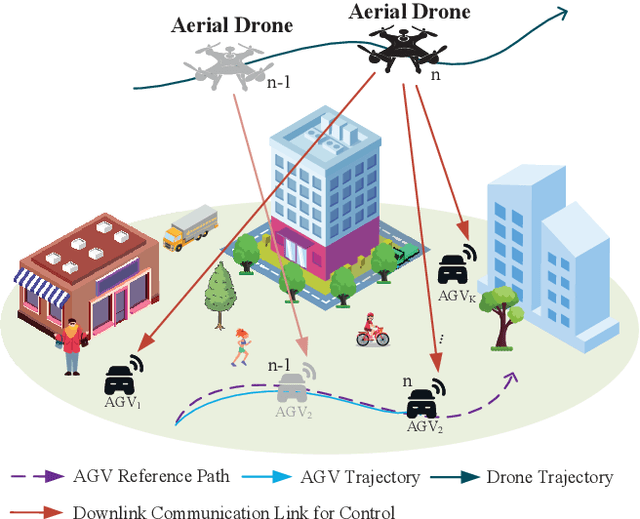
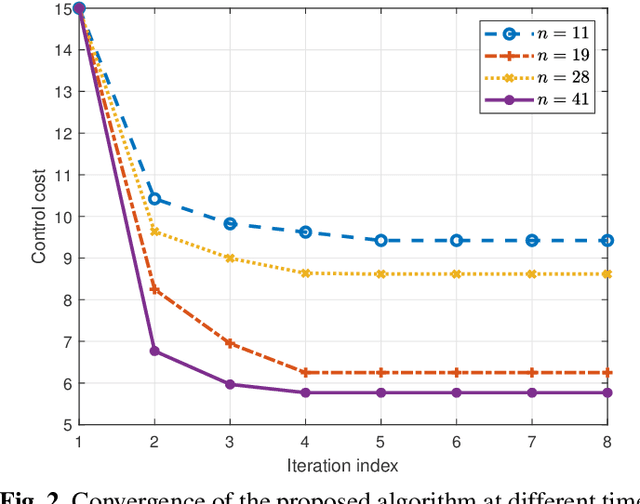
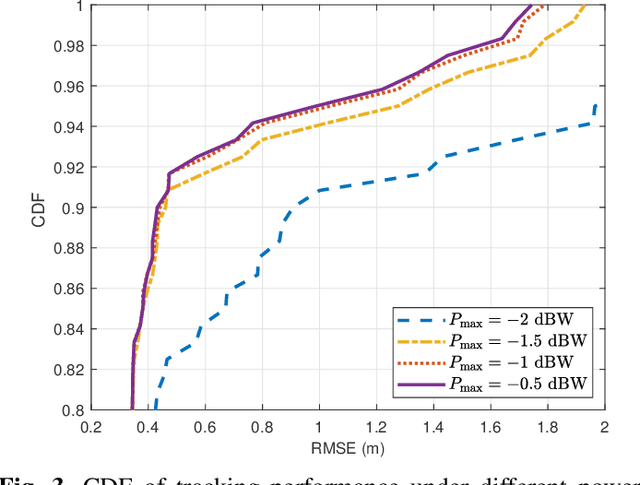
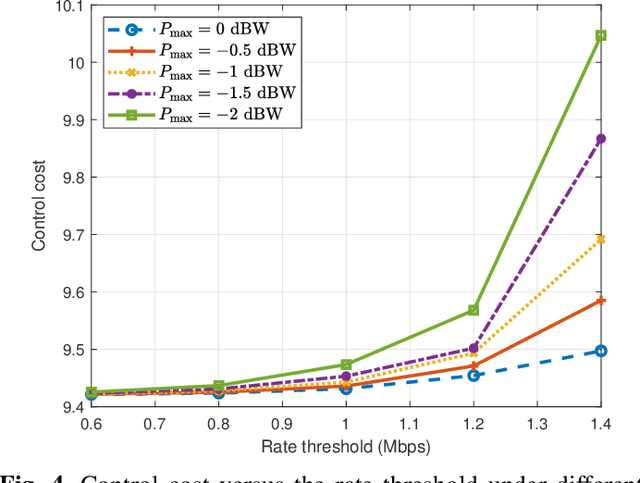
Low-altitude wireless networks (LAWNs) have been envisioned as flexible and transformative platforms for enabling delay-sensitive control applications in Internet of Things (IoT) systems. In this work, we investigate the real-time wireless control over a LAWN system, where an aerial drone is employed to serve multiple mobile automated guided vehicles (AGVs) via finite blocklength (FBL) transmission. Toward this end, we adopt the model predictive control (MPC) to ensure accurate trajectory tracking, while we analyze the communication reliability using the outage probability. Subsequently, we formulate an optimization problem to jointly determine control policy, transmit power allocation, and drone trajectory by accounting for the maximum travel distance and control input constraints. To address the resultant non-convex optimization problem, we first derive the closed-form expression of the outage probability under FBL transmission. Based on this, we reformulate the original problem as a quadratic programming (QP) problem, followed by developing an alternating optimization (AO) framework. Specifically, we employ the projected gradient descent (PGD) method and the successive convex approximation (SCA) technique to achieve computationally efficient sub-optimal solutions. Furthermore, we thoroughly analyze the convergence and computational complexity of the proposed algorithm. Extensive simulations and AirSim-based experiments are conducted to validate the superiority of our proposed approach compared to the baseline schemes in terms of control performance.
Token Communication in the Era of Large Models: An Information Bottleneck-Based Approach
Jul 02, 2025This letter proposes UniToCom, a unified token communication paradigm that treats tokens as the fundamental units for both processing and wireless transmission. Specifically, to enable efficient token representations, we propose a generative information bottleneck (GenIB) principle, which facilitates the learning of tokens that preserve essential information while supporting reliable generation across multiple modalities. By doing this, GenIB-based tokenization is conducive to improving the communication efficiency and reducing computational complexity. Additionally, we develop $\sigma$-GenIB to address the challenges of variance collapse in autoregressive modeling, maintaining representational diversity and stability. Moreover, we employ a causal Transformer-based multimodal large language model (MLLM) at the receiver to unify the processing of both discrete and continuous tokens under the next-token prediction paradigm. Simulation results validate the effectiveness and superiority of the proposed UniToCom compared to baselines under dynamic channel conditions. By integrating token processing with MLLMs, UniToCom enables scalable and generalizable communication in favor of multimodal understanding and generation, providing a potential solution for next-generation intelligent communications.
Stacked Intelligent Metasurfaces for Multi-Modal Semantic Communications
Jun 14, 2025Semantic communication (SemCom) powered by generative artificial intelligence enables highly efficient and reliable information transmission. However, it still necessitates the transmission of substantial amounts of data when dealing with complex scene information. In contrast, the stacked intelligent metasurface (SIM), leveraging wave-domain computing, provides a cost-effective solution for directly imaging complex scenes. Building on this concept, we propose an innovative SIM-aided multi-modal SemCom system. Specifically, an SIM is positioned in front of the transmit antenna for transmitting visual semantic information of complex scenes via imaging on the uniform planar array at the receiver. Furthermore, the simple scene description that contains textual semantic information is transmitted via amplitude-phase modulation over electromagnetic waves. To simultaneously transmit multi-modal information, we optimize the amplitude and phase of meta-atoms in the SIM using a customized gradient descent algorithm. The optimization aims to gradually minimize the mean squared error between the normalized energy distribution on the receiver array and the desired pattern corresponding to the visual semantic information. By combining the textual and visual semantic information, a conditional generative adversarial network is used to recover the complex scene accurately. Extensive numerical results verify the effectiveness of the proposed multi-modal SemCom system in reducing bandwidth overhead as well as the capability of the SIM for imaging the complex scene.