 Add to Chrome
 Add to Firefox
 Add to Edge
Rethinking Wireless Communications through Formal Mathematical AI Reasoning
Apr 28, 2026
Mathematical analysis has long underpinned wireless communication theory, yet the growing complexity of next-generation systems demands increasingly sophisticated reasoning from domain experts. Recent advances in AI mathematical reasoning, from formal theorem proving to large language model (LLM)-based derivation, offer a promising but largely unexplored path forward. Here we argue that wireless communications is a uniquely structured domain for formal AI reasoning, and propose a three-layer framework of verification, derivation, and discovery to rethink how wireless mathematical knowledge is established.

Intelligent Forensics in Next-Generation Mobile Networks: Evidence, Methods, and Applications
Mar 31, 2026This survey examines intelligent forensics in next-generation mobile networks, arguing that future wireless security must move beyond real-time detection toward accountable post-incident reconstruction. Unlike traditional digital forensics, wireless investigations rely on short-lived, distributed, and heterogeneous evidence, including radio waveforms, channel measurements, device-side artifacts, and network telemetry, affected by calibration, timing uncertainty, privacy constraints, and adversarial manipulation. To address this limitation, this paper develops an evidence-centric framework that treats wireless measurements as first-class forensic artifacts and organizes the field through a unified taxonomy spanning physical-layer, device-layer, network-layer, and cross-layer forensics. We further systematize the forensic workflow into readiness and preservation-by-design, acquisition, correlation and analysis, and reporting and reproducibility, while comparing the complementary roles of traditional methods and artificial intelligence-assisted techniques. Subsequently, we review major application areas, including anomaly discovery, attribution, provenance and localization, authenticity verification, and timeline reconstruction. Finally, we identify key open challenges, including domain shift, resource-aware evidence capture, and the benefits and admissibility risks of generative evidence. Overall, this paper positions wireless forensics as a foundational capability for trustworthy, auditable, and reproducible security in next-generation wireless systems. Readers can understand and streamline wireless forensics processes for specific applications, such as low-altitude wireless networks, vehicular communications, and edge general intelligence.
From Digital Twins to World Models:Opportunities, Challenges, and Applications for Mobile Edge General Intelligence
Mar 18, 2026The rapid evolution toward 6G and beyond communication systems is accelerating the convergence of digital twins and world models at the network edge. Traditional digital twins provide high-fidelity representations of physical systems and support monitoring, analysis, and offline optimization. However, in highly dynamic edge environments, they face limitations in autonomy, adaptability, and scalability. This paper presents a systematic survey of the transition from digital twins to world models and discusses its role in enabling edge general intelligence (EGI). First, the paper clarifies the conceptual differences between digital twins and world models and highlights the shift from physics-based, centralized, and system-centric replicas to data-driven, decentralized, and agent-centric internal models. This discussion helps readers gain a clear understanding of how this transition enables more adaptive, autonomous, and resource-efficient intelligence at the network edge. The paper reviews the design principles, architectures, and key components of world models, including perception, latent state representation, dynamics learning, imagination-based planning, and memory. In addition, it examines the integration of world models and digital twins in wireless EGI systems and surveys emerging applications in integrated sensing and communications, semantic communication, air-ground networks, and low-altitude wireless networks. Finally, this survey provides a systematic roadmap and practical insights for designing world-model-driven edge intelligence systems in wireless and edge computing environments. It also outlines key research challenges and future directions toward scalable, reliable, and interoperable world models for edge-native agentic AI.
Leveraging Large Vision Model for Multi-UAV Co-perception in Low-Altitude Wireless Networks
Mar 13, 2026Multi-uncrewed aerial vehicle (UAV) cooperative perception has emerged as a promising paradigm for diverse low-altitude economy applications, where complementary multi-view observations are leveraged to enhance perception performance via wireless communications. However, the massive visual data generated by multiple UAVs poses significant challenges in terms of communication latency and resource efficiency. To address these challenges, this paper proposes a communication-efficient cooperative perception framework, termed Base-Station-Helped UAV (BHU), which reduces communication overhead while enhancing perception performance. Specifically, we employ a Top-K selection mechanism to identify the most informative pixels from UAV-captured RGB images, enabling sparsified visual transmission with reduced data volume and latency. The sparsified images are transmitted to a ground server via multi-user MIMO (MU-MIMO), where a Swin-large-based MaskDINO encoder extracts bird's-eye-view (BEV) features and performs cooperative feature fusion for ground vehicle perception. Furthermore, we develop a diffusion model-based deep reinforcement learning (DRL) algorithm to jointly select cooperative UAVs, sparsification ratios, and precoding matrices, achieving a balance between communication efficiency and perception utility. Simulation results on the Air-Co-Pred dataset demonstrate that, compared with traditional CNN-based BEV fusion baselines, the proposed BHU framework improves perception performance by over 5% while reducing communication overhead by 85%, providing an effective solution for multi-UAV cooperative perception under resource-constrained wireless environments.
Wireless Context Engineering for Efficient Mobile Agentic AI and Edge General Intelligence
Feb 07, 2026Future wireless networks demand increasingly powerful intelligence to support sensing, communication, and autonomous decision-making. While scaling laws suggest improving performance by enlarging model capacity, practical edge deployments are fundamentally constrained by latency, energy, and memory, making unlimited model scaling infeasible. This creates a critical need to maximize the utility of limited inference-time inputs by filtering redundant observations and focusing on high-impact data. In large language models and generative artificial intelligence (AI), context engineering has emerged as a key paradigm to guide inference by selectively structuring and injecting task-relevant information. Inspired by this success, we extend context engineering to wireless systems, providing a systematic way to enhance edge AI performance without increasing model complexity. In dynamic environments, for example, beam prediction can benefit from augmenting instantaneous channel measurements with contextual cues such as user mobility trends or environment-aware propagation priors. We formally introduce wireless context engineering and propose a Wireless Context Communication Framework (WCCF) to adaptively orchestrate wireless context under inference-time constraints. This work provides researchers with a foundational perspective and practical design dimensions to manage the wireless context of wireless edge intelligence. An ISAC-enabled beam prediction case study illustrates the effectiveness of the proposed paradigm under constrained sensing budgets.
Stackelberg Game-Driven Defense for ISAC Against Channel Attacks in Low-Altitude Networks
Nov 09, 2025The increasing saturation of terrestrial resources has driven economic activities into low-altitude airspace. These activities, such as air taxis, rely on low-altitude wireless networks, and one key enabling technology is integrated sensing and communication (ISAC). However, in low-altitude airspace, ISAC is vulnerable to channel-access attacks, thereby degrading performance and threatening safety. To address this, we propose a defense framework based on a Stackelberg game. Specifically, we first model the system under attack, deriving metrics for the communication and the sensing to quantify performance. Then, we formulate the interaction as a three-player game where a malicious attacker acts as the leader, while the legitimate drone and ground base station act as followers. Using a backward induction algorithm, we obtain the Stackelberg equilibrium, allowing the defenders to dynamically adjust their strategies to mitigate the attack. Simulation results verify that the proposed algorithm converges to a stable solution and outperforms existing baselines, ensuring reliable ISAC performance for critical low-altitude applications.
Energy Efficient Trajectory Control and Resource Allocation in Multi-UAV-assisted MEC via Deep Reinforcement Learning
Aug 01, 2025Mobile edge computing (MEC) is a promising technique to improve the computational capacity of smart devices (SDs) in Internet of Things (IoT). However, the performance of MEC is restricted due to its fixed location and limited service scope. Hence, we investigate an unmanned aerial vehicle (UAV)-assisted MEC system, where multiple UAVs are dispatched and each UAV can simultaneously provide computing service for multiple SDs. To improve the performance of system, we formulated a UAV-based trajectory control and resource allocation multi-objective optimization problem (TCRAMOP) to simultaneously maximize the offloading number of UAVs and minimize total offloading delay and total energy consumption of UAVs by optimizing the flight paths of UAVs as well as the computing resource allocated to served SDs. Then, consider that the solution of TCRAMOP requires continuous decision-making and the system is dynamic, we propose an enhanced deep reinforcement learning (DRL) algorithm, namely, distributed proximal policy optimization with imitation learning (DPPOIL). This algorithm incorporates the generative adversarial imitation learning technique to improve the policy performance. Simulation results demonstrate the effectiveness of our proposed DPPOIL and prove that the learned strategy of DPPOIL is better compared with other baseline methods.
Temporal Spectrum Cartography in Low-Altitude Economy Networks: A Generative AI Framework with Multi-Agent Learning
May 21, 2025This paper introduces a two-stage generative AI (GenAI) framework tailored for temporal spectrum cartography in low-altitude economy networks (LAENets). LAENets, characterized by diverse aerial devices such as UAVs, rely heavily on wireless communication technologies while facing challenges, including spectrum congestion and dynamic environmental interference. Traditional spectrum cartography methods have limitations in handling the temporal and spatial complexities inherent to these networks. Addressing these challenges, the proposed framework first employs a Reconstructive Masked Autoencoder (RecMAE) capable of accurately reconstructing spectrum maps from sparse and temporally varying sensor data using a novel dual-mask mechanism. This approach significantly enhances the precision of reconstructed radio frequency (RF) power maps. In the second stage, the Multi-agent Diffusion Policy (MADP) method integrates diffusion-based reinforcement learning to optimize the trajectories of dynamic UAV sensors. By leveraging temporal-attention encoding, this method effectively manages spatial exploration and exploitation to minimize cumulative reconstruction errors. Extensive numerical experiments validate that this integrated GenAI framework outperforms traditional interpolation methods and deep learning baselines by achieving 57.35% and 88.68% reconstruction error reduction, respectively. The proposed trajectory planner substantially improves spectrum map accuracy, reconstruction stability, and sensor deployment efficiency in dynamically evolving low-altitude environments.
Decentralization of Generative AI via Mixture of Experts for Wireless Networks: A Comprehensive Survey
Apr 28, 2025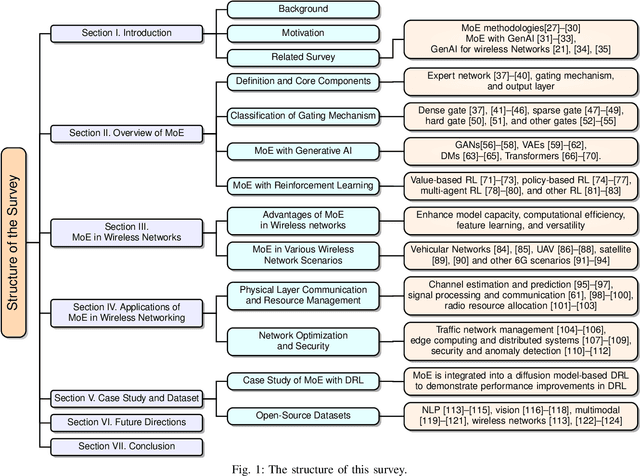
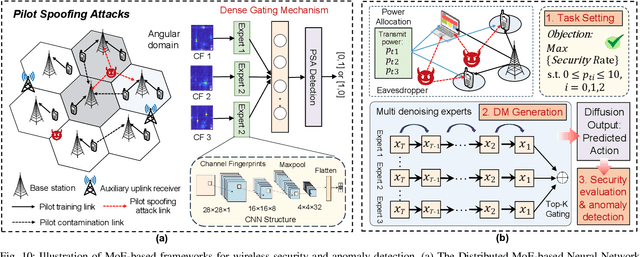
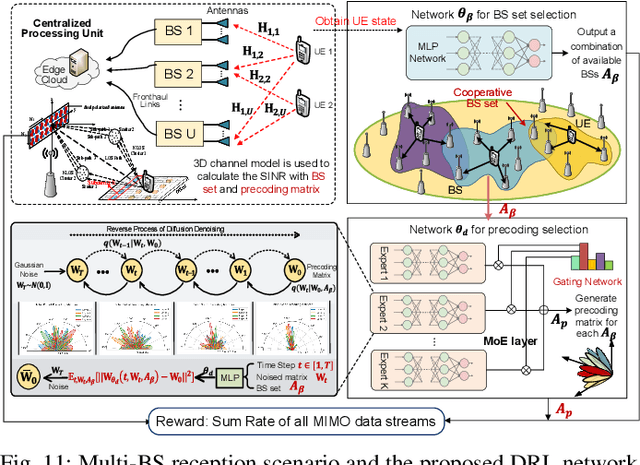
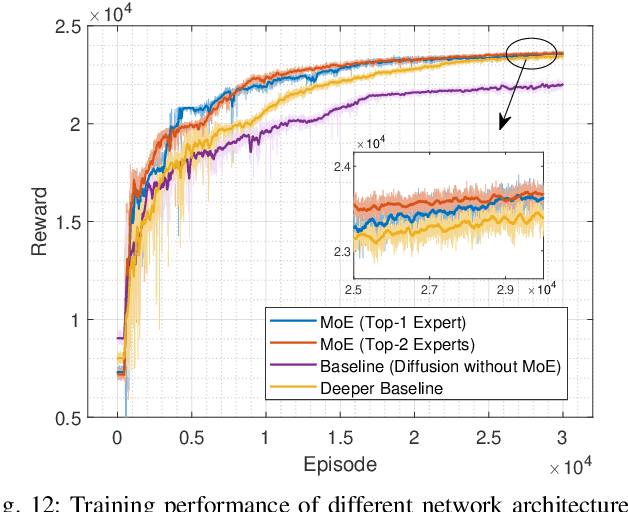
Mixture of Experts (MoE) has emerged as a promising paradigm for scaling model capacity while preserving computational efficiency, particularly in large-scale machine learning architectures such as large language models (LLMs). Recent advances in MoE have facilitated its adoption in wireless networks to address the increasing complexity and heterogeneity of modern communication systems. This paper presents a comprehensive survey of the MoE framework in wireless networks, highlighting its potential in optimizing resource efficiency, improving scalability, and enhancing adaptability across diverse network tasks. We first introduce the fundamental concepts of MoE, including various gating mechanisms and the integration with generative AI (GenAI) and reinforcement learning (RL). Subsequently, we discuss the extensive applications of MoE across critical wireless communication scenarios, such as vehicular networks, unmanned aerial vehicles (UAVs), satellite communications, heterogeneous networks, integrated sensing and communication (ISAC), and mobile edge networks. Furthermore, key applications in channel prediction, physical layer signal processing, radio resource management, network optimization, and security are thoroughly examined. Additionally, we present a detailed overview of open-source datasets that are widely used in MoE-based models to support diverse machine learning tasks. Finally, this survey identifies crucial future research directions for MoE, emphasizing the importance of advanced training techniques, resource-aware gating strategies, and deeper integration with emerging 6G technologies.
Generative AI-enabled Wireless Communications for Robust Low-Altitude Economy Networking
Feb 25, 2025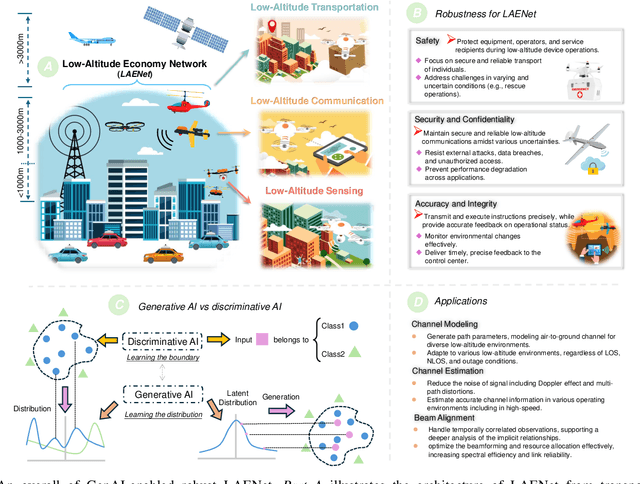
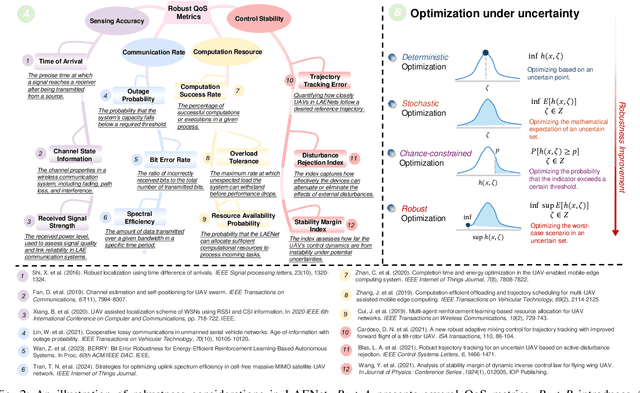
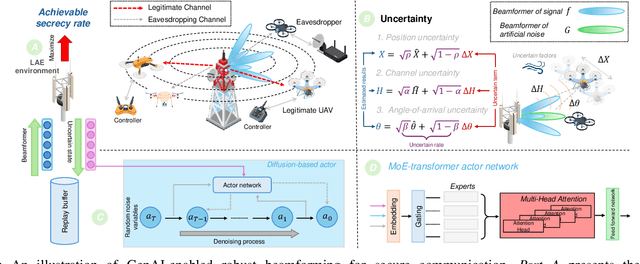
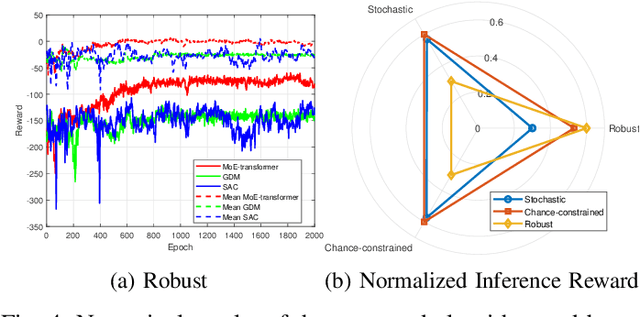
Low-Altitude Economy Networks (LAENets) have emerged as significant enablers of social activities, offering low-altitude services such as the transportation of packages, groceries, and medical supplies. Unlike traditional terrestrial networks, LAENets are characterized by control mechanisms and ever-changing operational factors, which make them more complex and susceptible to vulnerabilities. As applications of LAENet continue to expand, robustness of these systems becomes crucial. In this paper, we investigate a novel application of Generative Artificial Intelligence (GenAI) to improve the robustness of LAENets. We conduct a systematic analysis of robustness requirements for LAENets, complemented by a comprehensive review of robust Quality of Service (QoS) metrics from the wireless physical layer perspective. We then investigate existing GenAI-enabled approaches for robustness enhancement. This leads to our proposal of a novel diffusion-based optimization framework with a Mixture of Expert (MoE)-transformer actor network. In the robust beamforming case study, the proposed framework demonstrates its effectiveness by optimizing beamforming under uncertainties, achieving a more than 44% increase in the worst-case achievable secrecy rate. These findings highlight the significant potential of GenAI in strengthening LAENet robustness.