 Add to Chrome
 Add to Firefox
 Add to Edge
Hi-Token: Hierarchical Coordinate Tokenization for Generative Visual Grounding
Aug 04, 2026
Generative Vision-Language Models (VLMs) commonly treat bounding-box coordinates as independent output symbols, leaving numerical order and axis semantics implicit. We identify this representation as an important source of error in visual grounding. Hi-Token encodes each coordinate with axis-specific tokens for the hundreds, tens, and ones digits, which adds coarse-to-fine structure and increases token reuse while retaining the existing VLM architecture. Hi-GAR complements this representation with a geometry-based reward for Group Relative Policy Optimization (GRPO), using box overlap and coordinate accuracy at multiple scales. Controlled comparisons under matched training conditions show that Hi-Token improves localization throughout the evaluated IoU range. Hi-GAR further reduces low-overlap predictions and is used only during training. Experiments on three VLM backbones and the RefCOCO family show consistent gains across models and benchmarks. Hi-R1 achieves higher values than strong specialist baselines on most reported metrics. Analyses of token frequency, digit boundaries, object scale, and IoU distributions explain the effects of coordinate representation and reward training. The results show that structured coordinate generation provides an effective approach to generative visual grounding.

IoUPD: IoU-Aware Privileged Distillation for Visual Grounding with Multimodal Large Language Models
Jul 17, 2026Visual grounding with multimodal large language models is commonly formulated as autoregressive coordinate generation, where a model outputs bounding-box coordinates as text given an image and a referring-expression prompt. While this interface is simple and compatible with instruction following, it introduces a mismatch between training and evaluation: training optimizes token-level likelihood over coordinate strings, whereas grounding quality is measured by geometric overlap. We propose IoUPD, an IoU-aware privileged distillation method for coordinate-generating multimodal large language models. IoUPD uses ground-truth boxes not only as coordinate targets, but also as privileged training-time guidance. During training, the student receives the original image and prompt, while a frozen teacher receives a box-marked image and an augmented prompt that indicates the marked region. The student is trained with a supervised fine-tuning anchor and a privileged distillation loss whose token weights reflect both geometric importance and teacher reliability. At inference time, IoUPD requires no box overlay, privileged hint, teacher branch, or additional prediction module. Experiments on standard referring-expression grounding benchmarks show consistent region-level improvements over strong coordinate-generating baselines, demonstrating that ground-truth boxes can provide useful privileged guidance beyond serving as coordinate labels.
QueryGaussian: Scalable and Training-Free Open-Vocabulary 3D Instance Retrieval
Jun 18, 2026Efficiently retrieving specific 3D instances from large-scale scenes via natural language prompts remains a formidable challenge in multimedia analysis. Existing approaches predominantly follow a "scene-level embedding" paradigm, which requires distilling high-dimensional semantic features into every 3D primitive. This strategy suffers from a fundamental architectural bottleneck: memory and computational costs scale linearly with scene complexity, inevitably triggering out-of-memory (OOM) failures in city-scale environments. To address this barrier, we propose QueryGaussian, a training-free framework for expeditious and scalable open-vocabulary 3D instance retrieval. Unlike holistic semantic distillation, QueryGaussian employs an instance-level query mechanism that decouples semantic understanding from geometric representation. Specifically, we leverage pre-trained 2D vision models to interpret user prompts and lift segmentation masks into 3D via a concurrent maximum-weight association strategy, ensuring semantic-visual consistency. To mitigate projection ambiguity, we introduce a temporal fusion module with multi-stage adaptive density clustering. Experimental results demonstrate that QueryGaussian not only matches the accuracy of state-of-the-art methods but also delivers a decisive efficiency leap, reducing GPU memory usage by over 70% and accelerating inference by 180x. Crucially, QueryGaussian enables expeditious instance retrieval on city-scale scenes containing tens of millions of Gaussians using consumer-grade hardware.
Dual Causal Inference: Integrating Backdoor Adjustment and Instrumental Variable Learning for Medical VQA
Apr 22, 2026Medical Visual Question Answering (MedVQA) aims to generate clinically reliable answers conditioned on complex medical images and questions. However, existing methods often overfit to superficial cross-modal correlations, neglecting the intrinsic biases embedded in multimodal medical data. Consequently, models become vulnerable to cross-modal confounding effects, severely hindering their ability to provide trustworthy diagnostic reasoning. To address this limitation, we propose a novel Dual Causal Inference (DCI) framework for MedVQA. To the best of our knowledge, DCI is the first unified architecture that integrates Backdoor Adjustment (BDA) and Instrumental Variable (IV) learning to jointly tackle both observable and unobserved confounders. Specifically, we formulate a Structural Causal Model (SCM) where observable cross-modal biases (e.g., frequent visual and textual co-occurrences) are mitigated via BDA, while unobserved confounders are compensated using an IV learned from a shared latent space. To guarantee the validity of the IV, we design mutual information constraints that maximize its dependence on the fused multimodal representations while minimizing its associations with the unobserved confounders and target answers. Through this dual mechanism, DCI extracts deconfounded representations that capture genuine causal relationships. Extensive experiments on four benchmark datasets, SLAKE, SLAKE-CP, VQA-RAD, and PathVQA, demonstrate that our method consistently outperforms existing approaches, particularly in out-of-distribution (OOD) generalization. Furthermore, qualitative analyses confirm that DCI significantly enhances the interpretability and robustness of cross-modal reasoning by explicitly disentangling true causal effects from spurious cross-modal shortcuts.
Clinically Interpretable Sepsis Early Warning via LLM-Guided Simulation of Temporal Physiological Dynamics
Apr 22, 2026Timely and interpretable early warning of sepsis remains a major clinical challenge due to the complex temporal dynamics of physiological deterioration. Traditional data-driven models often provide accurate yet opaque predictions, limiting physicians' confidence and clinical applicability. To address this limitation, we propose a Large Language Model (LLM)-guided temporal simulation framework that explicitly models physiological trajectories prior to disease onset for clinically interpretable prediction. The framework consists of a spatiotemporal feature extraction module that captures dynamic dependencies among multivariate vital signs, a Medical Prompt-as-Prefix module that embeds clinical reasoning cues into LLMs, and an agent-based post-processing component that constrains predictions within physiologically plausible ranges. By first simulating the evolution of key physiological indicators and then classifying sepsis onset, our model offers transparent prediction mechanisms that align with clinical judgment. Evaluated on the MIMIC-IV and eICU databases, the proposed method achieves superior AUC scores (0.861-0.903) across 24-4-hour pre-onset prediction tasks, outperforming conventional deep learning and rule-based approaches. More importantly, it provides interpretable trajectories and risk trends that can assist clinicians in early intervention and personalized decision-making in intensive care environments.
Decoupled Hierarchical Distillation for Multimodal Emotion Recognition
Feb 04, 2026Human multimodal emotion recognition (MER) seeks to infer human emotions by integrating information from language, visual, and acoustic modalities. Although existing MER approaches have achieved promising results, they still struggle with inherent multimodal heterogeneities and varying contributions from different modalities. To address these challenges, we propose a novel framework, Decoupled Hierarchical Multimodal Distillation (DHMD). DHMD decouples each modality's features into modality-irrelevant (homogeneous) and modality-exclusive (heterogeneous) components using a self-regression mechanism. The framework employs a two-stage knowledge distillation (KD) strategy: (1) coarse-grained KD via a Graph Distillation Unit (GD-Unit) in each decoupled feature space, where a dynamic graph facilitates adaptive distillation among modalities, and (2) fine-grained KD through a cross-modal dictionary matching mechanism, which aligns semantic granularities across modalities to produce more discriminative MER representations. This hierarchical distillation approach enables flexible knowledge transfer and effectively improves cross-modal feature alignment. Experimental results demonstrate that DHMD consistently outperforms state-of-the-art MER methods, achieving 1.3\%/2.4\% (ACC$_7$), 1.3\%/1.9\% (ACC$_2$) and 1.9\%/1.8\% (F1) relative improvement on CMU-MOSI/CMU-MOSEI dataset, respectively. Meanwhile, visualization results reveal that both the graph edges and dictionary activations in DHMD exhibit meaningful distribution patterns across modality-irrelevant/-exclusive feature spaces.
* arXiv admin note: text overlap with arXiv:2303.13802
Enhancing Black-Litterman Portfolio via Hybrid Forecasting Model Combining Multivariate Decomposition and Noise Reduction
May 03, 2025The sensitivity to input parameters and lack of flexibility limits the traditional Mean-Variance model. In contrast, the Black-Litterman model has attracted widespread attention by integrating market equilibrium returns with investors' subjective views. This paper proposes a novel hybrid deep learning model combining Singular Spectrum analysis (SSA), Multivariate Aligned Empirical Mode Decomposition (MA-EMD), and Temporal Convolutional Networks (TCNs), aiming to improve the prediction accuracy of asset prices and thus enhance the ability of the Black-Litterman model to generate subjective views. Experimental results show that noise reduction pre-processing can improve the model's accuracy, and the prediction performance of the proposed model is significantly better than that of three multivariate decomposition benchmark models. We construct an investment portfolio by using 20 representative stocks from the NASDAQ 100 index. By combining the hybrid forecasting model with the Black-Litterman model, the generated investment portfolio exhibits better returns and risk control capabilities than the Mean-Variance, Equal-Weighted, and Market-Weighted models in the short holding period.
MambaDETR: Query-based Temporal Modeling using State Space Model for Multi-View 3D Object Detection
Nov 20, 2024
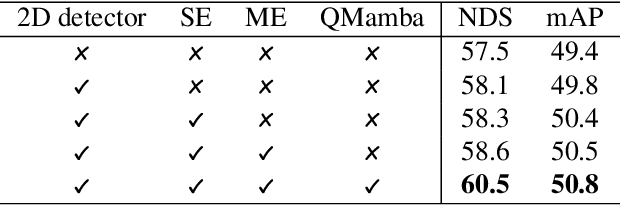
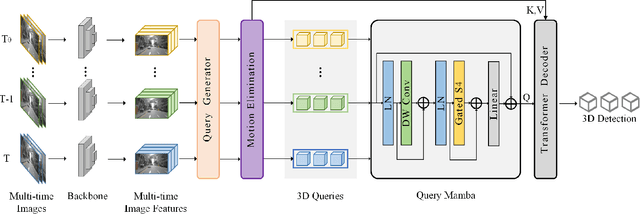
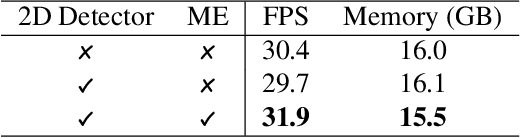
Utilizing temporal information to improve the performance of 3D detection has made great progress recently in the field of autonomous driving. Traditional transformer-based temporal fusion methods suffer from quadratic computational cost and information decay as the length of the frame sequence increases. In this paper, we propose a novel method called MambaDETR, whose main idea is to implement temporal fusion in the efficient state space. Moreover, we design a Motion Elimination module to remove the relatively static objects for temporal fusion. On the standard nuScenes benchmark, our proposed MambaDETR achieves remarkable result in the 3D object detection task, exhibiting state-of-the-art performance among existing temporal fusion methods.
MVLLaVA: An Intelligent Agent for Unified and Flexible Novel View Synthesis
Sep 11, 2024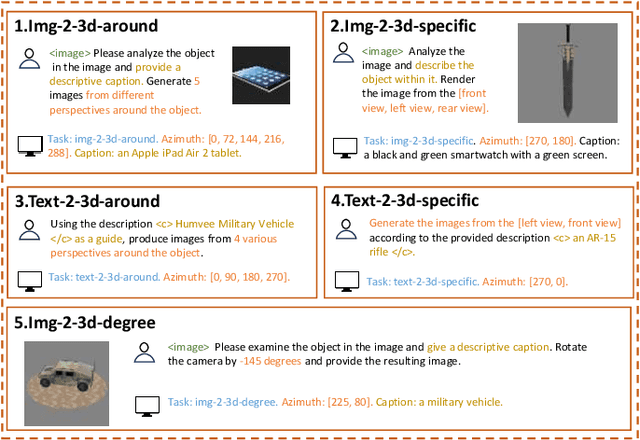

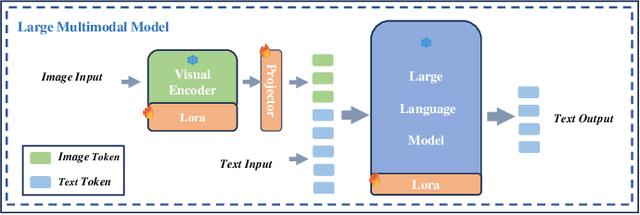
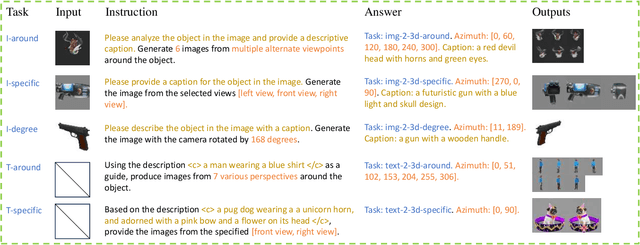
This paper introduces MVLLaVA, an intelligent agent designed for novel view synthesis tasks. MVLLaVA integrates multiple multi-view diffusion models with a large multimodal model, LLaVA, enabling it to handle a wide range of tasks efficiently. MVLLaVA represents a versatile and unified platform that adapts to diverse input types, including a single image, a descriptive caption, or a specific change in viewing azimuth, guided by language instructions for viewpoint generation. We carefully craft task-specific instruction templates, which are subsequently used to fine-tune LLaVA. As a result, MVLLaVA acquires the capability to generate novel view images based on user instructions, demonstrating its flexibility across diverse tasks. Experiments are conducted to validate the effectiveness of MVLLaVA, demonstrating its robust performance and versatility in tackling diverse novel view synthesis challenges.
ExpLLM: Towards Chain of Thought for Facial Expression Recognition
Sep 04, 2024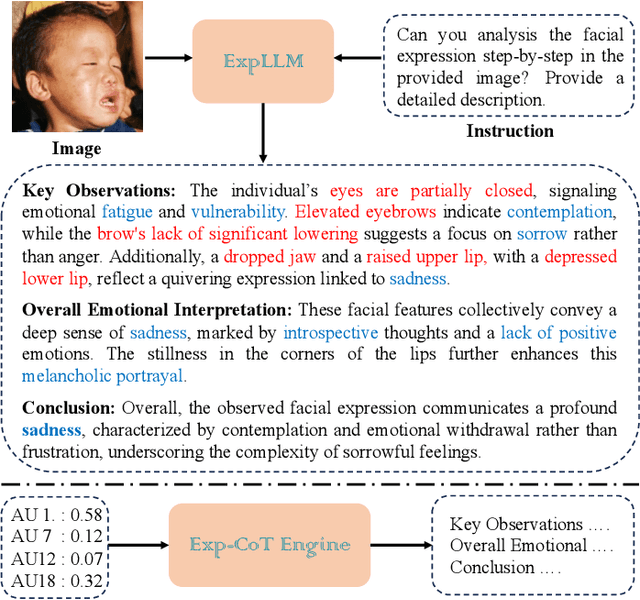
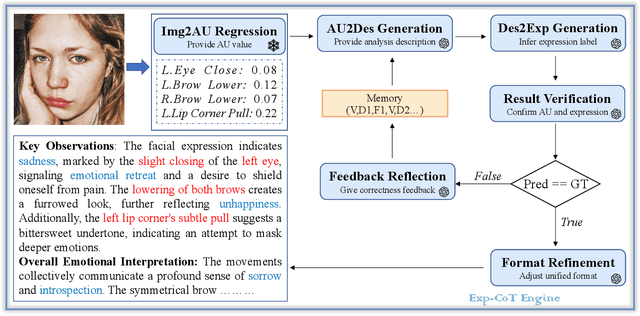

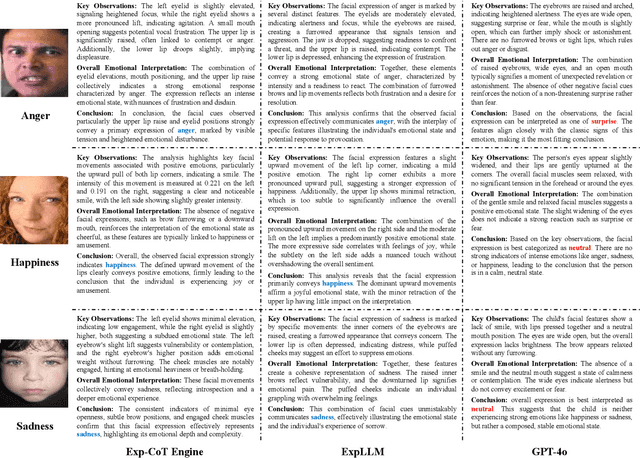
Facial expression recognition (FER) is a critical task in multimedia with significant implications across various domains. However, analyzing the causes of facial expressions is essential for accurately recognizing them. Current approaches, such as those based on facial action units (AUs), typically provide AU names and intensities but lack insight into the interactions and relationships between AUs and the overall expression. In this paper, we propose a novel method called ExpLLM, which leverages large language models to generate an accurate chain of thought (CoT) for facial expression recognition. Specifically, we have designed the CoT mechanism from three key perspectives: key observations, overall emotional interpretation, and conclusion. The key observations describe the AU's name, intensity, and associated emotions. The overall emotional interpretation provides an analysis based on multiple AUs and their interactions, identifying the dominant emotions and their relationships. Finally, the conclusion presents the final expression label derived from the preceding analysis. Furthermore, we also introduce the Exp-CoT Engine, designed to construct this expression CoT and generate instruction-description data for training our ExpLLM. Extensive experiments on the RAF-DB and AffectNet datasets demonstrate that ExpLLM outperforms current state-of-the-art FER methods. ExpLLM also surpasses the latest GPT-4o in expression CoT generation, particularly in recognizing micro-expressions where GPT-4o frequently fails.