 Add to Chrome
 Add to Firefox
 Add to Edge
DailyBench: A Unified Benchmark for AI-Generated and Manipulated Images from Modern Generative Models
Jul 27, 2026
Recent advances in generative models have shifted AI-generated image detection from identifying easily distinguishable, fully synthetic images to identifying highly realistic content generated by both modern generation and manipulation pipelines. However, existing detection benchmarks are often built with outdated generative models and primarily emphasize full-image synthesis, creating a growing mismatch between benchmark data and the images encountered in real-world generation and editing scenarios. To bridge this gap, we introduce DailyBench, a high-quality unified benchmark for evaluating whether AI-generated image detectors can generalize across both modern full-image synthesis and object-level manipulation. DailyBench contains two complementary subsets: FakeBench, which includes high-quality images synthesized by recent open-source and commercial generative models, and ManipulationBench, which introduces challenging object-level edits applied to real images using advanced image-conditional models. This design makes DailyBench a realistic testbed for studying both generator-level generalization and manipulation-aware detection under subtle local edits. Experiments on DailyBench reveal substantial robustness gaps in current detectors: methods reporting 91-96% balanced accuracy on GenImage drop to 60-76% on FakeBench and 54-66% on ManipulationBench. These results show that existing detectors remain poorly generalized to realistic synthesis and manipulation, highlighting DailyBench as a rigorous testbed for developing robust and manipulation-aware AI-generated image detection methods. The project is available at https://dailybench.github.io/

Spatiotemporal-Untrammelled Mixture of Experts for Multi-Person Motion Prediction
Dec 25, 2025Comprehensively and flexibly capturing the complex spatio-temporal dependencies of human motion is critical for multi-person motion prediction. Existing methods grapple with two primary limitations: i) Inflexible spatiotemporal representation due to reliance on positional encodings for capturing spatiotemporal information. ii) High computational costs stemming from the quadratic time complexity of conventional attention mechanisms. To overcome these limitations, we propose the Spatiotemporal-Untrammelled Mixture of Experts (ST-MoE), which flexibly explores complex spatio-temporal dependencies in human motion and significantly reduces computational cost. To adaptively mine complex spatio-temporal patterns from human motion, our model incorporates four distinct types of spatiotemporal experts, each specializing in capturing different spatial or temporal dependencies. To reduce the potential computational overhead while integrating multiple experts, we introduce bidirectional spatiotemporal Mamba as experts, each sharing bidirectional temporal and spatial Mamba in distinct combinations to achieve model efficiency and parameter economy. Extensive experiments on four multi-person benchmark datasets demonstrate that our approach not only outperforms state-of-art in accuracy but also reduces model parameter by 41.38% and achieves a 3.6x speedup in training. The code is available at https://github.com/alanyz106/ST-MoE.
EventCrab: Harnessing Frame and Point Synergy for Event-based Action Recognition and Beyond
Nov 27, 2024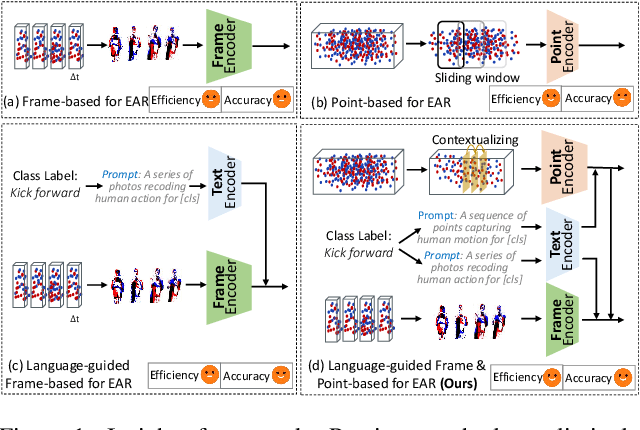
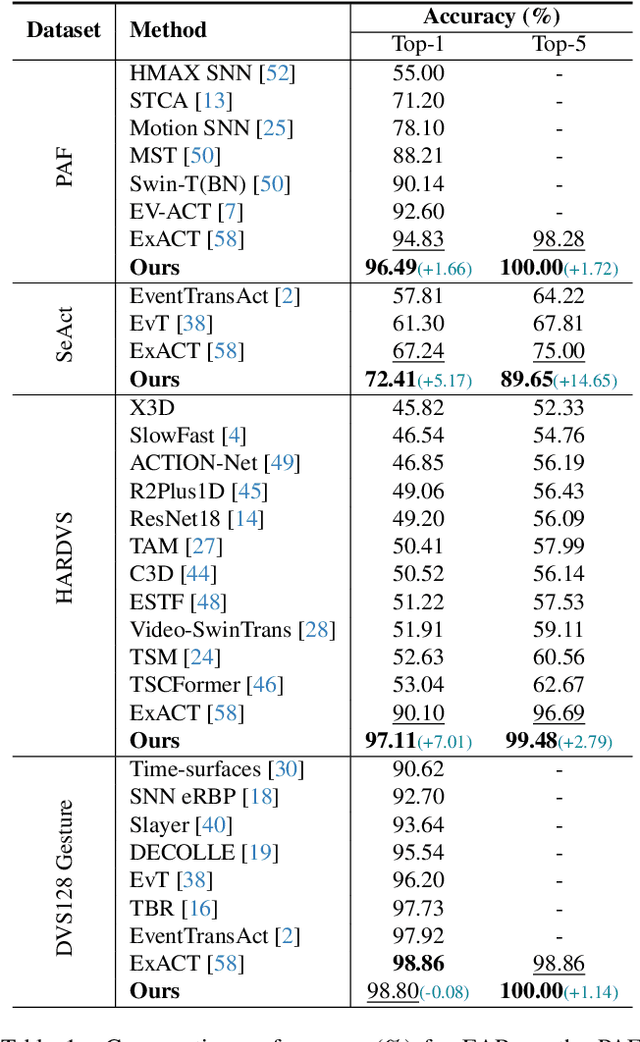


Event-based Action Recognition (EAR) possesses the advantages of high-temporal resolution capturing and privacy preservation compared with traditional action recognition. Current leading EAR solutions typically follow two regimes: project unconstructed event streams into dense constructed event frames and adopt powerful frame-specific networks, or employ lightweight point-specific networks to handle sparse unconstructed event points directly. However, such two regimes are blind to a fundamental issue: failing to accommodate the unique dense temporal and sparse spatial properties of asynchronous event data. In this article, we present a synergy-aware framework, i.e., EventCrab, that adeptly integrates the "lighter" frame-specific networks for dense event frames with the "heavier" point-specific networks for sparse event points, balancing accuracy and efficiency. Furthermore, we establish a joint frame-text-point representation space to bridge distinct event frames and points. In specific, to better exploit the unique spatiotemporal relationships inherent in asynchronous event points, we devise two strategies for the "heavier" point-specific embedding: i) a Spiking-like Context Learner (SCL) that extracts contextualized event points from raw event streams. ii) an Event Point Encoder (EPE) that further explores event-point long spatiotemporal features in a Hilbert-scan way. Experiments on four datasets demonstrate the significant performance of our proposed EventCrab, particularly gaining improvements of 5.17% on SeAct and 7.01% on HARDVS.
AdaFPP: Adapt-Focused Bi-Propagating Prototype Learning for Panoramic Activity Recognition
May 04, 2024Panoramic Activity Recognition (PAR) aims to identify multi-granularity behaviors performed by multiple persons in panoramic scenes, including individual activities, group activities, and global activities. Previous methods 1) heavily rely on manually annotated detection boxes in training and inference, hindering further practical deployment; or 2) directly employ normal detectors to detect multiple persons with varying size and spatial occlusion in panoramic scenes, blocking the performance gain of PAR. To this end, we consider learning a detector adapting varying-size occluded persons, which is optimized along with the recognition module in the all-in-one framework. Therefore, we propose a novel Adapt-Focused bi-Propagating Prototype learning (AdaFPP) framework to jointly recognize individual, group, and global activities in panoramic activity scenes by learning an adapt-focused detector and multi-granularity prototypes as the pretext tasks in an end-to-end way. Specifically, to accommodate the varying sizes and spatial occlusion of multiple persons in crowed panoramic scenes, we introduce a panoramic adapt-focuser, achieving the size-adapting detection of individuals by comprehensively selecting and performing fine-grained detections on object-dense sub-regions identified through original detections. In addition, to mitigate information loss due to inaccurate individual localizations, we introduce a bi-propagation prototyper that promotes closed-loop interaction and informative consistency across different granularities by facilitating bidirectional information propagation among the individual, group, and global levels. Extensive experiments demonstrate the significant performance of AdaFPP and emphasize its powerful applicability for PAR.