 Add to Chrome
 Add to Firefox
 Add to Edge
Teaching LLMs to Refine with Tools
Dec 22, 2024
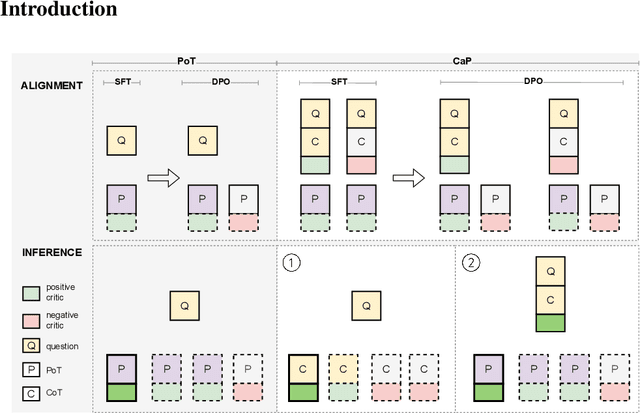
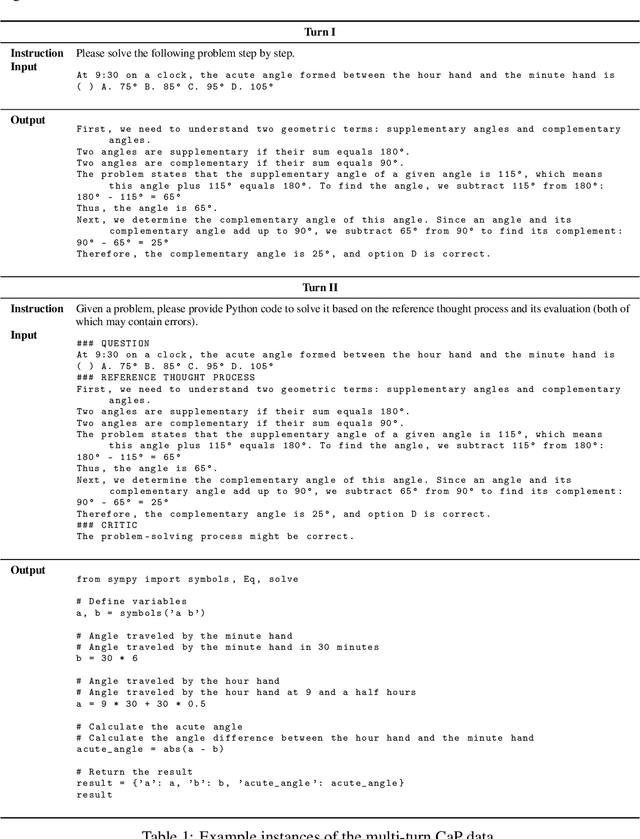
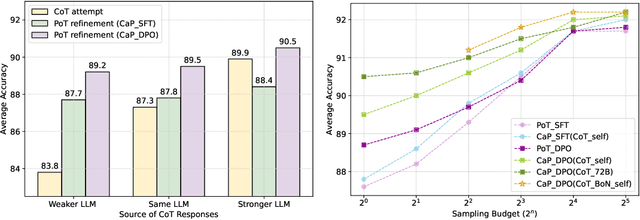
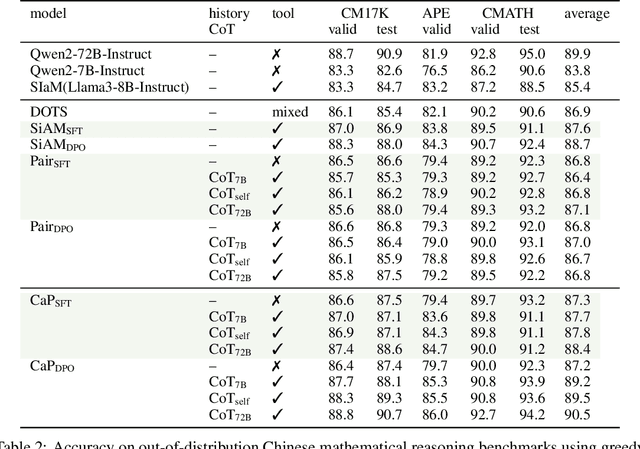
Large language models (LLMs) can refine their responses based on feedback, enabling self-improvement through iterative training or test-time refinement. However, existing methods predominantly focus on refinement within the same reasoning format, which may lead to non-correcting behaviors. We propose CaP, a novel approach that uses external tools to refine chain-of-thought (CoT) responses generated by the same or other LLMs. CaP employs a two-stage training process: supervised fine-tuning followed by preference optimization with DPO variants. Our observations highlight the critical role of preference optimization in enabling effective refinement. Additionally, we compare several sampling strategies to leverage CoT and tools at inference time. Experimental results demonstrate CaP's potential for effective cross-reasoning refinement and efficient inference.

Attention Entropy is a Key Factor: An Analysis of Parallel Context Encoding with Full-attention-based Pre-trained Language Models
Dec 21, 2024

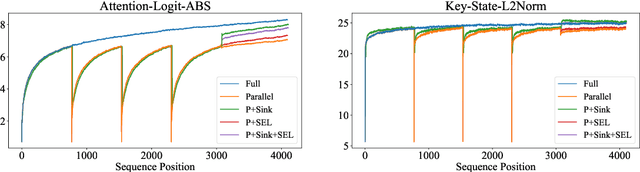
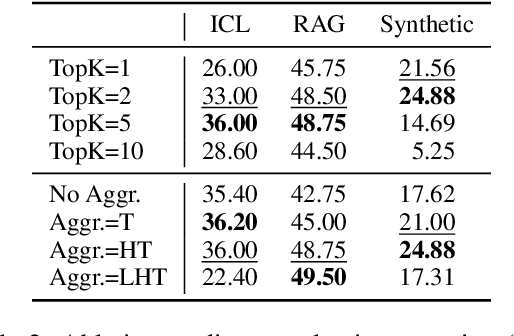
Large language models have shown remarkable performance across a wide range of language tasks, owing to their exceptional capabilities in context modeling. The most commonly used method of context modeling is full self-attention, as seen in standard decoder-only Transformers. Although powerful, this method can be inefficient for long sequences and may overlook inherent input structures. To address these problems, an alternative approach is parallel context encoding, which splits the context into sub-pieces and encodes them parallelly. Because parallel patterns are not encountered during training, naively applying parallel encoding leads to performance degradation. However, the underlying reasons and potential mitigations are unclear. In this work, we provide a detailed analysis of this issue and identify that unusually high attention entropy can be a key factor. Furthermore, we adopt two straightforward methods to reduce attention entropy by incorporating attention sinks and selective mechanisms. Experiments on various tasks reveal that these methods effectively lower irregular attention entropy and narrow performance gaps. We hope this study can illuminate ways to enhance context modeling mechanisms.
Low-Bit Quantization Favors Undertrained LLMs: Scaling Laws for Quantized LLMs with 100T Training Tokens
Nov 26, 2024

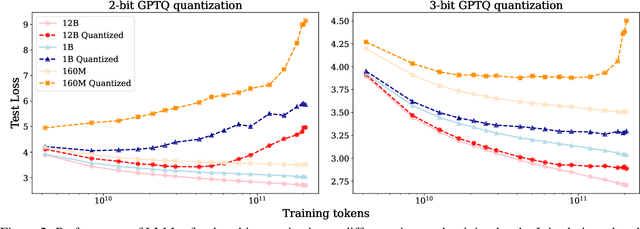
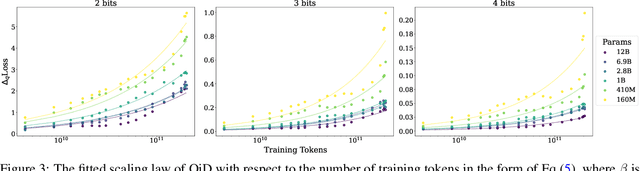
We reveal that low-bit quantization favors undertrained large language models (LLMs) by observing that models with larger sizes or fewer training tokens experience less quantization-induced degradation (QiD) when applying low-bit quantization, whereas smaller models with extensive training tokens suffer significant QiD. To gain deeper insights into this trend, we study over 1500 quantized LLM checkpoints of various sizes and at different training levels (undertrained or fully trained) in a controlled setting, deriving scaling laws for understanding the relationship between QiD and factors such as the number of training tokens, model size and bit width. With the derived scaling laws, we propose a novel perspective that we can use QiD to measure an LLM's training levels and determine the number of training tokens required for fully training LLMs of various sizes. Moreover, we use the scaling laws to predict the quantization performance of different-sized LLMs trained with 100 trillion tokens. Our projection shows that the low-bit quantization performance of future models, which are expected to be trained with over 100 trillion tokens, may NOT be desirable. This poses a potential challenge for low-bit quantization in the future and highlights the need for awareness of a model's training level when evaluating low-bit quantization research. To facilitate future research on this problem, we release all the 1500+ quantized checkpoints used in this work at https://huggingface.co/Xu-Ouyang.
Federated Incremental Named Entity Recognition
Nov 18, 2024


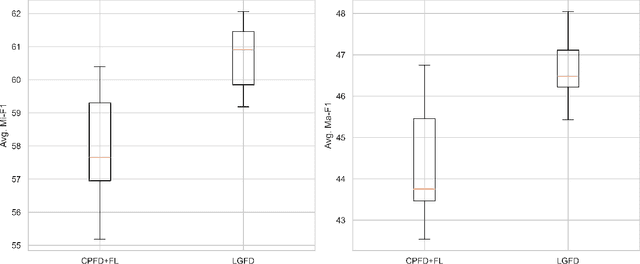
Federated Named Entity Recognition (FNER) boosts model training within each local client by aggregating the model updates of decentralized local clients, without sharing their private data. However, existing FNER methods assume fixed entity types and local clients in advance, leading to their ineffectiveness in practical applications. In a more realistic scenario, local clients receive new entity types continuously, while new local clients collecting novel data may irregularly join the global FNER training. This challenging setup, referred to here as Federated Incremental NER, renders the global model suffering from heterogeneous forgetting of old entity types from both intra-client and inter-client perspectives. To overcome these challenges, we propose a Local-Global Forgetting Defense (LGFD) model. Specifically, to address intra-client forgetting, we develop a structural knowledge distillation loss to retain the latent space's feature structure and a pseudo-label-guided inter-type contrastive loss to enhance discriminative capability over different entity types, effectively preserving previously learned knowledge within local clients. To tackle inter-client forgetting, we propose a task switching monitor that can automatically identify new entity types under privacy protection and store the latest old global model for knowledge distillation and pseudo-labeling. Experiments demonstrate significant improvement of our LGFD model over comparison methods.
Evaluating Moral Beliefs across LLMs through a Pluralistic Framework
Nov 06, 2024Proper moral beliefs are fundamental for language models, yet assessing these beliefs poses a significant challenge. This study introduces a novel three-module framework to evaluate the moral beliefs of four prominent large language models. Initially, we constructed a dataset containing 472 moral choice scenarios in Chinese, derived from moral words. The decision-making process of the models in these scenarios reveals their moral principle preferences. By ranking these moral choices, we discern the varying moral beliefs held by different language models. Additionally, through moral debates, we investigate the firmness of these models to their moral choices. Our findings indicate that English language models, namely ChatGPT and Gemini, closely mirror moral decisions of the sample of Chinese university students, demonstrating strong adherence to their choices and a preference for individualistic moral beliefs. In contrast, Chinese models such as Ernie and ChatGLM lean towards collectivist moral beliefs, exhibiting ambiguity in their moral choices and debates. This study also uncovers gender bias embedded within the moral beliefs of all examined language models. Our methodology offers an innovative means to assess moral beliefs in both artificial and human intelligence, facilitating a comparison of moral values across different cultures.
OpenWebVoyager: Building Multimodal Web Agents via Iterative Real-World Exploration, Feedback and Optimization
Oct 25, 2024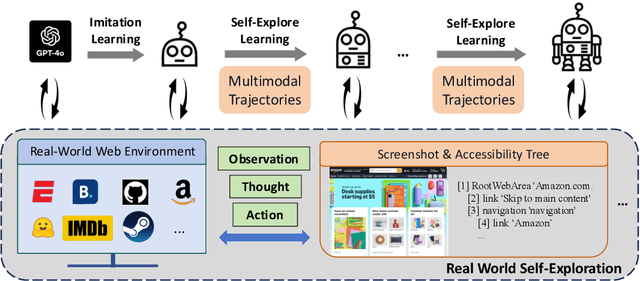
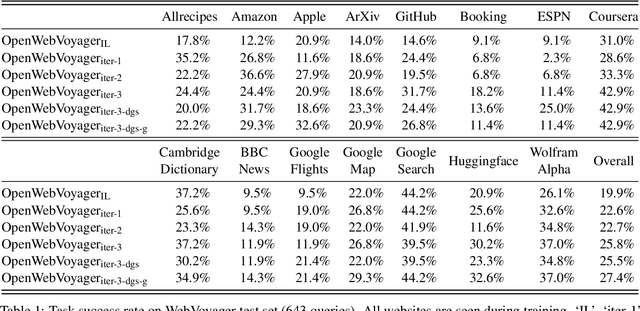

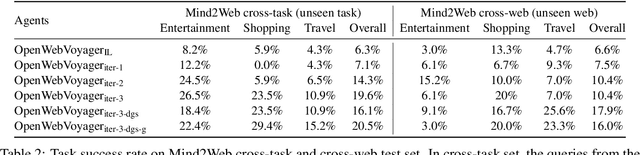
The rapid development of large language and multimodal models has sparked significant interest in using proprietary models, such as GPT-4o, to develop autonomous agents capable of handling real-world scenarios like web navigation. Although recent open-source efforts have tried to equip agents with the ability to explore environments and continuously improve over time, they are building text-only agents in synthetic environments where the reward signals are clearly defined. Such agents struggle to generalize to realistic settings that require multimodal perception abilities and lack ground-truth signals. In this paper, we introduce an open-source framework designed to facilitate the development of multimodal web agent that can autonomously conduct real-world exploration and improve itself. We first train the base model with imitation learning to gain the basic abilities. We then let the agent explore the open web and collect feedback on its trajectories. After that, it further improves its policy by learning from well-performing trajectories judged by another general-purpose model. This exploration-feedback-optimization cycle can continue for several iterations. Experimental results show that our web agent successfully improves itself after each iteration, demonstrating strong performance across multiple test sets.
LoGU: Long-form Generation with Uncertainty Expressions
Oct 18, 2024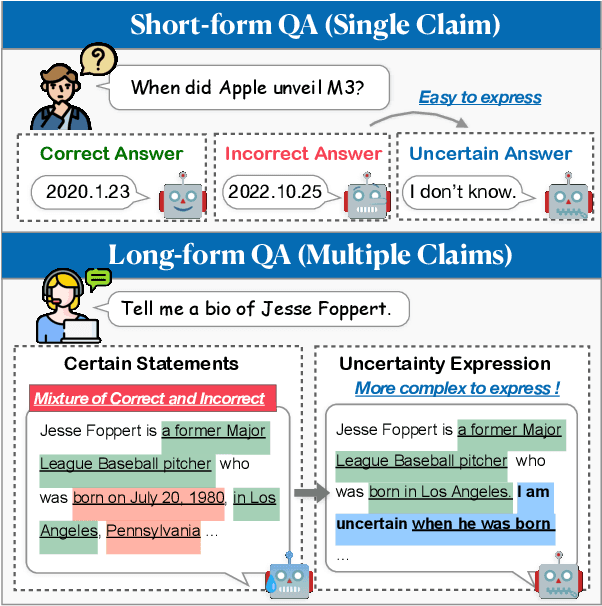
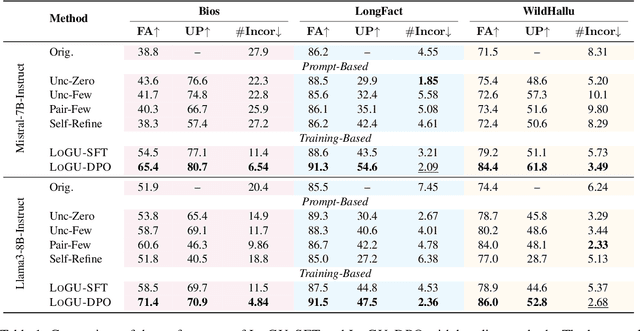
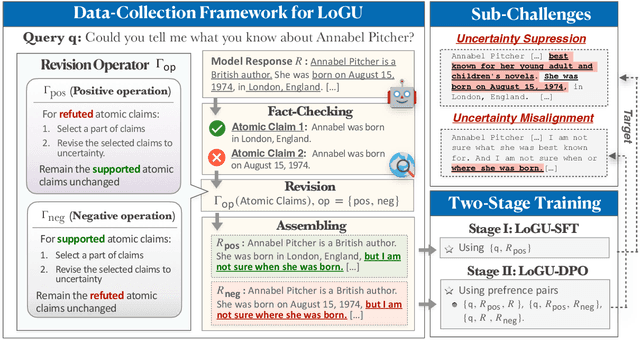
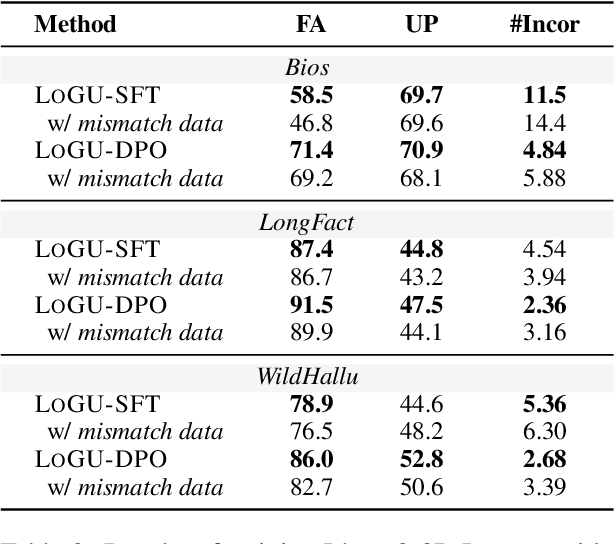
While Large Language Models (LLMs) demonstrate impressive capabilities, they still struggle with generating factually incorrect content (i.e., hallucinations). A promising approach to mitigate this issue is enabling models to express uncertainty when unsure. Previous research on uncertainty modeling has primarily focused on short-form QA, but realworld applications often require much longer responses. In this work, we introduce the task of Long-form Generation with Uncertainty(LoGU). We identify two key challenges: Uncertainty Suppression, where models hesitate to express uncertainty, and Uncertainty Misalignment, where models convey uncertainty inaccurately. To tackle these challenges, we propose a refinement-based data collection framework and a two-stage training pipeline. Our framework adopts a divide-and-conquer strategy, refining uncertainty based on atomic claims. The collected data are then used in training through supervised fine-tuning (SFT) and direct preference optimization (DPO) to enhance uncertainty expression. Extensive experiments on three long-form instruction following datasets show that our method significantly improves accuracy, reduces hallucinations, and maintains the comprehensiveness of responses.
Router-Tuning: A Simple and Effective Approach for Enabling Dynamic-Depth in Transformers
Oct 17, 2024Traditional transformer models often allocate a fixed amount of computational resources to every input token, leading to inefficient and unnecessary computation. To address this, the Mixture of Depths (MoD) was introduced to dynamically adjust the computational depth by skipping less important layers. Despite its promise, current MoD approaches remain under-explored and face two main challenges: (1) \textit{high training costs due to the need to train the entire model along with the routers that determine which layers to skip}, and (2) \textit{the risk of performance degradation when important layers are bypassed}. In response to the first issue, we propose Router-Tuning, a method that fine-tunes only the router on a small dataset, drastically reducing the computational overhead associated with full model training. For the second challenge, we propose MindSkip, which deploys \textit{Attention with Dynamic Depths}. This method preserves the model's performance while significantly enhancing computational and memory efficiency. Extensive experiments demonstrate that our approach delivers competitive results while dramatically improving the computation efficiency, e.g., 21\% speedup and only a 0.2\% performance drop. The code is released at \url{https://github.com/CASE-Lab-UMD/Router-Tuning}.
Atomic Calibration of LLMs in Long-Form Generations
Oct 17, 2024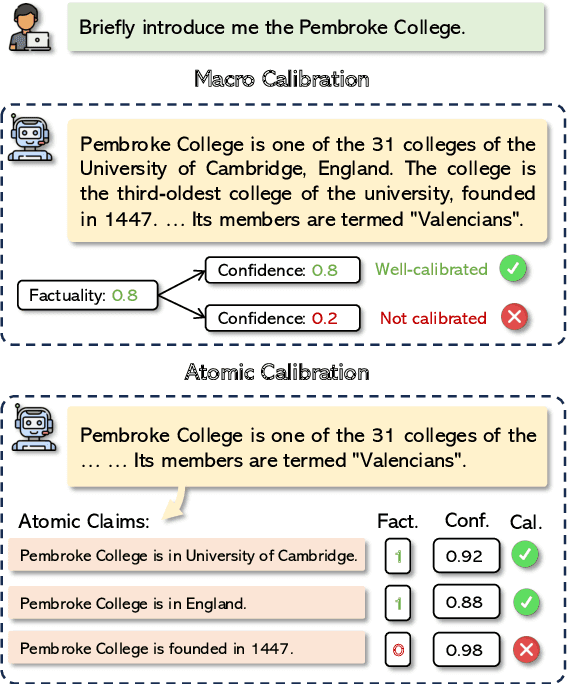
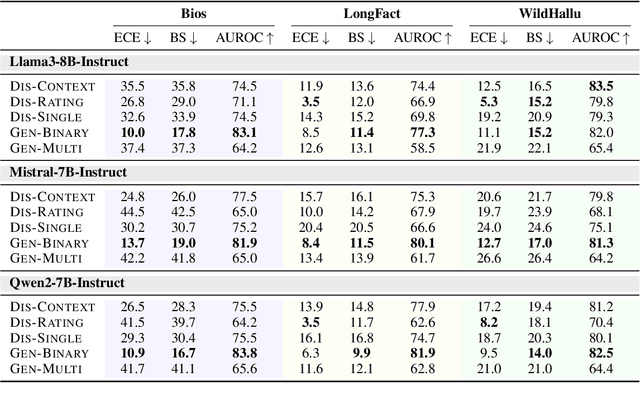
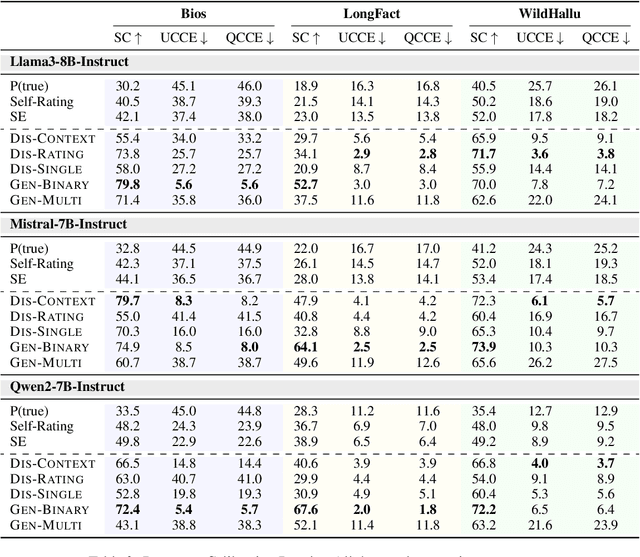
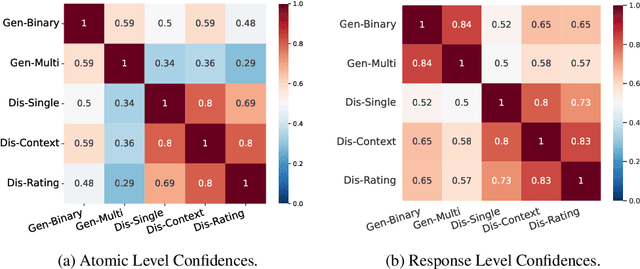
Large language models (LLMs) often suffer from hallucinations, posing significant challenges for real-world applications. Confidence calibration, which estimates the underlying uncertainty of model predictions, is essential to enhance the LLMs' trustworthiness. Existing research on LLM calibration has primarily focused on short-form tasks, providing a single confidence score at the response level (macro calibration). However, this approach is insufficient for long-form generations, where responses often contain more complex statements and may include both accurate and inaccurate information. Therefore, we introduce atomic calibration, a novel approach that evaluates factuality calibration at a fine-grained level by breaking down long responses into atomic claims. We classify confidence elicitation methods into discriminative and generative types and demonstrate that their combination can enhance calibration. Our extensive experiments on various LLMs and datasets show that atomic calibration is well-suited for long-form generation and can also improve macro calibration results. Additionally, atomic calibration reveals insightful patterns in LLM confidence throughout the generation process.
LongMemEval: Benchmarking Chat Assistants on Long-Term Interactive Memory
Oct 14, 2024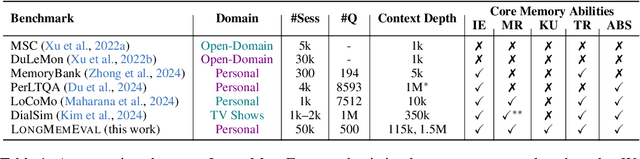
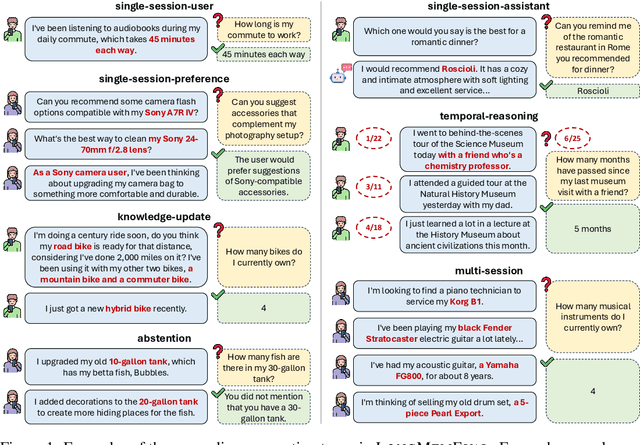
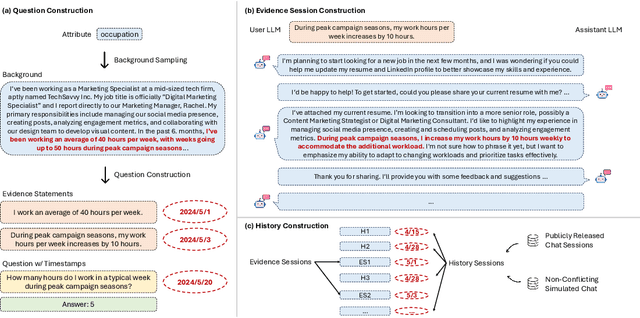
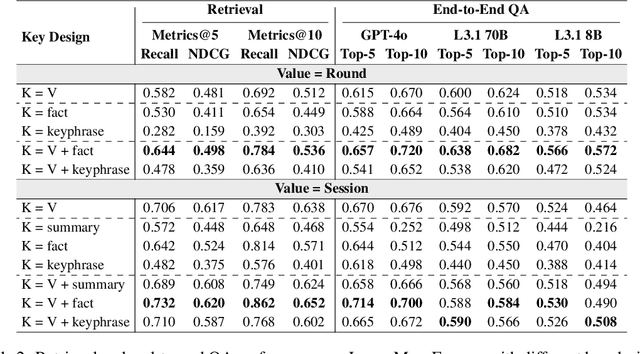
Recent large language model (LLM)-driven chat assistant systems have integrated memory components to track user-assistant chat histories, enabling more accurate and personalized responses. However, their long-term memory capabilities in sustained interactions remain underexplored. This paper introduces LongMemEval, a comprehensive benchmark designed to evaluate five core long-term memory abilities of chat assistants: information extraction, multi-session reasoning, temporal reasoning, knowledge updates, and abstention. With 500 meticulously curated questions embedded within freely scalable user-assistant chat histories, LongMemEval presents a significant challenge to existing long-term memory systems, with commercial chat assistants and long-context LLMs showing 30% accuracy drop on memorizing information across sustained interactions. We then present a unified framework that breaks down the long-term memory design into four design choices across the indexing, retrieval, and reading stages. Built upon key experimental insights, we propose several memory designs including session decomposition for optimizing value granularity, fact-augmented key expansion for enhancing the index structure, and time-aware query expansion for refining the search scope. Experiment results show that these optimizations greatly improve both memory recall and downstream question answering on LongMemEval. Overall, our study provides valuable resources and guidance for advancing the long-term memory capabilities of LLM-based chat assistants, paving the way toward more personalized and reliable conversational AI.