 Add to Chrome
 Add to Firefox
 Add to Edge
DREAM Technical Report
Aug 11, 2026
Industrial recommender systems commonly use cascaded retrieval, ranking, and re-ranking pipelines. Although efficient, these pipelines fragment information and objectives across modules, rely on rigid rules, and have limited awareness of real-time intent, leaving session-level shifts among browsing, comparison, and purchase insufficiently addressed. We present DREAM (Developing Recommender Engine with Agentic Methods), an autonomous optimization control architecture that adds a perception-aware, orchestrable, and auditable policy layer atop existing pipelines without replacing them. DREAM has two core components. First, a three-tier Intent Engine fuses on-device signals into structured L0/L1/L2 intent representations; its edge-cloud trigger chain reduces reporting volume to approximately 8.7%. Second, a Meta Engine uses a MetaModel for layered M1-to-M2-to-M3 reasoning: intent summarization, strategy planning informed by Strategy Memory, and parameter translation. It dispatches the resulting parameters through a unified outlet with safety guardrails. A Reward Dual Loop continuously optimizes both components by combining offline simulation for strategy-space exploration with online feedback for outcome calibration, forming a cycle of generation, execution, evaluation, and experience accumulation. Large-scale A/B tests on Taobao's homepage feed show that re-ranking control alone improves IPV by 2.06%, Core IPV by 2.39%, and GMV by 0.88%. Extending control to fine ranking raises these gains to 2.71%, 3.06%, and 1.31%, respectively, while consistently improving PV by more than 1%. These gains require neither replacement of pipeline models nor compromise of serving stability, supporting agentic meta-control as a viable paradigm for industrial recommendation.

MetaStrategy: Generative Ranking with Executable LLM Strategies
Aug 10, 2026Industrial recommender systems rank heterogeneous content under coupled user, business, commercial, and experience objectives. Existing generative ranking methods typically construct item sequences directly, making them difficult to integrate with mature predictive models, operational rules, and field-level guardrails. We present MetaStrategy, a framework that instead generates a structured, executable ranking strategy. Conditioned on request context, a large language model (LLM) policy emits a typed JSON bundle controlling objective weights, content and category preferences, experience constraints, and position policies. A deterministic validator and compiler instantiate an isolated Generator that competes atomically with incumbents under the list-level Evaluator of the Generator-Evaluator (GE) architecture. We train the policy in a production-path replay environment that re-executes logged requests through the current re-ranking stack without user exposure. The method combines selection, relative-rank, and baseline-lift rewards, a self-competitive curriculum that feeds frequent strategies back as competitors, and Evaluator-routed reward-augmented on-policy distillation that transfers complementary 4B-parameter Teachers into a compact 0.8B-parameter Student. We deploy MetaStrategy in Taobao Homepage Guess You Like through diff-triggered nearline generation; LLM inference remains outside synchronous ranking, with no observable increase in response time (RT). In a seven-day user-randomized online A/B test, MetaStrategy wins 27.93% of treatment-side GE calls and significantly improves click page views (click PV) by 2.11%, item-detail page views (IPV) by 3.12%, and transaction amount by 2.83%.
RecGPT-Mobile: On-Device Large Language Models for User Intent Understanding in Taobao Feed Recommendation
May 06, 2026Predicting a user's next search query from recent interaction behaviors is a critical problem in modern e-commerce systems, particularly in scenarios where user intent evolves rapidly. Large Language Models (LLMs) offer strong semantic reasoning capabilities and have recently been adopted to enhance training data construction for next-query prediction. However, due to resource constraints on mobile devices, existing applications are deployed on cloud servers, resulting in high inference costs. In this paper, we propose RecGPT-Mobile, a framework that designs a lightweight LLM-based intent understanding agent to improve recommendation quality in mobile e-commerce scenarios. By deploying LLMs directly on mobile devices, our approach can capture evolving interests of users more quickly and adjust the recommendation results in real time. Extensive offline analyses and online experiments demonstrate that our method significantly improves the accuracy of recommendation results, laying a practical path for LLM deployment in production-scale recommendation systems on mobile devices, as well as a scalable solution for integrating LLMs into real-world next-query prediction systems.
RecGPT Technical Report
Jul 30, 2025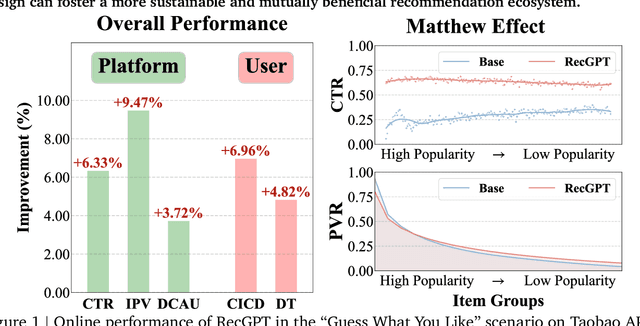
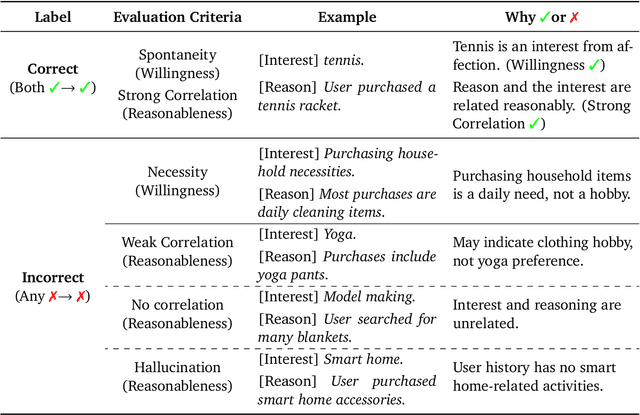
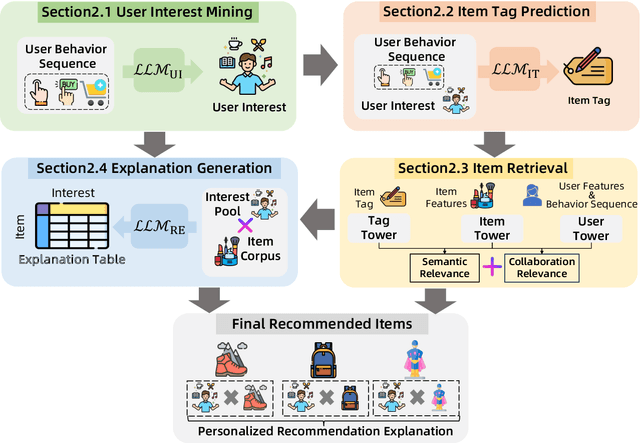

Recommender systems are among the most impactful applications of artificial intelligence, serving as critical infrastructure connecting users, merchants, and platforms. However, most current industrial systems remain heavily reliant on historical co-occurrence patterns and log-fitting objectives, i.e., optimizing for past user interactions without explicitly modeling user intent. This log-fitting approach often leads to overfitting to narrow historical preferences, failing to capture users' evolving and latent interests. As a result, it reinforces filter bubbles and long-tail phenomena, ultimately harming user experience and threatening the sustainability of the whole recommendation ecosystem. To address these challenges, we rethink the overall design paradigm of recommender systems and propose RecGPT, a next-generation framework that places user intent at the center of the recommendation pipeline. By integrating large language models (LLMs) into key stages of user interest mining, item retrieval, and explanation generation, RecGPT transforms log-fitting recommendation into an intent-centric process. To effectively align general-purpose LLMs to the above domain-specific recommendation tasks at scale, RecGPT incorporates a multi-stage training paradigm, which integrates reasoning-enhanced pre-alignment and self-training evolution, guided by a Human-LLM cooperative judge system. Currently, RecGPT has been fully deployed on the Taobao App. Online experiments demonstrate that RecGPT achieves consistent performance gains across stakeholders: users benefit from increased content diversity and satisfaction, merchants and the platform gain greater exposure and conversions. These comprehensive improvement results across all stakeholders validates that LLM-driven, intent-centric design can foster a more sustainable and mutually beneficial recommendation ecosystem.
Multi-channel Integrated Recommendation with Exposure Constraints
May 21, 2023
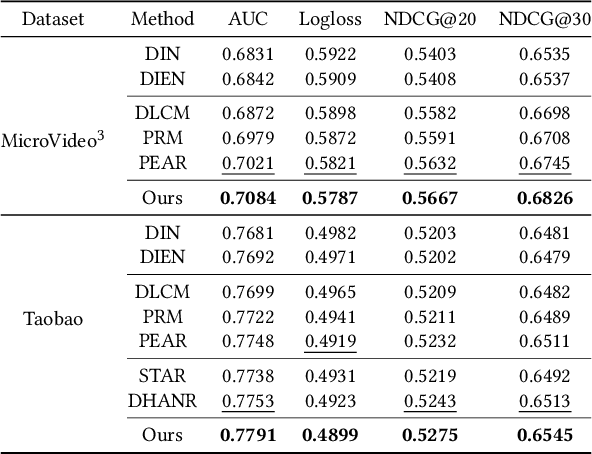
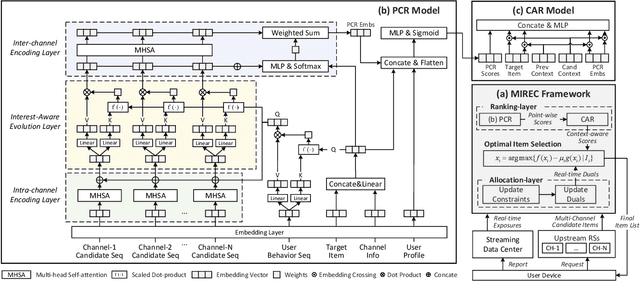
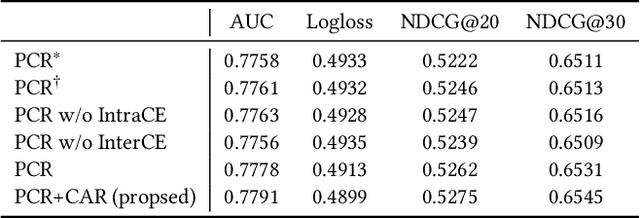
Integrated recommendation, which aims at jointly recommending heterogeneous items from different channels in a main feed, has been widely applied to various online platforms. Though attractive, integrated recommendation requires the ranking methods to migrate from conventional user-item models to the new user-channel-item paradigm in order to better capture users' preferences on both item and channel levels. Moreover, practical feed recommendation systems usually impose exposure constraints on different channels to ensure user experience. This leads to greater difficulty in the joint ranking of heterogeneous items. In this paper, we investigate the integrated recommendation task with exposure constraints in practical recommender systems. Our contribution is forth-fold. First, we formulate this task as a binary online linear programming problem and propose a two-layer framework named Multi-channel Integrated Recommendation with Exposure Constraints (MIREC) to obtain the optimal solution. Second, we propose an efficient online allocation algorithm to determine the optimal exposure assignment of different channels from a global view of all user requests over the entire time horizon. We prove that this algorithm reaches the optimal point under a regret bound of $ \mathcal{O}(\sqrt{T}) $ with linear complexity. Third, we propose a series of collaborative models to determine the optimal layout of heterogeneous items at each user request. The joint modeling of user interests, cross-channel correlation, and page context in our models aligns more with the browsing nature of feed products than existing models. Finally, we conduct extensive experiments on both offline datasets and online A/B tests to verify the effectiveness of MIREC. The proposed framework has now been implemented on the homepage of Taobao to serve the main traffic.
Multi-factor Sequential Re-ranking with Perception-Aware Diversification
May 21, 2023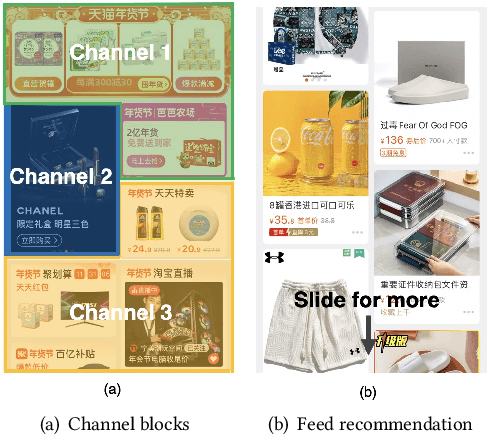
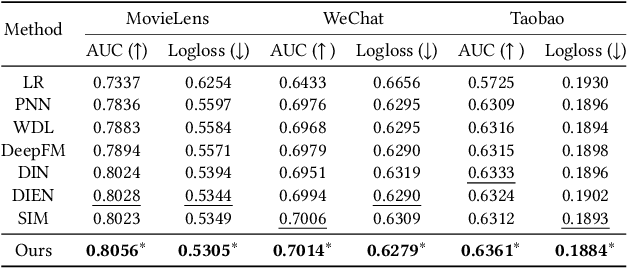
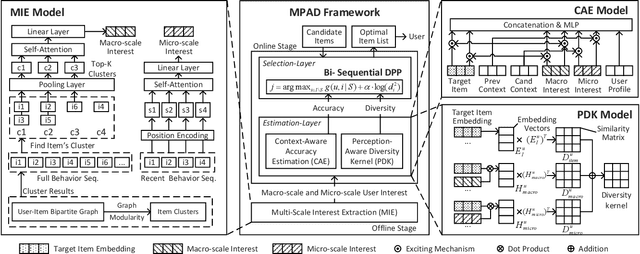
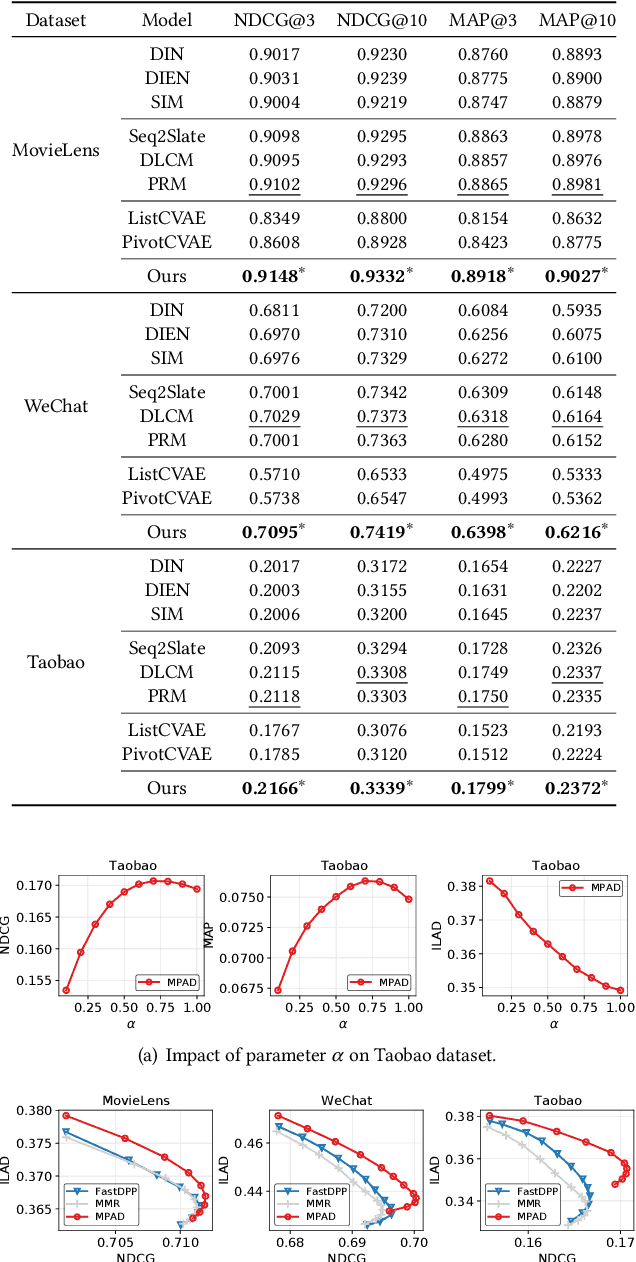
Feed recommendation systems, which recommend a sequence of items for users to browse and interact with, have gained significant popularity in practical applications. In feed products, users tend to browse a large number of items in succession, so the previously viewed items have a significant impact on users' behavior towards the following items. Therefore, traditional methods that mainly focus on improving the accuracy of recommended items are suboptimal for feed recommendations because they may recommend highly similar items. For feed recommendation, it is crucial to consider both the accuracy and diversity of the recommended item sequences in order to satisfy users' evolving interest when consecutively viewing items. To this end, this work proposes a general re-ranking framework named Multi-factor Sequential Re-ranking with Perception-Aware Diversification (MPAD) to jointly optimize accuracy and diversity for feed recommendation in a sequential manner. Specifically, MPAD first extracts users' different scales of interests from their behavior sequences through graph clustering-based aggregations. Then, MPAD proposes two sub-models to respectively evaluate the accuracy and diversity of a given item by capturing users' evolving interest due to the ever-changing context and users' personal perception of diversity from an item sequence perspective. This is consistent with the browsing nature of the feed scenario. Finally, MPAD generates the return list by sequentially selecting optimal items from the candidate set to maximize the joint benefits of accuracy and diversity of the entire list. MPAD has been implemented in Taobao's homepage feed to serve the main traffic and provide services to recommend billions of items to hundreds of millions of users every day.