 Add to Chrome
 Add to Firefox
 Add to Edge
DREAM Technical Report
Aug 11, 2026
Industrial recommender systems commonly use cascaded retrieval, ranking, and re-ranking pipelines. Although efficient, these pipelines fragment information and objectives across modules, rely on rigid rules, and have limited awareness of real-time intent, leaving session-level shifts among browsing, comparison, and purchase insufficiently addressed. We present DREAM (Developing Recommender Engine with Agentic Methods), an autonomous optimization control architecture that adds a perception-aware, orchestrable, and auditable policy layer atop existing pipelines without replacing them. DREAM has two core components. First, a three-tier Intent Engine fuses on-device signals into structured L0/L1/L2 intent representations; its edge-cloud trigger chain reduces reporting volume to approximately 8.7%. Second, a Meta Engine uses a MetaModel for layered M1-to-M2-to-M3 reasoning: intent summarization, strategy planning informed by Strategy Memory, and parameter translation. It dispatches the resulting parameters through a unified outlet with safety guardrails. A Reward Dual Loop continuously optimizes both components by combining offline simulation for strategy-space exploration with online feedback for outcome calibration, forming a cycle of generation, execution, evaluation, and experience accumulation. Large-scale A/B tests on Taobao's homepage feed show that re-ranking control alone improves IPV by 2.06%, Core IPV by 2.39%, and GMV by 0.88%. Extending control to fine ranking raises these gains to 2.71%, 3.06%, and 1.31%, respectively, while consistently improving PV by more than 1%. These gains require neither replacement of pipeline models nor compromise of serving stability, supporting agentic meta-control as a viable paradigm for industrial recommendation.

MetaStrategy: Generative Ranking with Executable LLM Strategies
Aug 10, 2026Industrial recommender systems rank heterogeneous content under coupled user, business, commercial, and experience objectives. Existing generative ranking methods typically construct item sequences directly, making them difficult to integrate with mature predictive models, operational rules, and field-level guardrails. We present MetaStrategy, a framework that instead generates a structured, executable ranking strategy. Conditioned on request context, a large language model (LLM) policy emits a typed JSON bundle controlling objective weights, content and category preferences, experience constraints, and position policies. A deterministic validator and compiler instantiate an isolated Generator that competes atomically with incumbents under the list-level Evaluator of the Generator-Evaluator (GE) architecture. We train the policy in a production-path replay environment that re-executes logged requests through the current re-ranking stack without user exposure. The method combines selection, relative-rank, and baseline-lift rewards, a self-competitive curriculum that feeds frequent strategies back as competitors, and Evaluator-routed reward-augmented on-policy distillation that transfers complementary 4B-parameter Teachers into a compact 0.8B-parameter Student. We deploy MetaStrategy in Taobao Homepage Guess You Like through diff-triggered nearline generation; LLM inference remains outside synchronous ranking, with no observable increase in response time (RT). In a seven-day user-randomized online A/B test, MetaStrategy wins 27.93% of treatment-side GE calls and significantly improves click page views (click PV) by 2.11%, item-detail page views (IPV) by 3.12%, and transaction amount by 2.83%.
Better Late Than Never: Formulating and Benchmarking Recommendation Editing
Jun 06, 2024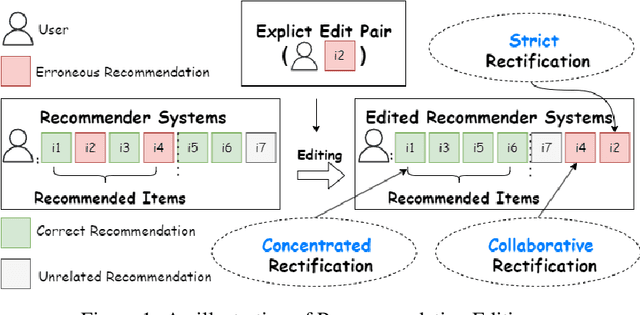

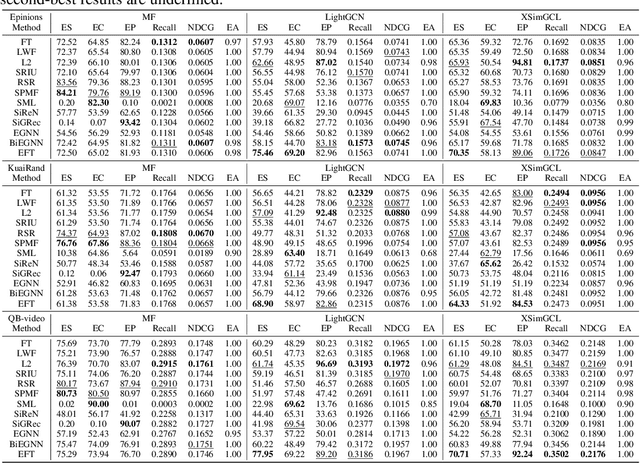
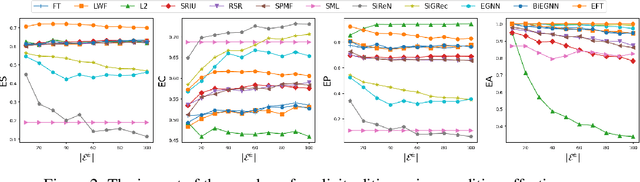
Recommendation systems play a pivotal role in suggesting items to users based on their preferences. However, in online platforms, these systems inevitably offer unsuitable recommendations due to limited model capacity, poor data quality, or evolving user interests. Enhancing user experience necessitates efficiently rectify such unsuitable recommendation behaviors. This paper introduces a novel and significant task termed recommendation editing, which focuses on modifying known and unsuitable recommendation behaviors. Specifically, this task aims to adjust the recommendation model to eliminate known unsuitable items without accessing training data or retraining the model. We formally define the problem of recommendation editing with three primary objectives: strict rectification, collaborative rectification, and concentrated rectification. Three evaluation metrics are developed to quantitatively assess the achievement of each objective. We present a straightforward yet effective benchmark for recommendation editing using novel Editing Bayesian Personalized Ranking Loss. To demonstrate the effectiveness of the proposed method, we establish a comprehensive benchmark that incorporates various methods from related fields. Codebase is available at https://github.com/cycl2018/Recommendation-Editing.
Revisiting the Message Passing in Heterophilous Graph Neural Networks
May 28, 2024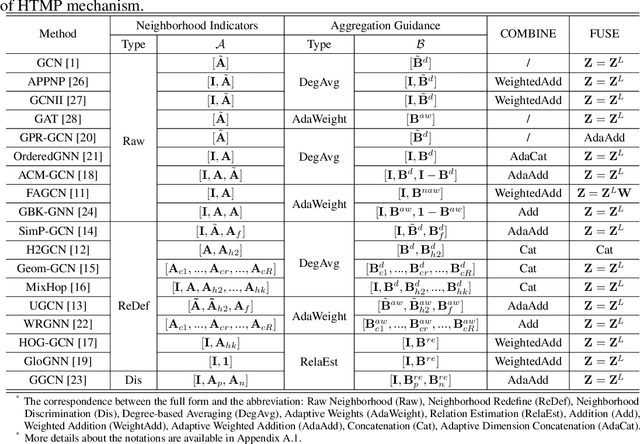
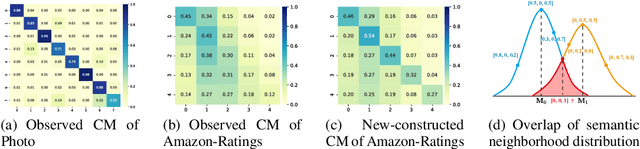
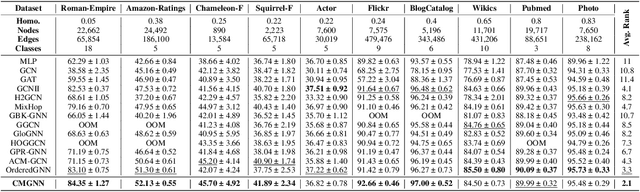
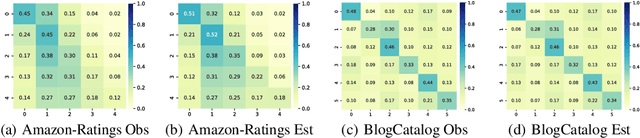
Graph Neural Networks (GNNs) have demonstrated strong performance in graph mining tasks due to their message-passing mechanism, which is aligned with the homophily assumption that adjacent nodes exhibit similar behaviors. However, in many real-world graphs, connected nodes may display contrasting behaviors, termed as heterophilous patterns, which has attracted increased interest in heterophilous GNNs (HTGNNs). Although the message-passing mechanism seems unsuitable for heterophilous graphs due to the propagation of class-irrelevant information, it is still widely used in many existing HTGNNs and consistently achieves notable success. This raises the question: why does message passing remain effective on heterophilous graphs? To answer this question, in this paper, we revisit the message-passing mechanisms in heterophilous graph neural networks and reformulate them into a unified heterophilious message-passing (HTMP) mechanism. Based on HTMP and empirical analysis, we reveal that the success of message passing in existing HTGNNs is attributed to implicitly enhancing the compatibility matrix among classes. Moreover, we argue that the full potential of the compatibility matrix is not completely achieved due to the existence of incomplete and noisy semantic neighborhoods in real-world heterophilous graphs. To bridge this gap, we introduce a new approach named CMGNN, which operates within the HTMP mechanism to explicitly leverage and improve the compatibility matrix. A thorough evaluation involving 10 benchmark datasets and comparative analysis against 13 well-established baselines highlights the superior performance of the HTMP mechanism and CMGNN method.