 Add to Chrome
 Add to Firefox
 Add to Edge
SSRLive: Live Streaming Recommendation with Dynamic Semantic ID
Jun 05, 2026
Live streaming has emerged as one of the fastest-growing forms of online media, enabling instant content broadcasting and real-time engagement between users and streamers. Despite the effectiveness of existing recommendation algorithms in this domain, they often suffer from limited utilization of computational resources, with low FLOPs that hinder further performance enhancement. Generative recommendation techniques, which have gained traction in various industrial tasks, offer a promising avenue for improving live streaming recommendations. However, directly applying generative methods to live streaming is non-trivial due to two major challenges: (1) static semantic IDs (SIDs) cannot reflect the rapidly changing nature of live room content; and (2) generative pipelines generally do not incorporate user--streamer interaction signals (e.g., likes, orders), which are critical for modeling user intent toward both the streamer and showcased products. To address these challenges, we introduce SSRLive: Dynamic Semantic ID-guided Streaming Recommendation for Live platforms. The proposed framework integrates a generative module and a discriminative module in a unified architecture. The generative component employs an encoder-decoder design to produce both static and dynamic SIDs, enabling timely representation of live room content while leveraging multimodal information. The discriminative component refines task-specific representations by combining SIDs with user features, augments them with user-streamer interaction data, and performs multi-task predictions. Online A/B tests in real-world deployment demonstrate tangible benefits: watch time (+3.38%), GMV (+0.72%), follower growth (+3.12%), and interaction volume (+2.92%). These improvements highlight the effectiveness and business value of SSRLive, which is now fully deployed, serving hundreds of millions of active users.

Multi-channel Integrated Recommendation with Exposure Constraints
May 21, 2023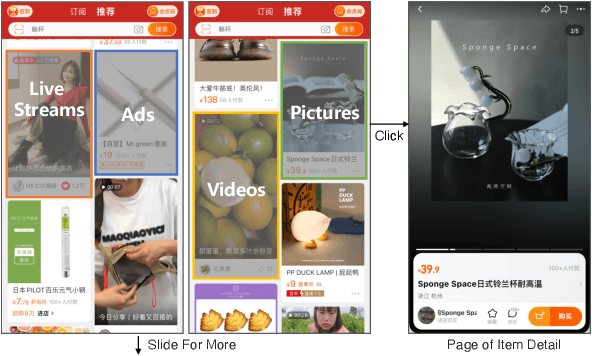
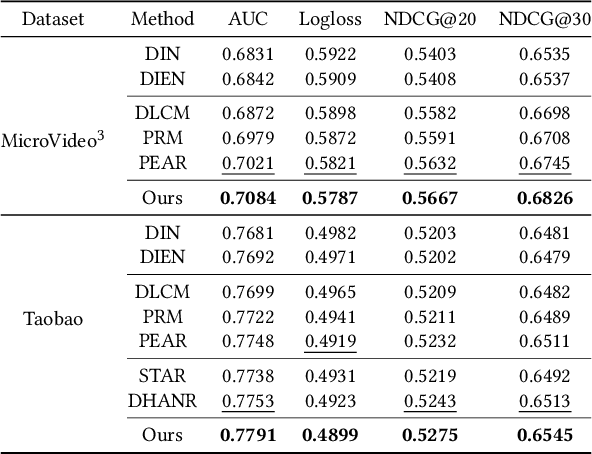
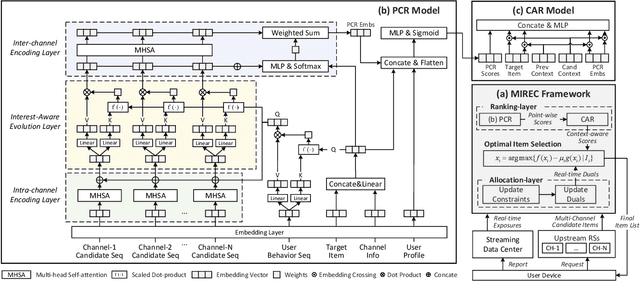
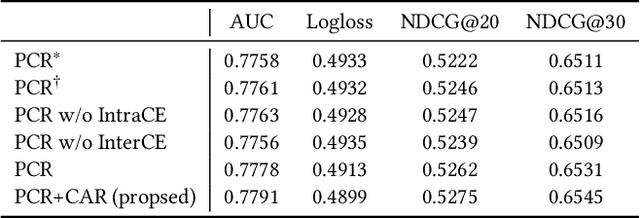
Integrated recommendation, which aims at jointly recommending heterogeneous items from different channels in a main feed, has been widely applied to various online platforms. Though attractive, integrated recommendation requires the ranking methods to migrate from conventional user-item models to the new user-channel-item paradigm in order to better capture users' preferences on both item and channel levels. Moreover, practical feed recommendation systems usually impose exposure constraints on different channels to ensure user experience. This leads to greater difficulty in the joint ranking of heterogeneous items. In this paper, we investigate the integrated recommendation task with exposure constraints in practical recommender systems. Our contribution is forth-fold. First, we formulate this task as a binary online linear programming problem and propose a two-layer framework named Multi-channel Integrated Recommendation with Exposure Constraints (MIREC) to obtain the optimal solution. Second, we propose an efficient online allocation algorithm to determine the optimal exposure assignment of different channels from a global view of all user requests over the entire time horizon. We prove that this algorithm reaches the optimal point under a regret bound of $ \mathcal{O}(\sqrt{T}) $ with linear complexity. Third, we propose a series of collaborative models to determine the optimal layout of heterogeneous items at each user request. The joint modeling of user interests, cross-channel correlation, and page context in our models aligns more with the browsing nature of feed products than existing models. Finally, we conduct extensive experiments on both offline datasets and online A/B tests to verify the effectiveness of MIREC. The proposed framework has now been implemented on the homepage of Taobao to serve the main traffic.
Multi-factor Sequential Re-ranking with Perception-Aware Diversification
May 21, 2023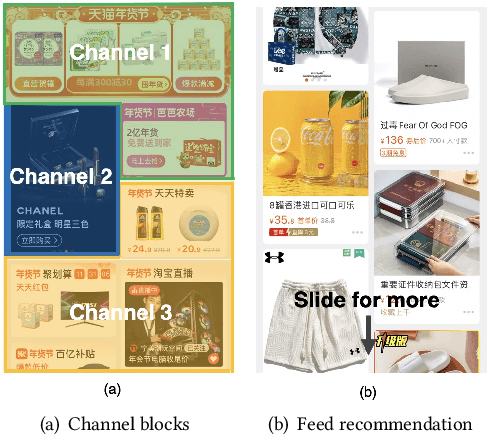
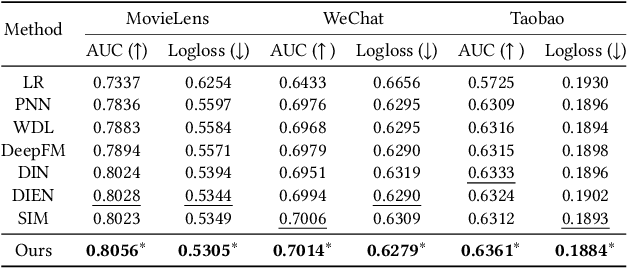
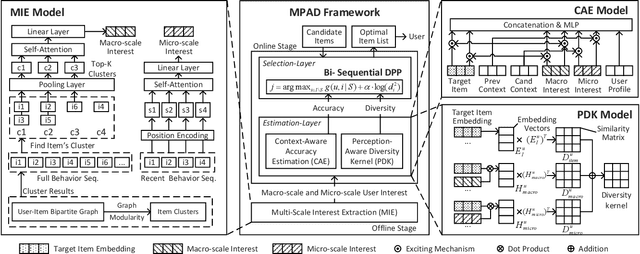
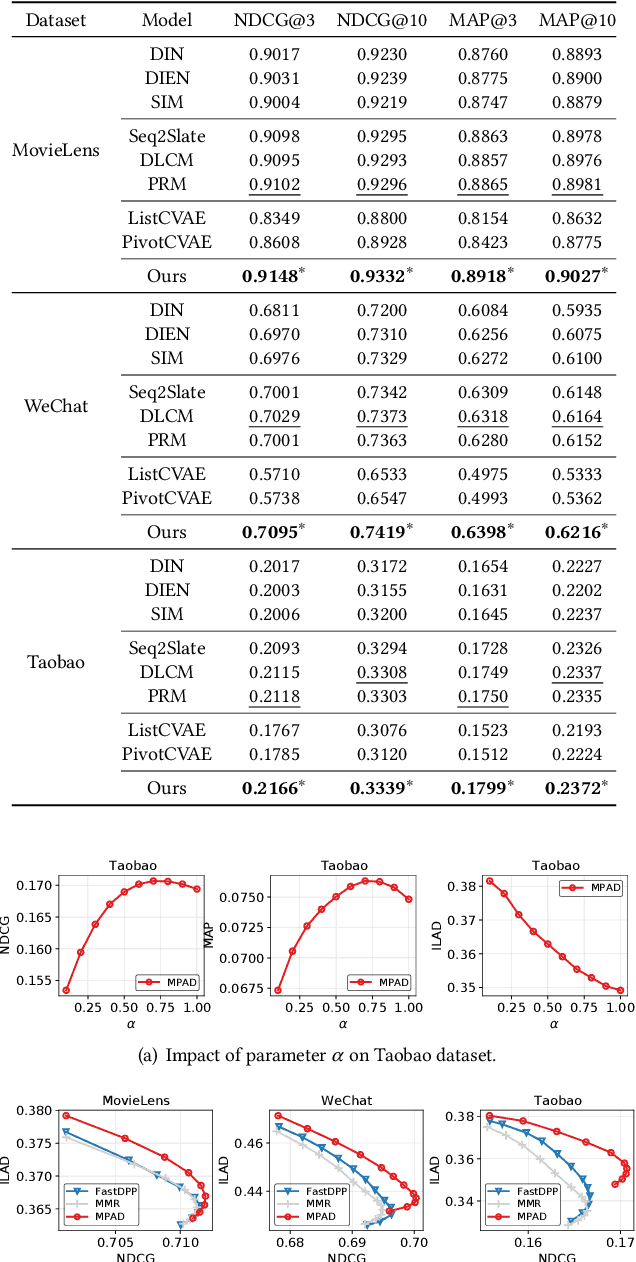
Feed recommendation systems, which recommend a sequence of items for users to browse and interact with, have gained significant popularity in practical applications. In feed products, users tend to browse a large number of items in succession, so the previously viewed items have a significant impact on users' behavior towards the following items. Therefore, traditional methods that mainly focus on improving the accuracy of recommended items are suboptimal for feed recommendations because they may recommend highly similar items. For feed recommendation, it is crucial to consider both the accuracy and diversity of the recommended item sequences in order to satisfy users' evolving interest when consecutively viewing items. To this end, this work proposes a general re-ranking framework named Multi-factor Sequential Re-ranking with Perception-Aware Diversification (MPAD) to jointly optimize accuracy and diversity for feed recommendation in a sequential manner. Specifically, MPAD first extracts users' different scales of interests from their behavior sequences through graph clustering-based aggregations. Then, MPAD proposes two sub-models to respectively evaluate the accuracy and diversity of a given item by capturing users' evolving interest due to the ever-changing context and users' personal perception of diversity from an item sequence perspective. This is consistent with the browsing nature of the feed scenario. Finally, MPAD generates the return list by sequentially selecting optimal items from the candidate set to maximize the joint benefits of accuracy and diversity of the entire list. MPAD has been implemented in Taobao's homepage feed to serve the main traffic and provide services to recommend billions of items to hundreds of millions of users every day.