 Add to Chrome
 Add to Firefox
 Add to Edge
RIE-Greedy: Regularization-Induced Exploration for Contextual Bandits
Mar 11, 2026
Real-world contextual bandit problems with complex reward models are often tackled with iteratively trained models, such as boosting trees. However, it is difficult to directly apply simple and effective exploration strategies--such as Thompson Sampling or UCB--on top of those black-box estimators. Existing approaches rely on sophisticated assumptions or intractable procedures that are hard to verify and implement in practice. In this work, we explore the use of an exploration-free (pure-greedy) action selection strategy, that exploits the randomness inherent in model fitting process as an intrinsic source of exploration. More specifically, we note that the stochasticity in cross-validation based regularization process can naturally induce Thompson Sampling-like exploration. We show that this regularization-induced exploration is theoretically equivalent to Thompson Sampling in the two-armed bandit case and empirically leads to reliable exploration in large-scale business environments compared to benchmark methods such as epsilon-greedy and other state-of-the-art approaches. Overall, our work reveals how regularized estimator training itself can induce effective exploration, offering both theoretical insight and practical guidance for contextual bandit design.

WebChain: A Large-Scale Human-Annotated Dataset of Real-World Web Interaction Traces
Mar 05, 2026We introduce WebChain, the largest open-source dataset of human-annotated trajectories on real-world websites, designed to accelerate reproducible research in web agents. It contains 31,725 trajectories and 318k steps, featuring a core Triple Alignment of visual, structural, and action data to provide rich, multi-modal supervision. The data is collected via a scalable pipeline that ensures coverage of complex, high-value tasks often missed by synthetic methods. Leveraging this dataset, we propose a Dual Mid-Training recipe that decouples spatial grounding from planning, achieving state-of-the-art performance on our proposed WebChainBench and other public GUI benchmarks. Our work provides the data and insights necessary to build and rigorously evaluate the next generation of scalable web agents.
WebFactory: Automated Compression of Foundational Language Intelligence into Grounded Web Agents
Mar 05, 2026Current paradigms for training GUI agents are fundamentally limited by a reliance on either unsafe, non-reproducible live web interactions or costly, scarce human-crafted data and environments. We argue this focus on data volume overlooks a more critical factor: the efficiency of compressing a large language model's (LLM) latent knowledge into actionable agent behavior. We introduce WebFactory, a novel, fully automated closed-loop reinforcement learning pipeline for GUI agents, systematically compressing LLM-encoded internet intelligence into efficient, grounded actions. Our pipeline features a process of scalable environment synthesis, knowledge-aware task generation, LLM-powered trajectory collection, decomposed reward RL training, and systematic agent evaluation. Remarkably, our agent demonstrates exceptional data efficiency and generalization. Trained on synthetic data from only 10 websites within WebFactory, it achieves performance comparable to GUI agents trained on the same amount of human-annotated data from a much larger set of environments. This superior performance is consistent across our internal offline and online transfer benchmarks, where our agent also significantly outperforms the base foundation model. We further provide critical insights into the "embodiment potential" of different LLM foundations, offering a new axis for model evaluation. This work presents a scalable and cost-effective paradigm for transforming passive internet knowledge into active, grounded intelligence, marking a critical step towards general-purpose interactive agents.
VenusBench-GD: A Comprehensive Multi-Platform GUI Benchmark for Diverse Grounding Tasks
Dec 18, 2025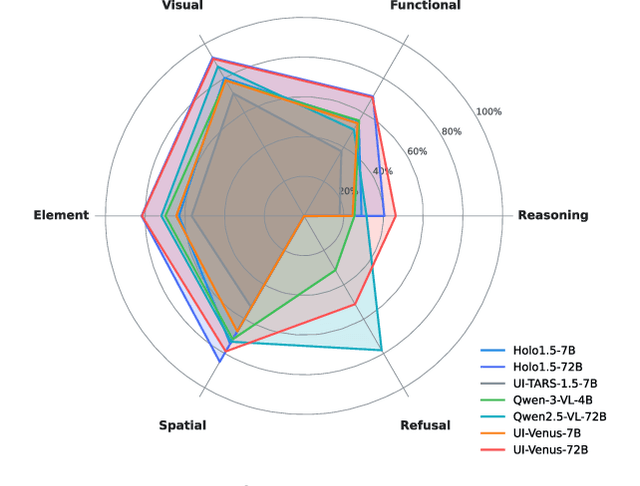
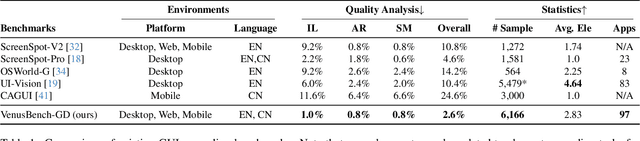
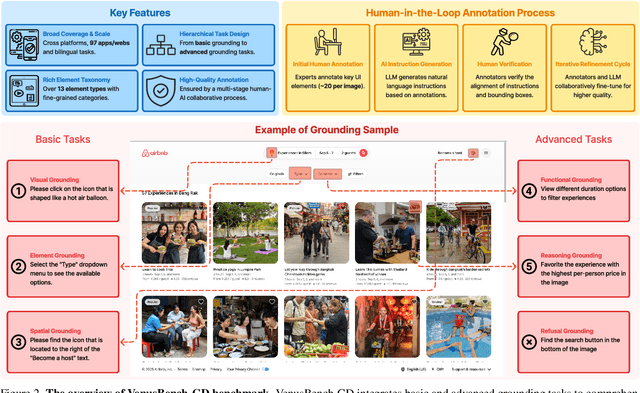
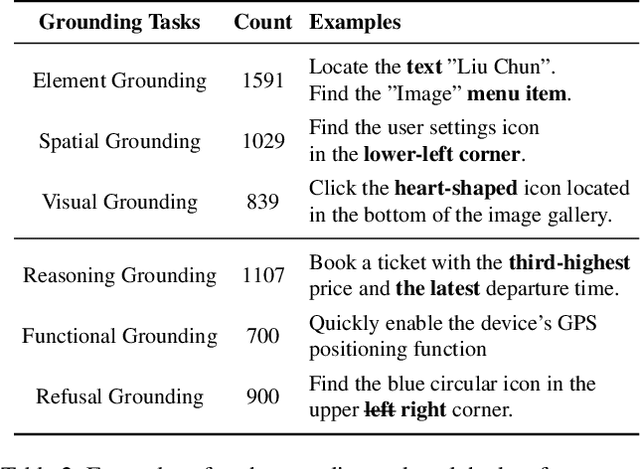
GUI grounding is a critical component in building capable GUI agents. However, existing grounding benchmarks suffer from significant limitations: they either provide insufficient data volume and narrow domain coverage, or focus excessively on a single platform and require highly specialized domain knowledge. In this work, we present VenusBench-GD, a comprehensive, bilingual benchmark for GUI grounding that spans multiple platforms, enabling hierarchical evaluation for real-word applications. VenusBench-GD contributes as follows: (i) we introduce a large-scale, cross-platform benchmark with extensive coverage of applications, diverse UI elements, and rich annotated data, (ii) we establish a high-quality data construction pipeline for grounding tasks, achieving higher annotation accuracy than existing benchmarks, and (iii) we extend the scope of element grounding by proposing a hierarchical task taxonomy that divides grounding into basic and advanced categories, encompassing six distinct subtasks designed to evaluate models from complementary perspectives. Our experimental findings reveal critical insights: general-purpose multimodal models now match or even surpass specialized GUI models on basic grounding tasks. In contrast, advanced tasks, still favor GUI-specialized models, though they exhibit significant overfitting and poor robustness. These results underscore the necessity of comprehensive, multi-tiered evaluation frameworks.
The BrowserGym Ecosystem for Web Agent Research
Dec 10, 2024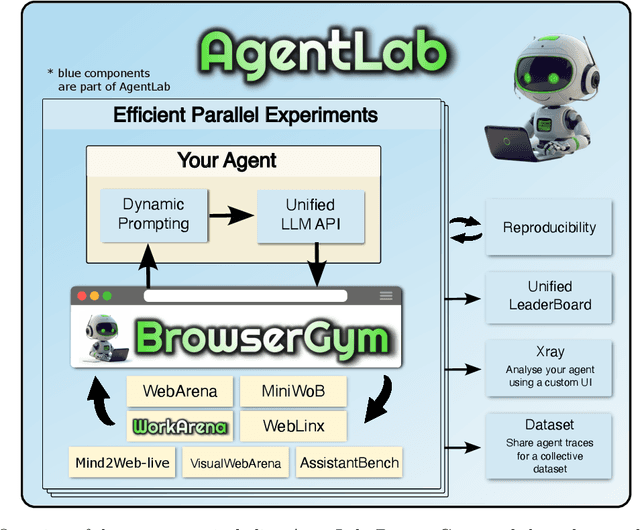
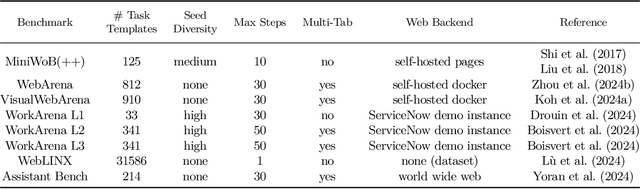

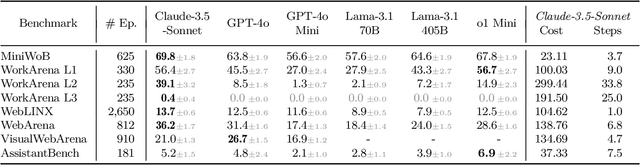
The BrowserGym ecosystem addresses the growing need for efficient evaluation and benchmarking of web agents, particularly those leveraging automation and Large Language Models (LLMs) for web interaction tasks. Many existing benchmarks suffer from fragmentation and inconsistent evaluation methodologies, making it challenging to achieve reliable comparisons and reproducible results. BrowserGym aims to solve this by providing a unified, gym-like environment with well-defined observation and action spaces, facilitating standardized evaluation across diverse benchmarks. Combined with AgentLab, a complementary framework that aids in agent creation, testing, and analysis, BrowserGym offers flexibility for integrating new benchmarks while ensuring consistent evaluation and comprehensive experiment management. This standardized approach seeks to reduce the time and complexity of developing web agents, supporting more reliable comparisons and facilitating in-depth analysis of agent behaviors, and could result in more adaptable, capable agents, ultimately accelerating innovation in LLM-driven automation. As a supporting evidence, we conduct the first large-scale, multi-benchmark web agent experiment and compare the performance of 6 state-of-the-art LLMs across all benchmarks currently available in BrowserGym. Among other findings, our results highlight a large discrepancy between OpenAI and Anthropic's latests models, with Claude-3.5-Sonnet leading the way on almost all benchmarks, except on vision-related tasks where GPT-4o is superior. Despite these advancements, our results emphasize that building robust and efficient web agents remains a significant challenge, due to the inherent complexity of real-world web environments and the limitations of current models.
WebCanvas: Benchmarking Web Agents in Online Environments
Jun 18, 2024For web agents to be practically useful, they must adapt to the continuously evolving web environment characterized by frequent updates to user interfaces and content. However, most existing benchmarks only capture the static aspects of the web. To bridge this gap, we introduce WebCanvas, an innovative online evaluation framework for web agents that effectively addresses the dynamic nature of web interactions. WebCanvas contains three main components to facilitate realistic assessments: (1) A novel evaluation metric which reliably capture critical intermediate actions or states necessary for task completions while disregarding noise caused by insignificant events or changed web-elements. (2) A benchmark dataset called Mind2Web-Live, a refined version of original Mind2Web static dataset containing 542 tasks with 2439 intermediate evaluation states; (3) Lightweight and generalizable annotation tools and testing pipelines that enables the community to collect and maintain the high-quality, up-to-date dataset. Building on WebCanvas, we open-source an agent framework with extensible modules for reasoning, providing a foundation for the community to conduct online inference and evaluations. Our best-performing agent achieves a task success rate of 23.1% and a task completion rate of 48.8% on the Mind2Web-Live test set. Additionally, we analyze the performance discrepancies across various websites, domains, and experimental environments. We encourage the community to contribute further insights on online agent evaluation, thereby advancing this field of research.
General Phrase Debiaser: Debiasing Masked Language Models at a Multi-Token Level
Nov 23, 2023The social biases and unwelcome stereotypes revealed by pretrained language models are becoming obstacles to their application. Compared to numerous debiasing methods targeting word level, there has been relatively less attention on biases present at phrase level, limiting the performance of debiasing in discipline domains. In this paper, we propose an automatic multi-token debiasing pipeline called \textbf{General Phrase Debiaser}, which is capable of mitigating phrase-level biases in masked language models. Specifically, our method consists of a \textit{phrase filter stage} that generates stereotypical phrases from Wikipedia pages as well as a \textit{model debias stage} that can debias models at the multi-token level to tackle bias challenges on phrases. The latter searches for prompts that trigger model's bias, and then uses them for debiasing. State-of-the-art results on standard datasets and metrics show that our approach can significantly reduce gender biases on both career and multiple disciplines, across models with varying parameter sizes.
From Adversarial Arms Race to Model-centric Evaluation: Motivating a Unified Automatic Robustness Evaluation Framework
May 29, 2023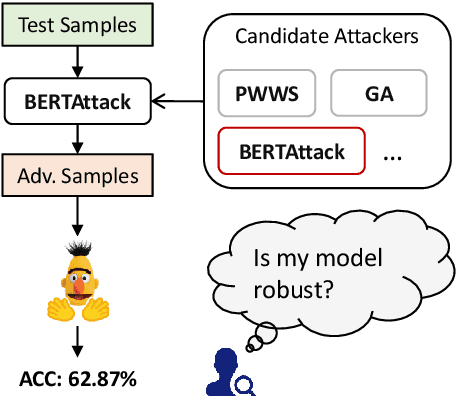
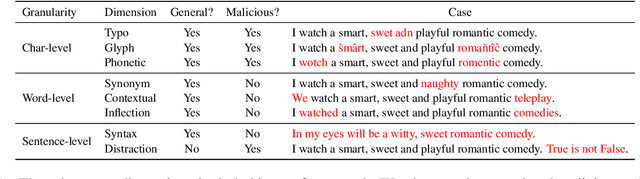

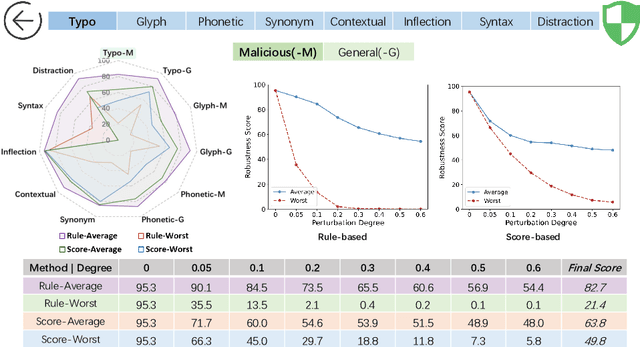
Textual adversarial attacks can discover models' weaknesses by adding semantic-preserved but misleading perturbations to the inputs. The long-lasting adversarial attack-and-defense arms race in Natural Language Processing (NLP) is algorithm-centric, providing valuable techniques for automatic robustness evaluation. However, the existing practice of robustness evaluation may exhibit issues of incomprehensive evaluation, impractical evaluation protocol, and invalid adversarial samples. In this paper, we aim to set up a unified automatic robustness evaluation framework, shifting towards model-centric evaluation to further exploit the advantages of adversarial attacks. To address the above challenges, we first determine robustness evaluation dimensions based on model capabilities and specify the reasonable algorithm to generate adversarial samples for each dimension. Then we establish the evaluation protocol, including evaluation settings and metrics, under realistic demands. Finally, we use the perturbation degree of adversarial samples to control the sample validity. We implement a toolkit RobTest that realizes our automatic robustness evaluation framework. In our experiments, we conduct a robustness evaluation of RoBERTa models to demonstrate the effectiveness of our evaluation framework, and further show the rationality of each component in the framework. The code will be made public at \url{https://github.com/thunlp/RobTest}.
Large Language Models Can be Lazy Learners: Analyze Shortcuts in In-Context Learning
May 26, 2023Large language models (LLMs) have recently shown great potential for in-context learning, where LLMs learn a new task simply by conditioning on a few input-label pairs (prompts). Despite their potential, our understanding of the factors influencing end-task performance and the robustness of in-context learning remains limited. This paper aims to bridge this knowledge gap by investigating the reliance of LLMs on shortcuts or spurious correlations within prompts. Through comprehensive experiments on classification and extraction tasks, we reveal that LLMs are "lazy learners" that tend to exploit shortcuts in prompts for downstream tasks. Additionally, we uncover a surprising finding that larger models are more likely to utilize shortcuts in prompts during inference. Our findings provide a new perspective on evaluating robustness in in-context learning and pose new challenges for detecting and mitigating the use of shortcuts in prompts.
Federated Learning for Computational Pathology on Gigapixel Whole Slide Images
Sep 23, 2020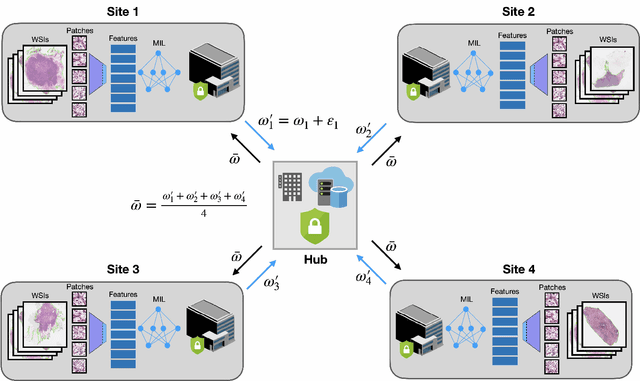
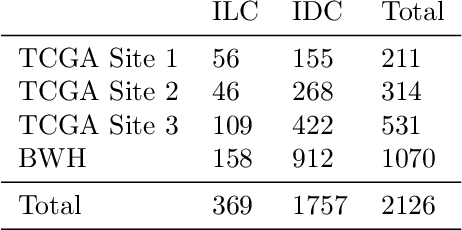
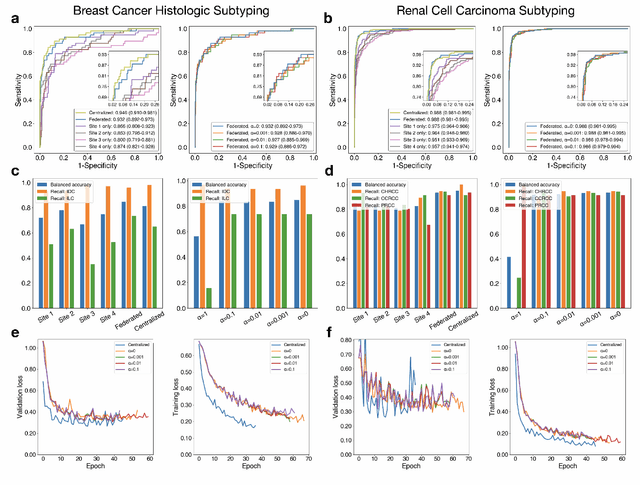
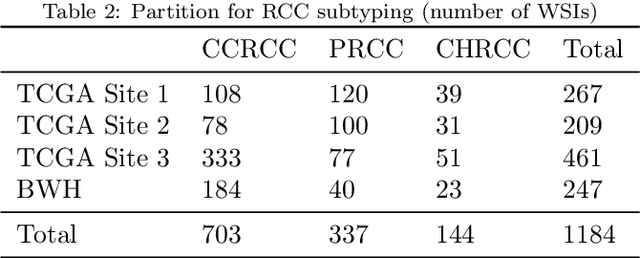
Deep Learning-based computational pathology algorithms have demonstrated profound ability to excel in a wide array of tasks that range from characterization of well known morphological phenotypes to predicting non-human-identifiable features from histology such as molecular alterations. However, the development of robust, adaptable, and accurate deep learning-based models often rely on the collection and time-costly curation large high-quality annotated training data that should ideally come from diverse sources and patient populations to cater for the heterogeneity that exists in such datasets. Multi-centric and collaborative integration of medical data across multiple institutions can naturally help overcome this challenge and boost the model performance but is limited by privacy concerns amongst other difficulties that may arise in the complex data sharing process as models scale towards using hundreds of thousands of gigapixel whole slide images. In this paper, we introduce privacy-preserving federated learning for gigapixel whole slide images in computational pathology using weakly-supervised attention multiple instance learning and differential privacy. We evaluated our approach on two different diagnostic problems using thousands of histology whole slide images with only slide-level labels. Additionally, we present a weakly-supervised learning framework for survival prediction and patient stratification from whole slide images and demonstrate its effectiveness in a federated setting. Our results show that using federated learning, we can effectively develop accurate weakly supervised deep learning models from distributed data silos without direct data sharing and its associated complexities, while also preserving differential privacy using randomized noise generation.