 Add to Chrome
 Add to Firefox
 Add to Edge
WebFactory: Automated Compression of Foundational Language Intelligence into Grounded Web Agents
Mar 05, 2026
Current paradigms for training GUI agents are fundamentally limited by a reliance on either unsafe, non-reproducible live web interactions or costly, scarce human-crafted data and environments. We argue this focus on data volume overlooks a more critical factor: the efficiency of compressing a large language model's (LLM) latent knowledge into actionable agent behavior. We introduce WebFactory, a novel, fully automated closed-loop reinforcement learning pipeline for GUI agents, systematically compressing LLM-encoded internet intelligence into efficient, grounded actions. Our pipeline features a process of scalable environment synthesis, knowledge-aware task generation, LLM-powered trajectory collection, decomposed reward RL training, and systematic agent evaluation. Remarkably, our agent demonstrates exceptional data efficiency and generalization. Trained on synthetic data from only 10 websites within WebFactory, it achieves performance comparable to GUI agents trained on the same amount of human-annotated data from a much larger set of environments. This superior performance is consistent across our internal offline and online transfer benchmarks, where our agent also significantly outperforms the base foundation model. We further provide critical insights into the "embodiment potential" of different LLM foundations, offering a new axis for model evaluation. This work presents a scalable and cost-effective paradigm for transforming passive internet knowledge into active, grounded intelligence, marking a critical step towards general-purpose interactive agents.

WebChain: A Large-Scale Human-Annotated Dataset of Real-World Web Interaction Traces
Mar 05, 2026We introduce WebChain, the largest open-source dataset of human-annotated trajectories on real-world websites, designed to accelerate reproducible research in web agents. It contains 31,725 trajectories and 318k steps, featuring a core Triple Alignment of visual, structural, and action data to provide rich, multi-modal supervision. The data is collected via a scalable pipeline that ensures coverage of complex, high-value tasks often missed by synthetic methods. Leveraging this dataset, we propose a Dual Mid-Training recipe that decouples spatial grounding from planning, achieving state-of-the-art performance on our proposed WebChainBench and other public GUI benchmarks. Our work provides the data and insights necessary to build and rigorously evaluate the next generation of scalable web agents.
VenusBench-GD: A Comprehensive Multi-Platform GUI Benchmark for Diverse Grounding Tasks
Dec 18, 2025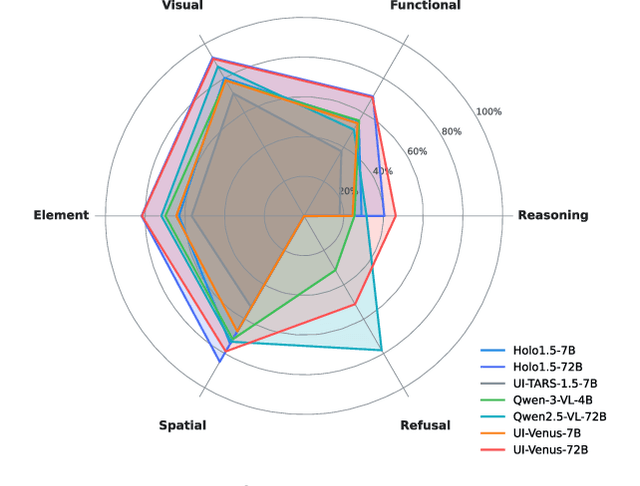
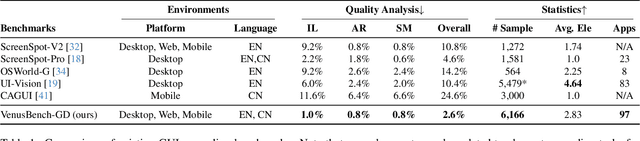
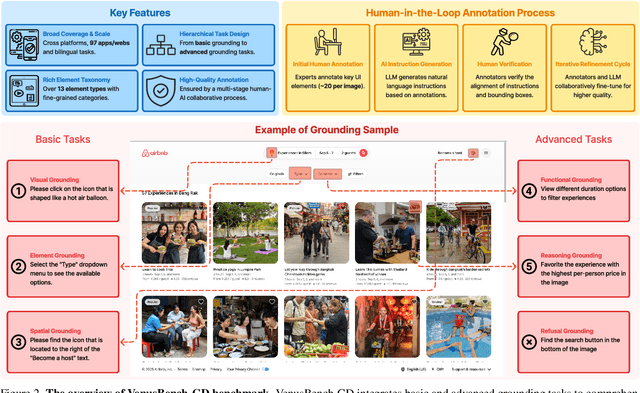
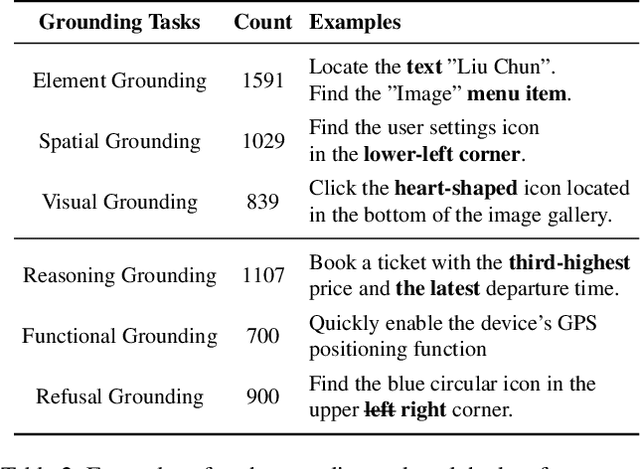
GUI grounding is a critical component in building capable GUI agents. However, existing grounding benchmarks suffer from significant limitations: they either provide insufficient data volume and narrow domain coverage, or focus excessively on a single platform and require highly specialized domain knowledge. In this work, we present VenusBench-GD, a comprehensive, bilingual benchmark for GUI grounding that spans multiple platforms, enabling hierarchical evaluation for real-word applications. VenusBench-GD contributes as follows: (i) we introduce a large-scale, cross-platform benchmark with extensive coverage of applications, diverse UI elements, and rich annotated data, (ii) we establish a high-quality data construction pipeline for grounding tasks, achieving higher annotation accuracy than existing benchmarks, and (iii) we extend the scope of element grounding by proposing a hierarchical task taxonomy that divides grounding into basic and advanced categories, encompassing six distinct subtasks designed to evaluate models from complementary perspectives. Our experimental findings reveal critical insights: general-purpose multimodal models now match or even surpass specialized GUI models on basic grounding tasks. In contrast, advanced tasks, still favor GUI-specialized models, though they exhibit significant overfitting and poor robustness. These results underscore the necessity of comprehensive, multi-tiered evaluation frameworks.
WebCanvas: Benchmarking Web Agents in Online Environments
Jun 18, 2024For web agents to be practically useful, they must adapt to the continuously evolving web environment characterized by frequent updates to user interfaces and content. However, most existing benchmarks only capture the static aspects of the web. To bridge this gap, we introduce WebCanvas, an innovative online evaluation framework for web agents that effectively addresses the dynamic nature of web interactions. WebCanvas contains three main components to facilitate realistic assessments: (1) A novel evaluation metric which reliably capture critical intermediate actions or states necessary for task completions while disregarding noise caused by insignificant events or changed web-elements. (2) A benchmark dataset called Mind2Web-Live, a refined version of original Mind2Web static dataset containing 542 tasks with 2439 intermediate evaluation states; (3) Lightweight and generalizable annotation tools and testing pipelines that enables the community to collect and maintain the high-quality, up-to-date dataset. Building on WebCanvas, we open-source an agent framework with extensible modules for reasoning, providing a foundation for the community to conduct online inference and evaluations. Our best-performing agent achieves a task success rate of 23.1% and a task completion rate of 48.8% on the Mind2Web-Live test set. Additionally, we analyze the performance discrepancies across various websites, domains, and experimental environments. We encourage the community to contribute further insights on online agent evaluation, thereby advancing this field of research.