 Add to Chrome
 Add to Firefox
 Add to Edge
When 2D Cues Fail: Improving Image Manipulation Localization with Reliable 3D Geometry
Jul 20, 2026
Existing image manipulation localization (IML) methods rely heavily on 2D forensic cues, such as low-level artifacts, noise traces, and semantic inconsistencies in the manipulated image. While effective in many cases, these cues become much less discriminative when manipulated regions are well blended with their surrounding context in appearance. In such cases, a manipulated region may remain locally appearance-consistent, but still violate the geometric structure of the surrounding scene. This limitation motivates us to go beyond purely 2D evidence and introduce geometric reasoning into IML. To this end, we leverage monocular reconstruction to obtain auxiliary geometric cues, including depth and surface normals. However, a key challenge lies in the fact that reconstructed geometry on manipulated images is inherently noisy and cannot be used naively. Rather than treating depth and normals as direct evidence, we estimate their reliability and exploit them selectively for localization. Based on this principle, we design a geometry-aware framework (GFrame) that fuses reliable geometric cues with RGB features and propagates them across scales to improve fine-grained localization. Extensive experiments show that the proposed method achieves excellent performance under limited budget constraints. These results indicate that reliable 3D geometry provides complementary forensic evidence beyond traditional 2D cues for IML. Related code will be released.

The Courtroom Trial of Pixels: Robust Image Manipulation Localization via Adversarial Evidence and Reinforcement Learning Judgment
Apr 16, 2026Although some existing image manipulation localization (IML) methods incorporate authenticity-related supervision, this information is typically utilized merely as an auxiliary training signal to enhance the model's sensitivity to manipulation artifacts, rather than being explicitly modeled as localization evidence opposing the manipulated regions. Consequently, when manipulation traces are subtle or degraded by post-processing and noise, these methods struggle to explicitly compare manipulated and authentic evidence, resulting in unreliable predictions in ambiguous areas. To address these issues, we propose a courtroom-style adjudication framework that regards IML task as the confrontation of evidence followed by judgment. The framework comprises a prosecution stream, a defense stream, and a judge model. We first build a dual-hypothesis segmentation architecture on a shared multi-scale encoder, in which the prosecution stream asserts manipulation and the defense stream asserts authenticity. Guided by edge priors, it produces evidence for manipulated and authentic regions through cascaded multi-level fusion, bidirectional disagreement suppression, and dynamic debate refinement. We further develop a reinforcement learning judge model that performs strategic re-inference and refinement on uncertain regions, yielding a manipulated-region mask. The judge model is trained with advantage-based rewards and a soft-IoU objective, and reliability is calibrated via entropy and cross-hypothesis consistency. Experimental results show that our model achieves superior average performance compared with SOTA IML methods.
General365: Benchmarking General Reasoning in Large Language Models Across Diverse and Challenging Tasks
Apr 13, 2026Contemporary large language models (LLMs) have demonstrated remarkable reasoning capabilities, particularly in specialized domains like mathematics and physics. However, their ability to generalize these reasoning skills to more general and broader contexts--often termed general reasoning--remains under-explored. Unlike domain-specific reasoning, general reasoning relies less on expert knowledge but still presents formidable reasoning challenges, such as complex constraints, nested logical branches, and semantic interference. To address this gap, we introduce General365, a benchmark specifically designed to assess general reasoning in LLMs. By restricting background knowledge to a K-12 level, General365 explicitly decouples reasoning from specialized expertise. The benchmark comprises 365 seed problems and 1,095 variant problems across eight categories, ensuring both high difficulty and diversity. Evaluations across 26 leading LLMs reveal that even the top-performing model achieves only 62.8% accuracy, in stark contrast to the near-perfect performances of LLMs in math and physics benchmarks. These results suggest that the reasoning abilities of current LLMs are heavily domain-dependent, leaving significant room for improvement in broader applications. We envision General365 as a catalyst for advancing LLM reasoning beyond domain-specific tasks toward robust, general-purpose real-world scenarios. Code, Dataset, and Leaderboard: https://general365.github.io
Step 3.5 Flash: Open Frontier-Level Intelligence with 11B Active Parameters
Feb 11, 2026We introduce Step 3.5 Flash, a sparse Mixture-of-Experts (MoE) model that bridges frontier-level agentic intelligence and computational efficiency. We focus on what matters most when building agents: sharp reasoning and fast, reliable execution. Step 3.5 Flash pairs a 196B-parameter foundation with 11B active parameters for efficient inference. It is optimized with interleaved 3:1 sliding-window/full attention and Multi-Token Prediction (MTP-3) to reduce the latency and cost of multi-round agentic interactions. To reach frontier-level intelligence, we design a scalable reinforcement learning framework that combines verifiable signals with preference feedback, while remaining stable under large-scale off-policy training, enabling consistent self-improvement across mathematics, code, and tool use. Step 3.5 Flash demonstrates strong performance across agent, coding, and math tasks, achieving 85.4% on IMO-AnswerBench, 86.4% on LiveCodeBench-v6 (2024.08-2025.05), 88.2% on tau2-Bench, 69.0% on BrowseComp (with context management), and 51.0% on Terminal-Bench 2.0, comparable to frontier models such as GPT-5.2 xHigh and Gemini 3.0 Pro. By redefining the efficiency frontier, Step 3.5 Flash provides a high-density foundation for deploying sophisticated agents in real-world industrial environments.
Step-DeepResearch Technical Report
Dec 24, 2025As LLMs shift toward autonomous agents, Deep Research has emerged as a pivotal metric. However, existing academic benchmarks like BrowseComp often fail to meet real-world demands for open-ended research, which requires robust skills in intent recognition, long-horizon decision-making, and cross-source verification. To address this, we introduce Step-DeepResearch, a cost-effective, end-to-end agent. We propose a Data Synthesis Strategy Based on Atomic Capabilities to reinforce planning and report writing, combined with a progressive training path from agentic mid-training to SFT and RL. Enhanced by a Checklist-style Judger, this approach significantly improves robustness. Furthermore, to bridge the evaluation gap in the Chinese domain, we establish ADR-Bench for realistic deep research scenarios. Experimental results show that Step-DeepResearch (32B) scores 61.4% on Scale AI Research Rubrics. On ADR-Bench, it significantly outperforms comparable models and rivals SOTA closed-source models like OpenAI and Gemini DeepResearch. These findings prove that refined training enables medium-sized models to achieve expert-level capabilities at industry-leading cost-efficiency.
AMO-Bench: Large Language Models Still Struggle in High School Math Competitions
Oct 30, 2025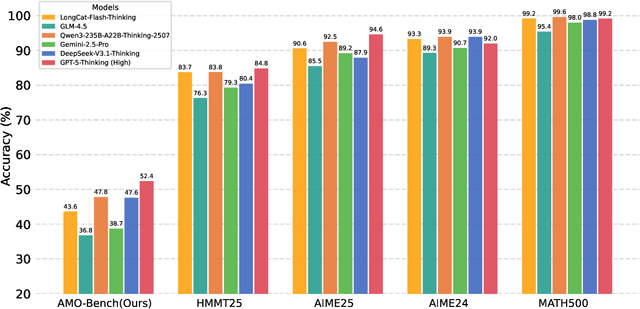
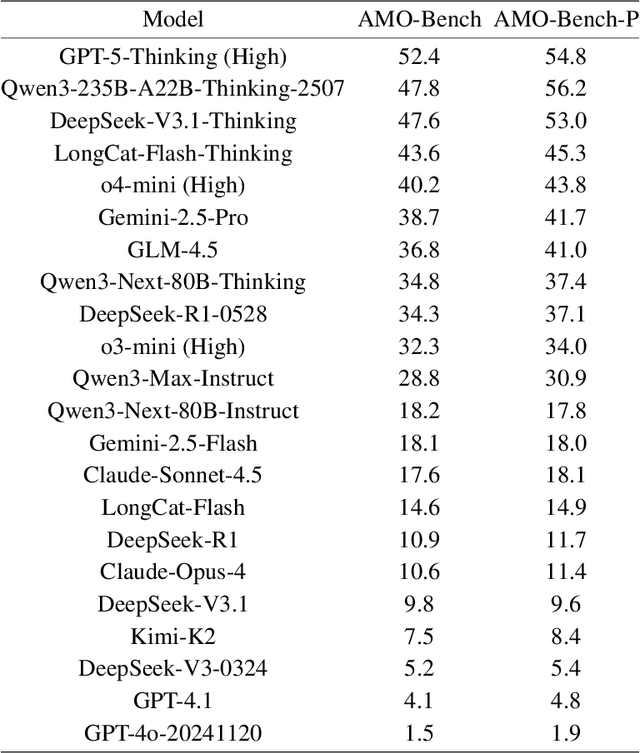
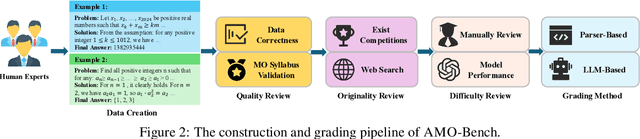
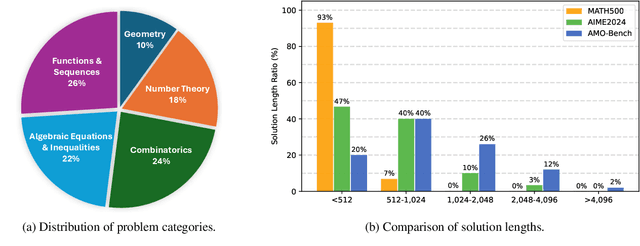
We present AMO-Bench, an Advanced Mathematical reasoning benchmark with Olympiad level or even higher difficulty, comprising 50 human-crafted problems. Existing benchmarks have widely leveraged high school math competitions for evaluating mathematical reasoning capabilities of large language models (LLMs). However, many existing math competitions are becoming less effective for assessing top-tier LLMs due to performance saturation (e.g., AIME24/25). To address this, AMO-Bench introduces more rigorous challenges by ensuring all 50 problems are (1) cross-validated by experts to meet at least the International Mathematical Olympiad (IMO) difficulty standards, and (2) entirely original problems to prevent potential performance leakages from data memorization. Moreover, each problem in AMO-Bench requires only a final answer rather than a proof, enabling automatic and robust grading for evaluation. Experimental results across 26 LLMs on AMO-Bench show that even the best-performing model achieves only 52.4% accuracy on AMO-Bench, with most LLMs scoring below 40%. Beyond these poor performances, our further analysis reveals a promising scaling trend with increasing test-time compute on AMO-Bench. These results highlight the significant room for improving the mathematical reasoning in current LLMs. We release AMO-Bench to facilitate further research into advancing the reasoning abilities of language models. https://amo-bench.github.io/
Uncovering and Mitigating Destructive Multi-Embedding Attacks in Deepfake Proactive Forensics
Aug 24, 2025With the rapid evolution of deepfake technologies and the wide dissemination of digital media, personal privacy is facing increasingly serious security threats. Deepfake proactive forensics, which involves embedding imperceptible watermarks to enable reliable source tracking, serves as a crucial defense against these threats. Although existing methods show strong forensic ability, they rely on an idealized assumption of single watermark embedding, which proves impractical in real-world scenarios. In this paper, we formally define and demonstrate the existence of Multi-Embedding Attacks (MEA) for the first time. When a previously protected image undergoes additional rounds of watermark embedding, the original forensic watermark can be destroyed or removed, rendering the entire proactive forensic mechanism ineffective. To address this vulnerability, we propose a general training paradigm named Adversarial Interference Simulation (AIS). Rather than modifying the network architecture, AIS explicitly simulates MEA scenarios during fine-tuning and introduces a resilience-driven loss function to enforce the learning of sparse and stable watermark representations. Our method enables the model to maintain the ability to extract the original watermark correctly even after a second embedding. Extensive experiments demonstrate that our plug-and-play AIS training paradigm significantly enhances the robustness of various existing methods against MEA.
Beyond Fully Supervised Pixel Annotations: Scribble-Driven Weakly-Supervised Framework for Image Manipulation Localization
Jul 17, 2025Deep learning-based image manipulation localization (IML) methods have achieved remarkable performance in recent years, but typically rely on large-scale pixel-level annotated datasets. To address the challenge of acquiring high-quality annotations, some recent weakly supervised methods utilize image-level labels to segment manipulated regions. However, the performance is still limited due to insufficient supervision signals. In this study, we explore a form of weak supervision that improves the annotation efficiency and detection performance, namely scribble annotation supervision. We re-annotated mainstream IML datasets with scribble labels and propose the first scribble-based IML (Sc-IML) dataset. Additionally, we propose the first scribble-based weakly supervised IML framework. Specifically, we employ self-supervised training with a structural consistency loss to encourage the model to produce consistent predictions under multi-scale and augmented inputs. In addition, we propose a prior-aware feature modulation module (PFMM) that adaptively integrates prior information from both manipulated and authentic regions for dynamic feature adjustment, further enhancing feature discriminability and prediction consistency in complex scenes. We also propose a gated adaptive fusion module (GAFM) that utilizes gating mechanisms to regulate information flow during feature fusion, guiding the model toward emphasizing potential tampered regions. Finally, we propose a confidence-aware entropy minimization loss (${\mathcal{L}}_{ {CEM }}$). This loss dynamically regularizes predictions in weakly annotated or unlabeled regions based on model uncertainty, effectively suppressing unreliable predictions. Experimental results show that our method outperforms existing fully supervised approaches in terms of average performance both in-distribution and out-of-distribution.
DiffMark: Diffusion-based Robust Watermark Against Deepfakes
Jul 02, 2025Deepfakes pose significant security and privacy threats through malicious facial manipulations. While robust watermarking can aid in authenticity verification and source tracking, existing methods often lack the sufficient robustness against Deepfake manipulations. Diffusion models have demonstrated remarkable performance in image generation, enabling the seamless fusion of watermark with image during generation. In this study, we propose a novel robust watermarking framework based on diffusion model, called DiffMark. By modifying the training and sampling scheme, we take the facial image and watermark as conditions to guide the diffusion model to progressively denoise and generate corresponding watermarked image. In the construction of facial condition, we weight the facial image by a timestep-dependent factor that gradually reduces the guidance intensity with the decrease of noise, thus better adapting to the sampling process of diffusion model. To achieve the fusion of watermark condition, we introduce a cross information fusion (CIF) module that leverages a learnable embedding table to adaptively extract watermark features and integrates them with image features via cross-attention. To enhance the robustness of the watermark against Deepfake manipulations, we integrate a frozen autoencoder during training phase to simulate Deepfake manipulations. Additionally, we introduce Deepfake-resistant guidance that employs specific Deepfake model to adversarially guide the diffusion sampling process to generate more robust watermarked images. Experimental results demonstrate the effectiveness of the proposed DiffMark on typical Deepfakes. Our code will be available at https://github.com/vpsg-research/DiffMark.
WaveGuard: Robust Deepfake Detection and Source Tracing via Dual-Tree Complex Wavelet and Graph Neural Networks
May 14, 2025Deepfake technology poses increasing risks such as privacy invasion and identity theft. To address these threats, we propose WaveGuard, a proactive watermarking framework that enhances robustness and imperceptibility via frequency-domain embedding and graph-based structural consistency. Specifically, we embed watermarks into high-frequency sub-bands using Dual-Tree Complex Wavelet Transform (DT-CWT) and employ a Structural Consistency Graph Neural Network (SC-GNN) to preserve visual quality. We also design an attention module to refine embedding precision. Experimental results on face swap and reenactment tasks demonstrate that WaveGuard outperforms state-of-the-art methods in both robustness and visual quality. Code is available at https://github.com/vpsg-research/WaveGuard.