 Add to Chrome
 Add to Firefox
 Add to Edge
Human Still Wins over LLM: An Empirical Study of Active Learning on Domain-Specific Annotation Tasks
Nov 16, 2023


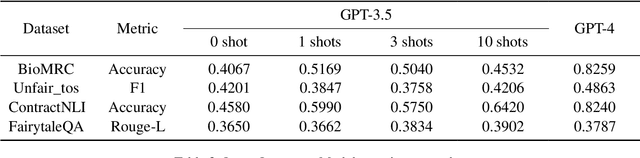
Large Language Models (LLMs) have demonstrated considerable advances, and several claims have been made about their exceeding human performance. However, in real-world tasks, domain knowledge is often required. Low-resource learning methods like Active Learning (AL) have been proposed to tackle the cost of domain expert annotation, raising this question: Can LLMs surpass compact models trained with expert annotations in domain-specific tasks? In this work, we conduct an empirical experiment on four datasets from three different domains comparing SOTA LLMs with small models trained on expert annotations with AL. We found that small models can outperform GPT-3.5 with a few hundreds of labeled data, and they achieve higher or similar performance with GPT-4 despite that they are hundreds time smaller. Based on these findings, we posit that LLM predictions can be used as a warmup method in real-world applications and human experts remain indispensable in tasks involving data annotation driven by domain-specific knowledge.

More Samples or More Prompt Inputs? Exploring Effective In-Context Sampling for LLM Few-Shot Prompt Engineering
Nov 16, 2023


While most existing works on LLM prompt-engineering focus only on how to select a better set of data samples inside one single prompt input (In-Context Learning or ICL), why can't we design and leverage multiple prompt inputs together to further improve the LLM performance? In this work, we propose In-Context Sampling (ICS), a low-resource LLM prompt-engineering technique to produce the most confident prediction results by optimizing the construction of multiple ICL prompt inputs. Extensive experiments with two SOTA LLMs (FlanT5-XL and Mistral-7B) on three NLI datasets (e-SNLI, Multi-NLI, and ANLI) illustrate that ICS can consistently enhance LLM's prediction performance and confidence. An ablation study suggests that a diversity-based ICS strategy may further improve LLM's performance, which sheds light on a new yet promising future research direction.
Is a Seat at the Table Enough? Engaging Teachers and Students in Dataset Specification for ML in Education
Nov 09, 2023Despite the promises of ML in education, its adoption in the classroom has surfaced numerous issues regarding fairness, accountability, and transparency, as well as concerns about data privacy and student consent. A root cause of these issues is the lack of understanding of the complex dynamics of education, including teacher-student interactions, collaborative learning, and classroom environment. To overcome these challenges and fully utilize the potential of ML in education, software practitioners need to work closely with educators and students to fully understand the context of the data (the backbone of ML applications) and collaboratively define the ML data specifications. To gain a deeper understanding of such a collaborative process, we conduct ten co-design sessions with ML software practitioners, educators, and students. In the sessions, teachers and students work with ML engineers, UX designers, and legal practitioners to define dataset characteristics for a given ML application. We find that stakeholders contextualize data based on their domain and procedural knowledge, proactively design data requirements to mitigate downstream harms and data reliability concerns, and exhibit role-based collaborative strategies and contribution patterns. Further, we find that beyond a seat at the table, meaningful stakeholder participation in ML requires structured supports: defined processes for continuous iteration and co-evaluation, shared contextual data quality standards, and information scaffolds for both technical and non-technical stakeholders to traverse expertise boundaries.
'Don't Get Too Technical with Me': A Discourse Structure-Based Framework for Science Journalism
Oct 23, 2023
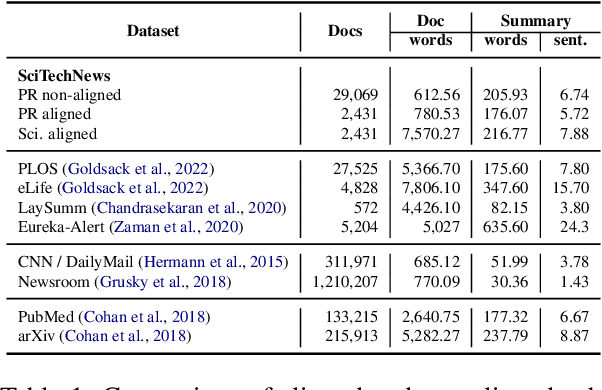


Science journalism refers to the task of reporting technical findings of a scientific paper as a less technical news article to the general public audience. We aim to design an automated system to support this real-world task (i.e., automatic science journalism) by 1) introducing a newly-constructed and real-world dataset (SciTechNews), with tuples of a publicly-available scientific paper, its corresponding news article, and an expert-written short summary snippet; 2) proposing a novel technical framework that integrates a paper's discourse structure with its metadata to guide generation; and, 3) demonstrating with extensive automatic and human experiments that our framework outperforms other baseline methods (e.g. Alpaca and ChatGPT) in elaborating a content plan meaningful for the target audience, simplifying the information selected, and producing a coherent final report in a layman's style.
Will the Prince Get True Love's Kiss? On the Model Sensitivity to Gender Perturbation over Fairytale Texts
Oct 16, 2023


Recent studies show that traditional fairytales are rife with harmful gender biases. To help mitigate these gender biases in fairytales, this work aims to assess learned biases of language models by evaluating their robustness against gender perturbations. Specifically, we focus on Question Answering (QA) tasks in fairytales. Using counterfactual data augmentation to the FairytaleQA dataset, we evaluate model robustness against swapped gender character information, and then mitigate learned biases by introducing counterfactual gender stereotypes during training time. We additionally introduce a novel approach that utilizes the massive vocabulary of language models to support text genres beyond fairytales. Our experimental results suggest that models are sensitive to gender perturbations, with significant performance drops compared to the original testing set. However, when first fine-tuned on a counterfactual training dataset, models are less sensitive to the later introduced anti-gender stereotyped text.
Talk2Care: Facilitating Asynchronous Patient-Provider Communication with Large-Language-Model
Sep 22, 2023
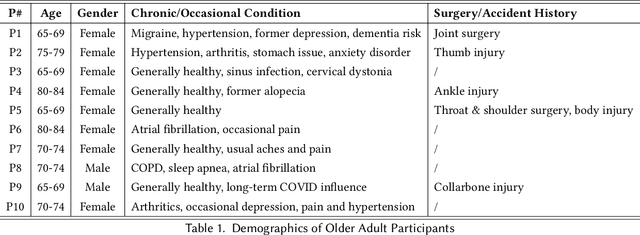
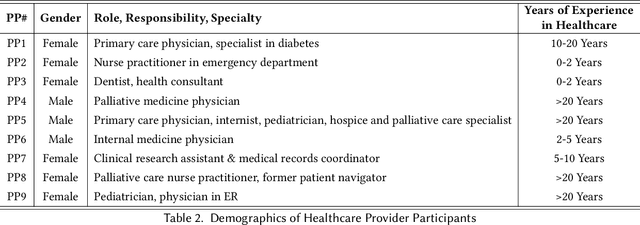

Despite the plethora of telehealth applications to assist home-based older adults and healthcare providers, basic messaging and phone calls are still the most common communication methods, which suffer from limited availability, information loss, and process inefficiencies. One promising solution to facilitate patient-provider communication is to leverage large language models (LLMs) with their powerful natural conversation and summarization capability. However, there is a limited understanding of LLMs' role during the communication. We first conducted two interview studies with both older adults (N=10) and healthcare providers (N=9) to understand their needs and opportunities for LLMs in patient-provider asynchronous communication. Based on the insights, we built an LLM-powered communication system, Talk2Care, and designed interactive components for both groups: (1) For older adults, we leveraged the convenience and accessibility of voice assistants (VAs) and built an LLM-powered VA interface for effective information collection. (2) For health providers, we built an LLM-based dashboard to summarize and present important health information based on older adults' conversations with the VA. We further conducted two user studies with older adults and providers to evaluate the usability of the system. The results showed that Talk2Care could facilitate the communication process, enrich the health information collected from older adults, and considerably save providers' efforts and time. We envision our work as an initial exploration of LLMs' capability in the intersection of healthcare and interpersonal communication.
"It's a Fair Game'', or Is It? Examining How Users Navigate Disclosure Risks and Benefits When Using LLM-Based Conversational Agents
Sep 20, 2023The widespread use of Large Language Model (LLM)-based conversational agents (CAs), especially in high-stakes domains, raises many privacy concerns. Building ethical LLM-based CAs that respect user privacy requires an in-depth understanding of the privacy risks that concern users the most. However, existing research, primarily model-centered, does not provide insight into users' perspectives. To bridge this gap, we analyzed sensitive disclosures in real-world ChatGPT conversations and conducted semi-structured interviews with 19 LLM-based CA users. We found that users are constantly faced with trade-offs between privacy, utility, and convenience when using LLM-based CAs. However, users' erroneous mental models and the dark patterns in system design limited their awareness and comprehension of the privacy risks. Additionally, the human-like interactions encouraged more sensitive disclosures, which complicated users' ability to navigate the trade-offs. We discuss practical design guidelines and the needs for paradigmatic shifts to protect the privacy of LLM-based CA users.
Rethinking Human-AI Collaboration in Complex Medical Decision Making: A Case Study in Sepsis Diagnosis
Sep 17, 2023
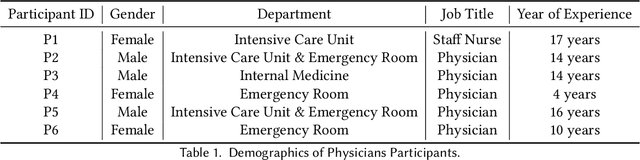
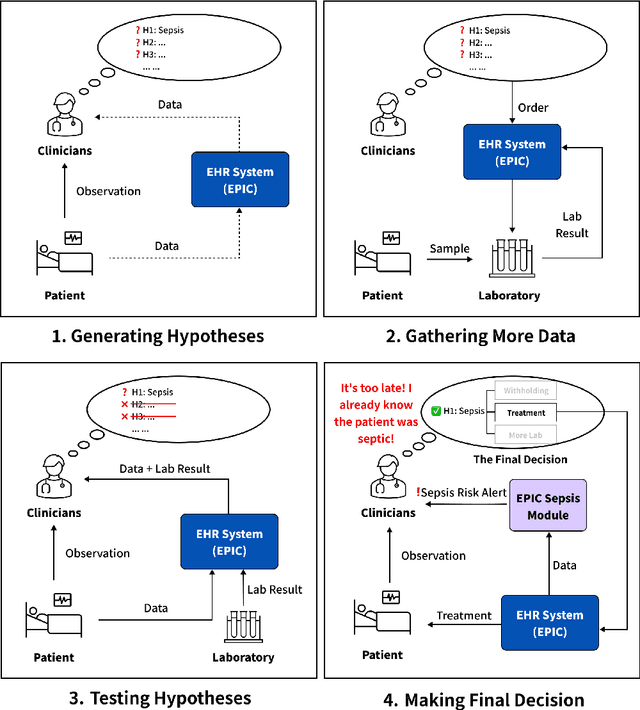

Today's AI systems for medical decision support often succeed on benchmark datasets in research papers but fail in real-world deployment. This work focuses on the decision making of sepsis, an acute life-threatening systematic infection that requires an early diagnosis with high uncertainty from the clinician. Our aim is to explore the design requirements for AI systems that can support clinical experts in making better decisions for the early diagnosis of sepsis. The study begins with a formative study investigating why clinical experts abandon an existing AI-powered Sepsis predictive module in their electrical health record (EHR) system. We argue that a human-centered AI system needs to support human experts in the intermediate stages of a medical decision-making process (e.g., generating hypotheses or gathering data), instead of focusing only on the final decision. Therefore, we build SepsisLab based on a state-of-the-art AI algorithm and extend it to predict the future projection of sepsis development, visualize the prediction uncertainty, and propose actionable suggestions (i.e., which additional laboratory tests can be collected) to reduce such uncertainty. Through heuristic evaluation with six clinicians using our prototype system, we demonstrate that SepsisLab enables a promising human-AI collaboration paradigm for the future of AI-assisted sepsis diagnosis and other high-stakes medical decision making.
PaniniQA: Enhancing Patient Education Through Interactive Question Answering
Aug 21, 2023Patient portal allows discharged patients to access their personalized discharge instructions in electronic health records (EHRs). However, many patients have difficulty understanding or memorizing their discharge instructions. In this paper, we present PaniniQA, a patient-centric interactive question answering system designed to help patients understand their discharge instructions. PaniniQA first identifies important clinical content from patients' discharge instructions and then formulates patient-specific educational questions. In addition, PaniniQA is also equipped with answer verification functionality to provide timely feedback to correct patients' misunderstandings. Our comprehensive automatic and human evaluation results demonstrate our PaniniQA is capable of improving patients' mastery of their medical instructions through effective interactions
Mental-LLM: Leveraging Large Language Models for Mental Health Prediction via Online Text Data
Aug 16, 2023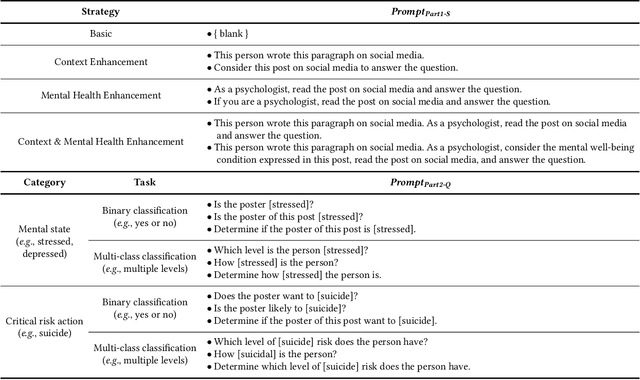
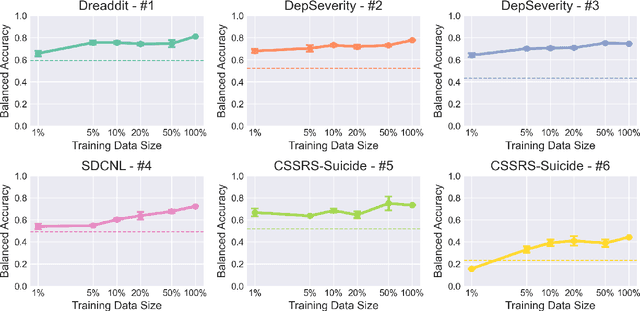
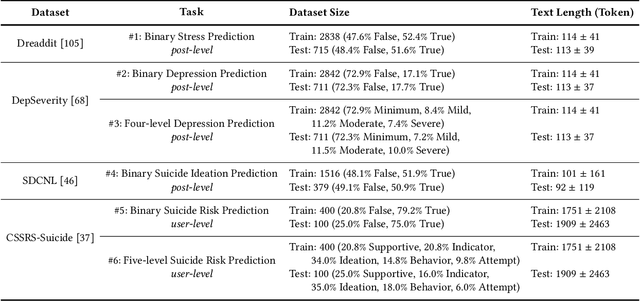
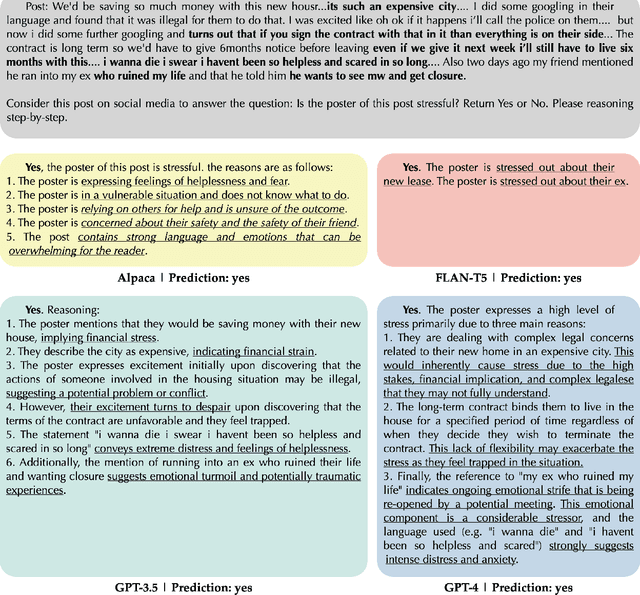
Advances in large language models (LLMs) have empowered a variety of applications. However, there is still a significant gap in research when it comes to understanding and enhancing the capabilities of LLMs in the field of mental health. In this work, we present the first comprehensive evaluation of multiple LLMs, including Alpaca, Alpaca-LoRA, FLAN-T5, GPT-3.5, and GPT-4, on various mental health prediction tasks via online text data. We conduct a broad range of experiments, covering zero-shot prompting, few-shot prompting, and instruction fine-tuning. The results indicate a promising yet limited performance of LLMs with zero-shot and few-shot prompt designs for the mental health tasks. More importantly, our experiments show that instruction finetuning can significantly boost the performance of LLMs for all tasks simultaneously. Our best-finetuned models, Mental-Alpaca and Mental-FLAN-T5, outperform the best prompt design of GPT-3.5 (25 and 15 times bigger) by 10.9% on balanced accuracy and the best of GPT-4 (250 and 150 times bigger) by 4.8%. They further perform on par with the state-of-the-art task-specific language model. We also conduct an exploratory case study on LLMs' capability on the mental health reasoning tasks, illustrating the promising capability of certain models such as GPT-4. We summarize our findings into a set of action guidelines for potential methods to enhance LLMs' capability for mental health tasks. Meanwhile, we also emphasize the important limitations before achieving deployability in real-world mental health settings, such as known racial and gender bias. We highlight the important ethical risks accompanying this line of research.