 Add to Chrome
 Add to Firefox
 Add to Edge
Marked Pedagogies: Examining Linguistic Biases in Personalized Automated Writing Feedback
Mar 12, 2026
Effective personalized feedback is critical to students' literacy development. Though LLM-powered tools now promise to automate such feedback at scale, LLMs are not language-neutral: they privilege standard academic English and reproduce social stereotypes, raising concerns about how "personalization" shapes the feedback students receive. We examine how four widely used LLMs (GPT-4o, GPT-3.5-turbo, Llama-3.3 70B, Llama-3.1 8B) adapt written feedback in response to student attributes. Using 600 eighth-grade persuasive essays from the PERSUADE dataset, we generated feedback under prompt conditions embedding gender, race/ethnicity, learning needs, achievement, and motivation. We analyze lexical shifts across model outputs by adapting the Marked Words framework. Our results reveal systematic, stereotype-aligned shifts in feedback conditioned on presumed student attributes--even when essay content was identical. Feedback for students marked by race, language, or disability often exhibited positive feedback bias and feedback withholding bias--overuse of praise, less substantive critique, and assumptions of limited ability. Across attributes, models tailored not only what content was emphasized but also how writing was judged and how students were addressed. We term these instructional orientations Marked Pedagogies and highlight the need for transparency and accountability in automated feedback tools.

Is a Seat at the Table Enough? Engaging Teachers and Students in Dataset Specification for ML in Education
Nov 09, 2023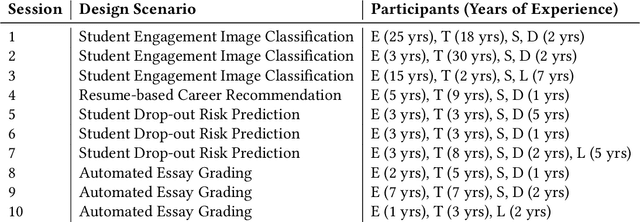
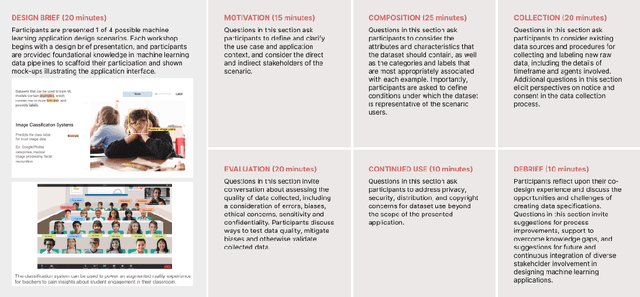

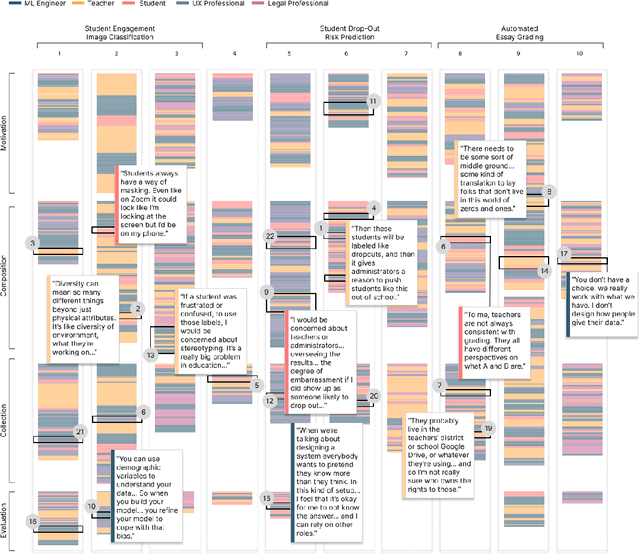
Despite the promises of ML in education, its adoption in the classroom has surfaced numerous issues regarding fairness, accountability, and transparency, as well as concerns about data privacy and student consent. A root cause of these issues is the lack of understanding of the complex dynamics of education, including teacher-student interactions, collaborative learning, and classroom environment. To overcome these challenges and fully utilize the potential of ML in education, software practitioners need to work closely with educators and students to fully understand the context of the data (the backbone of ML applications) and collaboratively define the ML data specifications. To gain a deeper understanding of such a collaborative process, we conduct ten co-design sessions with ML software practitioners, educators, and students. In the sessions, teachers and students work with ML engineers, UX designers, and legal practitioners to define dataset characteristics for a given ML application. We find that stakeholders contextualize data based on their domain and procedural knowledge, proactively design data requirements to mitigate downstream harms and data reliability concerns, and exhibit role-based collaborative strategies and contribution patterns. Further, we find that beyond a seat at the table, meaningful stakeholder participation in ML requires structured supports: defined processes for continuous iteration and co-evaluation, shared contextual data quality standards, and information scaffolds for both technical and non-technical stakeholders to traverse expertise boundaries.