 Add to Chrome
 Add to Firefox
 Add to Edge
ODYSSEY: Open-World Quadrupeds Exploration and Manipulation for Long-Horizon Tasks
Aug 11, 2025
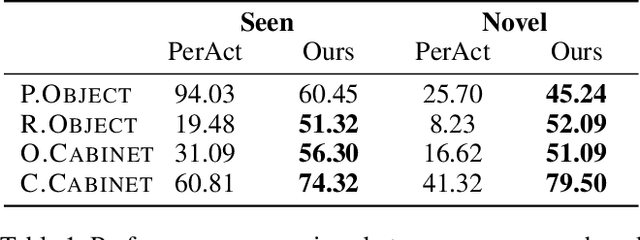
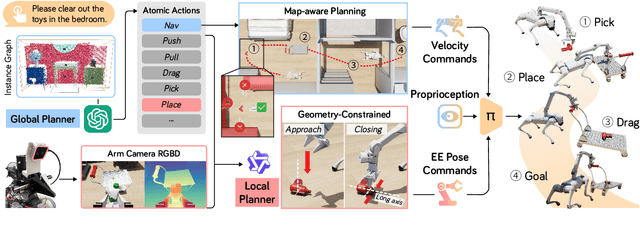

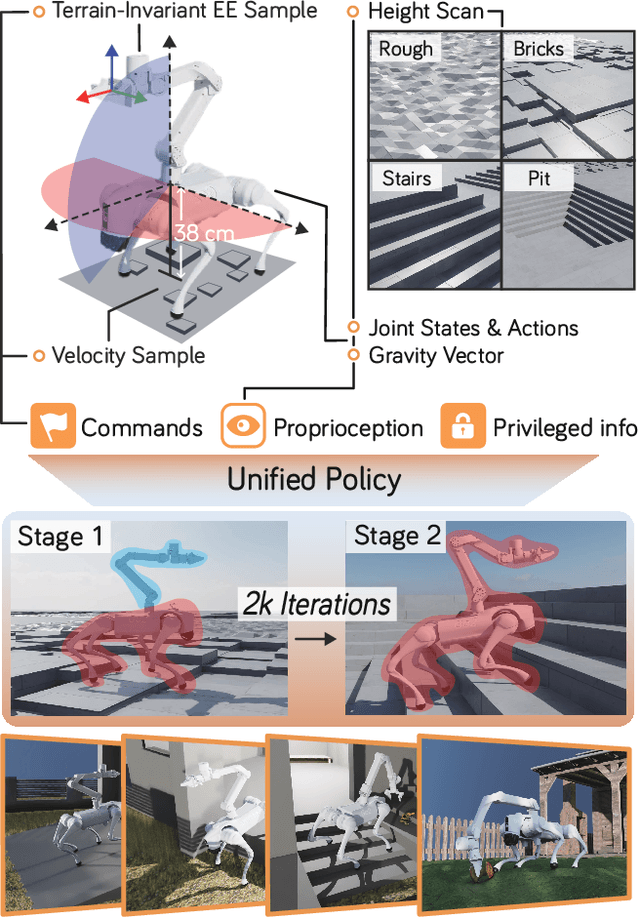
Language-guided long-horizon mobile manipulation has long been a grand challenge in embodied semantic reasoning, generalizable manipulation, and adaptive locomotion. Three fundamental limitations hinder progress: First, although large language models have improved spatial reasoning and task planning through semantic priors, existing implementations remain confined to tabletop scenarios, failing to address the constrained perception and limited actuation ranges of mobile platforms. Second, current manipulation strategies exhibit insufficient generalization when confronted with the diverse object configurations encountered in open-world environments. Third, while crucial for practical deployment, the dual requirement of maintaining high platform maneuverability alongside precise end-effector control in unstructured settings remains understudied. In this work, we present ODYSSEY, a unified mobile manipulation framework for agile quadruped robots equipped with manipulators, which seamlessly integrates high-level task planning with low-level whole-body control. To address the challenge of egocentric perception in language-conditioned tasks, we introduce a hierarchical planner powered by a vision-language model, enabling long-horizon instruction decomposition and precise action execution. At the control level, our novel whole-body policy achieves robust coordination across challenging terrains. We further present the first benchmark for long-horizon mobile manipulation, evaluating diverse indoor and outdoor scenarios. Through successful sim-to-real transfer, we demonstrate the system's generalization and robustness in real-world deployments, underscoring the practicality of legged manipulators in unstructured environments. Our work advances the feasibility of generalized robotic assistants capable of complex, dynamic tasks. Our project page: https://kaijwang.github.io/odyssey.github.io/

$π^3$: Scalable Permutation-Equivariant Visual Geometry Learning
Jul 17, 2025We introduce $\pi^3$, a feed-forward neural network that offers a novel approach to visual geometry reconstruction, breaking the reliance on a conventional fixed reference view. Previous methods often anchor their reconstructions to a designated viewpoint, an inductive bias that can lead to instability and failures if the reference is suboptimal. In contrast, $\pi^3$ employs a fully permutation-equivariant architecture to predict affine-invariant camera poses and scale-invariant local point maps without any reference frames. This design makes our model inherently robust to input ordering and highly scalable. These advantages enable our simple and bias-free approach to achieve state-of-the-art performance on a wide range of tasks, including camera pose estimation, monocular/video depth estimation, and dense point map reconstruction. Code and models are publicly available.
Training-Free Motion Customization for Distilled Video Generators with Adaptive Test-Time Distillation
Jun 24, 2025Distilled video generation models offer fast and efficient synthesis but struggle with motion customization when guided by reference videos, especially under training-free settings. Existing training-free methods, originally designed for standard diffusion models, fail to generalize due to the accelerated generative process and large denoising steps in distilled models. To address this, we propose MotionEcho, a novel training-free test-time distillation framework that enables motion customization by leveraging diffusion teacher forcing. Our approach uses high-quality, slow teacher models to guide the inference of fast student models through endpoint prediction and interpolation. To maintain efficiency, we dynamically allocate computation across timesteps according to guidance needs. Extensive experiments across various distilled video generation models and benchmark datasets demonstrate that our method significantly improves motion fidelity and generation quality while preserving high efficiency. Project page: https://euminds.github.io/motionecho/
Revisiting Depth Representations for Feed-Forward 3D Gaussian Splatting
Jun 05, 2025Depth maps are widely used in feed-forward 3D Gaussian Splatting (3DGS) pipelines by unprojecting them into 3D point clouds for novel view synthesis. This approach offers advantages such as efficient training, the use of known camera poses, and accurate geometry estimation. However, depth discontinuities at object boundaries often lead to fragmented or sparse point clouds, degrading rendering quality -- a well-known limitation of depth-based representations. To tackle this issue, we introduce PM-Loss, a novel regularization loss based on a pointmap predicted by a pre-trained transformer. Although the pointmap itself may be less accurate than the depth map, it effectively enforces geometric smoothness, especially around object boundaries. With the improved depth map, our method significantly improves the feed-forward 3DGS across various architectures and scenes, delivering consistently better rendering results. Our project page: https://aim-uofa.github.io/PMLoss
Active-O3: Empowering Multimodal Large Language Models with Active Perception via GRPO
May 27, 2025Active vision, also known as active perception, refers to the process of actively selecting where and how to look in order to gather task-relevant information. It is a critical component of efficient perception and decision-making in humans and advanced embodied agents. Recently, the use of Multimodal Large Language Models (MLLMs) as central planning and decision-making modules in robotic systems has gained extensive attention. However, despite the importance of active perception in embodied intelligence, there is little to no exploration of how MLLMs can be equipped with or learn active perception capabilities. In this paper, we first provide a systematic definition of MLLM-based active perception tasks. We point out that the recently proposed GPT-o3 model's zoom-in search strategy can be regarded as a special case of active perception; however, it still suffers from low search efficiency and inaccurate region selection. To address these issues, we propose ACTIVE-O3, a purely reinforcement learning based training framework built on top of GRPO, designed to equip MLLMs with active perception capabilities. We further establish a comprehensive benchmark suite to evaluate ACTIVE-O3 across both general open-world tasks, such as small-object and dense object grounding, and domain-specific scenarios, including small object detection in remote sensing and autonomous driving, as well as fine-grained interactive segmentation. In addition, ACTIVE-O3 also demonstrates strong zero-shot reasoning abilities on the V* Benchmark, without relying on any explicit reasoning data. We hope that our work can provide a simple codebase and evaluation protocol to facilitate future research on active perception in MLLMs.
Omni-R1: Reinforcement Learning for Omnimodal Reasoning via Two-System Collaboration
May 26, 2025Long-horizon video-audio reasoning and fine-grained pixel understanding impose conflicting requirements on omnimodal models: dense temporal coverage demands many low-resolution frames, whereas precise grounding calls for high-resolution inputs. We tackle this trade-off with a two-system architecture: a Global Reasoning System selects informative keyframes and rewrites the task at low spatial cost, while a Detail Understanding System performs pixel-level grounding on the selected high-resolution snippets. Because ``optimal'' keyframe selection and reformulation are ambiguous and hard to supervise, we formulate them as a reinforcement learning (RL) problem and present Omni-R1, an end-to-end RL framework built on Group Relative Policy Optimization. Omni-R1 trains the Global Reasoning System through hierarchical rewards obtained via online collaboration with the Detail Understanding System, requiring only one epoch of RL on small task splits. Experiments on two challenging benchmarks, namely Referring Audio-Visual Segmentation (RefAVS) and Reasoning Video Object Segmentation (REVOS), show that Omni-R1 not only surpasses strong supervised baselines but also outperforms specialized state-of-the-art models, while substantially improving out-of-domain generalization and mitigating multimodal hallucination. Our results demonstrate the first successful application of RL to large-scale omnimodal reasoning and highlight a scalable path toward universally foundation models.
POMATO: Marrying Pointmap Matching with Temporal Motion for Dynamic 3D Reconstruction
Apr 08, 20253D reconstruction in dynamic scenes primarily relies on the combination of geometry estimation and matching modules where the latter task is pivotal for distinguishing dynamic regions which can help to mitigate the interference introduced by camera and object motion. Furthermore, the matching module explicitly models object motion, enabling the tracking of specific targets and advancing motion understanding in complex scenarios. Recently, the proposed representation of pointmap in DUSt3R suggests a potential solution to unify both geometry estimation and matching in 3D space, but it still struggles with ambiguous matching in dynamic regions, which may hamper further improvement. In this work, we present POMATO, a unified framework for dynamic 3D reconstruction by marrying pointmap matching with temporal motion. Specifically, our method first learns an explicit matching relationship by mapping RGB pixels from both dynamic and static regions across different views to 3D pointmaps within a unified coordinate system. Furthermore, we introduce a temporal motion module for dynamic motions that ensures scale consistency across different frames and enhances performance in tasks requiring both precise geometry and reliable matching, most notably 3D point tracking. We show the effectiveness of the proposed pointmap matching and temporal fusion paradigm by demonstrating the remarkable performance across multiple downstream tasks, including video depth estimation, 3D point tracking, and pose estimation. Code and models are publicly available at https://github.com/wyddmw/POMATO.
Aether: Geometric-Aware Unified World Modeling
Mar 25, 2025The integration of geometric reconstruction and generative modeling remains a critical challenge in developing AI systems capable of human-like spatial reasoning. This paper proposes Aether, a unified framework that enables geometry-aware reasoning in world models by jointly optimizing three core capabilities: (1) 4D dynamic reconstruction, (2) action-conditioned video prediction, and (3) goal-conditioned visual planning. Through task-interleaved feature learning, Aether achieves synergistic knowledge sharing across reconstruction, prediction, and planning objectives. Building upon video generation models, our framework demonstrates unprecedented synthetic-to-real generalization despite never observing real-world data during training. Furthermore, our approach achieves zero-shot generalization in both action following and reconstruction tasks, thanks to its intrinsic geometric modeling. Remarkably, even without real-world data, its reconstruction performance is comparable with or even better than that of domain-specific models. Additionally, Aether employs camera trajectories as geometry-informed action spaces, enabling effective action-conditioned prediction and visual planning. We hope our work inspires the community to explore new frontiers in physically-reasonable world modeling and its applications.
SegAgent: Exploring Pixel Understanding Capabilities in MLLMs by Imitating Human Annotator Trajectories
Mar 11, 2025While MLLMs have demonstrated adequate image understanding capabilities, they still struggle with pixel-level comprehension, limiting their practical applications. Current evaluation tasks like VQA and visual grounding remain too coarse to assess fine-grained pixel comprehension accurately. Though segmentation is foundational for pixel-level understanding, existing methods often require MLLMs to generate implicit tokens, decoded through external pixel decoders. This approach disrupts the MLLM's text output space, potentially compromising language capabilities and reducing flexibility and extensibility, while failing to reflect the model's intrinsic pixel-level understanding. Thus, we introduce the Human-Like Mask Annotation Task (HLMAT), a new paradigm where MLLMs mimic human annotators using interactive segmentation tools. Modeling segmentation as a multi-step Markov Decision Process, HLMAT enables MLLMs to iteratively generate text-based click points, achieving high-quality masks without architectural changes or implicit tokens. Through this setup, we develop SegAgent, a model fine-tuned on human-like annotation trajectories, which achieves performance comparable to state-of-the-art (SOTA) methods and supports additional tasks like mask refinement and annotation filtering. HLMAT provides a protocol for assessing fine-grained pixel understanding in MLLMs and introduces a vision-centric, multi-step decision-making task that facilitates exploration of MLLMs' visual reasoning abilities. Our adaptations of policy improvement method StaR and PRM-guided tree search further enhance model robustness in complex segmentation tasks, laying a foundation for future advancements in fine-grained visual perception and multi-step decision-making for MLLMs.
PerturboLLaVA: Reducing Multimodal Hallucinations with Perturbative Visual Training
Mar 09, 2025This paper aims to address the challenge of hallucinations in Multimodal Large Language Models (MLLMs) particularly for dense image captioning tasks. To tackle the challenge, we identify the current lack of a metric that finely measures the caption quality in concept level. We hereby introduce HalFscore, a novel metric built upon the language graph and is designed to evaluate both the accuracy and completeness of dense captions at a granular level. Additionally, we identify the root cause of hallucination as the model's over-reliance on its language prior. To address this, we propose PerturboLLaVA, which reduces the model's reliance on the language prior by incorporating adversarially perturbed text during training. This method enhances the model's focus on visual inputs, effectively reducing hallucinations and producing accurate, image-grounded descriptions without incurring additional computational overhead. PerturboLLaVA significantly improves the fidelity of generated captions, outperforming existing approaches in handling multimodal hallucinations and achieving improved performance across general multimodal benchmarks.