 Add to Chrome
 Add to Firefox
 Add to Edge
Latent Spatial Memory for Video World Models
Jun 08, 2026
Video world models that maintain 3D spatial consistency across generated frames typically rely on explicit point cloud memory constructed in RGB space. This design is both computationally expensive, requiring repeated rendering and VAE encoding, and inherently lossy, as the round trip through pixel space discards rich features of the learned latent representation. In this paper, we introduce \emph{latent spatial memory} for video world models, a persistent 3D cache that stores scene information directly in the diffusion latent space, avoiding pixel-space reconstruction. Building on this, we propose Mirage, a latent-space spatial memory framework that constructs the memory by lifting latent tokens into 3D via depth-guided back-projection and queries it by synthesizing novel views through direct latent-space warping. This unified formulation eliminates both the information loss of pixel-space reconstruction and the computational burden of repeated encoding and rendering. Experiments show that latent spatial memory achieves up to \textbf{10.57}$\times$ faster end-to-end video generation and \textbf{55}$\times$ reduction in memory footprint relative to explicit 3D baselines. Leveraging the geometric prior of the diffusion model, Mirage attains state-of-the-art performance on WorldScore and strong reconstruction quality on RealEstate10K.

TriSplat: Simulation-Ready Feed-Forward 3D Scene Reconstruction
May 25, 2026Sparse-view 3D reconstruction is increasingly addressed with feed-forward splatting networks that predict explicit primitives directly from images. Yet most existing methods remain centered on Gaussian primitives and expose surfaces only indirectly: extracting a usable mesh for downstream simulation, physics reasoning, or embodied interaction still requires expensive post-hoc steps that break the feed-forward promise. This limitation is especially pronounced in pose-free settings, where scene structure and camera parameters must be estimated jointly from sparse observations. We present TriSplat, a feed-forward reconstruction network that represents scenes with oriented triangle primitives and directly exports simulation-ready mesh scenes from a single forward pass. Given input images, the network predicts local 3D point maps, triangle attributes, camera poses, and optional intrinsics. Rather than regressing triangle orientation as an unconstrained latent variable, our approach constructs geometry normals from the predicted point maps, refines them with an image-conditioned normal head, and converts them into stable local frames for triangle parameterization. A mono-normal bootstrap schedule further stabilizes early training, while opacity and blur scheduling progressively sharpens the learned surface representation for direct mesh extraction. Experiments on RealEstate10K and DL3DV show that this representation produces more geometry-faithful reconstructions than Gaussian feed-forward baselines while maintaining competitive novel-view rendering quality. Because the rendering primitives are themselves surface triangles, the output can be directly ingested by physics engines, collision detectors, and standard rendering pipelines without any conversion, making it a practical simulation-ready solution for feed-forward 3D scene reconstruction.
World-R1: Reinforcing 3D Constraints for Text-to-Video Generation
Apr 27, 2026Recent video foundation models demonstrate impressive visual synthesis but frequently suffer from geometric inconsistencies. While existing methods attempt to inject 3D priors via architectural modifications, they often incur high computational costs and limit scalability. We propose World-R1, a framework that aligns video generation with 3D constraints through reinforcement learning. To facilitate this alignment, we introduce a specialized pure text dataset tailored for world simulation. Utilizing Flow-GRPO, we optimize the model using feedback from pre-trained 3D foundation models and vision-language models to enforce structural coherence without altering the underlying architecture. We further employ a periodic decoupled training strategy to balance rigid geometric consistency with dynamic scene fluidity. Extensive evaluations reveal that our approach significantly enhances 3D consistency while preserving the original visual quality of the foundation model, effectively bridging the gap between video generation and scalable world simulation.
Feed-Forward 3D Scene Modeling: A Problem-Driven Perspective
Apr 15, 2026Reconstructing 3D representations from 2D inputs is a fundamental task in computer vision and graphics, serving as a cornerstone for understanding and interacting with the physical world. While traditional methods achieve high fidelity, they are limited by slow per-scene optimization or category-specific training, which hinders their practical deployment and scalability. Hence, generalizable feed-forward 3D reconstruction has witnessed rapid development in recent years. By learning a model that maps images directly to 3D representations in a single forward pass, these methods enable efficient reconstruction and robust cross-scene generalization. Our survey is motivated by a critical observation: despite the diverse geometric output representations, ranging from implicit fields to explicit primitives, existing feed-forward approaches share similar high-level architectural patterns, such as image feature extraction backbones, multi-view information fusion mechanisms, and geometry-aware design principles. Consequently, we abstract away from these representation differences and instead focus on model design, proposing a novel taxonomy centered on model design strategies that are agnostic to the output format. Our proposed taxonomy organizes the research directions into five key problems that drive recent research development: feature enhancement, geometry awareness, model efficiency, augmentation strategies and temporal-aware models. To support this taxonomy with empirical grounding and standardized evaluation, we further comprehensively review related benchmarks and datasets, and extensively discuss and categorize real-world applications based on feed-forward 3D models. Finally, we outline future directions to address open challenges such as scalability, evaluation standards, and world modeling.
Scalable Adaptation of 3D Geometric Foundation Models via Weak Supervision from Internet Video
Feb 08, 2026Geometric foundation models show promise in 3D reconstruction, yet their progress is severely constrained by the scarcity of diverse, large-scale 3D annotations. While Internet videos offer virtually unlimited raw data, utilizing them as a scaling source for geometric learning is challenging due to the absence of ground-truth geometry and the presence of observational noise. To address this, we propose SAGE, a framework for Scalable Adaptation of GEometric foundation models from raw video streams. SAGE leverages a hierarchical mining pipeline to transform videos into training trajectories and hybrid supervision: (1) Informative training trajectory selection; (2) Sparse Geometric Anchoring via SfM point clouds for global structural guidance; and (3) Dense Differentiable Consistency via 3D Gaussian rendering for multi-view constraints. To prevent catastrophic forgetting, we introduce a regularization strategy using anchor data. Extensive experiments show that SAGE significantly enhances zero-shot generalization, reducing Chamfer Distance by 20-42% on unseen benchmarks (7Scenes, TUM-RGBD, Matterport3D) compared to state-of-the-art baselines. To our knowledge, SAGE pioneers the adaptation of geometric foundation models via Internet video, establishing a scalable paradigm for general-purpose 3D learning.
Depth Anything 3: Recovering the Visual Space from Any Views
Nov 13, 2025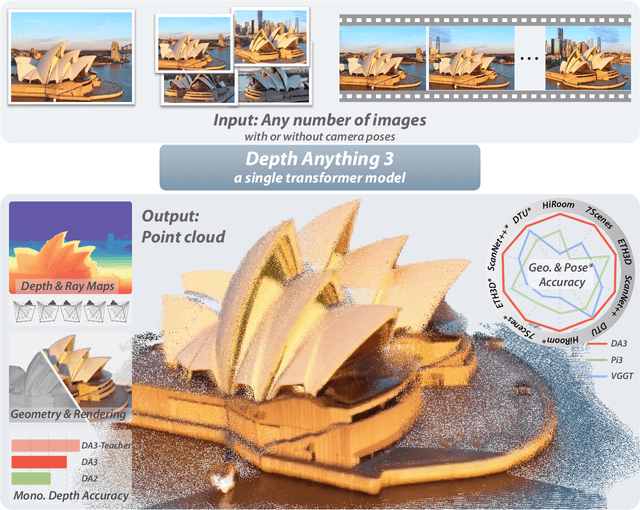
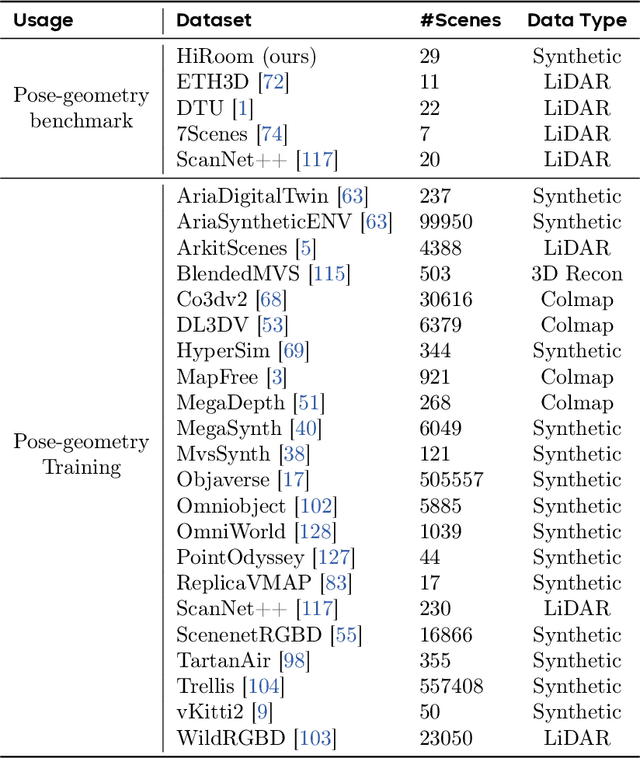

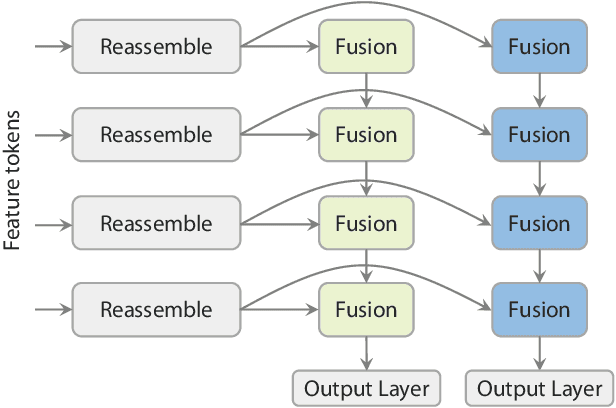
We present Depth Anything 3 (DA3), a model that predicts spatially consistent geometry from an arbitrary number of visual inputs, with or without known camera poses. In pursuit of minimal modeling, DA3 yields two key insights: a single plain transformer (e.g., vanilla DINO encoder) is sufficient as a backbone without architectural specialization, and a singular depth-ray prediction target obviates the need for complex multi-task learning. Through our teacher-student training paradigm, the model achieves a level of detail and generalization on par with Depth Anything 2 (DA2). We establish a new visual geometry benchmark covering camera pose estimation, any-view geometry and visual rendering. On this benchmark, DA3 sets a new state-of-the-art across all tasks, surpassing prior SOTA VGGT by an average of 44.3% in camera pose accuracy and 25.1% in geometric accuracy. Moreover, it outperforms DA2 in monocular depth estimation. All models are trained exclusively on public academic datasets.
Revisiting Depth Representations for Feed-Forward 3D Gaussian Splatting
Jun 05, 2025Depth maps are widely used in feed-forward 3D Gaussian Splatting (3DGS) pipelines by unprojecting them into 3D point clouds for novel view synthesis. This approach offers advantages such as efficient training, the use of known camera poses, and accurate geometry estimation. However, depth discontinuities at object boundaries often lead to fragmented or sparse point clouds, degrading rendering quality -- a well-known limitation of depth-based representations. To tackle this issue, we introduce PM-Loss, a novel regularization loss based on a pointmap predicted by a pre-trained transformer. Although the pointmap itself may be less accurate than the depth map, it effectively enforces geometric smoothness, especially around object boundaries. With the improved depth map, our method significantly improves the feed-forward 3DGS across various architectures and scenes, delivering consistently better rendering results. Our project page: https://aim-uofa.github.io/PMLoss
ZPressor: Bottleneck-Aware Compression for Scalable Feed-Forward 3DGS
May 29, 2025Feed-forward 3D Gaussian Splatting (3DGS) models have recently emerged as a promising solution for novel view synthesis, enabling one-pass inference without the need for per-scene 3DGS optimization. However, their scalability is fundamentally constrained by the limited capacity of their encoders, leading to degraded performance or excessive memory consumption as the number of input views increases. In this work, we analyze feed-forward 3DGS frameworks through the lens of the Information Bottleneck principle and introduce ZPressor, a lightweight architecture-agnostic module that enables efficient compression of multi-view inputs into a compact latent state $Z$ that retains essential scene information while discarding redundancy. Concretely, ZPressor enables existing feed-forward 3DGS models to scale to over 100 input views at 480P resolution on an 80GB GPU, by partitioning the views into anchor and support sets and using cross attention to compress the information from the support views into anchor views, forming the compressed latent state $Z$. We show that integrating ZPressor into several state-of-the-art feed-forward 3DGS models consistently improves performance under moderate input views and enhances robustness under dense view settings on two large-scale benchmarks DL3DV-10K and RealEstate10K. The video results, code and trained models are available on our project page: https://lhmd.top/zpressor.