 Add to Chrome
 Add to Firefox
 Add to Edge
Drag Your GAN: Interactive Point-based Manipulation on the Generative Image Manifold
May 18, 2023
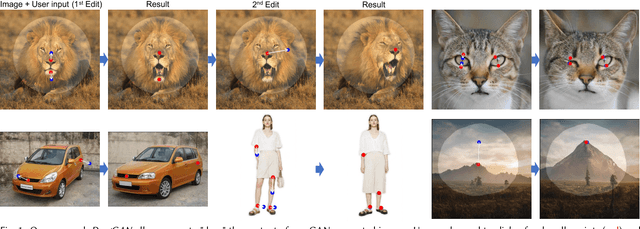


Synthesizing visual content that meets users' needs often requires flexible and precise controllability of the pose, shape, expression, and layout of the generated objects. Existing approaches gain controllability of generative adversarial networks (GANs) via manually annotated training data or a prior 3D model, which often lack flexibility, precision, and generality. In this work, we study a powerful yet much less explored way of controlling GANs, that is, to "drag" any points of the image to precisely reach target points in a user-interactive manner, as shown in Fig.1. To achieve this, we propose DragGAN, which consists of two main components: 1) a feature-based motion supervision that drives the handle point to move towards the target position, and 2) a new point tracking approach that leverages the discriminative generator features to keep localizing the position of the handle points. Through DragGAN, anyone can deform an image with precise control over where pixels go, thus manipulating the pose, shape, expression, and layout of diverse categories such as animals, cars, humans, landscapes, etc. As these manipulations are performed on the learned generative image manifold of a GAN, they tend to produce realistic outputs even for challenging scenarios such as hallucinating occluded content and deforming shapes that consistently follow the object's rigidity. Both qualitative and quantitative comparisons demonstrate the advantage of DragGAN over prior approaches in the tasks of image manipulation and point tracking. We also showcase the manipulation of real images through GAN inversion.

General Neural Gauge Fields
May 05, 2023The recent advance of neural fields, such as neural radiance fields, has significantly pushed the boundary of scene representation learning. Aiming to boost the computation efficiency and rendering quality of 3D scenes, a popular line of research maps the 3D coordinate system to another measuring system, e.g., 2D manifolds and hash tables, for modeling neural fields. The conversion of coordinate systems can be typically dubbed as gauge transformation, which is usually a pre-defined mapping function, e.g., orthogonal projection or spatial hash function. This begs a question: can we directly learn a desired gauge transformation along with the neural field in an end-to-end manner? In this work, we extend this problem to a general paradigm with a taxonomy of discrete & continuous cases, and develop an end-to-end learning framework to jointly optimize the gauge transformation and neural fields. To counter the problem that the learning of gauge transformations can collapse easily, we derive a general regularization mechanism from the principle of information conservation during the gauge transformation. To circumvent the high computation cost in gauge learning with regularization, we directly derive an information-invariant gauge transformation which allows to preserve scene information inherently and yield superior performance.
EgoLocate: Real-time Motion Capture, Localization, and Mapping with Sparse Body-mounted Sensors
May 02, 2023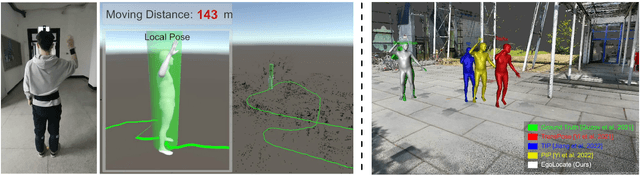
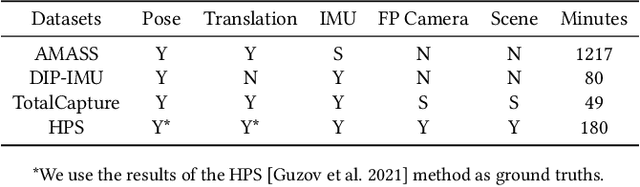
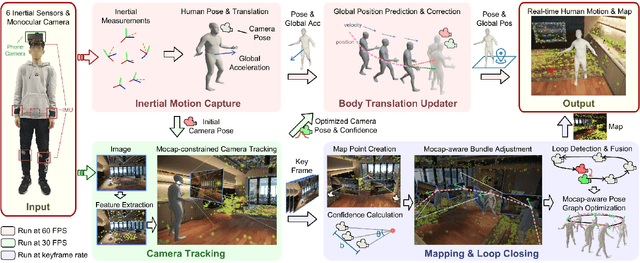

Human and environment sensing are two important topics in Computer Vision and Graphics. Human motion is often captured by inertial sensors, while the environment is mostly reconstructed using cameras. We integrate the two techniques together in EgoLocate, a system that simultaneously performs human motion capture (mocap), localization, and mapping in real time from sparse body-mounted sensors, including 6 inertial measurement units (IMUs) and a monocular phone camera. On one hand, inertial mocap suffers from large translation drift due to the lack of the global positioning signal. EgoLocate leverages image-based simultaneous localization and mapping (SLAM) techniques to locate the human in the reconstructed scene. On the other hand, SLAM often fails when the visual feature is poor. EgoLocate involves inertial mocap to provide a strong prior for the camera motion. Experiments show that localization, a key challenge for both two fields, is largely improved by our technique, compared with the state of the art of the two fields. Our codes are available for research at https://xinyu-yi.github.io/EgoLocate/.
OOD-CV-v2: An extended Benchmark for Robustness to Out-of-Distribution Shifts of Individual Nuisances in Natural Images
Apr 17, 2023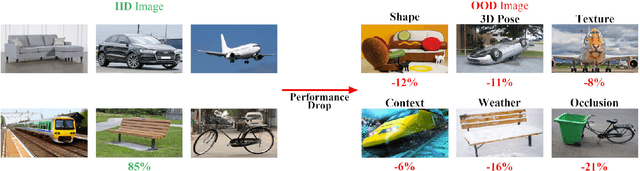
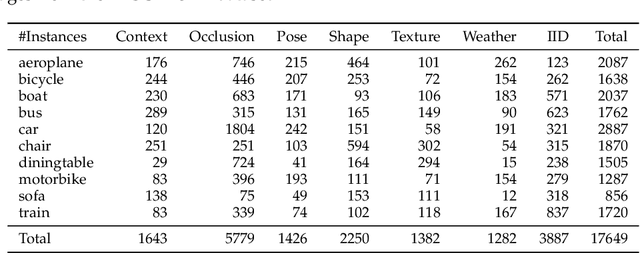
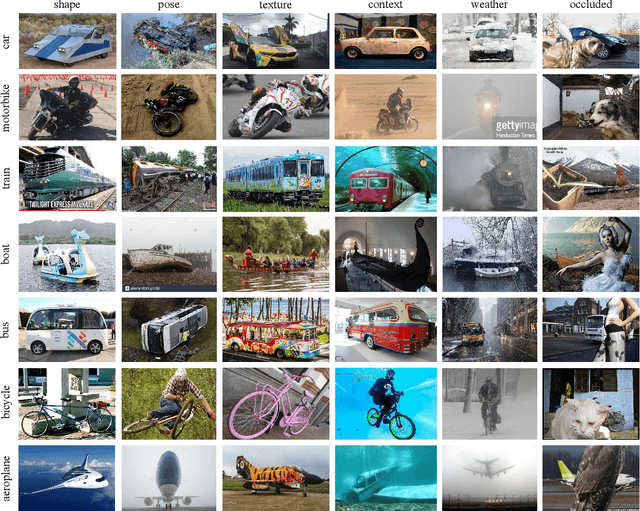

Enhancing the robustness of vision algorithms in real-world scenarios is challenging. One reason is that existing robustness benchmarks are limited, as they either rely on synthetic data or ignore the effects of individual nuisance factors. We introduce OOD-CV-v2, a benchmark dataset that includes out-of-distribution examples of 10 object categories in terms of pose, shape, texture, context and the weather conditions, and enables benchmarking of models for image classification, object detection, and 3D pose estimation. In addition to this novel dataset, we contribute extensive experiments using popular baseline methods, which reveal that: 1) Some nuisance factors have a much stronger negative effect on the performance compared to others, also depending on the vision task. 2) Current approaches to enhance robustness have only marginal effects, and can even reduce robustness. 3) We do not observe significant differences between convolutional and transformer architectures. We believe our dataset provides a rich test bed to study robustness and will help push forward research in this area. Our dataset can be accessed from http://www.ood-cv.org/challenge.html
GVP: Generative Volumetric Primitives
Mar 31, 2023Advances in 3D-aware generative models have pushed the boundary of image synthesis with explicit camera control. To achieve high-resolution image synthesis, several attempts have been made to design efficient generators, such as hybrid architectures with both 3D and 2D components. However, such a design compromises multiview consistency, and the design of a pure 3D generator with high resolution is still an open problem. In this work, we present Generative Volumetric Primitives (GVP), the first pure 3D generative model that can sample and render 512-resolution images in real-time. GVP jointly models a number of volumetric primitives and their spatial information, both of which can be efficiently generated via a 2D convolutional network. The mixture of these primitives naturally captures the sparsity and correspondence in the 3D volume. The training of such a generator with a high degree of freedom is made possible through a knowledge distillation technique. Experiments on several datasets demonstrate superior efficiency and 3D consistency of GVP over the state-of-the-art.
CCuantuMM: Cycle-Consistent Quantum-Hybrid Matching of Multiple Shapes
Mar 28, 2023


Jointly matching multiple, non-rigidly deformed 3D shapes is a challenging, $\mathcal{NP}$-hard problem. A perfect matching is necessarily cycle-consistent: Following the pairwise point correspondences along several shapes must end up at the starting vertex of the original shape. Unfortunately, existing quantum shape-matching methods do not support multiple shapes and even less cycle consistency. This paper addresses the open challenges and introduces the first quantum-hybrid approach for 3D shape multi-matching; in addition, it is also cycle-consistent. Its iterative formulation is admissible to modern adiabatic quantum hardware and scales linearly with the total number of input shapes. Both these characteristics are achieved by reducing the $N$-shape case to a sequence of three-shape matchings, the derivation of which is our main technical contribution. Thanks to quantum annealing, high-quality solutions with low energy are retrieved for the intermediate $\mathcal{NP}$-hard objectives. On benchmark datasets, the proposed approach significantly outperforms extensions to multi-shape matching of a previous quantum-hybrid two-shape matching method and is on-par with classical multi-matching methods.
F$^{2}$-NeRF: Fast Neural Radiance Field Training with Free Camera Trajectories
Mar 28, 2023This paper presents a novel grid-based NeRF called F2-NeRF (Fast-Free-NeRF) for novel view synthesis, which enables arbitrary input camera trajectories and only costs a few minutes for training. Existing fast grid-based NeRF training frameworks, like Instant-NGP, Plenoxels, DVGO, or TensoRF, are mainly designed for bounded scenes and rely on space warping to handle unbounded scenes. Existing two widely-used space-warping methods are only designed for the forward-facing trajectory or the 360-degree object-centric trajectory but cannot process arbitrary trajectories. In this paper, we delve deep into the mechanism of space warping to handle unbounded scenes. Based on our analysis, we further propose a novel space-warping method called perspective warping, which allows us to handle arbitrary trajectories in the grid-based NeRF framework. Extensive experiments demonstrate that F2-NeRF is able to use the same perspective warping to render high-quality images on two standard datasets and a new free trajectory dataset collected by us. Project page: https://totoro97.github.io/projects/f2-nerf.
HQ3DAvatar: High Quality Controllable 3D Head Avatar
Mar 25, 2023Multi-view volumetric rendering techniques have recently shown great potential in modeling and synthesizing high-quality head avatars. A common approach to capture full head dynamic performances is to track the underlying geometry using a mesh-based template or 3D cube-based graphics primitives. While these model-based approaches achieve promising results, they often fail to learn complex geometric details such as the mouth interior, hair, and topological changes over time. This paper presents a novel approach to building highly photorealistic digital head avatars. Our method learns a canonical space via an implicit function parameterized by a neural network. It leverages multiresolution hash encoding in the learned feature space, allowing for high-quality, faster training and high-resolution rendering. At test time, our method is driven by a monocular RGB video. Here, an image encoder extracts face-specific features that also condition the learnable canonical space. This encourages deformation-dependent texture variations during training. We also propose a novel optical flow based loss that ensures correspondences in the learned canonical space, thus encouraging artifact-free and temporally consistent renderings. We show results on challenging facial expressions and show free-viewpoint renderings at interactive real-time rates for medium image resolutions. Our method outperforms all existing approaches, both visually and numerically. We will release our multiple-identity dataset to encourage further research. Our Project page is available at: https://vcai.mpi-inf.mpg.de/projects/HQ3DAvatar/
Grid-guided Neural Radiance Fields for Large Urban Scenes
Mar 24, 2023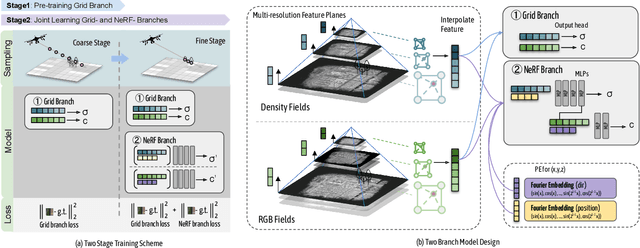
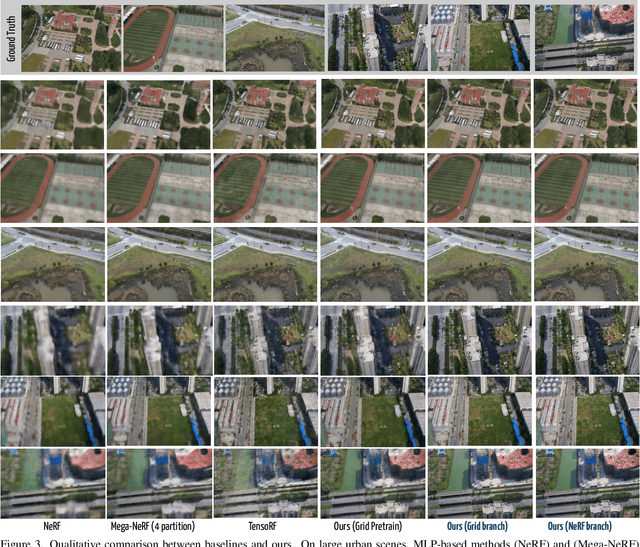
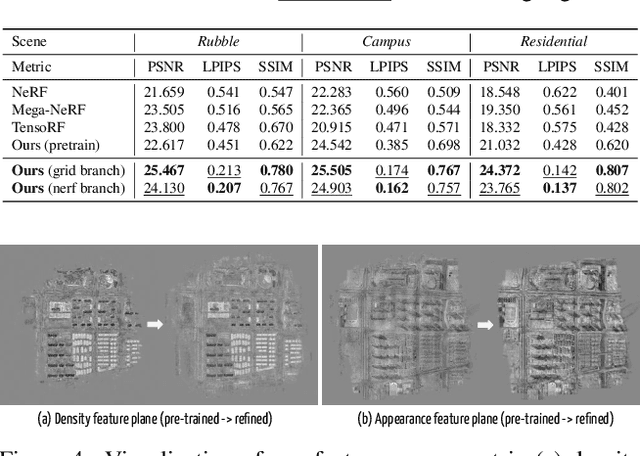
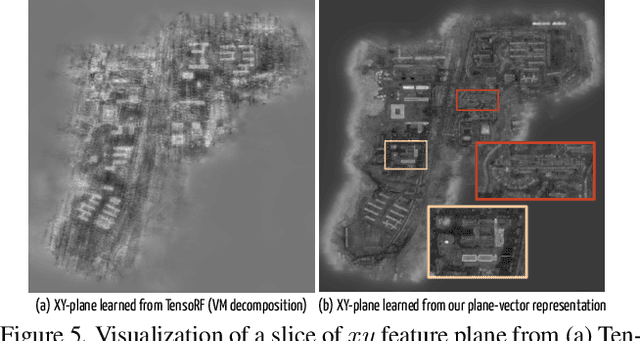
Purely MLP-based neural radiance fields (NeRF-based methods) often suffer from underfitting with blurred renderings on large-scale scenes due to limited model capacity. Recent approaches propose to geographically divide the scene and adopt multiple sub-NeRFs to model each region individually, leading to linear scale-up in training costs and the number of sub-NeRFs as the scene expands. An alternative solution is to use a feature grid representation, which is computationally efficient and can naturally scale to a large scene with increased grid resolutions. However, the feature grid tends to be less constrained and often reaches suboptimal solutions, producing noisy artifacts in renderings, especially in regions with complex geometry and texture. In this work, we present a new framework that realizes high-fidelity rendering on large urban scenes while being computationally efficient. We propose to use a compact multiresolution ground feature plane representation to coarsely capture the scene, and complement it with positional encoding inputs through another NeRF branch for rendering in a joint learning fashion. We show that such an integration can utilize the advantages of two alternative solutions: a light-weighted NeRF is sufficient, under the guidance of the feature grid representation, to render photorealistic novel views with fine details; and the jointly optimized ground feature planes, can meanwhile gain further refinements, forming a more accurate and compact feature space and output much more natural rendering results.
Regularized Vector Quantization for Tokenized Image Synthesis
Mar 11, 2023Quantizing images into discrete representations has been a fundamental problem in unified generative modeling. Predominant approaches learn the discrete representation either in a deterministic manner by selecting the best-matching token or in a stochastic manner by sampling from a predicted distribution. However, deterministic quantization suffers from severe codebook collapse and misalignment with inference stage while stochastic quantization suffers from low codebook utilization and perturbed reconstruction objective. This paper presents a regularized vector quantization framework that allows to mitigate above issues effectively by applying regularization from two perspectives. The first is a prior distribution regularization which measures the discrepancy between a prior token distribution and the predicted token distribution to avoid codebook collapse and low codebook utilization. The second is a stochastic mask regularization that introduces stochasticity during quantization to strike a good balance between inference stage misalignment and unperturbed reconstruction objective. In addition, we design a probabilistic contrastive loss which serves as a calibrated metric to further mitigate the perturbed reconstruction objective. Extensive experiments show that the proposed quantization framework outperforms prevailing vector quantization methods consistently across different generative models including auto-regressive models and diffusion models.