 Add to Chrome
 Add to Firefox
 Add to Edge
MemoBench: Benchmarking World Modeling in Dynamically Changing Environments
Jul 01, 2026
Video generation models aspire to simulate dynamic environments, and several benchmarks now evaluate memory consistency across frames. However, most assess consistency only while the target remains in view, and the few that force objects out of view evaluate static scenes where nothing changes during occlusion. To bridge this gap, we introduce MemoBench, a diagnostic benchmark built around the disappear-and-reappear paradigm in dynamically changing environments: a target object undergoes a physical process, disappears from view, and must be correctly recovered in its updated state upon reappearance. We curate 360 ground-truth clips spanning synthetic and real-world scenes, and design an evaluation suite combining automated metrics with VQA-based assessment across four diagnostic pillars. Evaluation of eight state-of-the-art models reveals key insights and open challenges regarding memory consistency under the disappear-and-reappear paradigm.

AC3S: Adaptive Conditioning for 3D-Aware Synthetic Data Generation
Jun 30, 2026Synthetic data generation has emerged as a powerful tool for improving data scalability in computer vision. Recent diffusion-based pipelines have demonstrated strong photorealism. However, how to enforce precise 3D structure and pose consistency in generated images remains challenging. Existing methods leverage visual prompts such as edge maps to guide diffusion models, but often suffer from over-conditioning artifacts that degrade image realism and limit dataset quality. In this paper, we present a diffusion-based image generation framework that enforces 3D structural alignment while preserving photorealism through adaptive conditioning. Our framework, Adaptive Conditioning for 3D-Aware Synthetic Data Generation (AC3S), introduces a self-supervised visual prompt modulator that dynamically adjusts the strength of ControlNet conditioning, preventing over-conditioning and enabling the diffusion model to retain its generative expressiveness. To further enhance diversity and semantic consistency, we develop a multi-agent vision language model framework that composes detailed and 3D-aware prompts aligned with the underlying geometric structure. Together, these components enable the scalable generation of high-quality synthetic datasets with accurate 2D and 3D annotations. Extensive experiments demonstrate that our method significantly improves image quality and downstream utility.
SEMAGIC: Learning Semantically Consistent Deformable 3D Representations from In-the-Wild Images
May 27, 2026Learning deformable 3D object models from single-view in-the-wild images has enabled impressive 3D shape reconstruction without supervision. However, it remains unclear whether these models capture the semantic structure required for downstream tasks. We find that existing deformable reconstruction approaches, despite producing visually plausible geometry, yield unstable correspondences across instances and perform poorly on semantic correspondence benchmarks. We introduce SEMAGIC, a framework for learning semantically consistent deformable 3D representations from single-view in-the-wild images. Rather than treating reconstruction as the end goal, SEMAGIC uses deformable modeling as a mechanism to discover category-level correspondences. Each category is represented by a canonical template mesh and a learned deformation field, functioning similarly to an autoencoder that reconstructs instance geometry from image features, enabling vertices to maintain consistent semantic meaning across instances. Semantic consistency is enforced during training through (i) a feature-level consistency loss aligning semantic features between canonical and deformed meshes, and (ii) vertex-index-conditioned deformation that preserves semantic correspondence across instances. By explicitly coupling geometric deformation with semantic alignment, SEMAGIC produces representations that maintain stable part correspondences across intra-category variation. Experiments demonstrate that SEMAGIC improves semantic correspondence of deformable models by +14.7 PCK@0.1 on SPair-71k, establishing deformable models as effective semantic 3D representations.
LychSim: A Controllable and Interactive Simulation Framework for Vision Research
May 12, 2026While self-supervised pretraining has reduced vision systems' reliance on synthetic data, simulation remains an indispensable tool for closed-loop optimization and rigorous out-of-distribution (OOD) evaluation. However, modern simulation platforms often present steep technical barriers, requiring extensive expertise in computer graphics and game development. In this work, we present LychSim, a highly controllable and interactive simulation framework built upon Unreal Engine 5 to bridge this gap. LychSim is built around three key designs: (1) a streamlined Python API that abstracts away underlying engine complexities; (2) a procedural data pipeline capable of generating diverse, high-fidelity environments with varying out-of-distribution (OOD) visual challenges, paired with rich 2D and 3D ground truths; and (3) a native integration of the Model Context Protocol (MCP) that transforms the simulator into a dynamic, closed-loop playground for reasoning agentic LLMs. We further annotate scene-level procedural rules and object-level pose alignments to enable semantically aligned 3D ground truths and automated scene modification. We demonstrate LychSim's capability across multiple downstream applications, including serving as a synthetic data engine, powering reinforcement learning-based adversarial examiners, and facilitating interactive, language-driven scene layout generation. To benefit the broader vision community, LychSim will be made publicly available, including full source code and various data annotations.
PASR: Pose-Aware 3D Shape Retrieval from Occluded Single Views
Apr 24, 2026Single-view 3D shape retrieval is a fundamental yet challenging task that is increasingly important with the growth of available 3D data. Existing approaches largely fall into two categories: those using contrastive learning to map point cloud features into existing vision-language spaces and those that learn a common embedding space for 2D images and 3D shapes. However, these feed-forward, holistic alignments are often difficult to interpret, which in turn limits their robustness and generalization to real-world applications. To address this problem, we propose Pose-Aware 3D Shape Retrieval (PASR), a framework that formulates retrieval as a feature-level analysis-by-synthesis problem by distilling knowledge from a 2D foundation model (DINOv3) into a 3D encoder. By aligning pose-conditioned 3D projections with 2D feature maps, our method bridges the gap between real-world images and synthetic meshes. During inference, PASR performs a test-time optimization via analysis-by-synthesis, jointly searching for the shape and pose that best reconstruct the patch-level feature map of the input image. This synthesis-based optimization is inherently robust to partial occlusion and sensitive to fine-grained geometric details. PASR substantially outperforms existing methods on both clean and occluded 3D shape retrieval datasets by a wide margin. Additionally, PASR demonstrates strong multi-task capabilities, achieving robust shape retrieval, competitive pose estimation, and accurate category classification within a single framework.
A Frame is Worth One Token: Efficient Generative World Modeling with Delta Tokens
Apr 06, 2026Anticipating diverse future states is a central challenge in video world modeling. Discriminative world models produce a deterministic prediction that implicitly averages over possible futures, while existing generative world models remain computationally expensive. Recent work demonstrates that predicting the future in the feature space of a vision foundation model (VFM), rather than a latent space optimized for pixel reconstruction, requires significantly fewer world model parameters. However, most such approaches remain discriminative. In this work, we introduce DeltaTok, a tokenizer that encodes the VFM feature difference between consecutive frames into a single continuous "delta" token, and DeltaWorld, a generative world model operating on these tokens to efficiently generate diverse plausible futures. Delta tokens reduce video from a three-dimensional spatio-temporal representation to a one-dimensional temporal sequence, for example yielding a 1,024x token reduction with 512x512 frames. This compact representation enables tractable multi-hypothesis training, where many futures are generated in parallel and only the best is supervised. At inference, this leads to diverse predictions in a single forward pass. Experiments on dense forecasting tasks demonstrate that DeltaWorld forecasts futures that more closely align with real-world outcomes, while having over 35x fewer parameters and using 2,000x fewer FLOPs than existing generative world models. Code and weights: https://deltatok.github.io.
Generative Adversarial Reasoner: Enhancing LLM Reasoning with Adversarial Reinforcement Learning
Dec 18, 2025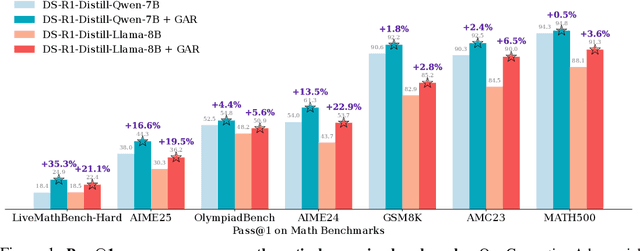

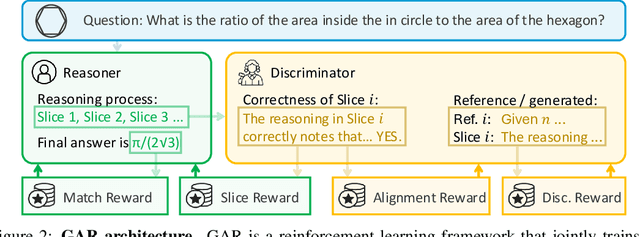
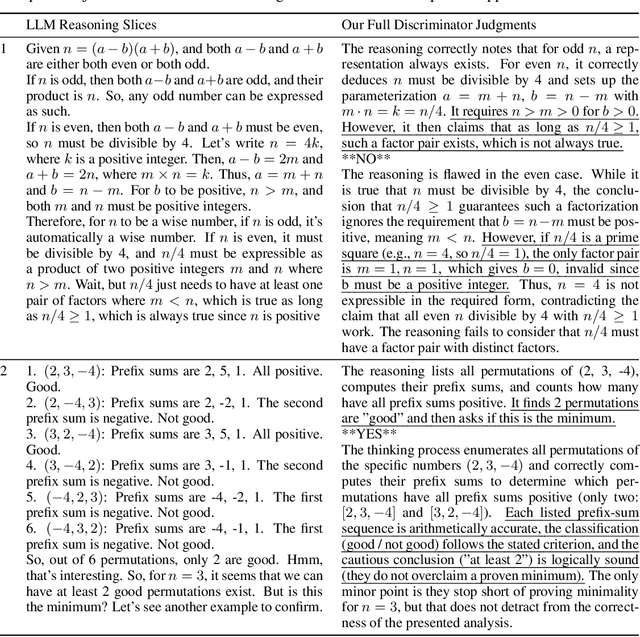
Large language models (LLMs) with explicit reasoning capabilities excel at mathematical reasoning yet still commit process errors, such as incorrect calculations, brittle logic, and superficially plausible but invalid steps. In this paper, we introduce Generative Adversarial Reasoner, an on-policy joint training framework designed to enhance reasoning by co-evolving an LLM reasoner and an LLM-based discriminator through adversarial reinforcement learning. A compute-efficient review schedule partitions each reasoning chain into logically complete slices of comparable length, and the discriminator evaluates each slice's soundness with concise, structured justifications. Learning couples complementary signals: the LLM reasoner is rewarded for logically consistent steps that yield correct answers, while the discriminator earns rewards for correctly detecting errors or distinguishing traces in the reasoning process. This produces dense, well-calibrated, on-policy step-level rewards that supplement sparse exact-match signals, improving credit assignment, increasing sample efficiency, and enhancing overall reasoning quality of LLMs. Across various mathematical benchmarks, the method delivers consistent gains over strong baselines with standard RL post-training. Specifically, on AIME24, we improve DeepSeek-R1-Distill-Qwen-7B from 54.0 to 61.3 (+7.3) and DeepSeek-R1-Distill-Llama-8B from 43.7 to 53.7 (+10.0). The modular discriminator also enables flexible reward shaping for objectives such as teacher distillation, preference alignment, and mathematical proof-based reasoning.
SpatialLLM: A Compound 3D-Informed Design towards Spatially-Intelligent Large Multimodal Models
May 01, 2025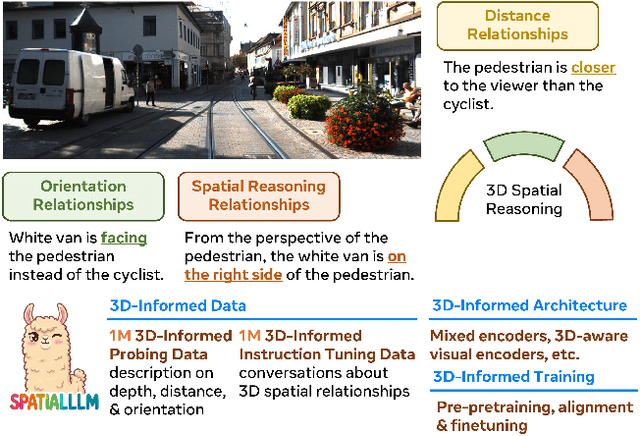
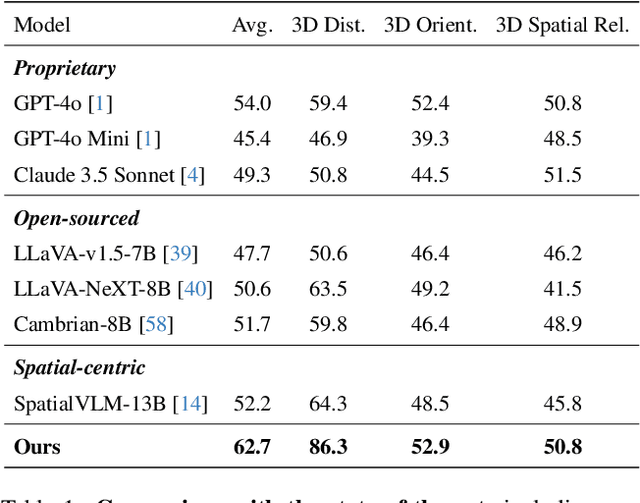
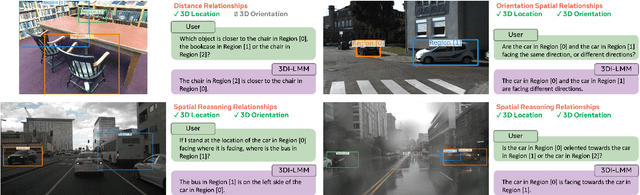
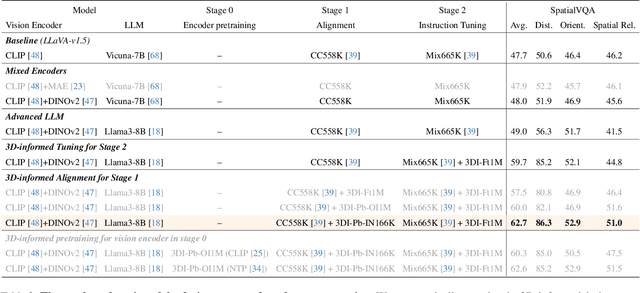
Humans naturally understand 3D spatial relationships, enabling complex reasoning like predicting collisions of vehicles from different directions. Current large multimodal models (LMMs), however, lack of this capability of 3D spatial reasoning. This limitation stems from the scarcity of 3D training data and the bias in current model designs toward 2D data. In this paper, we systematically study the impact of 3D-informed data, architecture, and training setups, introducing SpatialLLM, a large multi-modal model with advanced 3D spatial reasoning abilities. To address data limitations, we develop two types of 3D-informed training datasets: (1) 3D-informed probing data focused on object's 3D location and orientation, and (2) 3D-informed conversation data for complex spatial relationships. Notably, we are the first to curate VQA data that incorporate 3D orientation relationships on real images. Furthermore, we systematically integrate these two types of training data with the architectural and training designs of LMMs, providing a roadmap for optimal design aimed at achieving superior 3D reasoning capabilities. Our SpatialLLM advances machines toward highly capable 3D-informed reasoning, surpassing GPT-4o performance by 8.7%. Our systematic empirical design and the resulting findings offer valuable insights for future research in this direction.
SpatialReasoner: Towards Explicit and Generalizable 3D Spatial Reasoning
Apr 28, 2025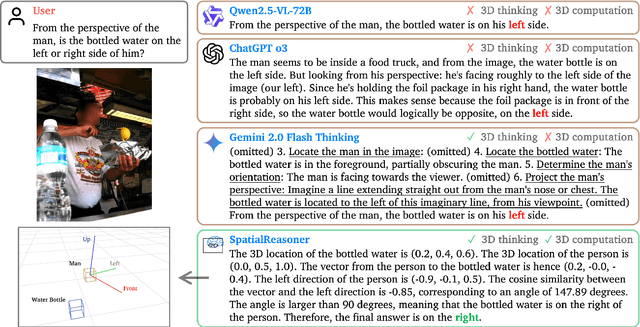
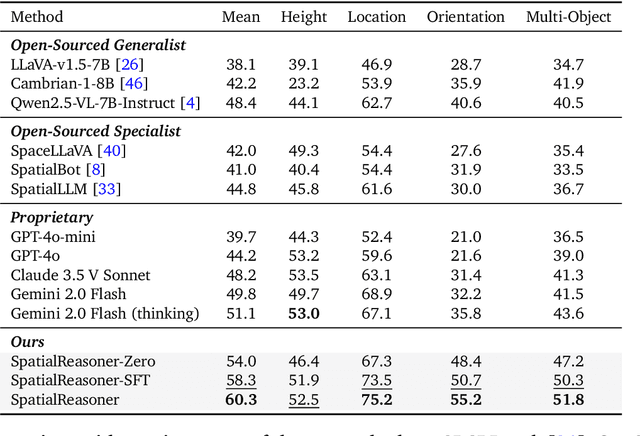
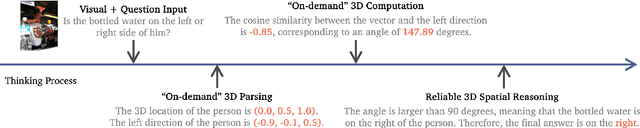

Recent studies in 3D spatial reasoning explore data-driven approaches and achieve enhanced spatial reasoning performance with reinforcement learning (RL). However, these methods typically perform spatial reasoning in an implicit manner, and it remains underexplored whether the acquired 3D knowledge generalizes to unseen question types at any stage of the training. In this work we introduce SpatialReasoner, a novel large vision-language model (LVLM) that address 3D spatial reasoning with explicit 3D representations shared between stages -- 3D perception, computation, and reasoning. Explicit 3D representations provide a coherent interface that supports advanced 3D spatial reasoning and enable us to study the factual errors made by LVLMs. Results show that our SpatialReasoner achieve improved performance on a variety of spatial reasoning benchmarks and generalizes better when evaluating on novel 3D spatial reasoning questions. Our study bridges the 3D parsing capabilities of prior visual foundation models with the powerful reasoning abilities of large language models, opening new directions for 3D spatial reasoning.
DINeMo: Learning Neural Mesh Models with no 3D Annotations
Mar 26, 2025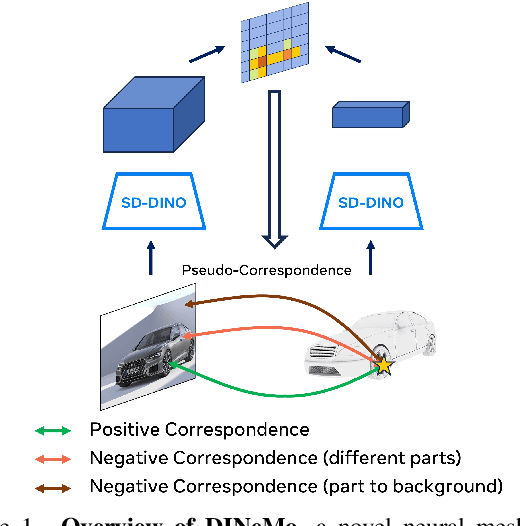
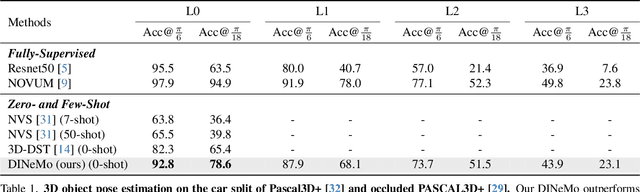
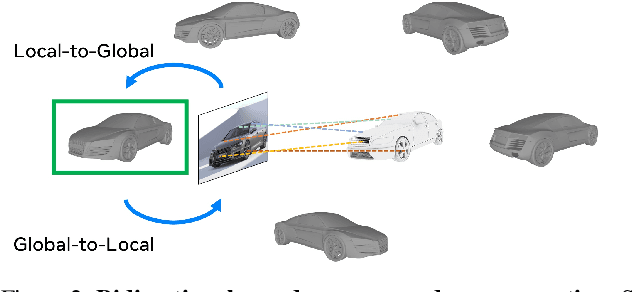
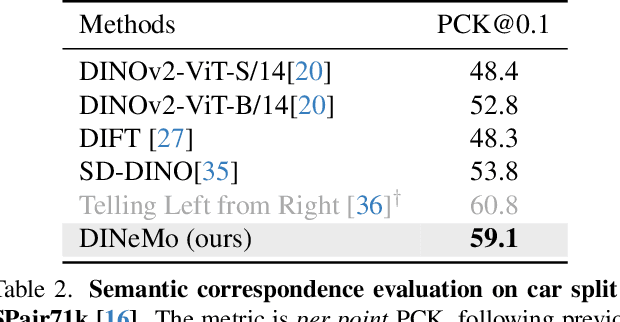
Category-level 3D/6D pose estimation is a crucial step towards comprehensive 3D scene understanding, which would enable a broad range of applications in robotics and embodied AI. Recent works explored neural mesh models that approach a range of 2D and 3D tasks from an analysis-by-synthesis perspective. Despite the largely enhanced robustness to partial occlusion and domain shifts, these methods depended heavily on 3D annotations for part-contrastive learning, which confines them to a narrow set of categories and hinders efficient scaling. In this work, we present DINeMo, a novel neural mesh model that is trained with no 3D annotations by leveraging pseudo-correspondence obtained from large visual foundation models. We adopt a bidirectional pseudo-correspondence generation method, which produce pseudo correspondence utilize both local appearance features and global context information. Experimental results on car datasets demonstrate that our DINeMo outperforms previous zero- and few-shot 3D pose estimation by a wide margin, narrowing the gap with fully-supervised methods by 67.3%. Our DINeMo also scales effectively and efficiently when incorporating more unlabeled images during training, which demonstrate the advantages over supervised learning methods that rely on 3D annotations. Our project page is available at https://analysis-by-synthesis.github.io/DINeMo/.