 Add to Chrome
 Add to Firefox
 Add to Edge
Zero-Fi: Zero-Shot Wi-Fi-Based Human Activity Recognition via Contrastive Signal-Language Alignment
Jul 29, 2026
Wi-Fi-based human activity recognition has advanced substantially, but most existing methods assume a closed set of activities and require labeled Wi-Fi samples for every target class, limiting their ability to recognize unseen activities. We present Zero-Fi, a contrastive signal-language alignment framework for zero-shot Wi-Fi-based human activity recognition. Zero-Fi learns unified representations from complementary Wi-Fi signal features and aligns them with the semantic representations of natural-language activity descriptions in a shared embedding space. This cross-modal alignment enables Zero-Fi to recognize new activity classes without requiring labeled Wi-Fi samples or model adaptation for those classes. Experiments on large-scale public benchmark datasets demonstrate effective zero-shot recognition of held-out activity classes, highlighting the potential of signal-language alignment to extend Wi-Fi sensing beyond predefined activity classes.

mmSimPrior: Learning Simulation Priors for Data-Efficient Real-World Generalizable Radar-Based Human Motion Reconstruction
Jul 25, 2026Millimeter-wave (mmWave) radar offers privacy-preserving and lighting-robust sensing for human motion reconstruction, but learning models that generalize across real deployments require diverse paired radar-motion data that are costly to collect. Simulation provides scalable supervision, yet models trained on clean synthetic signals transfer poorly because of multipath, clutter, response statistics, and resolution degradation. We present mmSimPrior, a simulation-pretrained framework that factorizes transferable knowledge into signal, motion, and radar-to-motion mapping priors. A multi-modal signal encoder is pretrained with a physics-informed domain-randomization curriculum that emulates propagation- and acquisition-level variations, while a joint-temporal tokenizer learns a discrete prior over plausible human motion. A shared mapping prior supports classification over a learned motion codebook for constrained zero-shot reconstruction and continuous regression for flexible limited-data adaptation. We further construct a 4.2M-frame, 31K-sequence dataset suite and introduce a No-Overlap Setting that excludes repeated complete subject-environment-location-motion configurations across adaptation and test. Experiments on mmSimPrior-Real and RT-Pose demonstrate consistent gains: with only 24 paired real sequences, mmSimPrior-Reg reduces MPJPE by 24.7% to 39.0% over the strongest baseline across the three environments, while mmSimPrior-Cls reduces zero-shot MPJPE by 8.5% without finetuning.
WMAttack: Automated Attack Search for Adversarial Evaluation of World-Model Agents
May 22, 2026Despite the growing use of world models as decision-making agents, their adversarial robustness remains underexplored due to the lack of dedicated automated evaluation methods. A key obstacle is that attack evaluation must be both accurate and efficient: weak manually tuned attacks can overestimate robustness, while exhaustive hyperparameter search is prohibitively expensive because each candidate requires closed-loop rollouts through learned latent dynamics. We introduce WMAttack, an automated attack-search framework for adversarial evaluation of world-model agents. WMAttack formulates robustness evaluation as a finite-budget search over attack configurations, including attack families, perturbation budgets, optimization steps, restarts, and allocation rules. To improve search accuracy, Self-Correcting Attack Search (SCAS) refines the attack proposal distribution using feedback from reward degradation, action instability, runtime cost, and rollout variability. To improve search efficiency, Representation-Guided Attack Retrieval (RGAR) retrieves effective historical configurations from representation-similar tasks, providing a warm start for unseen environments. We provide a theoretical explanation showing that proposal refinement improves finite-budget search when it shifts probability mass toward high-utility attacks. Across Atari and DeepMind Control tasks, WMAttack consistently discovers stronger attacks than the evaluated baselines, improving normalized reward drop from 0.497 to 1.034 on DreamerV3 Atari and from 0.319 to 0.682 on DMC. Ablations further show that RGAR improves initial candidate quality and SCAS improves final attack utility under fixed evaluation budgets.
Monocular Models are Strong Learners for Multi-View Human Mesh Recovery
Mar 20, 2026Multi-view human mesh recovery (HMR) is broadly deployed in diverse domains where high accuracy and strong generalization are essential. Existing approaches can be broadly grouped into geometry-based and learning-based methods. However, geometry-based methods (e.g., triangulation) rely on cumbersome camera calibration, while learning-based approaches often generalize poorly to unseen camera configurations due to the lack of multi-view training data, limiting their performance in real-world scenarios. To enable calibration-free reconstruction that generalizes to arbitrary camera setups, we propose a training-free framework that leverages pretrained single-view HMR models as strong priors, eliminating the need for multi-view training data. Our method first constructs a robust and consistent multi-view initialization from single-view predictions, and then refines it via test-time optimization guided by multi-view consistency and anatomical constraints. Extensive experiments demonstrate state-of-the-art performance on standard benchmarks, surpassing multi-view models trained with explicit multi-view supervision.
USD: A User-Intent-Driven Sampling and Dual-Debiasing Framework for Large-Scale Homepage Recommendations
Jul 09, 2025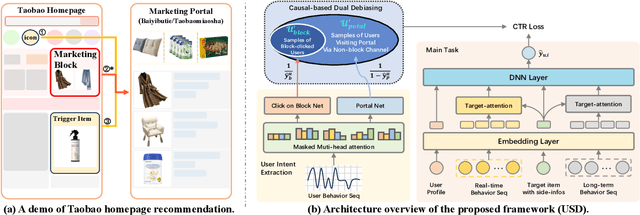
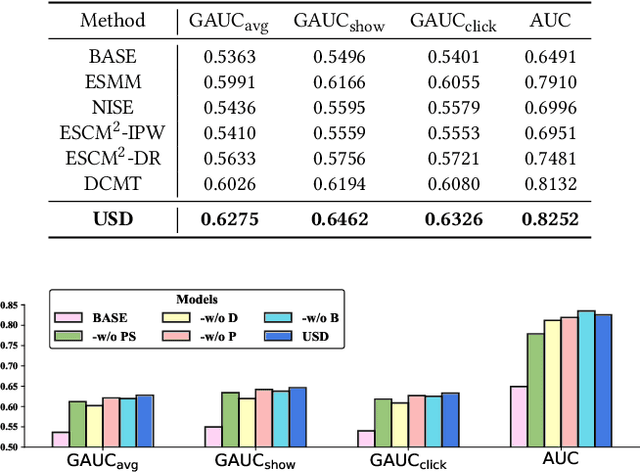
Large-scale homepage recommendations face critical challenges from pseudo-negative samples caused by exposure bias, where non-clicks may indicate inattention rather than disinterest. Existing work lacks thorough analysis of invalid exposures and typically addresses isolated aspects (e.g., sampling strategies), overlooking the critical impact of pseudo-positive samples - such as homepage clicks merely to visit marketing portals. We propose a unified framework for large-scale homepage recommendation sampling and debiasing. Our framework consists of two key components: (1) a user intent-aware negative sampling module to filter invalid exposure samples, and (2) an intent-driven dual-debiasing module that jointly corrects exposure bias and click bias. Extensive online experiments on Taobao demonstrate the efficacy of our framework, achieving significant improvements in user click-through rates (UCTR) by 35.4\% and 14.5\% in two variants of the marketing block on the Taobao homepage, Baiyibutie and Taobaomiaosha.
A Generative Re-ranking Model for List-level Multi-objective Optimization at Taobao
May 12, 2025E-commerce recommendation systems aim to generate ordered lists of items for customers, optimizing multiple business objectives, such as clicks, conversions and Gross Merchandise Volume (GMV). Traditional multi-objective optimization methods like formulas or Learning-to-rank (LTR) models take effect at item-level, neglecting dynamic user intent and contextual item interactions. List-level multi-objective optimization in the re-ranking stage can overcome this limitation, but most current re-ranking models focus more on accuracy improvement with context. In addition, re-ranking is faced with the challenges of time complexity and diversity. In light of this, we propose a novel end-to-end generative re-ranking model named Sequential Ordered Regression Transformer-Generator (SORT-Gen) for the less-studied list-level multi-objective optimization problem. Specifically, SORT-Gen is divided into two parts: 1)Sequential Ordered Regression Transformer innovatively uses Transformer and ordered regression to accurately estimate multi-objective values for variable-length sub-lists. 2)Mask-Driven Fast Generation Algorithm combines multi-objective candidate queues, efficient item selection and diversity mechanism into model inference, providing a fast online list generation method. Comprehensive online experiments demonstrate that SORT-Gen brings +4.13% CLCK and +8.10% GMV for Baiyibutie, a notable Mini-app of Taobao. Currently, SORT-Gen has been successfully deployed in multiple scenarios of Taobao App, serving for a vast number of users.
Transferable Deployment of Semantic Edge Inference Systems via Unsupervised Domain Adaption
Apr 16, 2025This paper investigates deploying semantic edge inference systems for performing a common image clarification task. In particular, each system consists of multiple Internet of Things (IoT) devices that first locally encode the sensing data into semantic features and then transmit them to an edge server for subsequent data fusion and task inference. The inference accuracy is determined by efficient training of the feature encoder/decoder using labeled data samples. Due to the difference in sensing data and communication channel distributions, deploying the system in a new environment may induce high costs in annotating data labels and re-training the encoder/decoder models. To achieve cost-effective transferable system deployment, we propose an efficient Domain Adaptation method for Semantic Edge INference systems (DASEIN) that can maintain high inference accuracy in a new environment without the need for labeled samples. Specifically, DASEIN exploits the task-relevant data correlation between different deployment scenarios by leveraging the techniques of unsupervised domain adaptation and knowledge distillation. It devises an efficient two-step adaptation procedure that sequentially aligns the data distributions and adapts to the channel variations. Numerical results show that, under a substantial change in sensing data distributions, the proposed DASEIN outperforms the best-performing benchmark method by 7.09% and 21.33% in inference accuracy when the new environment has similar or 25 dB lower channel signal to noise power ratios (SNRs), respectively. This verifies the effectiveness of the proposed method in adapting both data and channel distributions in practical transfer deployment applications.
FinRobot: An Open-Source AI Agent Platform for Financial Applications using Large Language Models
May 23, 2024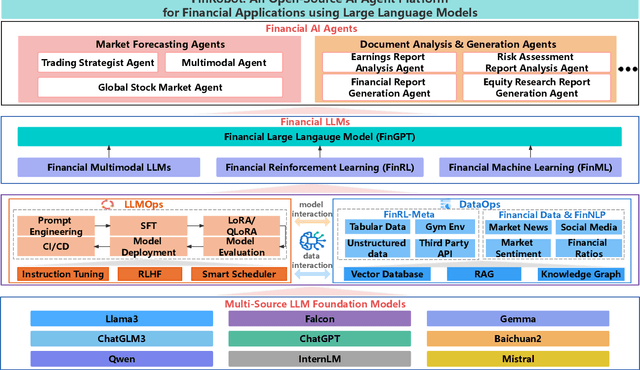
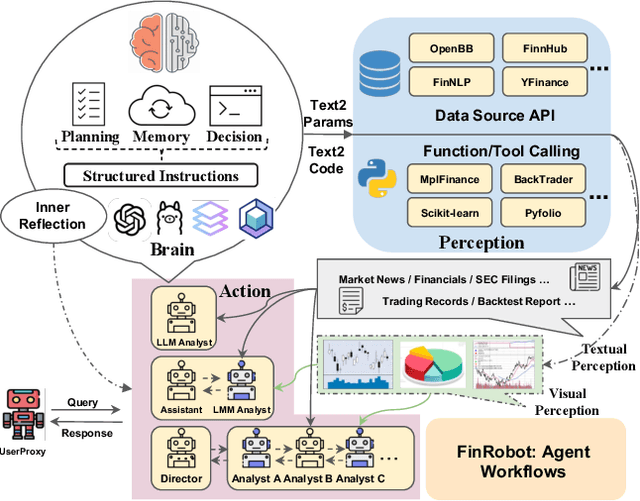
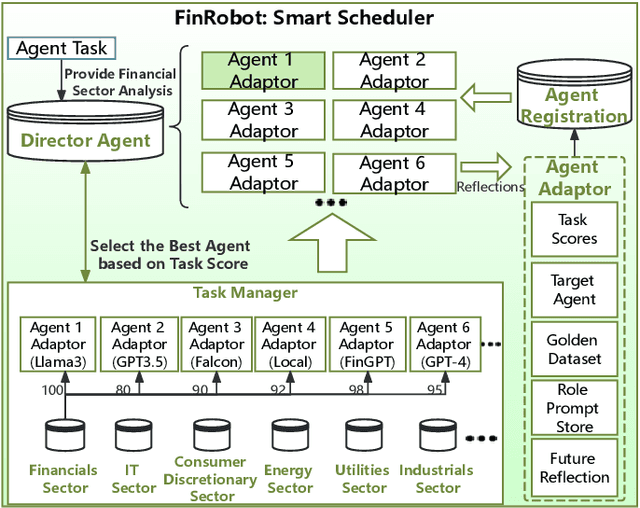

As financial institutions and professionals increasingly incorporate Large Language Models (LLMs) into their workflows, substantial barriers, including proprietary data and specialized knowledge, persist between the finance sector and the AI community. These challenges impede the AI community's ability to enhance financial tasks effectively. Acknowledging financial analysis's critical role, we aim to devise financial-specialized LLM-based toolchains and democratize access to them through open-source initiatives, promoting wider AI adoption in financial decision-making. In this paper, we introduce FinRobot, a novel open-source AI agent platform supporting multiple financially specialized AI agents, each powered by LLM. Specifically, the platform consists of four major layers: 1) the Financial AI Agents layer that formulates Financial Chain-of-Thought (CoT) by breaking sophisticated financial problems down into logical sequences; 2) the Financial LLM Algorithms layer dynamically configures appropriate model application strategies for specific tasks; 3) the LLMOps and DataOps layer produces accurate models by applying training/fine-tuning techniques and using task-relevant data; 4) the Multi-source LLM Foundation Models layer that integrates various LLMs and enables the above layers to access them directly. Finally, FinRobot provides hands-on for both professional-grade analysts and laypersons to utilize powerful AI techniques for advanced financial analysis. We open-source FinRobot at \url{https://github.com/AI4Finance-Foundation/FinRobot}.
Redistributing the Precision and Content in 3D-LUT-based Inverse Tone-mapping for HDR/WCG Display
Oct 15, 2023ITM(inverse tone-mapping) converts SDR (standard dynamic range) footage to HDR/WCG (high dynamic range /wide color gamut) for media production. It happens not only when remastering legacy SDR footage in front-end content provider, but also adapting on-theair SDR service on user-end HDR display. The latter requires more efficiency, thus the pre-calculated LUT (look-up table) has become a popular solution. Yet, conventional fixed LUT lacks adaptability, so we learn from research community and combine it with AI. Meanwhile, higher-bit-depth HDR/WCG requires larger LUT than SDR, so we consult traditional ITM for an efficiency-performance trade-off: We use 3 smaller LUTs, each has a non-uniform packing (precision) respectively denser in dark, middle and bright luma range. In this case, their results will have less error only in their own range, so we use a contribution map to combine their best parts to final result. With the guidance of this map, the elements (content) of 3 LUTs will also be redistributed during training. We conduct ablation studies to verify method's effectiveness, and subjective and objective experiments to show its practicability. Code is available at: https://github.com/AndreGuo/ITMLUT.
Edge Cloud Collaborative Stream Computing for Real-Time Structural Health Monitoring
Oct 11, 2023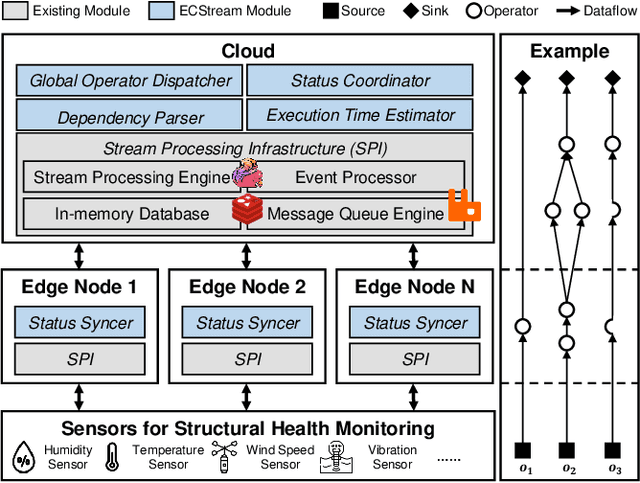

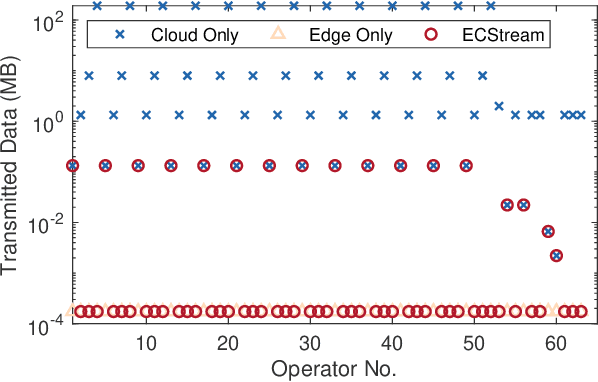
Structural Health Monitoring (SHM) is crucial for the safety and maintenance of various infrastructures. Due to the large amount of data generated by numerous sensors and the high real-time requirements of many applications, SHM poses significant challenges. Although the cloud-centric stream computing paradigm opens new opportunities for real-time data processing, it consumes too much network bandwidth. In this paper, we propose ECStream, an Edge Cloud collaborative fine-grained stream operator scheduling framework for SHM. We collectively consider atomic and composite operators together with their iterative computability to model and formalize the problem of minimizing bandwidth usage and end-to-end operator processing latency. Preliminary evaluation results show that ECStream can effectively balance bandwidth usage and end-to-end operator computation latency, reducing bandwidth usage by 73.01% and latency by 34.08% on average compared to the cloud-centric approach.