 Add to Chrome
 Add to Firefox
 Add to Edge
On the Regularity and Generalization of One-Step Wasserstein-guided Generative Models for PDE-Induced Measures
May 20, 2026
Despite the remarkable empirical success of generative models, the available theory on their statistical accuracy in scientific computing remains largely pessimistic. This paper develops a theoretical framework for understanding the regularity of transport maps and the generalization properties of one-step Wasserstein-guided generative models for PDE-induced probability measures. We consider normalized target densities associated with linear elliptic and parabolic equations on bounded domains, as well as diffusion and Fokker--Planck equations on the torus. Under standard structural assumptions, we prove that these target measures satisfy doubling conditions. By combining this fact with regularity theory for optimal transport between doubling measures, we show that the optimal transport map from a uniform source measure to the target measure is Hölder continuous. This regularity yields an approximation-theoretic justification for one-step generative models that learn PDE-induced distributions via a single pushforward map. As a representative instance, we study DeepParticle and derive excess-risk bounds characterizing the discrepancy between the learned map and the population-optimal map. We also establish a robustness estimate under target shift and illustrate the theory with experiments which support the derived rates.

FinRobot: An Open-Source AI Agent Platform for Financial Applications using Large Language Models
May 23, 2024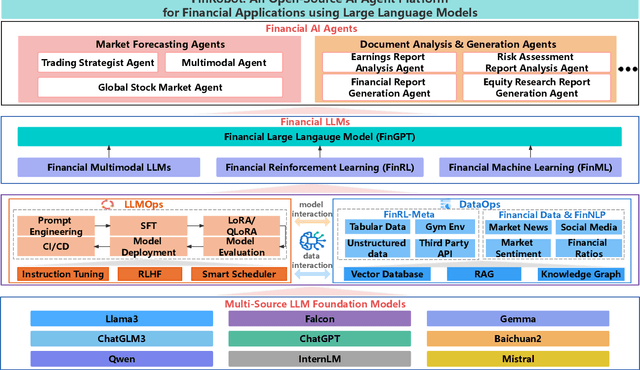
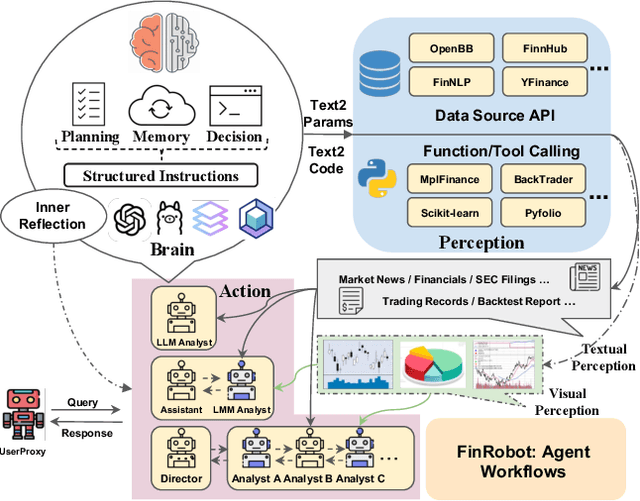
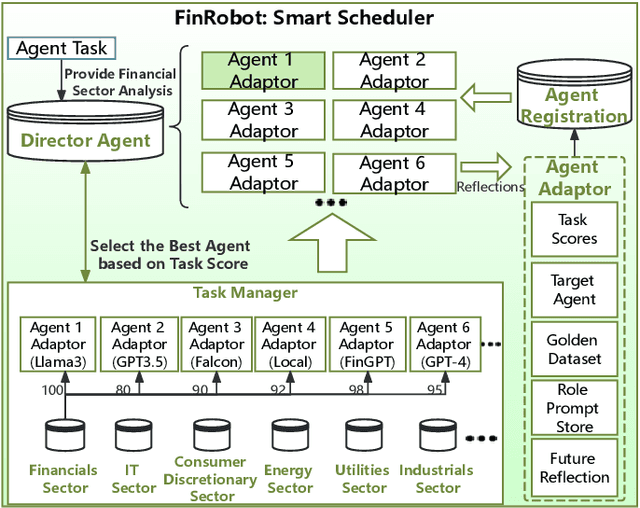
As financial institutions and professionals increasingly incorporate Large Language Models (LLMs) into their workflows, substantial barriers, including proprietary data and specialized knowledge, persist between the finance sector and the AI community. These challenges impede the AI community's ability to enhance financial tasks effectively. Acknowledging financial analysis's critical role, we aim to devise financial-specialized LLM-based toolchains and democratize access to them through open-source initiatives, promoting wider AI adoption in financial decision-making. In this paper, we introduce FinRobot, a novel open-source AI agent platform supporting multiple financially specialized AI agents, each powered by LLM. Specifically, the platform consists of four major layers: 1) the Financial AI Agents layer that formulates Financial Chain-of-Thought (CoT) by breaking sophisticated financial problems down into logical sequences; 2) the Financial LLM Algorithms layer dynamically configures appropriate model application strategies for specific tasks; 3) the LLMOps and DataOps layer produces accurate models by applying training/fine-tuning techniques and using task-relevant data; 4) the Multi-source LLM Foundation Models layer that integrates various LLMs and enables the above layers to access them directly. Finally, FinRobot provides hands-on for both professional-grade analysts and laypersons to utilize powerful AI techniques for advanced financial analysis. We open-source FinRobot at \url{https://github.com/AI4Finance-Foundation/FinRobot}.