 Add to Chrome
 Add to Firefox
 Add to Edge
Zero-Fi: Zero-Shot Wi-Fi-Based Human Activity Recognition via Contrastive Signal-Language Alignment
Jul 29, 2026
Wi-Fi-based human activity recognition has advanced substantially, but most existing methods assume a closed set of activities and require labeled Wi-Fi samples for every target class, limiting their ability to recognize unseen activities. We present Zero-Fi, a contrastive signal-language alignment framework for zero-shot Wi-Fi-based human activity recognition. Zero-Fi learns unified representations from complementary Wi-Fi signal features and aligns them with the semantic representations of natural-language activity descriptions in a shared embedding space. This cross-modal alignment enables Zero-Fi to recognize new activity classes without requiring labeled Wi-Fi samples or model adaptation for those classes. Experiments on large-scale public benchmark datasets demonstrate effective zero-shot recognition of held-out activity classes, highlighting the potential of signal-language alignment to extend Wi-Fi sensing beyond predefined activity classes.

A Survey on Reconfigurable Intelligent Surfaces in Practical Systems: Security and Privacy Perspectives
Dec 12, 2025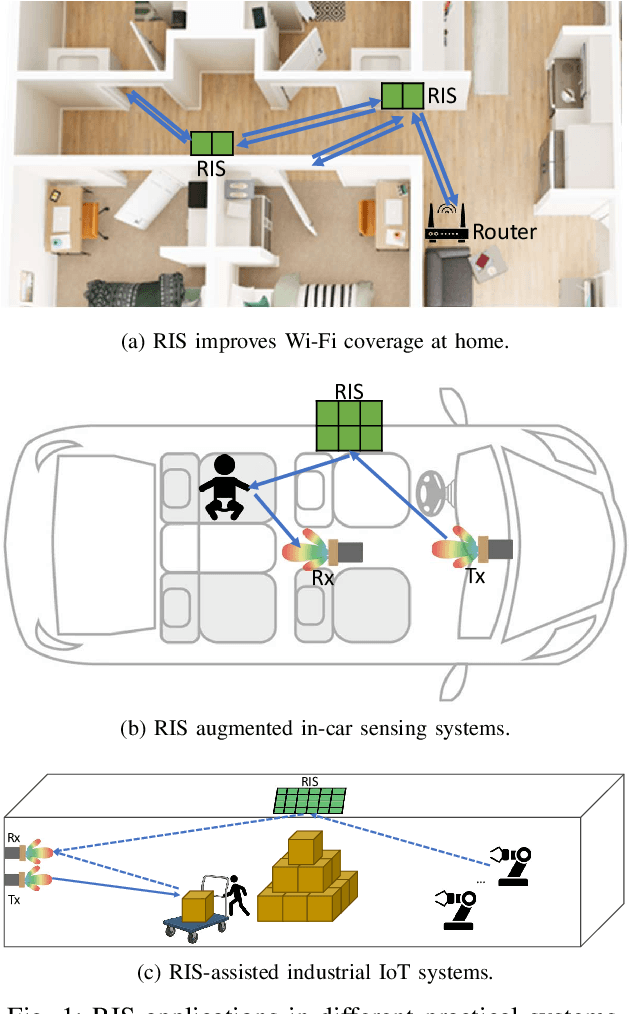
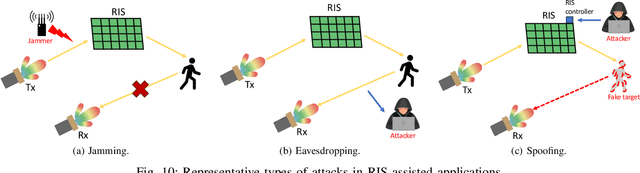
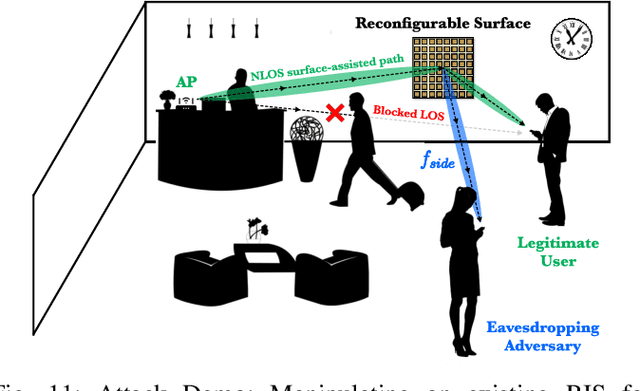
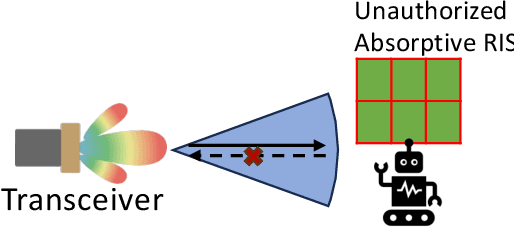
Reconfigurable Intelligent Surfaces (RIS) have emerged as a transformative technology capable of reshaping wireless environments through dynamic manipulation of electromagnetic waves. While extensive research has explored their theoretical benefits for communication and sensing, practical deployments in smart environments such as homes, vehicles, and industrial settings remain limited and under-examined, particularly from security and privacy perspectives. This survey provides a comprehensive examination of RIS applications in real-world systems, with a focus on the security and privacy threats, vulnerabilities, and defensive strategies relevant to practical use. We analyze scenarios with two types of systems (with and without legitimate RIS) and two types of attackers (with and without malicious RIS), and demonstrate how RIS may introduce new attacks to practical systems, including eavesdropping, jamming, and spoofing attacks. In response, we review defenses against RIS-related attacks in these systems, such as applying additional security algorithms, disrupting attackers, and early detection of unauthorized RIS. We also discuss scenarios in which the legitimate user applies an additional RIS to defend against attacks. To support future research, we also provide a collection of open-source tools, datasets, demos, and papers at: https://awesome-ris-security.github.io/. By highlighting RIS's functionality and its security/privacy challenges and opportunities, this survey aims to guide researchers and engineers toward the development of secure, resilient, and privacy-preserving RIS-enabled practical wireless systems and environments.
Wi-Chat: Large Language Model Powered Wi-Fi Sensing
Feb 18, 2025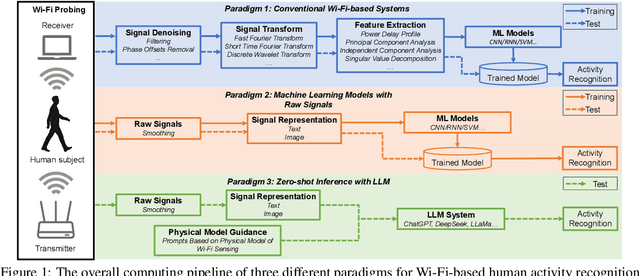
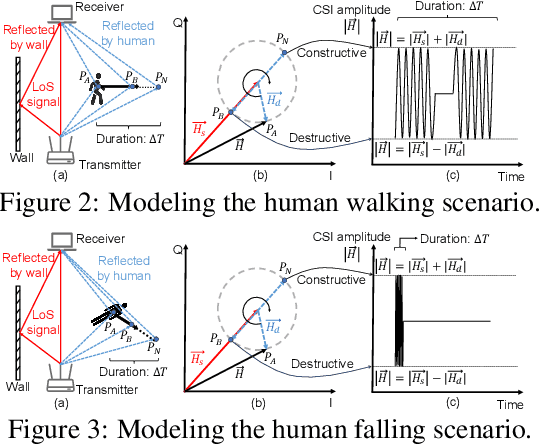
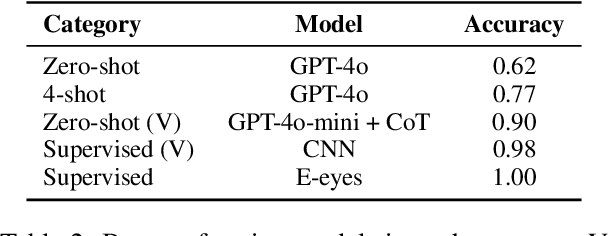
Recent advancements in Large Language Models (LLMs) have demonstrated remarkable capabilities across diverse tasks. However, their potential to integrate physical model knowledge for real-world signal interpretation remains largely unexplored. In this work, we introduce Wi-Chat, the first LLM-powered Wi-Fi-based human activity recognition system. We demonstrate that LLMs can process raw Wi-Fi signals and infer human activities by incorporating Wi-Fi sensing principles into prompts. Our approach leverages physical model insights to guide LLMs in interpreting Channel State Information (CSI) data without traditional signal processing techniques. Through experiments on real-world Wi-Fi datasets, we show that LLMs exhibit strong reasoning capabilities, achieving zero-shot activity recognition. These findings highlight a new paradigm for Wi-Fi sensing, expanding LLM applications beyond conventional language tasks and enhancing the accessibility of wireless sensing for real-world deployments.