 Add to Chrome
 Add to Firefox
 Add to Edge
NVIDIA OmniDreams: Real-Time Generative World Model for Closed-Loop Autonomous Vehicle Simulation
Jun 02, 2026
As autonomous vehicle capabilities advance, the safe evaluation of driving policies in long-tail scenarios remains a critical bottleneck. In closed-loop simulation, the driving policy model actively interacts with the environment, where its actions dynamically update the simulator state and directly influence the next set of generated sensor observations. While recent reconstruction-based neural simulators offer photorealism, they are fundamentally constrained by their initial captured data and struggle to generalize to highly dynamic or novel scenes. To overcome these limitations, we introduce OmniDreams, a foundation generative world model mid- and post-trained from the Cosmos diffusion model to autoregressively generate action-conditioned videos in real time. By leveraging the rich visual priors of Cosmos and mid- and post-training on 21k hours of driving scenarios, OmniDreams synthesizes complex, unobserved phenomena that are hard for traditional simulators to capture, such as extreme weather and unpredictable dynamic agent behaviors. Crucially, it autoregressively conditions its photorealistic sensor generation on past frames, the current simulator state, and immediate driving actions. Deployed in a closed-loop system with the Alpamayo 1 policy model and AlpaSim orchestrator, OmniDreams acts as a highly responsive, reactive environment, providing a scalable and comprehensive solution for training and evaluating next-generation autonomous driving policies. We additionally show preliminary results indicating that a world-action model (WAM) post-trained from OmniDreams achieves strong performance on the Physical AI Autonomous Vehicles NuRec dataset, surpassing the VLA-based Alpamayo 1.5 research policy model while using only 1/5 the total parameters. These results highlight the potential for a real-time world model like OmniDreams to also serve as a backbone for policy architectures.

Cosmos 3: Omnimodal World Models for Physical AI
Jun 01, 2026We introduce Cosmos 3, a family of omnimodal world models designed to jointly process and generate language, image, video, audio, and action sequences within a unified mixture-of-transformers architecture. By supporting highly flexible input-output configurations, Cosmos 3 seamlessly unifies critical modalities for Physical AI -- effectively subsuming vision-language models, video generators, world simulators, and world-action models into a single framework. Our evaluation demonstrates that Cosmos 3 establishes a new state-of-the-art across a diverse suite of understanding and generation tasks, demonstrating omnimodal world models as scalable, general-purpose backbones for embodied agents. Our post-trained Cosmos 3 models were ranked as the best open-source Text-to-Image and Image-to-Video models by Artificial Analysis, and the best policy model by RoboArena at the time the technical report was written. To accelerate open research and deployment in Physical AI, we make our code, model checkpoints, curated synthetic datasets, and evaluation benchmark available under the Linux Foundation's OpenMDW-1.1 https://openmdw.ai/license/1-1/ License at https://github.com/nvidia/cosmos}{github.com/nvidia/cosmos and https://huggingface.co/collections/nvidia/cosmos3 . The project website is available at https://research.nvidia.com/labs/cosmos-lab/cosmos3 .
VLM-AutoDrive: Post-Training Vision-Language Models for Safety-Critical Autonomous Driving Events
Mar 18, 2026The rapid growth of ego-centric dashcam footage presents a major challenge for detecting safety-critical events such as collisions and near-collisions, scenarios that are brief, rare, and difficult for generic vision models to capture. While multimodal large language models (MLLMs) demonstrate strong general reasoning ability, they underperform in driving contexts due to domain and temporal misalignment. We introduce VLM-AutoDrive, a modular post-training framework for adapting pretrained Vision-Language Models (VLMs) to high-fidelity anomaly detection. The framework integrates metadata-derived captions, LLM-generated descriptions, visual question answering (VQA) pairs, and chain-of-thought (CoT) reasoning supervision to enable domain-aligned and interpretable learning. Off-the-shelf VLMs such as NVIDIA's Cosmos-Reason1 7B (CR1) exhibit near-zero Collision recall in zero-shot settings; fine-tuning with VLM-AutoDrive improves Collision F1 from 0.00 to 0.69 and overall accuracy from 35.35% to 77.27%. VLM-AutoDrive offers a scalable recipe for adapting general-purpose VLMs to safety-critical, temporally localized perception tasks. Evaluated on real-world Nexar dashcam videos, it achieves substantial gains in Collision and Near-Collision detection while producing interpretable reasoning traces, bridging the gap between perception, causality, and decision reasoning in autonomous driving.
Why Chain of Thought Fails in Clinical Text Understanding
Sep 26, 2025Large language models (LLMs) are increasingly being applied to clinical care, a domain where both accuracy and transparent reasoning are critical for safe and trustworthy deployment. Chain-of-thought (CoT) prompting, which elicits step-by-step reasoning, has demonstrated improvements in performance and interpretability across a wide range of tasks. However, its effectiveness in clinical contexts remains largely unexplored, particularly in the context of electronic health records (EHRs), the primary source of clinical documentation, which are often lengthy, fragmented, and noisy. In this work, we present the first large-scale systematic study of CoT for clinical text understanding. We assess 95 advanced LLMs on 87 real-world clinical text tasks, covering 9 languages and 8 task types. Contrary to prior findings in other domains, we observe that 86.3\% of models suffer consistent performance degradation in the CoT setting. More capable models remain relatively robust, while weaker ones suffer substantial declines. To better characterize these effects, we perform fine-grained analyses of reasoning length, medical concept alignment, and error profiles, leveraging both LLM-as-a-judge evaluation and clinical expert evaluation. Our results uncover systematic patterns in when and why CoT fails in clinical contexts, which highlight a critical paradox: CoT enhances interpretability but may undermine reliability in clinical text tasks. This work provides an empirical basis for clinical reasoning strategies of LLMs, highlighting the need for transparent and trustworthy approaches.
BRIDGE: Benchmarking Large Language Models for Understanding Real-world Clinical Practice Text
May 01, 2025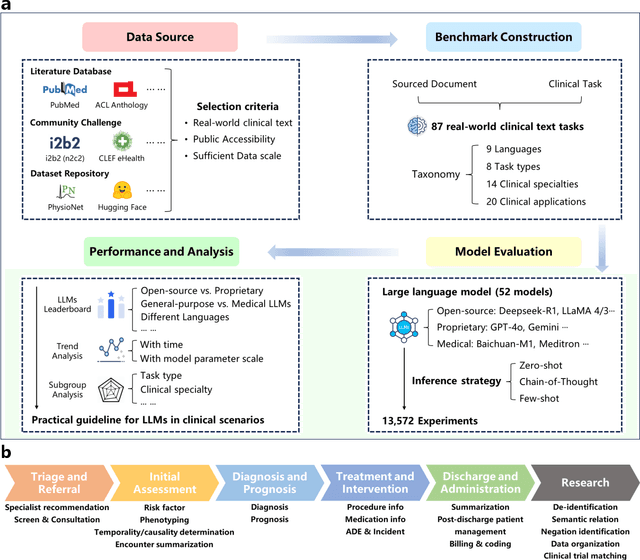
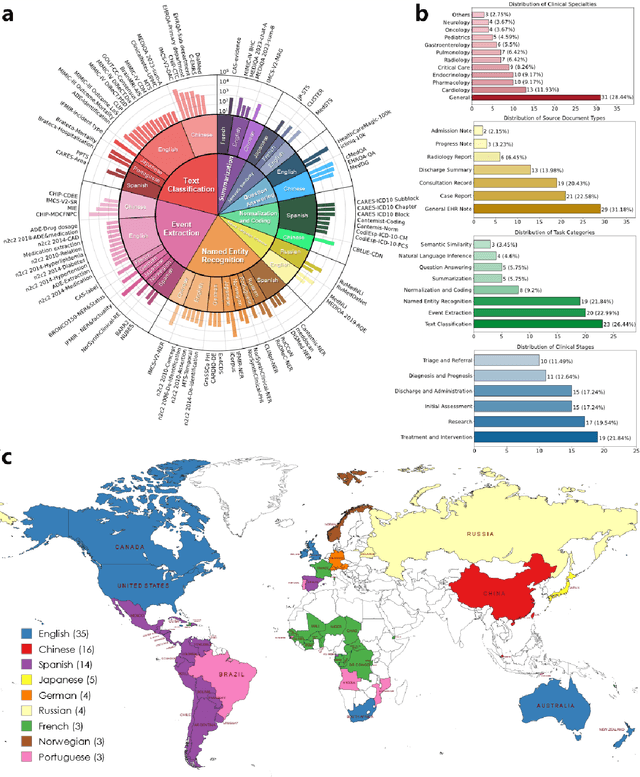
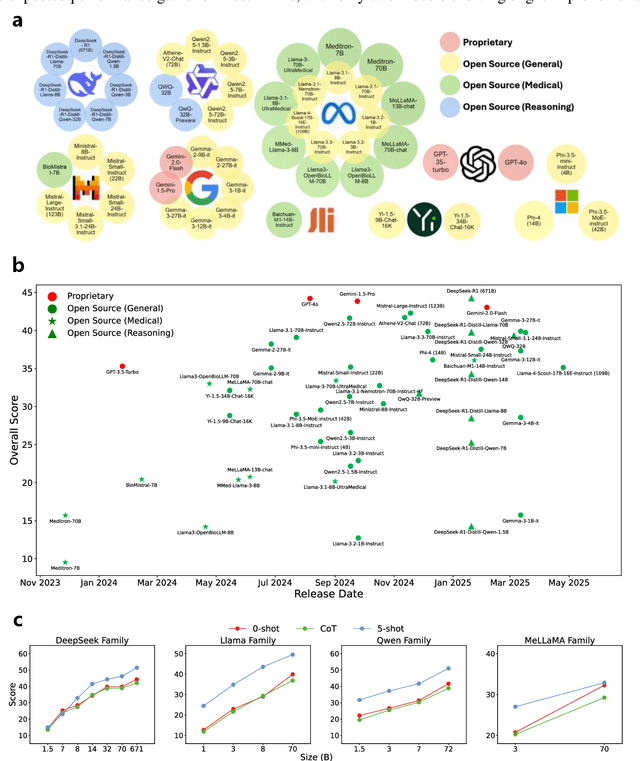
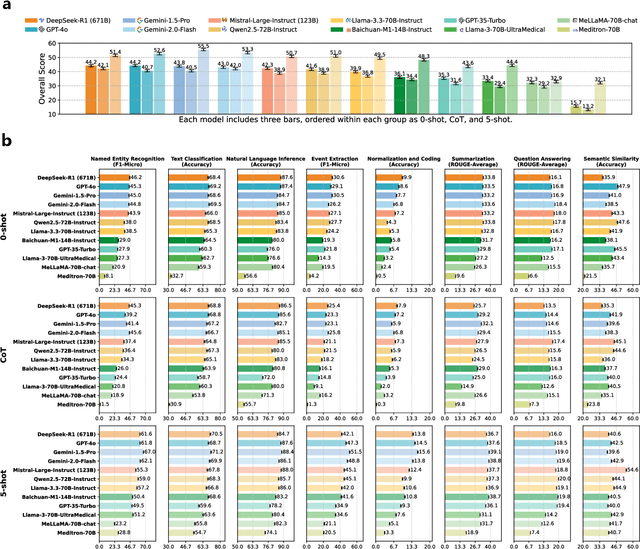
Large language models (LLMs) hold great promise for medical applications and are evolving rapidly, with new models being released at an accelerated pace. However, current evaluations of LLMs in clinical contexts remain limited. Most existing benchmarks rely on medical exam-style questions or PubMed-derived text, failing to capture the complexity of real-world electronic health record (EHR) data. Others focus narrowly on specific application scenarios, limiting their generalizability across broader clinical use. To address this gap, we present BRIDGE, a comprehensive multilingual benchmark comprising 87 tasks sourced from real-world clinical data sources across nine languages. We systematically evaluated 52 state-of-the-art LLMs (including DeepSeek-R1, GPT-4o, Gemini, and Llama 4) under various inference strategies. With a total of 13,572 experiments, our results reveal substantial performance variation across model sizes, languages, natural language processing tasks, and clinical specialties. Notably, we demonstrate that open-source LLMs can achieve performance comparable to proprietary models, while medically fine-tuned LLMs based on older architectures often underperform versus updated general-purpose models. The BRIDGE and its corresponding leaderboard serve as a foundational resource and a unique reference for the development and evaluation of new LLMs in real-world clinical text understanding. The BRIDGE leaderboard: https://huggingface.co/spaces/YLab-Open/BRIDGE-Medical-Leaderboard
VideoPanda: Video Panoramic Diffusion with Multi-view Attention
Apr 15, 2025High resolution panoramic video content is paramount for immersive experiences in Virtual Reality, but is non-trivial to collect as it requires specialized equipment and intricate camera setups. In this work, we introduce VideoPanda, a novel approach for synthesizing 360$^\circ$ videos conditioned on text or single-view video data. VideoPanda leverages multi-view attention layers to augment a video diffusion model, enabling it to generate consistent multi-view videos that can be combined into immersive panoramic content. VideoPanda is trained jointly using two conditions: text-only and single-view video, and supports autoregressive generation of long-videos. To overcome the computational burden of multi-view video generation, we randomly subsample the duration and camera views used during training and show that the model is able to gracefully generalize to generating more frames during inference. Extensive evaluations on both real-world and synthetic video datasets demonstrate that VideoPanda generates more realistic and coherent 360$^\circ$ panoramas across all input conditions compared to existing methods. Visit the project website at https://research-staging.nvidia.com/labs/toronto-ai/VideoPanda/ for results.
Cosmos-Transfer1: Conditional World Generation with Adaptive Multimodal Control
Mar 18, 2025We introduce Cosmos-Transfer, a conditional world generation model that can generate world simulations based on multiple spatial control inputs of various modalities such as segmentation, depth, and edge. In the design, the spatial conditional scheme is adaptive and customizable. It allows weighting different conditional inputs differently at different spatial locations. This enables highly controllable world generation and finds use in various world-to-world transfer use cases, including Sim2Real. We conduct extensive evaluations to analyze the proposed model and demonstrate its applications for Physical AI, including robotics Sim2Real and autonomous vehicle data enrichment. We further demonstrate an inference scaling strategy to achieve real-time world generation with an NVIDIA GB200 NVL72 rack. To help accelerate research development in the field, we open-source our models and code at https://github.com/nvidia-cosmos/cosmos-transfer1.
L4GM: Large 4D Gaussian Reconstruction Model
Jun 14, 2024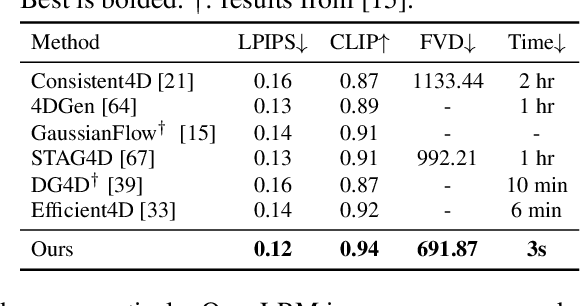
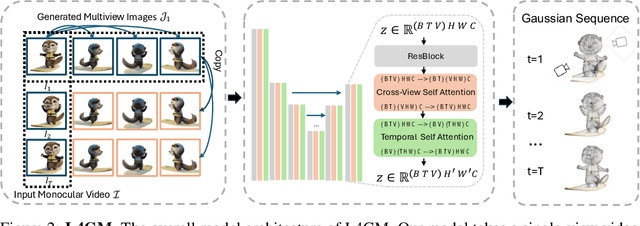
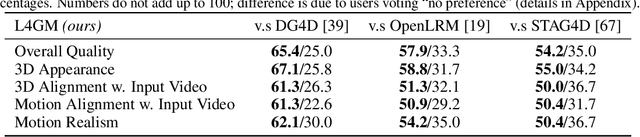
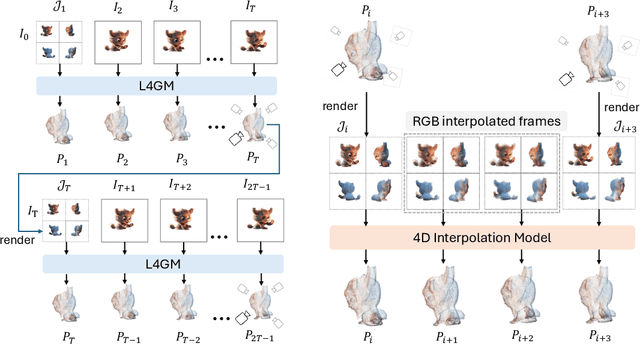
We present L4GM, the first 4D Large Reconstruction Model that produces animated objects from a single-view video input -- in a single feed-forward pass that takes only a second. Key to our success is a novel dataset of multiview videos containing curated, rendered animated objects from Objaverse. This dataset depicts 44K diverse objects with 110K animations rendered in 48 viewpoints, resulting in 12M videos with a total of 300M frames. We keep our L4GM simple for scalability and build directly on top of LGM, a pretrained 3D Large Reconstruction Model that outputs 3D Gaussian ellipsoids from multiview image input. L4GM outputs a per-frame 3D Gaussian Splatting representation from video frames sampled at a low fps and then upsamples the representation to a higher fps to achieve temporal smoothness. We add temporal self-attention layers to the base LGM to help it learn consistency across time, and utilize a per-timestep multiview rendering loss to train the model. The representation is upsampled to a higher framerate by training an interpolation model which produces intermediate 3D Gaussian representations. We showcase that L4GM that is only trained on synthetic data generalizes extremely well on in-the-wild videos, producing high quality animated 3D assets.
LATTE3D: Large-scale Amortized Text-To-Enhanced3D Synthesis
Mar 22, 2024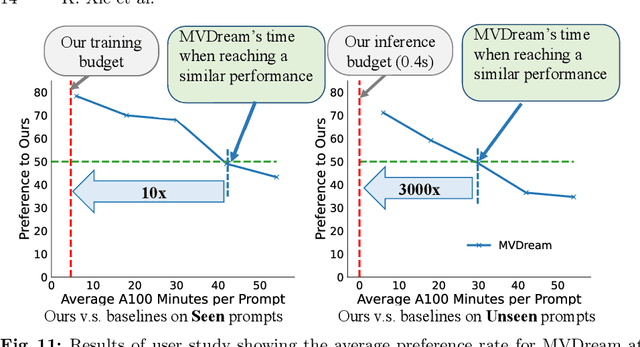
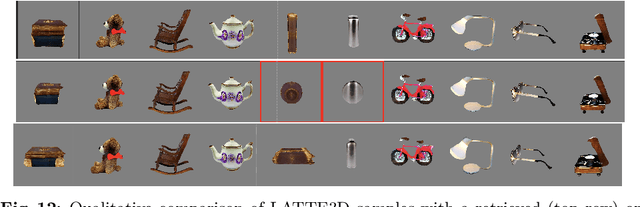
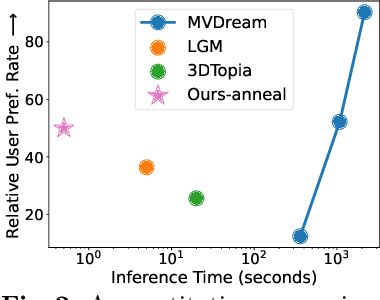
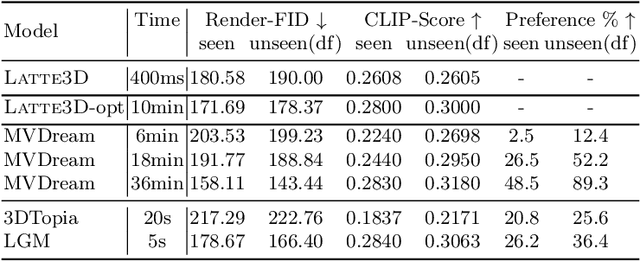
Recent text-to-3D generation approaches produce impressive 3D results but require time-consuming optimization that can take up to an hour per prompt. Amortized methods like ATT3D optimize multiple prompts simultaneously to improve efficiency, enabling fast text-to-3D synthesis. However, they cannot capture high-frequency geometry and texture details and struggle to scale to large prompt sets, so they generalize poorly. We introduce LATTE3D, addressing these limitations to achieve fast, high-quality generation on a significantly larger prompt set. Key to our method is 1) building a scalable architecture and 2) leveraging 3D data during optimization through 3D-aware diffusion priors, shape regularization, and model initialization to achieve robustness to diverse and complex training prompts. LATTE3D amortizes both neural field and textured surface generation to produce highly detailed textured meshes in a single forward pass. LATTE3D generates 3D objects in 400ms, and can be further enhanced with fast test-time optimization.
Generating Transferable Adversarial Simulation Scenarios for Self-Driving via Neural Rendering
Sep 27, 2023
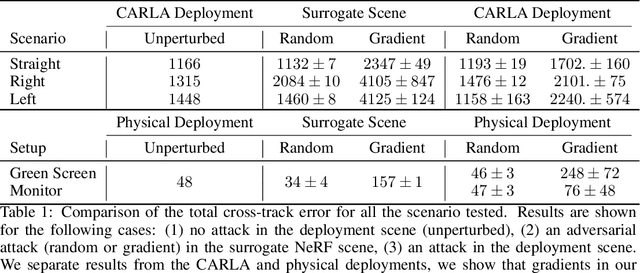
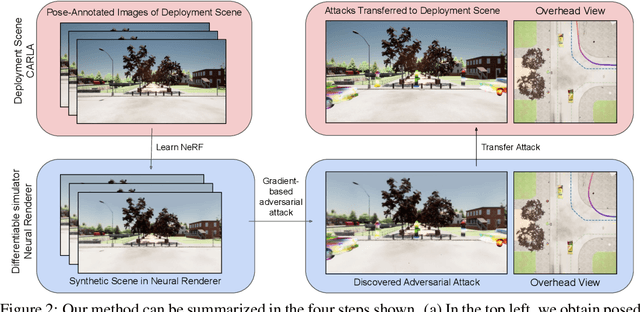
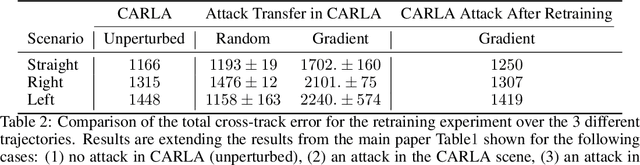
Self-driving software pipelines include components that are learned from a significant number of training examples, yet it remains challenging to evaluate the overall system's safety and generalization performance. Together with scaling up the real-world deployment of autonomous vehicles, it is of critical importance to automatically find simulation scenarios where the driving policies will fail. We propose a method that efficiently generates adversarial simulation scenarios for autonomous driving by solving an optimal control problem that aims to maximally perturb the policy from its nominal trajectory. Given an image-based driving policy, we show that we can inject new objects in a neural rendering representation of the deployment scene, and optimize their texture in order to generate adversarial sensor inputs to the policy. We demonstrate that adversarial scenarios discovered purely in the neural renderer (surrogate scene) can often be successfully transferred to the deployment scene, without further optimization. We demonstrate this transfer occurs both in simulated and real environments, provided the learned surrogate scene is sufficiently close to the deployment scene.