 Add to Chrome
 Add to Firefox
 Add to Edge
Vidu S1: A Real-Time Interactive Video Generation Model
Jul 03, 2026
We introduce Vidu S1, a real-time interactive video generation model supporting voice control of digital characters. Users can control video generation content at any moment through voice instructions. Vidu S1 supports infinite-length real-time video generation without blurring, drift, or visual distortion. Built with TurboDiffusion and TurboServe, Vidu S1 outputs 540p real-time videos at up to 42 FPS on regular consumer GPUs. Users can upload custom images of real people, anime, and pets, and choose different voice tones for personalized experiences. Experiments show that Vidu S1 achieves the best performance across all test metrics while fully meeting real-time inference requirements. A playable online demo is available at https://vidu.com/vidu-stream.

Causal-rCM: A Unified Teacher-Forcing and Self-Forcing Open Recipe for Autoregressive Diffusion Distillation in Streaming Video Generation and Interactive World Models
Jun 24, 2026Autoregressive video diffusion with causal diffusion transformers has emerged as a major paradigm for real-time streaming video generation and action-conditioned interactive world models. In this work, we extend rCM, an advanced diffusion distillation framework, to autoregressive video diffusion. The core philosophy of rCM lies in the complementarity between forward and reverse divergences, represented by consistency models (CMs) and distribution matching distillation (DMD), respectively, in diffusion distillation. This philosophy naturally carries over to the autoregressive setting, where teacher-forcing (TF) provides an offline, forward-divergence causal training paradigm, while self-forcing (SF) corresponds to an on-policy, reverse-divergence refinement. Our contributions are: (1) through extensive experiments, we show that teacher-forcing CM is currently the best complement to self-forcing DMD as an initialization strategy (2) we present the first implementation of teacher-forcing-based continuous-time CMs (e.g., sCM/MeanFlow) for autoregressive video diffusion, enabled by our custom-mask FlashAttention-2 JVP kernel, achieving 10$\times$ faster convergence compared to discrete-time CMs (dCMs) (3) we introduce Causal-rCM, a leading, unified, and scalable algorithm-infrastructure open recipe for diffusion distillation and causal training (4) we achieve state-of-the-art streaming video generation performance in both frame-wise and chunk-wise settings, using only synthetic data for training. Notably, our distilled 2-step causal Wan2.1-1.3B model achieves a VBench-T2V score of 84.63 with only 1 or 2 sampling steps. We further apply Causal-rCM to Cosmos 3, an advanced omnimodal world foundation model for physical AI with action-conditioned generation capability, enabling an interactive world model.
minWM: A Full-Stack Open-Source Framework for Real-Time Interactive Video World Models
May 28, 2026Recent video diffusion foundation models have achieved remarkable progress in high-quality video generation, yet turning them into real-time interactive video world models remains challenging. Interactive world models require controllable, causal, and low-latency rollout, which in practice demands a full pipeline spanning data construction, controllable fine-tuning, autoregressive training, few-step distillation, and streaming inference. In this work, we present minWM, a full-stack open-source framework for building real-time interactive video world models. minWM provides an end-to-end pipeline that converts existing bidirectional T2V/TI2V video foundation models into camera-controllable few-step autoregressive world models. Specifically, minWM first fine-tunes a bidirectional video diffusion model with camera control, and then applies the Causal Forcing / Causal Forcing++ pipeline, including AR diffusion training, causal ODE or causal consistency distillation, and asymmetric DMD, to distill it into a few-step autoregressive generator for low-latency rollout. The framework is modular and architecture-extensible: we instantiate it on representative open backbones, including Wan2.1-T2V-1.3B and HY1.5-TI2V-8B, covering both cross-attention-based condition injection and MMDiT-style architectures. minWM also supports adapting existing video world models, such as HY-WorldPlay, to new data distributions, training recipes, and latency targets. Beyond releasing runnable scripts, checkpoints, documentation, and inference code, we provide practical ablations on camera trajectory quality, controllability training steps, and minimal batch-size requirements. We hope minWM serves as a reproducible and extensible recipe for building and adapting real-time interactive video world models. Project Page: [https://github.com/shengshu-ai/minWM](https://github.com/shengshu-ai/minWM)
Causal Forcing++: Scalable Few-Step Autoregressive Diffusion Distillation for Real-Time Interactive Video Generation
May 14, 2026Real-time interactive video generation requires low-latency, streaming, and controllable rollout. Existing autoregressive (AR) diffusion distillation methods have achieved strong results in the chunk-wise 4-step regime by distilling bidirectional base models into few-step AR students, but they remain limited by coarse response granularity and non-negligible sampling latency. In this paper, we study a more aggressive setting: frame-wise autoregression with only 1--2 sampling steps. In this regime, we identify the initialization of a few-step AR student as the key bottleneck: existing strategies are either target-misaligned, incapable of few-step generation, or too costly to scale. We propose \textbf{Causal Forcing++}, a principled and scalable pipeline that uses \emph{causal consistency distillation} (causal CD) for few-step AR initialization. The core idea is that causal CD learns the same AR-conditional flow map as causal ODE distillation, but obtains supervision from a single online teacher ODE step between adjacent timesteps, avoiding the need to precompute and store full PF-ODE trajectories. This makes the initialization both more efficient and easier to optimize. The resulting pipeline, \ours, surpasses the SOTA 4-step chunk-wise Causal Forcing under the \textit{\textbf{frame-wise 2-step setting}} by 0.1 in VBench Total, 0.3 in VBench Quality, and 0.335 in VisionReward, while reducing first-frame latency by 50\% and Stage 2 training cost by $\sim$$4\times$. We further extend the pipeline to action-conditioned world model generation in the spirit of Genie3. Project Page: https://github.com/thu-ml/Causal-Forcing and https://github.com/shengshu-ai/minWM .
Causal Forcing: Autoregressive Diffusion Distillation Done Right for High-Quality Real-Time Interactive Video Generation
Feb 02, 2026To achieve real-time interactive video generation, current methods distill pretrained bidirectional video diffusion models into few-step autoregressive (AR) models, facing an architectural gap when full attention is replaced by causal attention. However, existing approaches do not bridge this gap theoretically. They initialize the AR student via ODE distillation, which requires frame-level injectivity, where each noisy frame must map to a unique clean frame under the PF-ODE of an AR teacher. Distilling an AR student from a bidirectional teacher violates this condition, preventing recovery of the teacher's flow map and instead inducing a conditional-expectation solution, which degrades performance. To address this issue, we propose Causal Forcing that uses an AR teacher for ODE initialization, thereby bridging the architectural gap. Empirical results show that our method outperforms all baselines across all metrics, surpassing the SOTA Self Forcing by 19.3\% in Dynamic Degree, 8.7\% in VisionReward, and 16.7\% in Instruction Following. Project page and the code: \href{https://thu-ml.github.io/CausalForcing.github.io/}{https://thu-ml.github.io/CausalForcing.github.io/}
FlexWorld: Progressively Expanding 3D Scenes for Flexiable-View Synthesis
Mar 17, 2025Generating flexible-view 3D scenes, including 360{\deg} rotation and zooming, from single images is challenging due to a lack of 3D data. To this end, we introduce FlexWorld, a novel framework consisting of two key components: (1) a strong video-to-video (V2V) diffusion model to generate high-quality novel view images from incomplete input rendered from a coarse scene, and (2) a progressive expansion process to construct a complete 3D scene. In particular, leveraging an advanced pre-trained video model and accurate depth-estimated training pairs, our V2V model can generate novel views under large camera pose variations. Building upon it, FlexWorld progressively generates new 3D content and integrates it into the global scene through geometry-aware scene fusion. Extensive experiments demonstrate the effectiveness of FlexWorld in generating high-quality novel view videos and flexible-view 3D scenes from single images, achieving superior visual quality under multiple popular metrics and datasets compared to existing state-of-the-art methods. Qualitatively, we highlight that FlexWorld can generate high-fidelity scenes with flexible views like 360{\deg} rotations and zooming. Project page: https://ml-gsai.github.io/FlexWorld.
FedDA-TSformer: Federated Domain Adaptation with Vision TimeSformer for Left Ventricle Segmentation on Gated Myocardial Perfusion SPECT Image
Feb 23, 2025Background and Purpose: Functional assessment of the left ventricle using gated myocardial perfusion (MPS) single-photon emission computed tomography relies on the precise extraction of the left ventricular contours while simultaneously ensuring the security of patient data. Methods: In this paper, we introduce the integration of Federated Domain Adaptation with TimeSformer, named 'FedDA-TSformer' for left ventricle segmentation using MPS. FedDA-TSformer captures spatial and temporal features in gated MPS images, leveraging spatial attention, temporal attention, and federated learning for improved domain adaptation while ensuring patient data security. In detail, we employed Divide-Space-Time-Attention mechanism to extract spatio-temporal correlations from the multi-centered MPS datasets, ensuring that predictions are spatio-temporally consistent. To achieve domain adaptation, we align the model output on MPS from three different centers using local maximum mean discrepancy (LMMD) loss. This approach effectively addresses the dual requirements of federated learning and domain adaptation, enhancing the model's performance during training with multi-site datasets while ensuring the protection of data from different hospitals. Results: Our FedDA-TSformer was trained and evaluated using MPS datasets collected from three hospitals, comprising a total of 150 subjects. Each subject's cardiac cycle was divided into eight gates. The model achieved Dice Similarity Coefficients (DSC) of 0.842 and 0.907 for left ventricular (LV) endocardium and epicardium segmentation, respectively. Conclusion: Our proposed FedDA-TSformer model addresses the challenge of multi-center generalization, ensures patient data privacy protection, and demonstrates effectiveness in left ventricular (LV) segmentation.
RIFLEx: A Free Lunch for Length Extrapolation in Video Diffusion Transformers
Feb 21, 2025
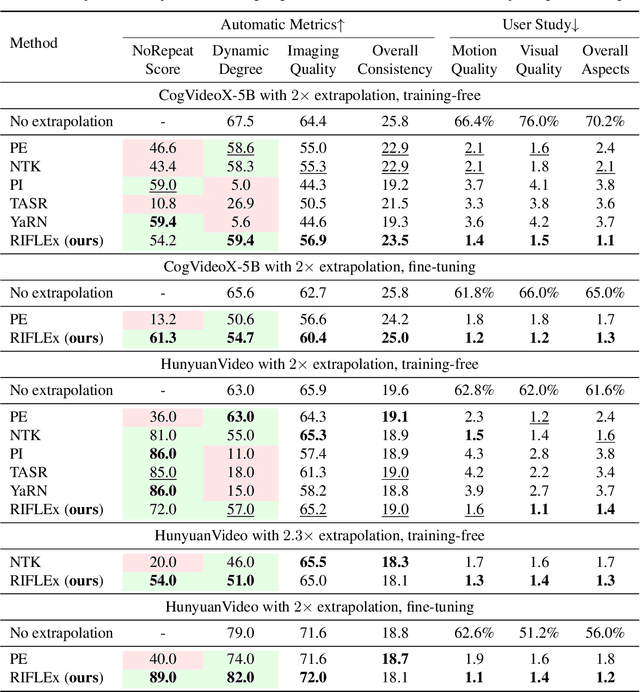
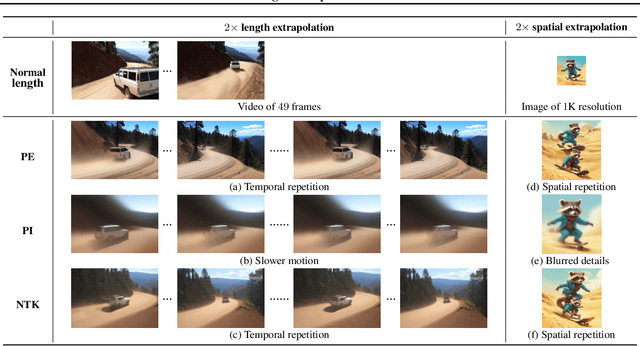

Recent advancements in video generation have enabled models to synthesize high-quality, minute-long videos. However, generating even longer videos with temporal coherence remains a major challenge, and existing length extrapolation methods lead to temporal repetition or motion deceleration. In this work, we systematically analyze the role of frequency components in positional embeddings and identify an intrinsic frequency that primarily governs extrapolation behavior. Based on this insight, we propose RIFLEx, a minimal yet effective approach that reduces the intrinsic frequency to suppress repetition while preserving motion consistency, without requiring any additional modifications. RIFLEx offers a true free lunch--achieving high-quality $2\times$ extrapolation on state-of-the-art video diffusion transformers in a completely training-free manner. Moreover, it enhances quality and enables $3\times$ extrapolation by minimal fine-tuning without long videos. Project page and codes: \href{https://riflex-video.github.io/}{https://riflex-video.github.io/.}
Unrolling Plug-and-Play Network for Hyperspectral Unmixing
Sep 07, 2024
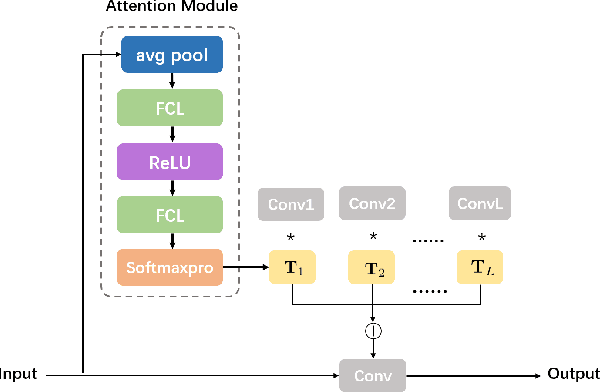
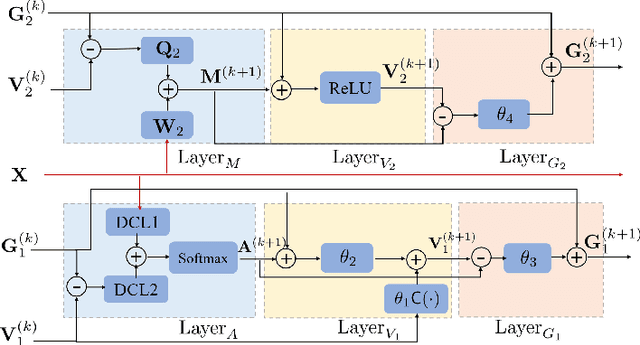

Deep learning based unmixing methods have received great attention in recent years and achieve remarkable performance. These methods employ a data-driven approach to extract structure features from hyperspectral image, however, they tend to be less physical interpretable. Conventional unmixing methods are with much more interpretability, whereas they require manually designing regularization and choosing penalty parameters. To overcome these limitations, we propose a novel unmixing method by unrolling the plug-and-play unmixing algorithm to conduct the deep architecture. Our method integrates both inner and outer priors. The carefully designed unfolding deep architecture is used to learn the spectral and spatial information from the hyperspectral image, which we refer to as inner priors. Additionally, our approach incorporates deep denoisers that have been pretrained on a large volume of image data to leverage the outer priors. Secondly, we design a dynamic convolution to model the multiscale information. Different scales are fused using an attention module. Experimental results of both synthetic and real datasets demonstrate that our method outperforms compared methods.
Identifying and Solving Conditional Image Leakage in Image-to-Video Diffusion Model
Jun 22, 2024
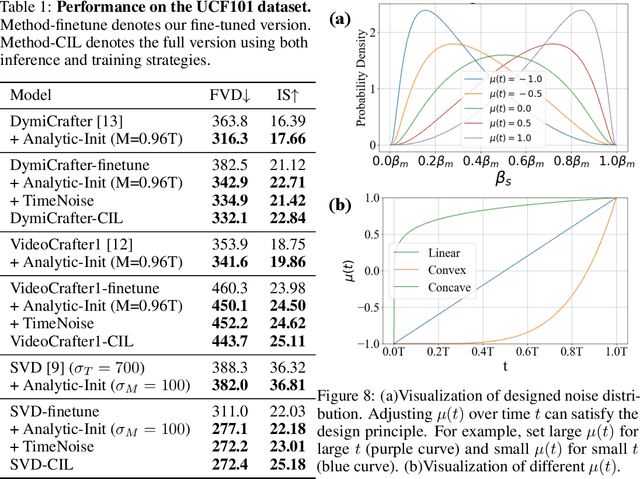

Diffusion models have obtained substantial progress in image-to-video (I2V) generation. However, such models are not fully understood. In this paper, we report a significant but previously overlooked issue in I2V diffusion models (I2V-DMs), namely, conditional image leakage. I2V-DMs tend to over-rely on the conditional image at large time steps, neglecting the crucial task of predicting the clean video from noisy inputs, which results in videos lacking dynamic and vivid motion. We further address this challenge from both inference and training aspects by presenting plug-and-play strategies accordingly. First, we introduce a training-free inference strategy that starts the generation process from an earlier time step to avoid the unreliable late-time steps of I2V-DMs, as well as an initial noise distribution with optimal analytic expressions (Analytic-Init) by minimizing the KL divergence between it and the actual marginal distribution to effectively bridge the training-inference gap. Second, to mitigate conditional image leakage during training, we design a time-dependent noise distribution for the conditional image, which favors high noise levels at large time steps to sufficiently interfere with the conditional image. We validate these strategies on various I2V-DMs using our collected open-domain image benchmark and the UCF101 dataset. Extensive results demonstrate that our methods outperform baselines by producing videos with more dynamic and natural motion without compromising image alignment and temporal consistency. The project page: \url{https://cond-image-leak.github.io/}.