 Add to Chrome
 Add to Firefox
 Add to Edge
Extracting Neural Materials from Multi-view Images
Jun 25, 2026
Neural materials can represent complex specular reflections and scattering effects in a compact, universal basis. However, acquiring and authoring such materials remains challenging. We present NeuMatEx, a differentiable inverse rendering method for extracting spatially varying neural materials from images. The nonlinear structure of neural material latent spaces makes optimization with naive inverse rendering infeasible. To address this, we train a Large Material Reconstruction Model (LMRM) that directly predicts initialbase color, neural material latents, and aleatoric uncertainty guides from images. This material prior provides a good initialization and better constrains our subsequent optimization using inverse path tracing. The predicted uncertainty further helps by anchoring high-confidence regions more tightly to the LMRM prediction, preventing lighting and complex specular effects from being baked into materials. Experiments on synthetic and real assets show that NeuMatEx extracts complex materials with better visual quality and material decomposition than PBR-based methods.

AlbedoEdit: Unified Instance-Level Video Editing with Albedo Guidance
May 31, 2026Video generative models have achieved remarkable progress in synthesizing photorealistic video sequences. However, enabling broader and more creative downstream applications requires fine-grained instance-level video editing, including object insertion, object removal, and texture editing, which has emerged as a prominent yet challenging problem. Existing approaches either propose unified generative frameworks with only coarse semantic control, or design task-specific frameworks for individual editing tasks, limiting their flexibility and applicability across diverse real-world scenarios. To address these limitations, we propose AlbedoEdit, a unified generative video editing framework that jointly supports object insertion, object removal, and texture editing. Our key insight is that the intrinsic albedo map, which is invariant to lighting and contains no specularity, shadowing and inter-reflection effects, provides an effective and user-friendly mechanism for specifying fine-grained appearance edits. Built upon video foundation models, AlbedoEdit is fine-tuned to translate source RGB videos into edited RGB videos, conditioned on a user-edited first-frame albedo. Trained on a new paired synthetic dataset covering all three editing tasks, AlbedoEdit implicitly learns to harmonize edited contents and simulate complex real-world visual effects triggered by editing operations, including specular highlights, soft shadows, and mirror reflections. AlbedoEdit demonstrates superior performance over state-of-the-art video editing approaches, both qualitatively and quantitatively. Project webpage is https://vcai.mpi-inf.mpg.de/projects/AlbedoEdit/.
VideoMatGen: PBR Materials through Joint Generative Modeling
Mar 17, 2026We present a method for generating physically-based materials for 3D shapes based on a video diffusion transformer architecture. Our method is conditioned on input geometry and a text description, and jointly models multiple material properties (base color, roughness, metallicity, height map) to form physically plausible materials. We further introduce a custom variational auto-encoder which encodes multiple material modalities into a compact latent space, which enables joint generation of multiple modalities without increasing the number of tokens. Our pipeline generates high-quality materials for 3D shapes given a text prompt, compatible with common content creation tools.
UniRelight: Learning Joint Decomposition and Synthesis for Video Relighting
Jun 18, 2025We address the challenge of relighting a single image or video, a task that demands precise scene intrinsic understanding and high-quality light transport synthesis. Existing end-to-end relighting models are often limited by the scarcity of paired multi-illumination data, restricting their ability to generalize across diverse scenes. Conversely, two-stage pipelines that combine inverse and forward rendering can mitigate data requirements but are susceptible to error accumulation and often fail to produce realistic outputs under complex lighting conditions or with sophisticated materials. In this work, we introduce a general-purpose approach that jointly estimates albedo and synthesizes relit outputs in a single pass, harnessing the generative capabilities of video diffusion models. This joint formulation enhances implicit scene comprehension and facilitates the creation of realistic lighting effects and intricate material interactions, such as shadows, reflections, and transparency. Trained on synthetic multi-illumination data and extensive automatically labeled real-world videos, our model demonstrates strong generalization across diverse domains and surpasses previous methods in both visual fidelity and temporal consistency.
VideoMat: Extracting PBR Materials from Video Diffusion Models
Jun 11, 2025We leverage finetuned video diffusion models, intrinsic decomposition of videos, and physically-based differentiable rendering to generate high quality materials for 3D models given a text prompt or a single image. We condition a video diffusion model to respect the input geometry and lighting condition. This model produces multiple views of a given 3D model with coherent material properties. Secondly, we use a recent model to extract intrinsics (base color, roughness, metallic) from the generated video. Finally, we use the intrinsics alongside the generated video in a differentiable path tracer to robustly extract PBR materials directly compatible with common content creation tools.
Generative Detail Enhancement for Physically Based Materials
Feb 19, 2025We present a tool for enhancing the detail of physically based materials using an off-the-shelf diffusion model and inverse rendering. Our goal is to enhance the visual fidelity of materials with detail that is often tedious to author, by adding signs of wear, aging, weathering, etc. As these appearance details are often rooted in real-world processes, we leverage a generative image model trained on a large dataset of natural images with corresponding visuals in context. Starting with a given geometry, UV mapping, and basic appearance, we render multiple views of the object. We use these views, together with an appearance-defining text prompt, to condition a diffusion model. The details it generates are then backpropagated from the enhanced images to the material parameters via inverse differentiable rendering. For inverse rendering to be successful, the generated appearance has to be consistent across all the images. We propose two priors to address the multi-view consistency of the diffusion model. First, we ensure that the initial noise that seeds the diffusion process is itself consistent across views by integrating it from a view-independent UV space. Second, we enforce geometric consistency by biasing the attention mechanism via a projective constraint so that pixels attend strongly to their corresponding pixel locations in other views. Our approach does not require any training or finetuning of the diffusion model, is agnostic of the material model used, and the enhanced material properties, i.e., 2D PBR textures, can be further edited by artists.
DiffusionRenderer: Neural Inverse and Forward Rendering with Video Diffusion Models
Jan 30, 2025


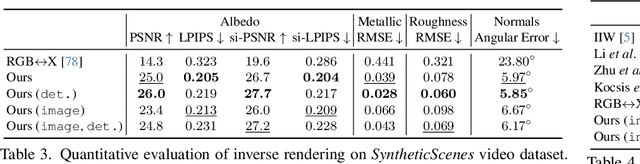
Understanding and modeling lighting effects are fundamental tasks in computer vision and graphics. Classic physically-based rendering (PBR) accurately simulates the light transport, but relies on precise scene representations--explicit 3D geometry, high-quality material properties, and lighting conditions--that are often impractical to obtain in real-world scenarios. Therefore, we introduce DiffusionRenderer, a neural approach that addresses the dual problem of inverse and forward rendering within a holistic framework. Leveraging powerful video diffusion model priors, the inverse rendering model accurately estimates G-buffers from real-world videos, providing an interface for image editing tasks, and training data for the rendering model. Conversely, our rendering model generates photorealistic images from G-buffers without explicit light transport simulation. Experiments demonstrate that DiffusionRenderer effectively approximates inverse and forwards rendering, consistently outperforming the state-of-the-art. Our model enables practical applications from a single video input--including relighting, material editing, and realistic object insertion.
Edify 3D: Scalable High-Quality 3D Asset Generation
Nov 11, 2024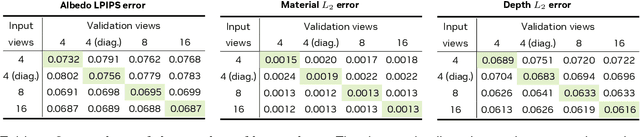
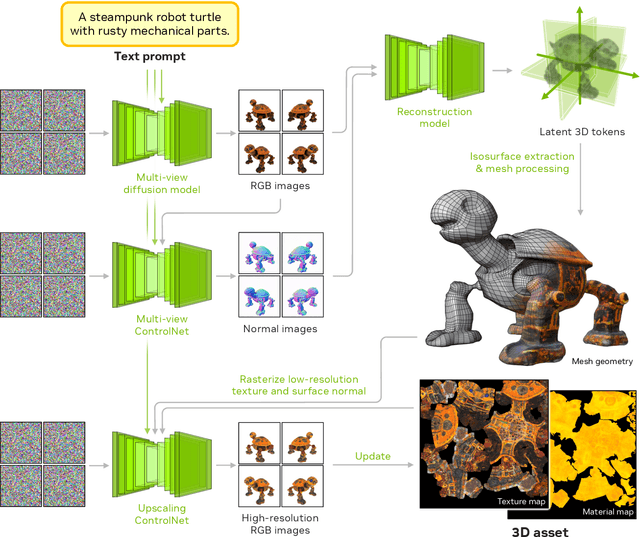
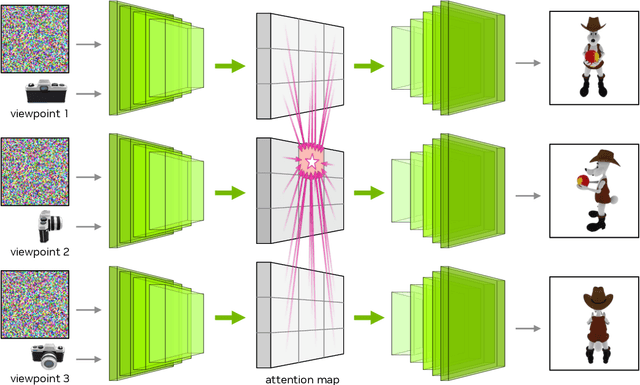
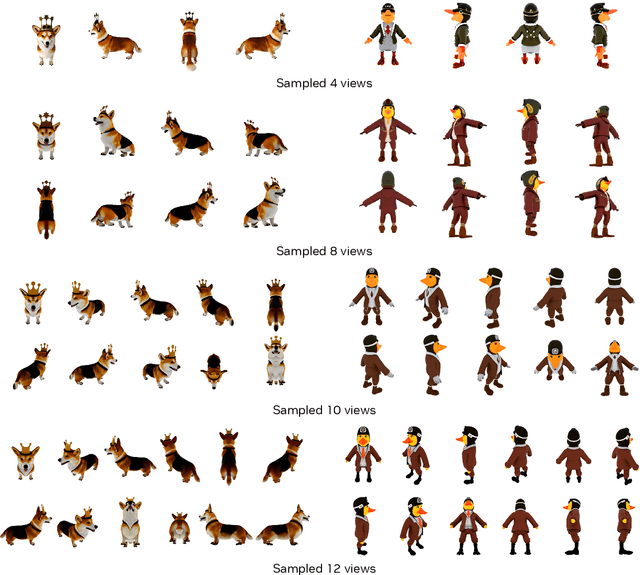
We introduce Edify 3D, an advanced solution designed for high-quality 3D asset generation. Our method first synthesizes RGB and surface normal images of the described object at multiple viewpoints using a diffusion model. The multi-view observations are then used to reconstruct the shape, texture, and PBR materials of the object. Our method can generate high-quality 3D assets with detailed geometry, clean shape topologies, high-resolution textures, and materials within 2 minutes of runtime.
Flexible Isosurface Extraction for Gradient-Based Mesh Optimization
Aug 10, 2023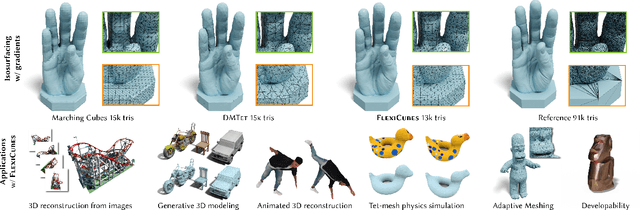
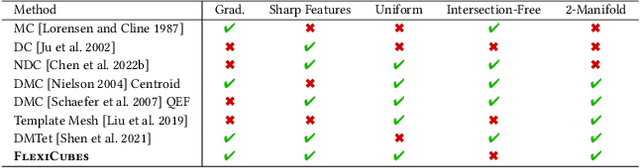
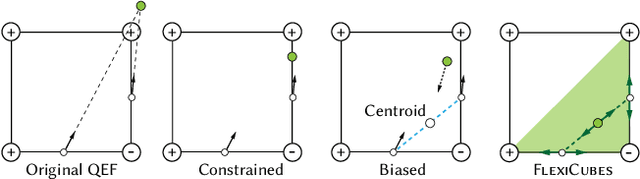
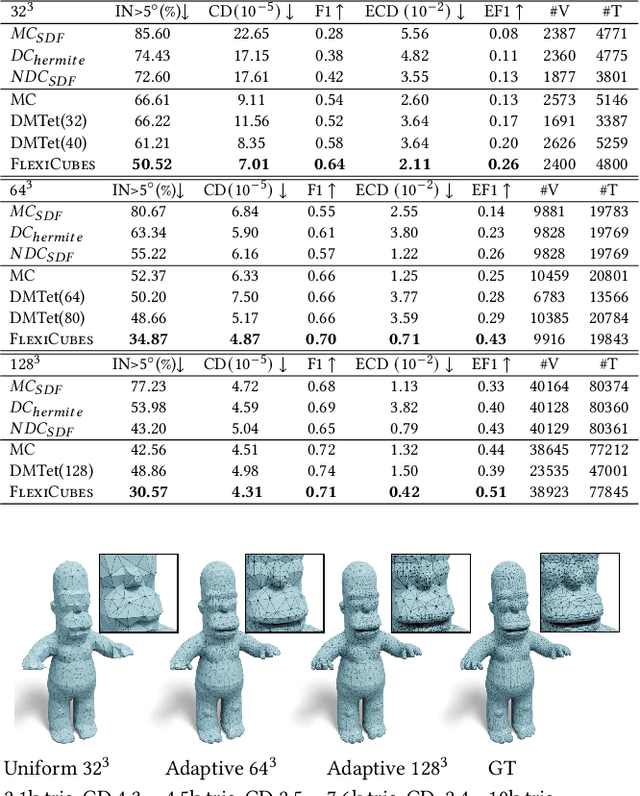
This work considers gradient-based mesh optimization, where we iteratively optimize for a 3D surface mesh by representing it as the isosurface of a scalar field, an increasingly common paradigm in applications including photogrammetry, generative modeling, and inverse physics. Existing implementations adapt classic isosurface extraction algorithms like Marching Cubes or Dual Contouring; these techniques were designed to extract meshes from fixed, known fields, and in the optimization setting they lack the degrees of freedom to represent high-quality feature-preserving meshes, or suffer from numerical instabilities. We introduce FlexiCubes, an isosurface representation specifically designed for optimizing an unknown mesh with respect to geometric, visual, or even physical objectives. Our main insight is to introduce additional carefully-chosen parameters into the representation, which allow local flexible adjustments to the extracted mesh geometry and connectivity. These parameters are updated along with the underlying scalar field via automatic differentiation when optimizing for a downstream task. We base our extraction scheme on Dual Marching Cubes for improved topological properties, and present extensions to optionally generate tetrahedral and hierarchically-adaptive meshes. Extensive experiments validate FlexiCubes on both synthetic benchmarks and real-world applications, showing that it offers significant improvements in mesh quality and geometric fidelity.
* SIGGRAPH 2023. Project page: https://research.nvidia.com/labs/toronto-ai/flexicubes/
Neural Fields meet Explicit Geometric Representation for Inverse Rendering of Urban Scenes
Apr 06, 2023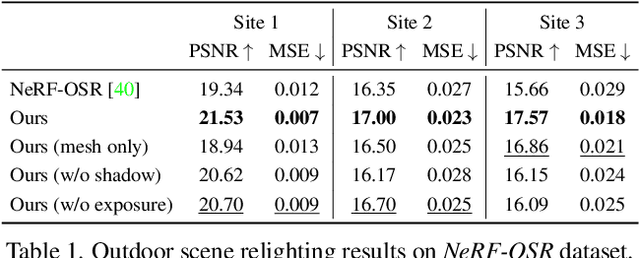
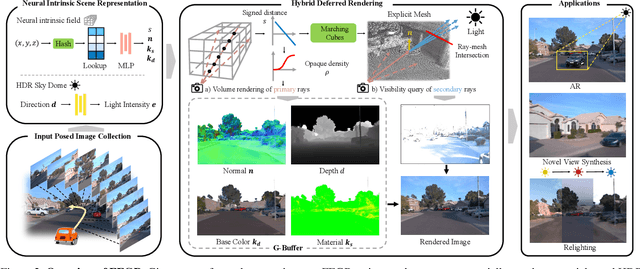
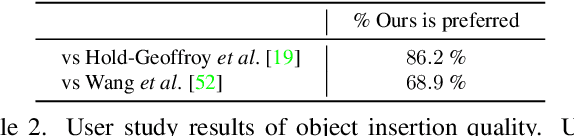
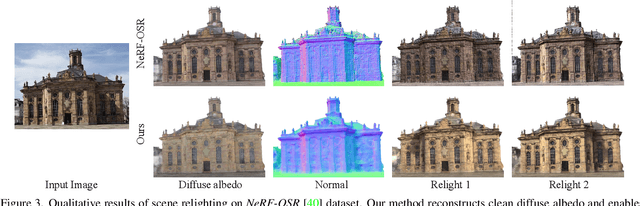
Reconstruction and intrinsic decomposition of scenes from captured imagery would enable many applications such as relighting and virtual object insertion. Recent NeRF based methods achieve impressive fidelity of 3D reconstruction, but bake the lighting and shadows into the radiance field, while mesh-based methods that facilitate intrinsic decomposition through differentiable rendering have not yet scaled to the complexity and scale of outdoor scenes. We present a novel inverse rendering framework for large urban scenes capable of jointly reconstructing the scene geometry, spatially-varying materials, and HDR lighting from a set of posed RGB images with optional depth. Specifically, we use a neural field to account for the primary rays, and use an explicit mesh (reconstructed from the underlying neural field) for modeling secondary rays that produce higher-order lighting effects such as cast shadows. By faithfully disentangling complex geometry and materials from lighting effects, our method enables photorealistic relighting with specular and shadow effects on several outdoor datasets. Moreover, it supports physics-based scene manipulations such as virtual object insertion with ray-traced shadow casting.