 Add to Chrome
 Add to Firefox
 Add to Edge
FinDeepIndicator: Benchmarking Deep Research Agents in End-to-End Financial Indicator Construction
Aug 01, 2026
Financial indicators are essential tools for transforming raw financial data into interpretable measures for various downstream tasks, such as valuation, risk assessment, and economic analysis. However, existing financial benchmarks largely focus on answer-level accuracy and often assume that relevant data are already provided, leaving the assessment of the intermediate process of indicator construction underexplored. In this work, we propose FinDeepIndicator, the first benchmark dedicated to evaluating Deep Research (DR) agents in end-to-end financial indicator construction. Specifically, FinDeepIndicator evaluates DR agents across four stages in indicator construction: formula specification, data collection, indicator calculation, and answer generation, and covers fundamental, technical, and macroeconomic indicators organized into 21 fine-grained sub-categories. It contains 3,350 curated question-answer (QA) pairs derived from both U.S. and Chinese markets, 10 years of historical financial data, and 800 listed companies. Extensive experiments on search-equipped Large Language Models (LLMs) and DR agents show that, while LLMs generally perform well in formula specification, their accuracy drops substantially during data retrieval and numerical execution. DR agents consistently outperform search-equipped LLMs, yet remain unreliable in realistic financial analysis settings. These findings provide insights for developing more capable and trustworthy DR agents in finance.

IMMNet: Hybrid Fusion of Model-based and Data-driven Approaches for Maneuvering Target Tracking
Jul 15, 2026Maneuvering target tracking in three-dimensional space remains a challenging problem due to complex motion dynamics and model mismatch. To address this, this paper proposes a hybrid model/data-driven algorithm named IMMNet, which integrates the interpretable structure of the interacting multiple model (IMM) algorithm with learnable neural components. Unlike end-to-end black-box methods, the proposed IMMNet algorithm not only can preserve the Bayesian inference mechanism that is essential for real-time radar applications, but also can adaptively learn motion patterns and noise characteristics from data. Extensive experiments demonstrate that the proposed IMMNet algorithm consistently outperforms the existing algorithms across various scenarios, validating it as a robust, interpretable, and practical solution for maneuvering target tracking.
An Extended Object Poisson Multi-Bernoulli Filter with Zero-Inflated Poisson Model Using Belief Propagation
May 25, 2026This paper presents an efficient implementation of the extended object Poisson multi-Bernoulli (PMB) filter under the zero-inflated Poisson (ZIP) object measurement model using particle belief propagation (BP). The ZIP measurement model separates a Bernoulli object detection event from the conditional Poisson generation of object measurements, enabling principled handling of empty measurement sets. Building upon the PMB mixture posterior, we present a factorized joint posterior over set of objects with object detection variables and a dual representation of data association using both object-oriented and measurement-oriented association variables. Notably, this representation replaces the implicit high-order global hypothesis constraint by local consistency factors, yielding a factor graph amenable to BP. In addition, we present a particle-based implementation, in which the Poisson intensity for undetected objects is analytic, whereas the single object densities of Bernoulli components for the detected objects are represented using particles. Simulation results demonstrate that the proposed method has superior performance than existing sampling-based implementations of extended object PMB filter with ZIP model in terms of both estimation accuracy and runtime.
Event-Triggered Distributed Target Tracking via PRIMEX
Apr 23, 2026PRIMEX (prime-based graph encoding and extraction) is a recently proposed framework for scalable distributed fusion. In PRIMEX, the information pedigree of state estimates or probability density functions is encoded using the information codes, enabling lightweight arithmetic for redundancy removal and data integration. Building on PRIMEX and its memoryless fusion strategy based on a least-squares approximation, in this paper we present two efficient distributed tracking algorithms: a consensus-based PRIMEX method that fuses information from all neighbors, and a greedy gossip-based PRIMEX method that fuses with the most informative neighbor. To further increase communication efficiency, we incorporate an event-triggered mechanism, in which transmission decisions are driven by information novelty measured using differences between the information codes. The proposed methods are evaluated and compared with covariance intersection and centralized fusion in a distributed single target tracking scenario. Simulation results show that PRIMEX-based methods remain competitive in tracking accuracy while improving communication efficiency.
Watermarking Large Language Model-based Time Series Forecasting
Jul 28, 2025Large Language Model-based Time Series Forecasting (LLMTS) has shown remarkable promise in handling complex and diverse temporal data, representing a significant step toward foundation models for time series analysis. However, this emerging paradigm introduces two critical challenges. First, the substantial commercial potential and resource-intensive development raise urgent concerns about intellectual property (IP) protection. Second, their powerful time series forecasting capabilities may be misused to produce misleading or fabricated deepfake time series data. To address these concerns, we explore watermarking the outputs of LLMTS models, that is, embedding imperceptible signals into the generated time series data that remain detectable by specialized algorithms. We propose a novel post-hoc watermarking framework, Waltz, which is broadly compatible with existing LLMTS models. Waltz is inspired by the empirical observation that time series patch embeddings are rarely aligned with a specific set of LLM tokens, which we term ``cold tokens''. Leveraging this insight, Waltz embeds watermarks by rewiring the similarity statistics between patch embeddings and cold token embeddings, and detects watermarks using similarity z-scores. To minimize potential side effects, we introduce a similarity-based embedding position identification strategy and employ projected gradient descent to constrain the watermark noise within a defined boundary. Extensive experiments using two popular LLMTS models across seven benchmark datasets demonstrate that Waltz achieves high watermark detection accuracy with minimal impact on the quality of the generated time series.
UniCTokens: Boosting Personalized Understanding and Generation via Unified Concept Tokens
May 20, 2025Personalized models have demonstrated remarkable success in understanding and generating concepts provided by users. However, existing methods use separate concept tokens for understanding and generation, treating these tasks in isolation. This may result in limitations for generating images with complex prompts. For example, given the concept $\langle bo\rangle$, generating "$\langle bo\rangle$ wearing its hat" without additional textual descriptions of its hat. We call this kind of generation personalized knowledge-driven generation. To address the limitation, we present UniCTokens, a novel framework that effectively integrates personalized information into a unified vision language model (VLM) for understanding and generation. UniCTokens trains a set of unified concept tokens to leverage complementary semantics, boosting two personalized tasks. Moreover, we propose a progressive training strategy with three stages: understanding warm-up, bootstrapping generation from understanding, and deepening understanding from generation to enhance mutual benefits between both tasks. To quantitatively evaluate the unified VLM personalization, we present UnifyBench, the first benchmark for assessing concept understanding, concept generation, and knowledge-driven generation. Experimental results on UnifyBench indicate that UniCTokens shows competitive performance compared to leading methods in concept understanding, concept generation, and achieving state-of-the-art results in personalized knowledge-driven generation. Our research demonstrates that enhanced understanding improves generation, and the generation process can yield valuable insights into understanding. Our code and dataset will be released at: \href{https://github.com/arctanxarc/UniCTokens}{https://github.com/arctanxarc/UniCTokens}.
MCTS-Judge: Test-Time Scaling in LLM-as-a-Judge for Code Correctness Evaluation
Feb 18, 2025The LLM-as-a-Judge paradigm shows promise for evaluating generative content but lacks reliability in reasoning-intensive scenarios, such as programming. Inspired by recent advances in reasoning models and shifts in scaling laws, we pioneer bringing test-time computation into LLM-as-a-Judge, proposing MCTS-Judge, a resource-efficient, System-2 thinking framework for code correctness evaluation. MCTS-Judge leverages Monte Carlo Tree Search (MCTS) to decompose problems into simpler, multi-perspective evaluations. Through a node-selection strategy that combines self-assessment based on historical actions in the current trajectory and the Upper Confidence Bound for Trees based on prior rollouts, MCTS-Judge balances global optimization and refinement of the current trajectory. We further designed a high-precision, unit-test-level reward mechanism to encourage the Large Language Model (LLM) to perform line-by-line analysis. Extensive experiments on three benchmarks and five LLMs demonstrate the effectiveness of MCTS-Judge, which improves the base model's accuracy from 41% to 80%, surpassing the o1-series models with 3x fewer tokens. Further evaluations validate the superiority of its reasoning trajectory in logic, analytics, thoroughness, and overall quality, while revealing the test-time scaling law of the LLM-as-a-Judge paradigm.
Efficient Inference for Large Language Model-based Generative Recommendation
Oct 07, 2024


Large Language Model (LLM)-based generative recommendation has achieved notable success, yet its practical deployment is costly particularly due to excessive inference latency caused by autoregressive decoding. For lossless LLM decoding acceleration, Speculative Decoding (SD) has emerged as a promising solution. However, applying SD to generative recommendation presents unique challenges due to the requirement of generating top-K items (i.e., K distinct token sequences) as a recommendation list by beam search. This leads to more stringent verification in SD, where all the top-K sequences from the target LLM must be successfully drafted by the draft model at each decoding step. To alleviate this, we consider 1) boosting top-K sequence alignment between the draft model and the target LLM, and 2) relaxing the verification strategy to reduce trivial LLM calls. To this end, we propose an alignment framework named AtSpeed, which presents the AtSpeed-S optimization objective for top-K alignment under the strict top-K verification. Moreover, we introduce a relaxed sampling verification strategy that allows high-probability non-top-K drafted sequences to be accepted, significantly reducing LLM calls. Correspondingly, we propose AtSpeed-R for top-K alignment under this relaxed sampling verification. Empirical results on two real-world datasets demonstrate that AtSpeed significantly accelerates LLM-based generative recommendation, e.g., near 2x speedup under strict top-K verification and up to 2.5 speedup under relaxed sampling verification. The codes and datasets will be released in the near future.
FELLAS: Enhancing Federated Sequential Recommendation with LLM as External Services
Oct 07, 2024


Federated sequential recommendation (FedSeqRec) has gained growing attention due to its ability to protect user privacy. Unfortunately, the performance of FedSeqRec is still unsatisfactory because the models used in FedSeqRec have to be lightweight to accommodate communication bandwidth and clients' on-device computational resource constraints. Recently, large language models (LLMs) have exhibited strong transferable and generalized language understanding abilities and therefore, in the NLP area, many downstream tasks now utilize LLMs as a service to achieve superior performance without constructing complex models. Inspired by this successful practice, we propose a generic FedSeqRec framework, FELLAS, which aims to enhance FedSeqRec by utilizing LLMs as an external service. Specifically, FELLAS employs an LLM server to provide both item-level and sequence-level representation assistance. The item-level representation service is queried by the central server to enrich the original ID-based item embedding with textual information, while the sequence-level representation service is accessed by each client. However, invoking the sequence-level representation service requires clients to send sequences to the external LLM server. To safeguard privacy, we implement dx-privacy satisfied sequence perturbation, which protects clients' sensitive data with guarantees. Additionally, a contrastive learning-based method is designed to transfer knowledge from the noisy sequence representation to clients' sequential recommendation models. Furthermore, to empirically validate the privacy protection capability of FELLAS, we propose two interacted item inference attacks. Extensive experiments conducted on three datasets with two widely used sequential recommendation models demonstrate the effectiveness and privacy-preserving capability of FELLAS.
PDC-FRS: Privacy-preserving Data Contribution for Federated Recommender System
Sep 12, 2024


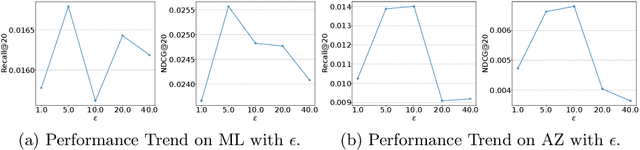
Federated recommender systems (FedRecs) have emerged as a popular research direction for protecting users' privacy in on-device recommendations. In FedRecs, users keep their data locally and only contribute their local collaborative information by uploading model parameters to a central server. While this rigid framework protects users' raw data during training, it severely compromises the recommendation model's performance due to the following reasons: (1) Due to the power law distribution nature of user behavior data, individual users have few data points to train a recommendation model, resulting in uploaded model updates that may be far from optimal; (2) As each user's uploaded parameters are learned from local data, which lacks global collaborative information, relying solely on parameter aggregation methods such as FedAvg to fuse global collaborative information may be suboptimal. To bridge this performance gap, we propose a novel federated recommendation framework, PDC-FRS. Specifically, we design a privacy-preserving data contribution mechanism that allows users to share their data with a differential privacy guarantee. Based on the shared but perturbed data, an auxiliary model is trained in parallel with the original federated recommendation process. This auxiliary model enhances FedRec by augmenting each user's local dataset and integrating global collaborative information. To demonstrate the effectiveness of PDC-FRS, we conduct extensive experiments on two widely used recommendation datasets. The empirical results showcase the superiority of PDC-FRS compared to baseline methods.