 Add to Chrome
 Add to Firefox
 Add to Edge
GLinSAT: The General Linear Satisfiability Neural Network Layer By Accelerated Gradient Descent
Sep 26, 2024
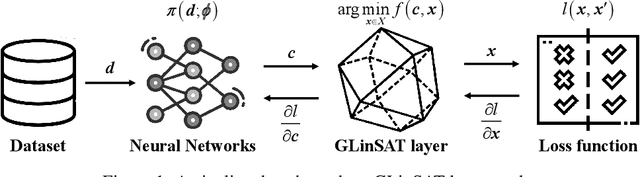
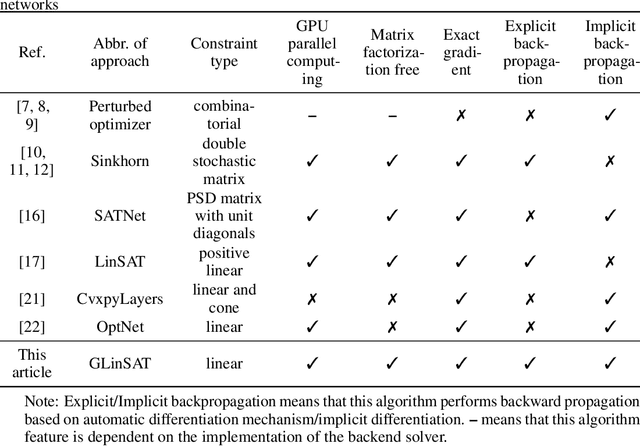
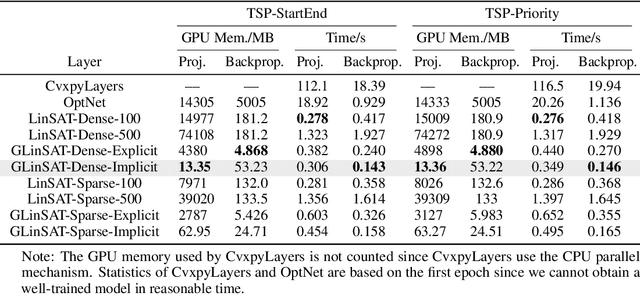
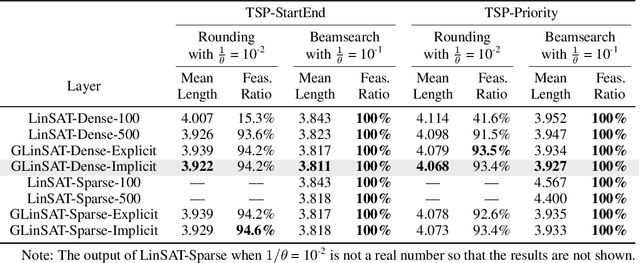
Ensuring that the outputs of neural networks satisfy specific constraints is crucial for applying neural networks to real-life decision-making problems. In this paper, we consider making a batch of neural network outputs satisfy bounded and general linear constraints. We first reformulate the neural network output projection problem as an entropy-regularized linear programming problem. We show that such a problem can be equivalently transformed into an unconstrained convex optimization problem with Lipschitz continuous gradient according to the duality theorem. Then, based on an accelerated gradient descent algorithm with numerical performance enhancement, we present our architecture, GLinSAT, to solve the problem. To the best of our knowledge, this is the first general linear satisfiability layer in which all the operations are differentiable and matrix-factorization-free. Despite the fact that we can explicitly perform backpropagation based on automatic differentiation mechanism, we also provide an alternative approach in GLinSAT to calculate the derivatives based on implicit differentiation of the optimality condition. Experimental results on constrained traveling salesman problems, partial graph matching with outliers, predictive portfolio allocation and power system unit commitment demonstrate the advantages of GLinSAT over existing satisfiability layers.

Inference-Time Language Model Alignment via Integrated Value Guidance
Sep 26, 2024Large language models are typically fine-tuned to align with human preferences, but tuning large models is computationally intensive and complex. In this work, we introduce $\textit{Integrated Value Guidance}$ (IVG), a method that uses implicit and explicit value functions to guide language model decoding at token and chunk-level respectively, efficiently aligning large language models purely at inference time. This approach circumvents the complexities of direct fine-tuning and outperforms traditional methods. Empirically, we demonstrate the versatility of IVG across various tasks. In controlled sentiment generation and summarization tasks, our method significantly improves the alignment of large models using inference-time guidance from $\texttt{gpt2}$-based value functions. Moreover, in a more challenging instruction-following benchmark AlpacaEval 2.0, we show that both specifically tuned and off-the-shelf value functions greatly improve the length-controlled win rates of large models against $\texttt{gpt-4-turbo}$ (e.g., $19.51\% \rightarrow 26.51\%$ for $\texttt{Mistral-7B-Instruct-v0.2}$ and $25.58\% \rightarrow 33.75\%$ for $\texttt{Mixtral-8x7B-Instruct-v0.1}$ with Tulu guidance).
Graph and Sequential Neural Networks in Session-based Recommendation: A Survey
Aug 27, 2024Recent years have witnessed the remarkable success of recommendation systems (RSs) in alleviating the information overload problem. As a new paradigm of RSs, session-based recommendation (SR) specializes in users' short-term preference capture and aims to provide a more dynamic and timely recommendation based on the ongoing interacted actions. In this survey, we will give a comprehensive overview of the recent works on SR. First, we clarify the definitions of various SR tasks and introduce the characteristics of session-based recommendation against other recommendation tasks. Then, we summarize the existing methods in two categories: sequential neural network based methods and graph neural network (GNN) based methods. The standard frameworks and technical are also introduced. Finally, we discuss the challenges of SR and new research directions in this area.
Data Generation Scheme for Thermal Modality with Edge-Guided Adversarial Conditional Diffusion Model
Aug 07, 2024In challenging low light and adverse weather conditions,thermal vision algorithms,especially object detection,have exhibited remarkable potential,contrasting with the frequent struggles encountered by visible vision algorithms. Nevertheless,the efficacy of thermal vision algorithms driven by deep learning models remains constrained by the paucity of available training data samples. To this end,this paper introduces a novel approach termed the edge guided conditional diffusion model. This framework aims to produce meticulously aligned pseudo thermal images at the pixel level,leveraging edge information extracted from visible images. By utilizing edges as contextual cues from the visible domain,the diffusion model achieves meticulous control over the delineation of objects within the generated images. To alleviate the impacts of those visible-specific edge information that should not appear in the thermal domain,a two-stage modality adversarial training strategy is proposed to filter them out from the generated images by differentiating the visible and thermal modality. Extensive experiments on LLVIP demonstrate ECDM s superiority over existing state-of-the-art approaches in terms of image generation quality.
SampleAttention: Near-Lossless Acceleration of Long Context LLM Inference with Adaptive Structured Sparse Attention
Jun 28, 2024Large language models (LLMs) now support extremely long context windows, but the quadratic complexity of vanilla attention results in significantly long Time-to-First-Token (TTFT) latency. Existing approaches to address this complexity require additional pretraining or finetuning, and often sacrifice model accuracy. In this paper, we first provide both theoretical and empirical foundations for near-lossless sparse attention. We find dynamically capturing head-specific sparse patterns at runtime with low overhead is crucial. To address this, we propose SampleAttention, an adaptive structured and near-lossless sparse attention. Leveraging observed significant sparse patterns, SampleAttention attends to a fixed percentage of adjacent tokens to capture local window patterns, and employs a two-stage query-guided key-value filtering approach, which adaptively select a minimum set of key-values with low overhead, to capture column stripe patterns. Comprehensive evaluations show that SampleAttention can seamlessly replace vanilla attention in off-the-shelf LLMs with nearly no accuracy loss, and reduces TTFT by up to $2.42\times$ compared with FlashAttention.
Near-Lossless Acceleration of Long Context LLM Inference with Adaptive Structured Sparse Attention
Jun 17, 2024Large language models (LLMs) now support extremely long context windows, but the quadratic complexity of vanilla attention results in significantly long Time-to-First-Token (TTFT) latency. Existing approaches to address this complexity require additional pretraining or finetuning, and often sacrifice model accuracy. In this paper, we first provide both theoretical and empirical foundations for near-lossless sparse attention. We find dynamically capturing head-specific sparse patterns at runtime with low overhead is crucial. To address this, we propose SampleAttention, an adaptive structured and near-lossless sparse attention. Leveraging observed significant sparse patterns, SampleAttention attends to a fixed percentage of adjacent tokens to capture local window patterns, and employs a two-stage query-guided key-value filtering approach, which adaptively select a minimum set of key-values with low overhead, to capture column stripe patterns. Comprehensive evaluations show that SampleAttention can seamlessly replace vanilla attention in off-the-shelf LLMs with nearly no accuracy loss, and reduces TTFT by up to $2.42\times$ compared with FlashAttention.
Iterative Length-Regularized Direct Preference Optimization: A Case Study on Improving 7B Language Models to GPT-4 Level
Jun 17, 2024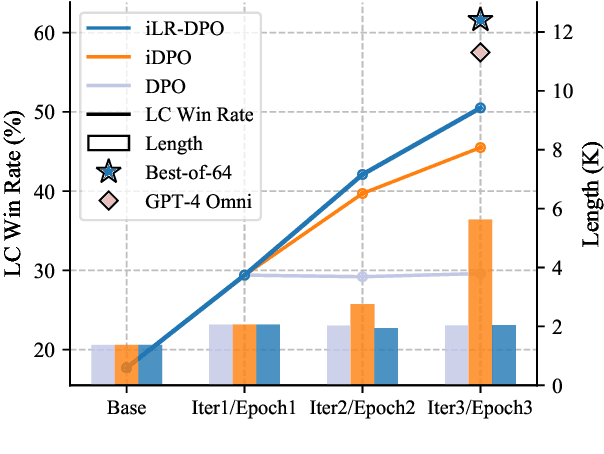
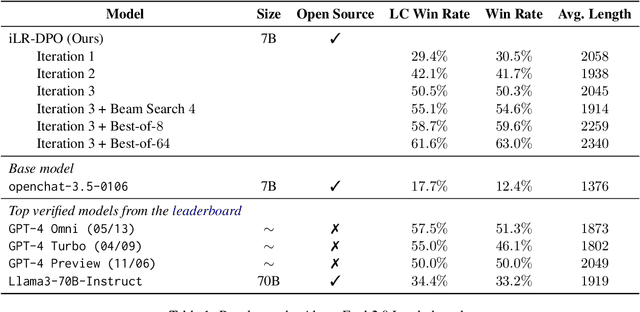
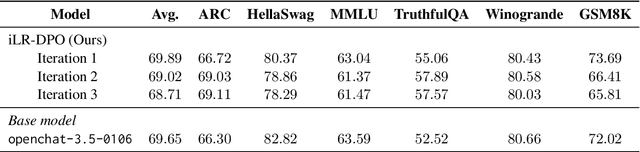
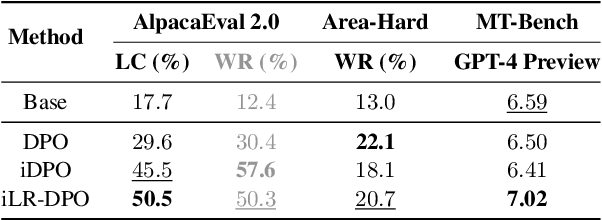
Direct Preference Optimization (DPO), a standard method for aligning language models with human preferences, is traditionally applied to offline preferences. Recent studies show that DPO benefits from iterative training with online preferences labeled by a trained reward model. In this work, we identify a pitfall of vanilla iterative DPO - improved response quality can lead to increased verbosity. To address this, we introduce iterative length-regularized DPO (iLR-DPO) to penalize response length. Our empirical results show that iLR-DPO can enhance a 7B model to perform on par with GPT-4 without increasing verbosity. Specifically, our 7B model achieves a $50.5\%$ length-controlled win rate against $\texttt{GPT-4 Preview}$ on AlpacaEval 2.0, and excels across standard benchmarks including MT-Bench, Arena-Hard and OpenLLM Leaderboard. These results demonstrate the effectiveness of iterative DPO in aligning language models with human feedback.
Neuro-Symbolic Temporal Point Processes
Jun 06, 2024Our goal is to $\textit{efficiently}$ discover a compact set of temporal logic rules to explain irregular events of interest. We introduce a neural-symbolic rule induction framework within the temporal point process model. The negative log-likelihood is the loss that guides the learning, where the explanatory logic rules and their weights are learned end-to-end in a $\textit{differentiable}$ way. Specifically, predicates and logic rules are represented as $\textit{vector embeddings}$, where the predicate embeddings are fixed and the rule embeddings are trained via gradient descent to obtain the most appropriate compositional representations of the predicate embeddings. To make the rule learning process more efficient and flexible, we adopt a $\textit{sequential covering algorithm}$, which progressively adds rules to the model and removes the event sequences that have been explained until all event sequences have been covered. All the found rules will be fed back to the models for a final rule embedding and weight refinement. Our approach showcases notable efficiency and accuracy across synthetic and real datasets, surpassing state-of-the-art baselines by a wide margin in terms of efficiency.
Latent Logic Tree Extraction for Event Sequence Explanation from LLMs
Jun 04, 2024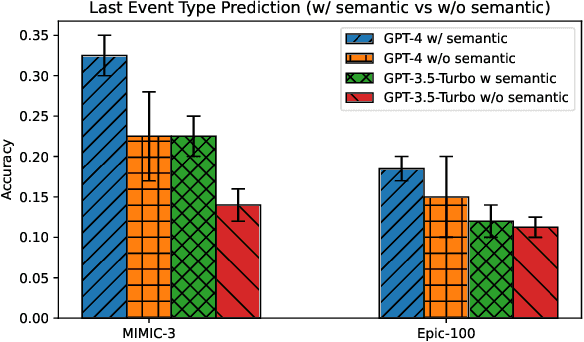
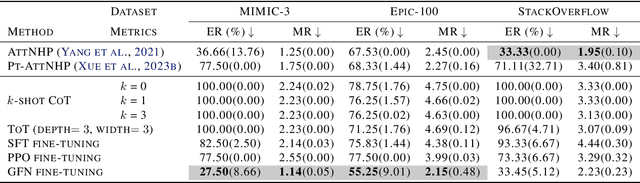
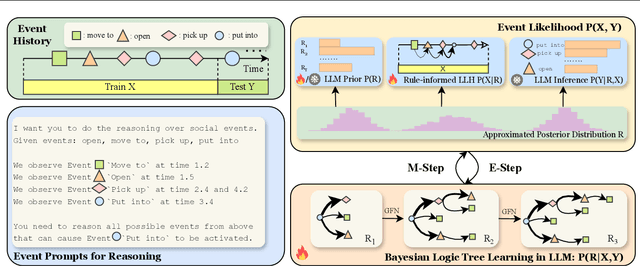
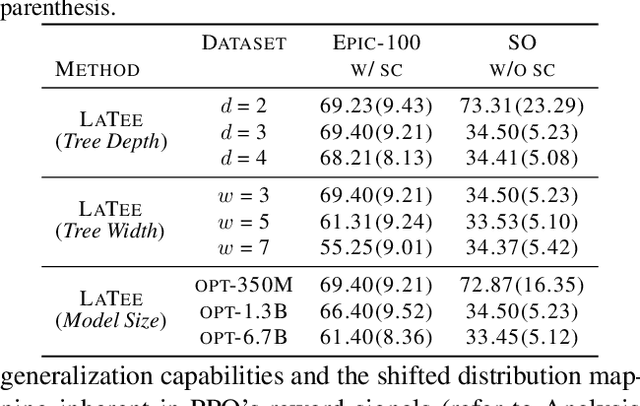
Modern high-stakes systems, such as healthcare or robotics, often generate vast streaming event sequences. Our goal is to design an efficient, plug-and-play tool to elicit logic tree-based explanations from Large Language Models (LLMs) to provide customized insights into each observed event sequence. Built on the temporal point process model for events, our method employs the likelihood function as a score to evaluate generated logic trees. We propose an amortized Expectation-Maximization (EM) learning framework and treat the logic tree as latent variables. In the E-step, we evaluate the posterior distribution over the latent logic trees using an LLM prior and the likelihood of the observed event sequences. LLM provides a high-quality prior for the latent logic trees, however, since the posterior is built over a discrete combinatorial space, we cannot get the closed-form solution. We propose to generate logic tree samples from the posterior using a learnable GFlowNet, which is a diversity-seeking generator for structured discrete variables. The M-step employs the generated logic rules to approximate marginalization over the posterior, facilitating the learning of model parameters and refining the tunable LLM prior parameters. In the online setting, our locally built, lightweight model will iteratively extract the most relevant rules from LLMs for each sequence using only a few iterations. Empirical demonstrations showcase the promising performance and adaptability of our framework.
Weak-to-Strong Search: Align Large Language Models via Searching over Small Language Models
May 29, 2024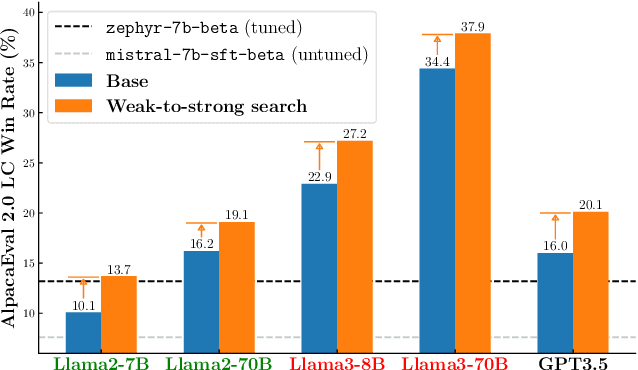
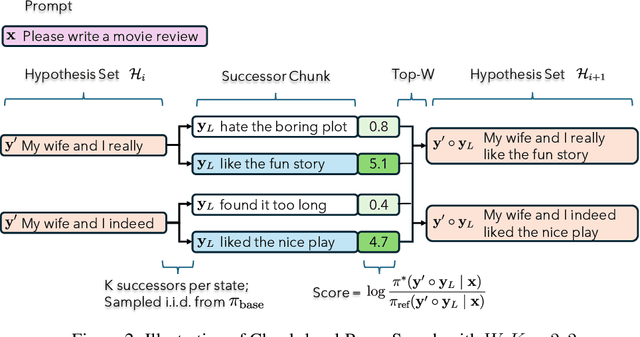
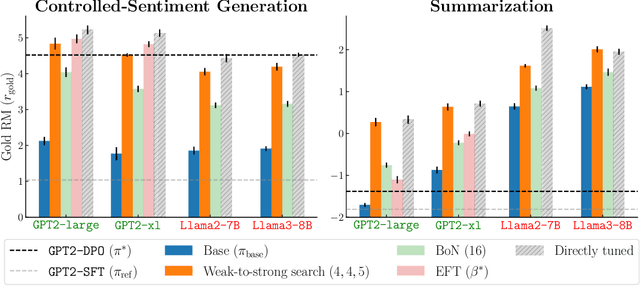
Large language models are usually fine-tuned to align with human preferences. However, fine-tuning a large language model can be challenging. In this work, we introduce $\textit{weak-to-strong search}$, framing the alignment of a large language model as a test-time greedy search to maximize the log-likelihood difference between small tuned and untuned models while sampling from the frozen large model. This method serves both as (i) a compute-efficient model up-scaling strategy that avoids directly tuning the large model and as (ii) an instance of weak-to-strong generalization that enhances a strong model with weak test-time guidance. Empirically, we demonstrate the flexibility of weak-to-strong search across different tasks. In controlled-sentiment generation and summarization, we use tuned and untuned $\texttt{gpt2}$s to effectively improve the alignment of large models without additional training. Crucially, in a more difficult instruction-following benchmark, AlpacaEval 2.0, we show that reusing off-the-shelf small model pairs (e.g., $\texttt{zephyr-7b-beta}$ and its untuned version) can significantly improve the length-controlled win rates of both white-box and black-box large models against $\texttt{gpt-4-turbo}$ (e.g., $34.4 \rightarrow 37.9$ for $\texttt{Llama-3-70B-Instruct}$ and $16.0 \rightarrow 20.1$ for $\texttt{gpt-3.5-turbo-instruct}$), despite the small models' low win rates $\approx 10.0$.