 Add to Chrome
 Add to Firefox
 Add to Edge
ParCo: Part-Coordinating Text-to-Motion Synthesis
Mar 27, 2024

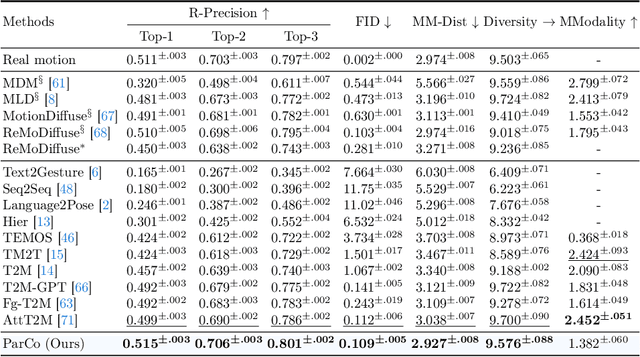

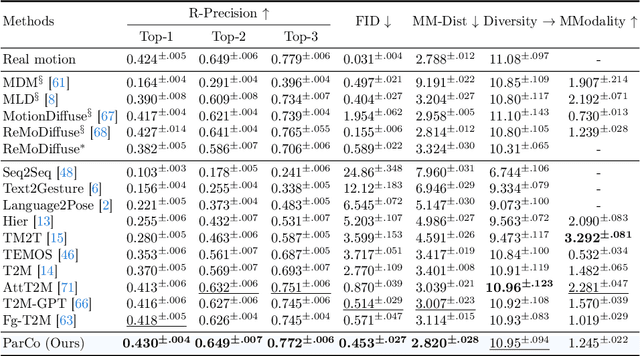
We study a challenging task: text-to-motion synthesis, aiming to generate motions that align with textual descriptions and exhibit coordinated movements. Currently, the part-based methods introduce part partition into the motion synthesis process to achieve finer-grained generation. However, these methods encounter challenges such as the lack of coordination between different part motions and difficulties for networks to understand part concepts. Moreover, introducing finer-grained part concepts poses computational complexity challenges. In this paper, we propose Part-Coordinating Text-to-Motion Synthesis (ParCo), endowed with enhanced capabilities for understanding part motions and communication among different part motion generators, ensuring a coordinated and fined-grained motion synthesis. Specifically, we discretize whole-body motion into multiple part motions to establish the prior concept of different parts. Afterward, we employ multiple lightweight generators designed to synthesize different part motions and coordinate them through our part coordination module. Our approach demonstrates superior performance on common benchmarks with economic computations, including HumanML3D and KIT-ML, providing substantial evidence of its effectiveness. Code is available at https://github.com/qrzou/ParCo .

Resource Allocation in Large Language Model Integrated 6G Vehicular Networks
Mar 27, 2024In the upcoming 6G era, vehicular networks are shifting from simple Vehicle-to-Vehicle (V2V) communication to the more complex Vehicle-to-Everything (V2X) connectivity. At the forefront of this shift is the incorporation of Large Language Models (LLMs) into vehicles. Known for their sophisticated natural language processing abilities, LLMs change how users interact with their vehicles. This integration facilitates voice-driven commands and interactions, departing from the conventional manual control systems. However, integrating LLMs into vehicular systems presents notable challenges. The substantial computational demands and energy requirements of LLMs pose significant challenges, especially in the constrained environment of a vehicle. Additionally, the time-sensitive nature of tasks in vehicular networks adds another layer of complexity. In this paper, we consider an edge computing system where vehicles process the initial layers of LLM computations locally, and offload the remaining LLM computation tasks to the Roadside Units (RSUs), envisioning a vehicular ecosystem where LLM computations seamlessly interact with the ultra-low latency and high-bandwidth capabilities of 6G networks. To balance the trade-off between completion time and energy consumption, we formulate a multi-objective optimization problem to minimize the total cost of the vehicles and RSUs. The problem is then decomposed into two sub-problems, which are solved by sequential quadratic programming (SQP) method and fractional programming technique. The simulation results clearly indicate that the algorithm we have proposed is highly effective in reducing both the completion time and energy consumption of the system.
Bayesian multi-exposure image fusion for robust high dynamic range ptychography
Mar 19, 2024Image information is restricted by the dynamic range of the detector, which can be addressed using multi-exposure image fusion (MEF). The conventional MEF approach employed in ptychography is often inadequate under conditions of low signal-to-noise ratio (SNR) or variations in illumination intensity. To address this, we developed a Bayesian approach for MEF based on a modified Poisson noise model that considers the background and saturation. Our method outperforms conventional MEF under challenging experimental conditions, as demonstrated by the synthetic and experimental data. Furthermore, this method is versatile and applicable to any imaging scheme requiring high dynamic range (HDR).
Self-Consistency Training for Hamiltonian Prediction
Mar 14, 2024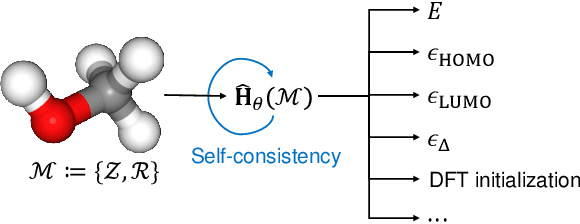
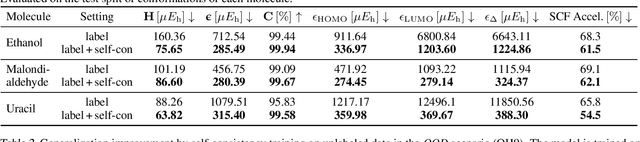
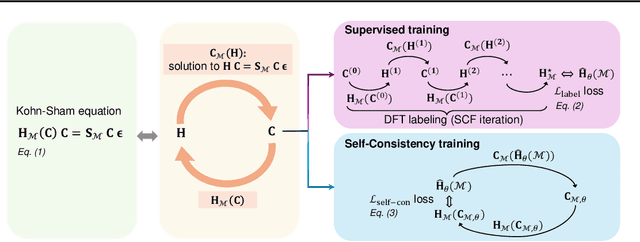

Hamiltonian prediction is a versatile formulation to leverage machine learning for solving molecular science problems. Yet, its applicability is limited by insufficient labeled data for training. In this work, we highlight that Hamiltonian prediction possesses a self-consistency principle, based on which we propose an exact training method that does not require labeled data. This merit addresses the data scarcity difficulty, and distinguishes the task from other property prediction formulations with unique benefits: (1) self-consistency training enables the model to be trained on a large amount of unlabeled data, hence substantially enhances generalization; (2) self-consistency training is more efficient than labeling data with DFT for supervised training, since it is an amortization of DFT calculation over a set of molecular structures. We empirically demonstrate the better generalization in data-scarce and out-of-distribution scenarios, and the better efficiency from the amortization. These benefits push forward the applicability of Hamiltonian prediction to an ever larger scale.
FaceChain-SuDe: Building Derived Class to Inherit Category Attributes for One-shot Subject-Driven Generation
Mar 11, 2024Subject-driven generation has garnered significant interest recently due to its ability to personalize text-to-image generation. Typical works focus on learning the new subject's private attributes. However, an important fact has not been taken seriously that a subject is not an isolated new concept but should be a specialization of a certain category in the pre-trained model. This results in the subject failing to comprehensively inherit the attributes in its category, causing poor attribute-related generations. In this paper, motivated by object-oriented programming, we model the subject as a derived class whose base class is its semantic category. This modeling enables the subject to inherit public attributes from its category while learning its private attributes from the user-provided example. Specifically, we propose a plug-and-play method, Subject-Derived regularization (SuDe). It constructs the base-derived class modeling by constraining the subject-driven generated images to semantically belong to the subject's category. Extensive experiments under three baselines and two backbones on various subjects show that our SuDe enables imaginative attribute-related generations while maintaining subject fidelity. Codes will be open sourced soon at FaceChain (https://github.com/modelscope/facechain).
User Connection and Resource Allocation Optimization in Blockchain Empowered Metaverse over 6G Wireless Communications
Mar 08, 2024The convergence of blockchain, Metaverse, and non-fungible tokens (NFTs) brings transformative digital opportunities alongside challenges like privacy and resource management. Addressing these, we focus on optimizing user connectivity and resource allocation in an NFT-centric and blockchain-enabled Metaverse in this paper. Through user work-offloading, we optimize data tasks, user connection parameters, and server computing frequency division. In the resource allocation phase, we optimize communication-computation resource distributions, including bandwidth, transmit power, and computing frequency. We introduce the trust-cost ratio (TCR), a pivotal measure combining trust scores from users' resources and server history with delay and energy costs. This balance ensures sustained user engagement and trust. The DASHF algorithm, central to our approach, encapsulates the Dinkelbach algorithm, alternating optimization, semidefinite relaxation (SDR), the Hungarian method, and a novel fractional programming technique from a recent IEEE JSAC paper [2]. The most challenging part of DASHF is to rewrite an optimization problem as Quadratically Constrained Quadratic Programming (QCQP) via carefully designed transformations, in order to be solved by SDR and the Hungarian algorithm. Extensive simulations validate the DASHF algorithm's efficacy, revealing critical insights for enhancing blockchain-Metaverse applications, especially with NFTs.
Articulated Object Manipulation with Coarse-to-fine Affordance for Mitigating the Effect of Point Cloud Noise
Mar 07, 20243D articulated objects are inherently challenging for manipulation due to the varied geometries and intricate functionalities associated with articulated objects.Point-level affordance, which predicts the per-point actionable score and thus proposes the best point to interact with, has demonstrated excellent performance and generalization capabilities in articulated object manipulation. However, a significant challenge remains: while previous works use perfect point cloud generated in simulation, the models cannot directly apply to the noisy point cloud in the real-world. To tackle this challenge, we leverage the property of real-world scanned point cloud that, the point cloud becomes less noisy when the camera is closer to the object. Therefore, we propose a novel coarse-to-fine affordance learning pipeline to mitigate the effect of point cloud noise in two stages. In the first stage, we learn the affordance on the noisy far point cloud which includes the whole object to propose the approximated place to manipulate. Then, we move the camera in front of the approximated place, scan a less noisy point cloud containing precise local geometries for manipulation, and learn affordance on such point cloud to propose fine-grained final actions. The proposed method is thoroughly evaluated both using large-scale simulated noisy point clouds mimicking real-world scans, and in the real world scenarios, with superiority over existing methods, demonstrating the effectiveness in tackling the noisy real-world point cloud problem.
AnatoMix: Anatomy-aware Data Augmentation for Multi-organ Segmentation
Mar 05, 2024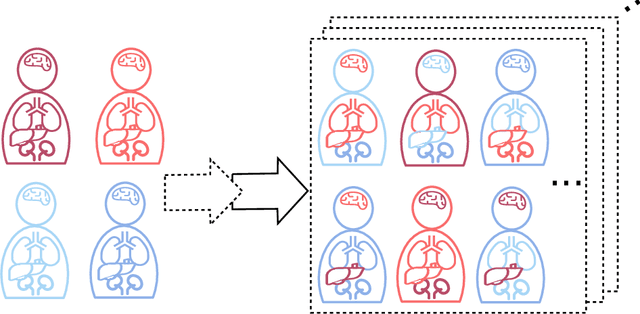
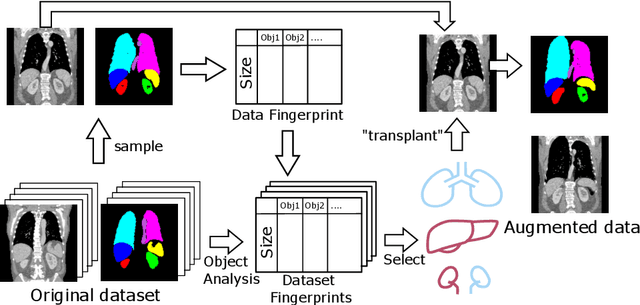
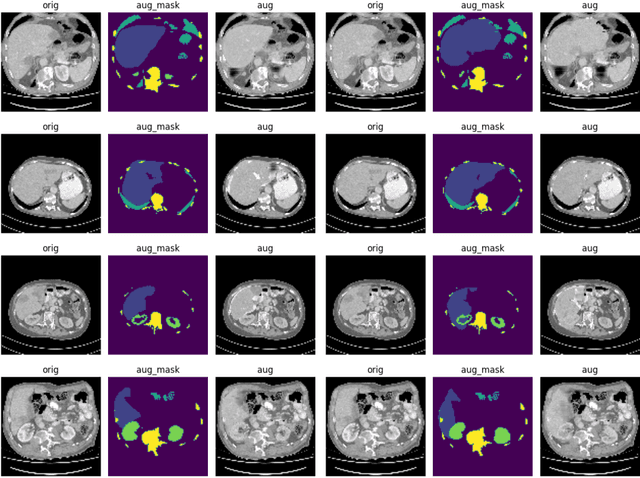
Multi-organ segmentation in medical images is a widely researched task and can save much manual efforts of clinicians in daily routines. Automating the organ segmentation process using deep learning (DL) is a promising solution and state-of-the-art segmentation models are achieving promising accuracy. In this work, We proposed a novel data augmentation strategy for increasing the generalizibility of multi-organ segmentation datasets, namely AnatoMix. By object-level matching and manipulation, our method is able to generate new images with correct anatomy, i.e. organ segmentation mask, exponentially increasing the size of the segmentation dataset. Initial experiments have been done to investigate the segmentation performance influenced by our method on a public CT dataset. Our augmentation method can lead to mean dice of 76.1, compared with 74.8 of the baseline method.
ASPIRe: An Informative Trajectory Planner with Mutual Information Approximation for Target Search and Tracking
Mar 04, 2024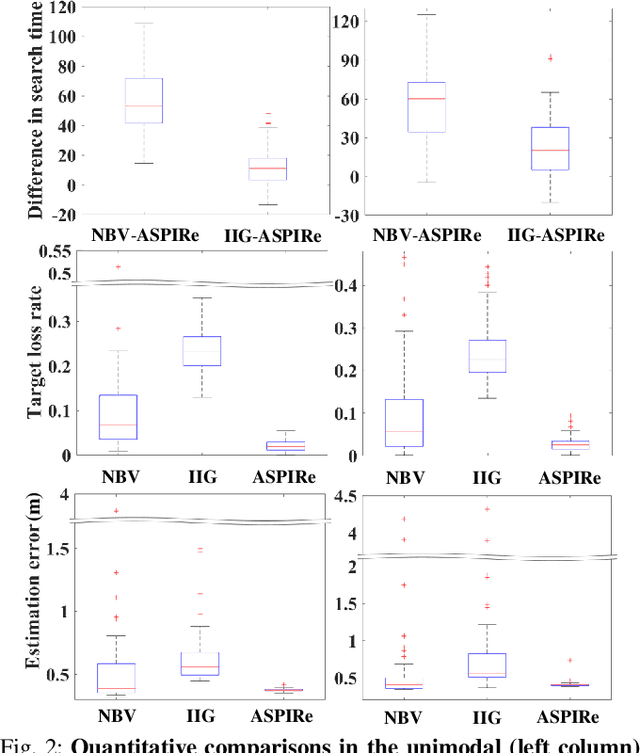
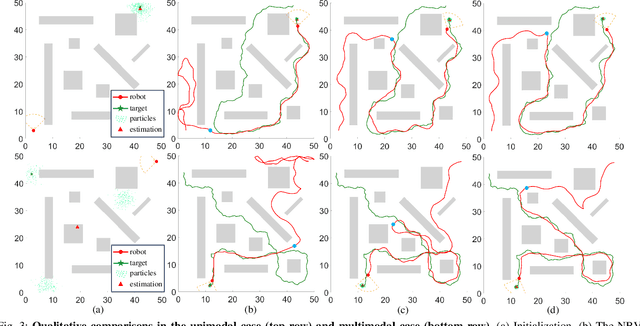
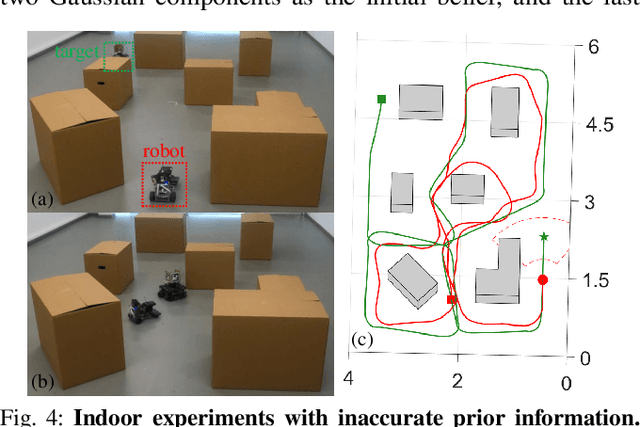
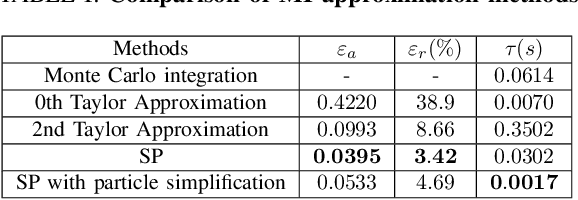
This paper proposes an informative trajectory planning approach, namely, \textit{adaptive particle filter tree with sigma point-based mutual information reward approximation} (ASPIRe), for mobile target search and tracking (SAT) in cluttered environments with limited sensing field of view. We develop a novel sigma point-based approximation to accurately estimate mutual information (MI) for general, non-Gaussian distributions utilizing particle representation of the belief state, while simultaneously maintaining high computational efficiency. Building upon the MI approximation, we develop the Adaptive Particle Filter Tree (APFT) approach with MI as the reward, which features belief state tree nodes for informative trajectory planning in continuous state and measurement spaces. An adaptive criterion is proposed in APFT to adjust the planning horizon based on the expected information gain. Simulations and physical experiments demonstrate that ASPIRe achieves real-time computation and outperforms benchmark methods in terms of both search efficiency and estimation accuracy.
DOZE: A Dataset for Open-Vocabulary Zero-Shot Object Navigation in Dynamic Environments
Feb 29, 2024Zero-Shot Object Navigation (ZSON) requires agents to autonomously locate and approach unseen objects in unfamiliar environments and has emerged as a particularly challenging task within the domain of Embodied AI. Existing datasets for developing ZSON algorithms lack consideration of dynamic obstacles, object attribute diversity, and scene texts, thus exhibiting noticeable discrepancy from real-world situations. To address these issues, we propose a Dataset for Open-Vocabulary Zero-Shot Object Navigation in Dynamic Environments (DOZE) that comprises ten high-fidelity 3D scenes with over 18k tasks, aiming to mimic complex, dynamic real-world scenarios. Specifically, DOZE scenes feature multiple moving humanoid obstacles, a wide array of open-vocabulary objects, diverse distinct-attribute objects, and valuable textual hints. Besides, different from existing datasets that only provide collision checking between the agent and static obstacles, we enhance DOZE by integrating capabilities for detecting collisions between the agent and moving obstacles. This novel functionality enables evaluation of the agents' collision avoidance abilities in dynamic environments. We test four representative ZSON methods on DOZE, revealing substantial room for improvement in existing approaches concerning navigation efficiency, safety, and object recognition accuracy. Our dataset could be found at https://DOZE-Dataset.github.io/.