 Add to Chrome
 Add to Firefox
 Add to Edge
Improving Deep Learning-Based Target Volume Auto-Delineation for Adaptive MR-Guided Radiotherapy in Head and Neck Cancer: Impact of a Volume-Aware Dice Loss
Apr 11, 2026
Background: Manual delineation of target volumes in head and neck cancer (HNC) remains a significant bottleneck in radiotherapy planning, characterized by high inter-observer variability and time consumption. This study evaluates the integration of a Volume-Aware (VA) Dice loss function into a self-configuring deep learning framework to enhance the auto-segmentation of primary tumors (PT) and metastatic lymph nodes (LN) for adaptive MR-guided radiotherapy. We investigate how volume-sensitive weighting affects the detection of small, anatomically complex nodal metastases compared to conventional loss functions. Methods: Utilizing the HNTS-MRG 2024 dataset, we implemented an nnU-Net ResEnc M architecture. We conducted a multi-label segmentation task, comparing a standard Dice loss baseline against two Volume-Aware configurations: a "Dual Mask" setup (VA loss on both PT and LN) and a "Selective LN Mask" setup (VA loss on LN only). Evaluation metrics included volumetric Dice scores, surface-based metrics (SDS, MSD, HD95), and lesion-wise binary detection sensitivity and precision. Results: The Selective LN Mask configuration achieved the highest LN Volumetric Dice Score (0.758 vs. 0.734 baseline) and significantly improved LN Lesion-Wise Detection Sensitivity (84.93% vs. 81.80%). However, a critical trade-off was observed; PT detection precision declined significantly in the selective setup (63.65% vs. 81.27%). The Dual Mask configuration provided the most balanced performance across both targets, maintaining primary tumor precision at 82.04% while improving LN sensitivity to 83.46%. Conclusions: A volume-sensitive loss function mitigated the under-representation of small metastatic lesions in HNC. While selective weighting yielded the best nodal detection, a dual-mask approach is required in multi-label tasks to maintain segmentation accuracy for larger primary tumor volumes.

Cut to the Mix: Simple Data Augmentation Outperforms Elaborate Ones in Limited Organ Segmentation Datasets
Feb 03, 2026Multi-organ segmentation is a widely applied clinical routine and automated organ segmentation tools dramatically improve the pipeline of the radiologists. Recently, deep learning (DL) based segmentation models have shown the capacity to accomplish such a task. However, the training of the segmentation networks requires large amount of data with manual annotations, which is a major concern due to the data scarcity from clinic. Working with limited data is still common for researches on novel imaging modalities. To enhance the effectiveness of DL models trained with limited data, data augmentation (DA) is a crucial regularization technique. Traditional DA (TDA) strategies focus on basic intra-image operations, i.e. generating images with different orientations and intensity distributions. In contrast, the interimage and object-level DA operations are able to create new images from separate individuals. However, such DA strategies are not well explored on the task of multi-organ segmentation. In this paper, we investigated four possible inter-image DA strategies: CutMix, CarveMix, ObjectAug and AnatoMix, on two organ segmentation datasets. The result shows that CutMix, CarveMix and AnatoMix can improve the average dice score by 4.9, 2.0 and 1.9, compared with the state-of-the-art nnUNet without DA strategies. These results can be further improved by adding TDA strategies. It is revealed in our experiments that Cut-Mix is a robust but simple DA strategy to drive up the segmentation performance for multi-organ segmentation, even when CutMix produces intuitively 'wrong' images. Our implementation is publicly available for future benchmarks.
Benchmarking GPT-5 in Radiation Oncology: Measurable Gains, but Persistent Need for Expert Oversight
Aug 29, 2025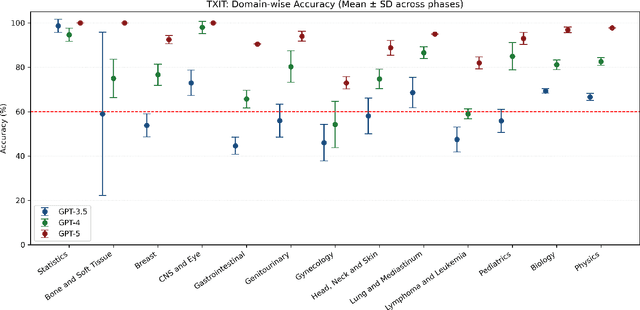
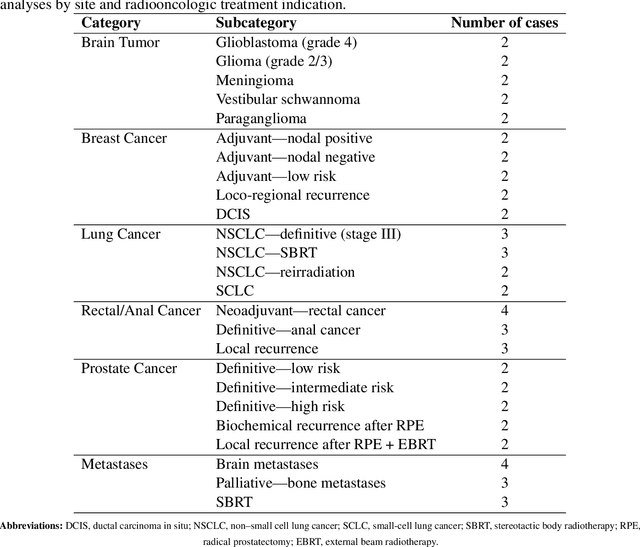
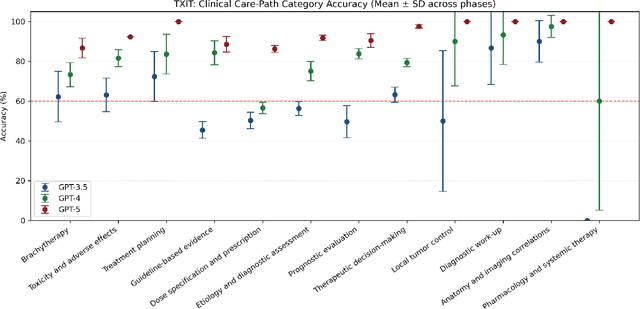
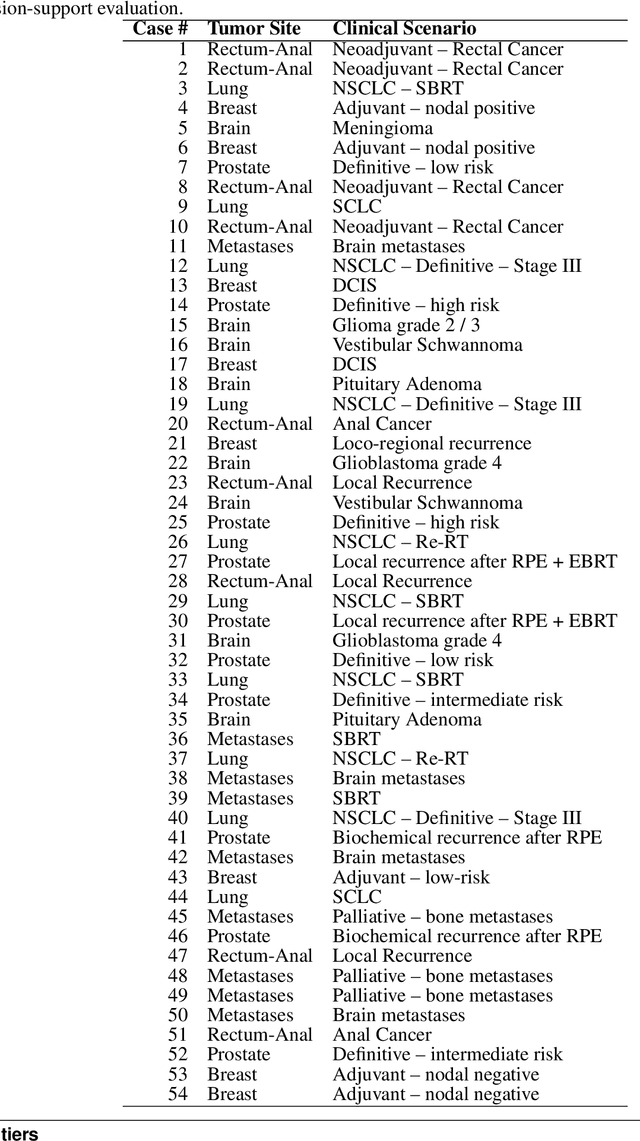
Introduction: Large language models (LLM) have shown great potential in clinical decision support. GPT-5 is a novel LLM system that has been specifically marketed towards oncology use. Methods: Performance was assessed using two complementary benchmarks: (i) the ACR Radiation Oncology In-Training Examination (TXIT, 2021), comprising 300 multiple-choice items, and (ii) a curated set of 60 authentic radiation oncologic vignettes representing diverse disease sites and treatment indications. For the vignette evaluation, GPT-5 was instructed to generate concise therapeutic plans. Four board-certified radiation oncologists rated correctness, comprehensiveness, and hallucinations. Inter-rater reliability was quantified using Fleiss' \k{appa}. Results: On the TXIT benchmark, GPT-5 achieved a mean accuracy of 92.8%, outperforming GPT-4 (78.8%) and GPT-3.5 (62.1%). Domain-specific gains were most pronounced in Dose and Diagnosis. In the vignette evaluation, GPT-5's treatment recommendations were rated highly for correctness (mean 3.24/4, 95% CI: 3.11-3.38) and comprehensiveness (3.59/4, 95% CI: 3.49-3.69). Hallucinations were rare with no case reaching majority consensus for their presence. Inter-rater agreement was low (Fleiss' \k{appa} 0.083 for correctness), reflecting inherent variability in clinical judgment. Errors clustered in complex scenarios requiring precise trial knowledge or detailed clinical adaptation. Discussion: GPT-5 clearly outperformed prior model variants on the radiation oncology multiple-choice benchmark. Although GPT-5 exhibited favorable performance in generating real-world radiation oncology treatment recommendations, correctness ratings indicate room for further improvement. While hallucinations were infrequent, the presence of substantive errors underscores that GPT-5-generated recommendations require rigorous expert oversight before clinical implementation.
AnatoMix: Anatomy-aware Data Augmentation for Multi-organ Segmentation
Mar 05, 2024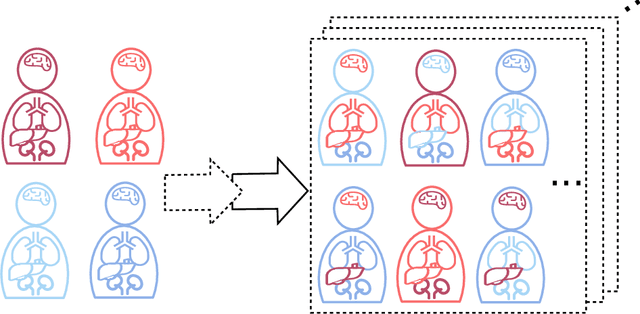
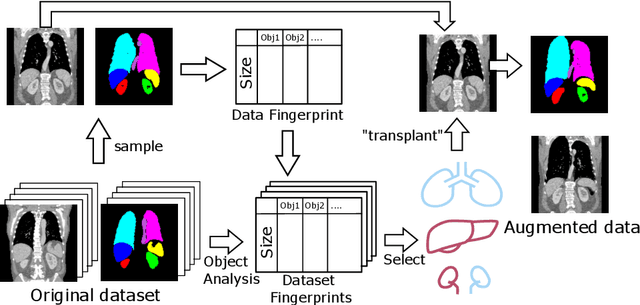
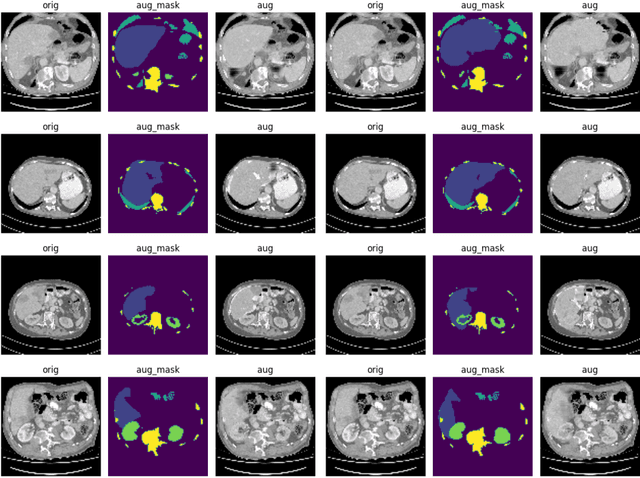
Multi-organ segmentation in medical images is a widely researched task and can save much manual efforts of clinicians in daily routines. Automating the organ segmentation process using deep learning (DL) is a promising solution and state-of-the-art segmentation models are achieving promising accuracy. In this work, We proposed a novel data augmentation strategy for increasing the generalizibility of multi-organ segmentation datasets, namely AnatoMix. By object-level matching and manipulation, our method is able to generate new images with correct anatomy, i.e. organ segmentation mask, exponentially increasing the size of the segmentation dataset. Initial experiments have been done to investigate the segmentation performance influenced by our method on a public CT dataset. Our augmentation method can lead to mean dice of 76.1, compared with 74.8 of the baseline method.