 Add to Chrome
 Add to Firefox
 Add to Edge
LLM-as-a-Verifier: A General-Purpose Verification Framework
Jul 06, 2026
Scaling pre-training, post-training, and test-time compute have become the central paradigms for improving the capabilities of LLMs. In this work, we identify verification, the ability to determine the correctness of a solution, as a new scaling axis. To unlock this and demonstrate its effectiveness, we introduce LLM-as-a-Verifier, a general-purpose verification framework that provides fine-grained feedback for agentic tasks without requiring additional training. Unlike standard LM judges that prompt LLMs to produce discrete scores for candidate solutions, LLM-as-a-Verifier computes the expectation over the distribution of scoring token logits to generate continuous scores. This probabilistic formulation enables verification to scale along multiple dimensions: (1) score granularity, (2) repeated evaluation, and (3) criteria decomposition. In particular, we show that scaling the scoring granularity leads to better separation between positive and negative solutions, resulting in more calibrated comparisons. Moreover, scaling repeated evaluation and criteria decomposition consistently lead to additional gains in verification accuracy through variance and complexity reduction. We further introduce a cost-efficient ranking algorithm for selecting the best solution among candidates using the verifier's continuous scores. LLM-as-a-Verifier achieves state-of-the-art performance on Terminal-Bench V2 (86.5%), SWE-Bench Verified (78.2%), RoboRewardBench (87.4%), and MedAgentBench (73.3%). Beyond verification, the fine-grained signals from LLM-as-a-Verifier can also serve as a proxy for estimating task progress. We build an extension for Claude Code, enabling developers to monitor and improve their own agentic systems. Finally, we show that LLM-as-a-Verifier can provide dense feedback for RL, improving the sample efficiency of SAC and GRPO on robotics and mathematical reasoning benchmarks.

Scaling Verification Can Be More Effective than Scaling Policy Learning for Vision-Language-Action Alignment
Feb 12, 2026The long-standing vision of general-purpose robots hinges on their ability to understand and act upon natural language instructions. Vision-Language-Action (VLA) models have made remarkable progress toward this goal, yet their generated actions can still misalign with the given instructions. In this paper, we investigate test-time verification as a means to shrink the "intention-action gap.'' We first characterize the test-time scaling law for embodied instruction following and demonstrate that jointly scaling the number of rephrased instructions and generated actions greatly increases test-time sample diversity, often recovering correct actions more efficiently than scaling each dimension independently. To capitalize on these scaling laws, we present CoVer, a contrastive verifier for vision-language-action alignment, and show that our architecture scales gracefully with additional computational resources and data. We then introduce "boot-time compute" and a hierarchical verification inference pipeline for VLAs. At deployment, our framework precomputes a diverse set of rephrased instructions from a Vision-Language-Model (VLM), repeatedly generates action candidates for each instruction, and then uses a verifier to select the optimal high-level prompt and low-level action chunks. Compared to scaling policy pre-training on the same data, our verification approach yields 22% gains in-distribution and 13% out-of-distribution on the SIMPLER benchmark, with a further 45% improvement in real-world experiments. On the PolaRiS benchmark, CoVer achieves 14% gains in task progress and 9% in success rate.
HPRM: High-Performance Robotic Middleware for Intelligent Autonomous Systems
Dec 02, 2024


The rise of intelligent autonomous systems, especially in robotics and autonomous agents, has created a critical need for robust communication middleware that can ensure real-time processing of extensive sensor data. Current robotics middleware like Robot Operating System (ROS) 2 faces challenges with nondeterminism and high communication latency when dealing with large data across multiple subscribers on a multi-core compute platform. To address these issues, we present High-Performance Robotic Middleware (HPRM), built on top of the deterministic coordination language Lingua Franca (LF). HPRM employs optimizations including an in-memory object store for efficient zero-copy transfer of large payloads, adaptive serialization to minimize serialization overhead, and an eager protocol with real-time sockets to reduce handshake latency. Benchmarks show HPRM achieves up to 173x lower latency than ROS2 when broadcasting large messages to multiple nodes. We then demonstrate the benefits of HPRM by integrating it with the CARLA simulator and running reinforcement learning agents along with object detection workloads. In the CARLA autonomous driving application, HPRM attains 91.1% lower latency than ROS2. The deterministic coordination semantics of HPRM, combined with its optimized IPC mechanisms, enable efficient and predictable real-time communication for intelligent autonomous systems.
SELA: Tree-Search Enhanced LLM Agents for Automated Machine Learning
Oct 22, 2024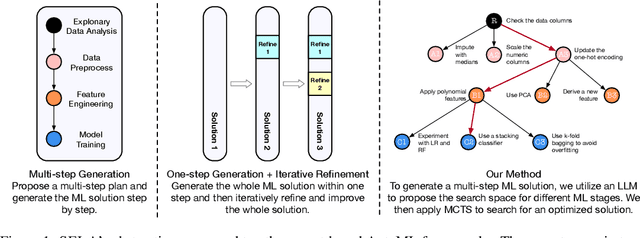

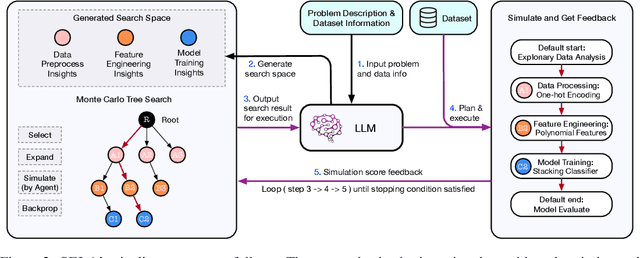

Automated Machine Learning (AutoML) approaches encompass traditional methods that optimize fixed pipelines for model selection and ensembling, as well as newer LLM-based frameworks that autonomously build pipelines. While LLM-based agents have shown promise in automating machine learning tasks, they often generate low-diversity and suboptimal code, even after multiple iterations. To overcome these limitations, we introduce Tree-Search Enhanced LLM Agents (SELA), an innovative agent-based system that leverages Monte Carlo Tree Search (MCTS) to optimize the AutoML process. By representing pipeline configurations as trees, our framework enables agents to conduct experiments intelligently and iteratively refine their strategies, facilitating a more effective exploration of the machine learning solution space. This novel approach allows SELA to discover optimal pathways based on experimental feedback, improving the overall quality of the solutions. In an extensive evaluation across 20 machine learning datasets, we compare the performance of traditional and agent-based AutoML methods, demonstrating that SELA achieves a win rate of 65% to 80% against each baseline across all datasets. These results underscore the significant potential of agent-based strategies in AutoML, offering a fresh perspective on tackling complex machine learning challenges.
Optimizing Distributed Reinforcement Learning with Reactor Model and Lingua Franca
Dec 07, 2023Distributed Reinforcement Learning (RL) frameworks are essential for mapping RL workloads to multiple computational resources, allowing for faster generation of samples, estimation of values, and policy improvement. These computational paradigms require a seamless integration of training, serving, and simulation workloads. Existing frameworks, such as Ray, are not managing this orchestration efficiently. In this study, we've proposed a solution implementing Reactor Model, which enforces a set of actors to have a fixed communication pattern. This allows the scheduler to eliminate works needed for synchronization, such as acquiring and releasing locks for each actor or sending and processing coordination-related messages. Our framework, Lingua Franca (LF), a coordination language based on the Reactor Model, also provides a unified interface that allows users to automatically generate dataflow graphs for distributed RL. On average, LF outperformed Ray in generating samples from OpenAI Gym and Atari environments by 1.21x and 11.62x, reduced the average training time of synchronized parallel Q-learning by 31.2%, and accelerated Multi-Agent RL inference by 5.12x.