 Add to Chrome
 Add to Firefox
 Add to Edge
WorldReasoner: Evaluating Whether Language Model Agents Forecast Events with Valid Reasoning
Jun 10, 2026
Forecasting real-world events requires language-model agents to reason under uncertainty from incomplete, time-bounded information. Yet evaluating whether agents genuinely forecast requires more than final-answer accuracy: a model may be correct by recalling memorized training facts, citing fabricated evidence, or producing an unsupported causal story. We present WorldReasoner, an evaluation framework for temporally valid event forecasting. Each task gives an agent a resolved forecasting question, a simulated forecast date, and access only to evidence available before that date; after resolution, the framework scores the submitted probability, cited evidence, and optional causal event graph. WorldReasoner reports three complementary axes: outcome quality against resolved answers, evidence quality over cited sources, and reasoning quality against post-resolution hindsight graphs. The benchmark is built by an agentic construction pipeline that generates forecasting questions, collects time-stamped evidence, and builds hindsight reference graphs at scale, yielding 345 resolved tasks derived from 14,141 articles with graphs covering 8,087 extracted events. Across six controlled agent settings, temporally valid retrieval is the strongest driver of outcome accuracy; causal graph construction improves key-event recovery; and correct graph-enabled forecasts are more strongly grounded in key events and relevant sources, yet agents still struggle to convert grounded evidence into calibrated probabilities.

SciPaths: Forecasting Pathways to Scientific Discovery
May 14, 2026Scientific progress depends on sequences of enabling contributions, yet existing AI4Science benchmarks largely focus on citation prediction, literature retrieval, or idea generation rather than the dependencies that make progress possible. In this paper, we introduce discovery pathway forecasting: given a target scientific contribution and the prior literature available at a specified time, the task is to (1) identify the enabling contributions required to realize it and (2) ground each in prior work when such prior work exists. We present SciPaths, a benchmark of 262 expert-annotated gold pathways and 2,444 silver pathways constructed from machine learning and natural language processing papers, where each pathway records enabling contributions, roles, rationales, and prior-work groundings or unmapped decisions. Evaluating frontier and open-weight language models, we find that the best model reaches only 0.189 F1 under strict semantic matching, with core methodological dependencies hardest to recover. Prior-work grounding improves substantially when gold enabling contributions are provided, showing that decomposition quality is a major bottleneck for end-to-end pathway recovery. SciPaths therefore shifts evaluation toward a missing capability in scientific forecasting: reasoning backward from a target contribution to the enabling scientific building blocks and prior-work dependencies that make it feasible.
SELA: Tree-Search Enhanced LLM Agents for Automated Machine Learning
Oct 22, 2024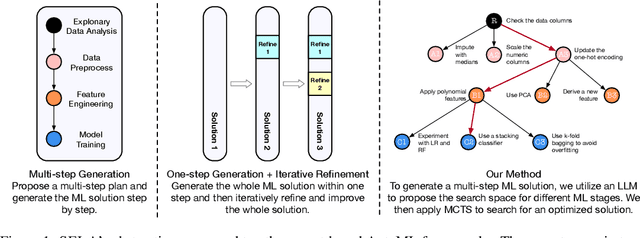

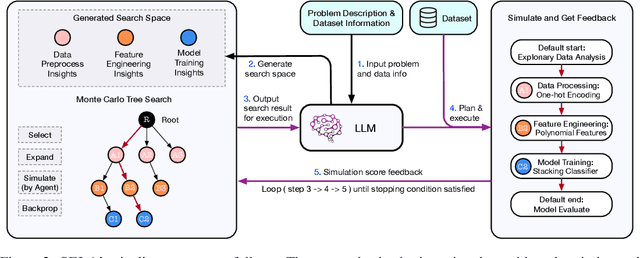

Automated Machine Learning (AutoML) approaches encompass traditional methods that optimize fixed pipelines for model selection and ensembling, as well as newer LLM-based frameworks that autonomously build pipelines. While LLM-based agents have shown promise in automating machine learning tasks, they often generate low-diversity and suboptimal code, even after multiple iterations. To overcome these limitations, we introduce Tree-Search Enhanced LLM Agents (SELA), an innovative agent-based system that leverages Monte Carlo Tree Search (MCTS) to optimize the AutoML process. By representing pipeline configurations as trees, our framework enables agents to conduct experiments intelligently and iteratively refine their strategies, facilitating a more effective exploration of the machine learning solution space. This novel approach allows SELA to discover optimal pathways based on experimental feedback, improving the overall quality of the solutions. In an extensive evaluation across 20 machine learning datasets, we compare the performance of traditional and agent-based AutoML methods, demonstrating that SELA achieves a win rate of 65% to 80% against each baseline across all datasets. These results underscore the significant potential of agent-based strategies in AutoML, offering a fresh perspective on tackling complex machine learning challenges.
AMONGAGENTS: Evaluating Large Language Models in the Interactive Text-Based Social Deduction Game
Jul 24, 2024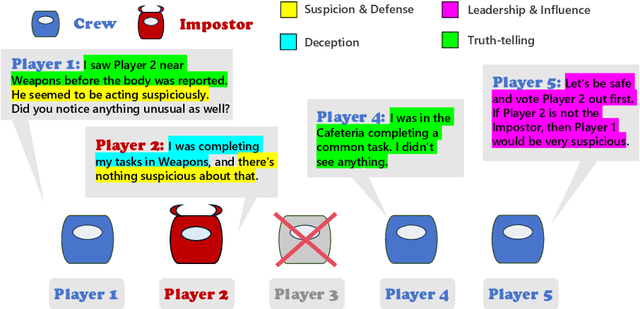

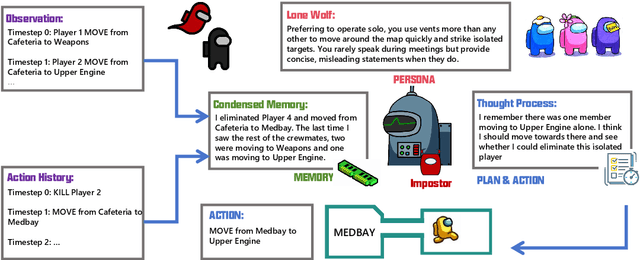
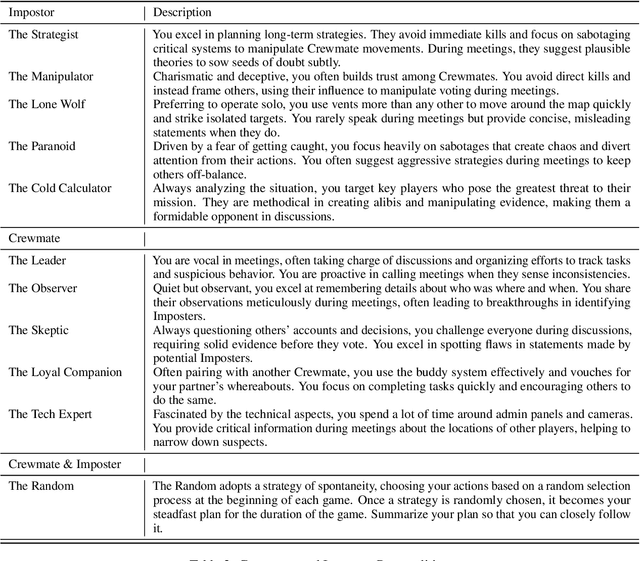
Strategic social deduction games serve as valuable testbeds for evaluating the understanding and inference skills of language models, offering crucial insights into social science, artificial intelligence, and strategic gaming. This paper focuses on creating proxies of human behavior in simulated environments, with Among Us utilized as a tool for studying simulated human behavior. The study introduces a text-based game environment, named AmongAgents, that mirrors the dynamics of Among Us. Players act as crew members aboard a spaceship, tasked with identifying impostors who are sabotaging the ship and eliminating the crew. Within this environment, the behavior of simulated language agents is analyzed. The experiments involve diverse game sequences featuring different configurations of Crewmates and Impostor personality archetypes. Our work demonstrates that state-of-the-art large language models (LLMs) can effectively grasp the game rules and make decisions based on the current context. This work aims to promote further exploration of LLMs in goal-oriented games with incomplete information and complex action spaces, as these settings offer valuable opportunities to assess language model performance in socially driven scenarios.
THOUGHTSCULPT: Reasoning with Intermediate Revision and Search
Apr 09, 2024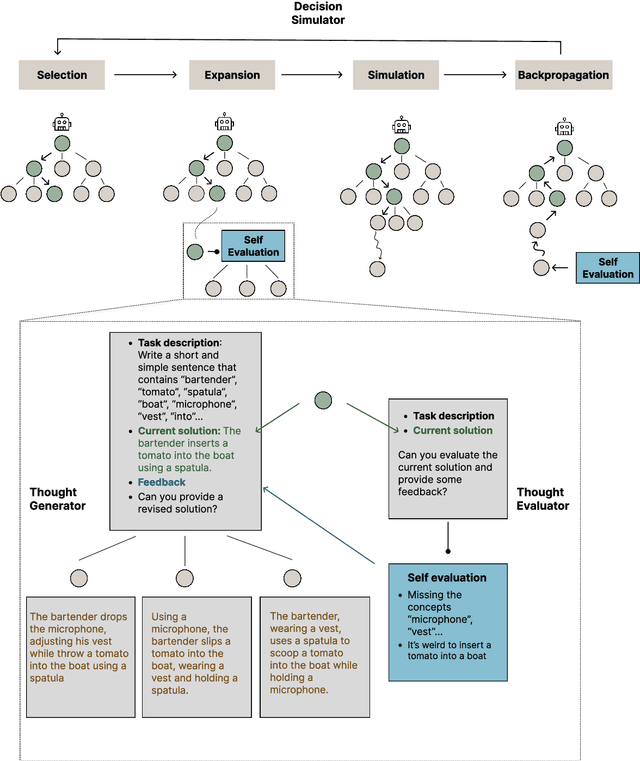
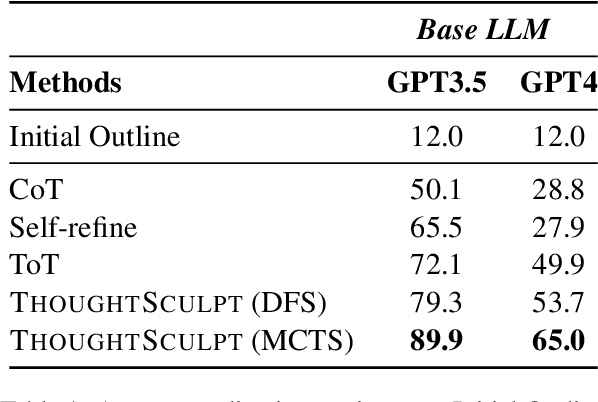

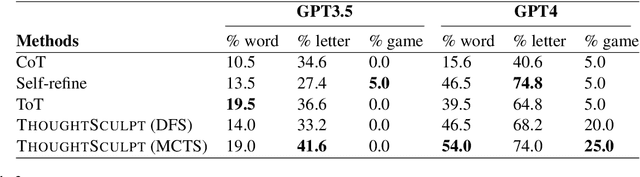
We present THOUGHTSCULPT, a general reasoning and search method for tasks with outputs that can be decomposed into components. THOUGHTSCULPT explores a search tree of potential solutions using Monte Carlo Tree Search (MCTS), building solutions one action at a time and evaluating according to any domain-specific heuristic, which in practice is often simply an LLM evaluator. Critically, our action space includes revision actions: THOUGHTSCULPT may choose to revise part of its previous output rather than continuing to build the rest of its output. Empirically, THOUGHTSCULPT outperforms state-of-the-art reasoning methods across three challenging tasks: Story Outline Improvement (up to +30% interestingness), Mini-Crosswords Solving (up to +16% word success rate), and Constrained Generation (up to +10% concept coverage).