 Add to Chrome
 Add to Firefox
 Add to Edge
BendTwin: Robust Dense-to-Sparse Physical Reconstruction with Bending-Aware Differentiable Spring-Mass Models
Aug 06, 2026
Reconstructing objects with mechanical properties from video observations enables physically consistent dynamic prediction, benefiting robotics planning and interaction. Existing spring--mass based physical driven reconstruction approaches offer efficient and differentiable physical reconstruction, but they typically rely on axial springs alone. Such formulations oversimplify the underlying structural mechanics and can become mechanically under-constrained when the physical graph is coarsened, limiting their ability to preserve stable local deformation. We present BendTwin, a bending-aware differentiable spring--mass framework for video-based reconstruction and future prediction of deformable objects. BendTwin introduces bending stiffness and damping over local surface triplets, penalizing deviations from rest angles and regularizing higher-order deformation. These bending constraints improve mechanical stability while preserving the simplicity of spring--mass system. Experiments show that BendTwin consistently outperforms the axial-only PhysTwin baseline. Ablation studies further demonstrate that the bending constraints maintain system stability across different downsampling ratios and consistently improve upon the original PhysTwin formulation. Overall, BendTwin provides an effective approach for constructing mechanically faithful digital twins from sparse-view RGB-D videos.

UnderOneFacade: Worldwide Facade Semantic Segmentation Benchmark Dataset
Jul 02, 2026Globally consistent semantic digital twins require centimeter-accurate and geographically transferable 3D facade segmentation. However, progress in facade parsing is limited by the lack of large-scale, standardized benchmarks for evaluating cross-domain generalization. Existing datasets are geographically narrow, semantically inconsistent, or insufficiently precise. We introduce UnderOneFacade, the largest cross-country and cross-continent 3D facade benchmark to date, comprising centimeter-accurate point clouds with hierarchical, harmonized, and architecturally grounded semantic labels totaling 2.7 billion annotated points. Through a systematic evaluation of representative point-, graph- and transformer-based architectures, we show that current methods struggle to recognize fine-grained architectural elements and degrade significantly across geographic domains, with the best models achieving only up to 33 IoU on the fine-grained LoFG3 benchmark. By combining geometric precision with standardized semantics at unprecedented scale, UnderOneFacade establishes a rigorous benchmark for developing robust and transferable 3D segmentation models. The dataset, evaluation scripts, and pretrained models will be released upon publication.
You Only Touch Once: 6-DoF Object Pose Estimation from Single Tactile Contact
Jun 27, 2026Accurate 6-DoF object pose estimation is fundamental to robotic manipulation, yet vision-based methods often fail under occlusion, poor lighting, and reflective or transparent surfaces. We present YOTO, a tactile-only pose estimation system that recovers the full 6-DoF object pose from a single pair of simultaneous contacts, without requiring contact history. YOTO represents each tactile contact as a local 3D point cloud and localizes it on the object surface through a coarse-to-fine network. The two localized contacts, together with the calibrated sensor poses, are then fed to a closed-form normal-aware SVD solver that recovers the full 6-DoF object pose in one step. To reduce real-data requirements, the localization network is pretrained on virtual tactile patches sampled from the object model and fine-tuned with a small number of real contacts. We further show that YOTO can operate on object models reconstructed from consumer-grade mobile scans, and quantify the gap relative to CAD-based models. Experiments on four geometrically diverse objects demonstrate accurate tactile contact localization and pose estimation, outperforming vision-based and geometric baselines, especially when visual perception is unreliable. Code, trained models, and the real GelSight dataset will be released upon publication.
SemCityLoc: Aerial 6DoF Localization Using Semantic 3D City Models
Jun 25, 2026Aerial 6DoF localization typically relies on precise GNSS signals or radiometrically rich 3D reconstructions, limiting scalability and on-board deployment. We propose SemCityLoc, a semantic-geometric alignment system that reframes aerial pose estimation as structured surface registration between foundation-model-derived visual priors and standardized LoD-compliant 3D city models. Instead of matching sparse contours or dense texture, our method aligns semantic surfaces and monocular depth with lightweight semantic 3D building models, increasing pose discriminability in repetitive and occluded urban environments. To enable accurate evaluation, we introduce SemCityLockeD, the first real-world benchmark combining centimeter-accurate UAV poses with standardized LoD1--LoD3 semantic city models and challenging low-altitude imagery. Experiments demonstrate substantial improvements over existing map-based approaches, improving recall by up to 36% and reducing mean positional error from 9.89m to 2.62m in challenging urban canyons. Our results indicate that semantically structured geometry provides sufficient and scalable constraints for high-precision aerial localization without radiometric scene reconstructions. The code and data are available at https://albertchen98.github.io/SemCityLoc.
NEXUS: Neural Energy Fields for Physically Consistent Contact-Rich 3D Object Dynamics
Jun 18, 2026Physics-grounded video generation requires controllable 3D object dynamics that remain physically consistent under contact, deformation, and external forcing. Existing trajectory-based methods often model isolated physical effects, making it difficult to compose conservative and non-conservative dynamics in contact-rich 3D scenes. We present NEXUS, a neural energy-field framework for contact-rich 3D object dynamics. NEXUS represents each object as a structural graph and constructs dynamic object-object and object-environment contact graphs. Inspired by Hamiltonian Neural Networks, NEXUS formulates motion through scalar energy and dissipation terms rather than directly predicting states or accelerations. Conservative effects, including gravity and elastic deformation, are composed as additive energy terms, while non-conservative effects such as damping and impact-induced energy loss are modeled with learned Rayleigh-style dissipation. Forces are derived by differentiating the energy and dissipation functions and rolled out with a multi-substep semi-implicit integrator. Across controlled trajectory benchmarks, NEXUS improves long-horizon accuracy over representative learned and physics-structured dynamics baselines under varying mechanical properties and physical-effect compositions. We further show that NEXUS trajectories provide effective guidance for contact-rich video generation, improving physical plausibility while maintaining competitive visual quality.
ActionReasoning: Robot Action Reasoning in 3D Space with LLM for Robotic Brick Stacking
Feb 24, 2026Classical robotic systems typically rely on custom planners designed for constrained environments. While effective in restricted settings, these systems lack generalization capabilities, limiting the scalability of embodied AI and general-purpose robots. Recent data-driven Vision-Language-Action (VLA) approaches aim to learn policies from large-scale simulation and real-world data. However, the continuous action space of the physical world significantly exceeds the representational capacity of linguistic tokens, making it unclear if scaling data alone can yield general robotic intelligence. To address this gap, we propose ActionReasoning, an LLM-driven framework that performs explicit action reasoning to produce physics-consistent, prior-guided decisions for robotic manipulation. ActionReasoning leverages the physical priors and real-world knowledge already encoded in Large Language Models (LLMs) and structures them within a multi-agent architecture. We instantiate this framework on a tractable case study of brick stacking, where the environment states are assumed to be already accurately measured. The environmental states are then serialized and passed to a multi-agent LLM framework that generates physics-aware action plans. The experiments demonstrate that the proposed multi-agent LLM framework enables stable brick placement while shifting effort from low-level domain-specific coding to high-level tool invocation and prompting, highlighting its potential for broader generalization. This work introduces a promising approach to bridging perception and execution in robotic manipulation by integrating physical reasoning with LLMs.
InfraDiffusion: zero-shot depth map restoration with diffusion models and prompted segmentation from sparse infrastructure point clouds
Sep 03, 2025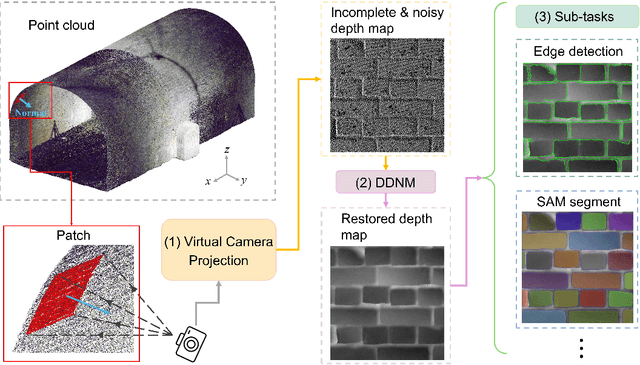
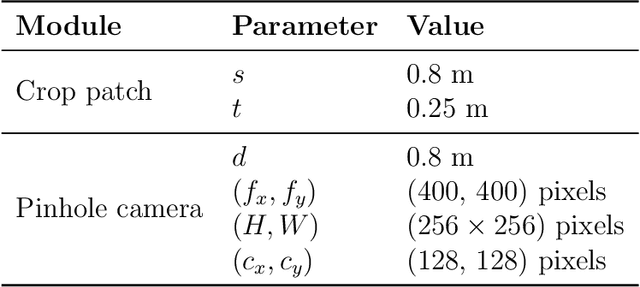
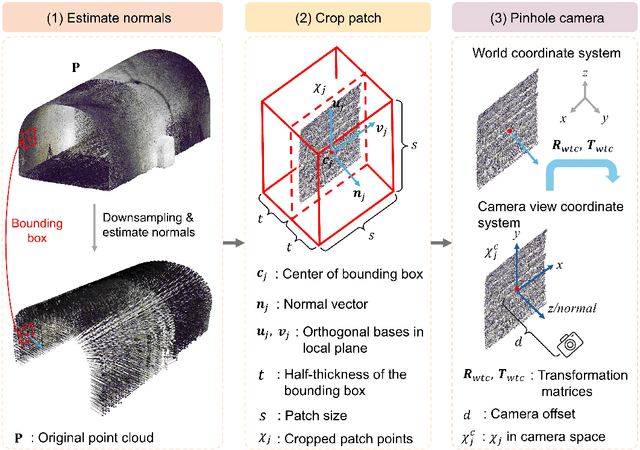
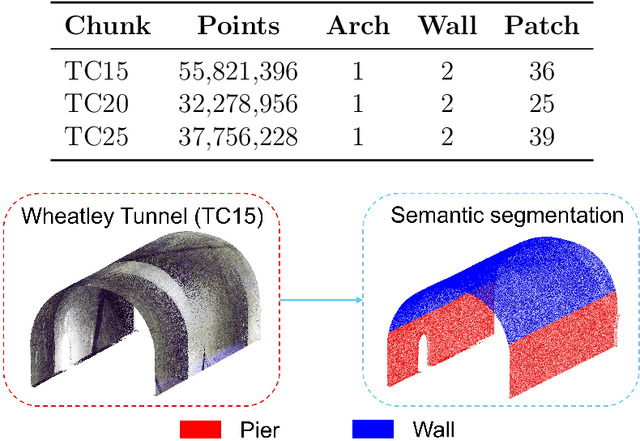
Point clouds are widely used for infrastructure monitoring by providing geometric information, where segmentation is required for downstream tasks such as defect detection. Existing research has automated semantic segmentation of structural components, while brick-level segmentation (identifying defects such as spalling and mortar loss) has been primarily conducted from RGB images. However, acquiring high-resolution images is impractical in low-light environments like masonry tunnels. Point clouds, though robust to dim lighting, are typically unstructured, sparse, and noisy, limiting fine-grained segmentation. We present InfraDiffusion, a zero-shot framework that projects masonry point clouds into depth maps using virtual cameras and restores them by adapting the Denoising Diffusion Null-space Model (DDNM). Without task-specific training, InfraDiffusion enhances visual clarity and geometric consistency of depth maps. Experiments on masonry bridge and tunnel point cloud datasets show significant improvements in brick-level segmentation using the Segment Anything Model (SAM), underscoring its potential for automated inspection of masonry assets. Our code and data is available at https://github.com/Jingyixiong/InfraDiffusion-official-implement.
A 3D Multimodal Feature for Infrastructure Anomaly Detection
Feb 09, 2025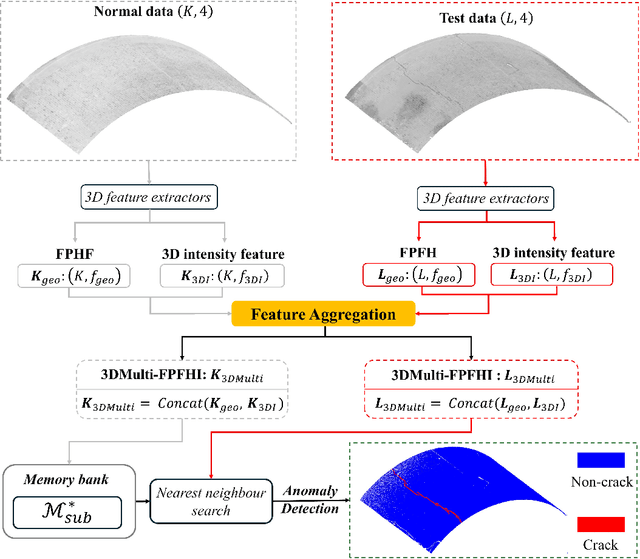
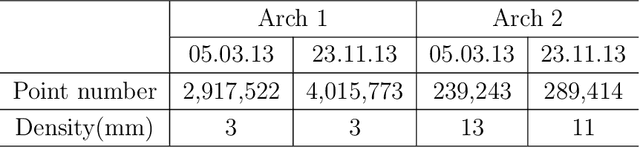
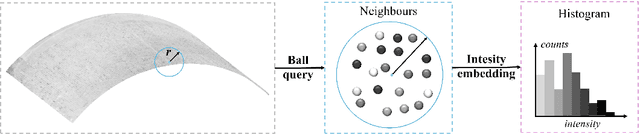
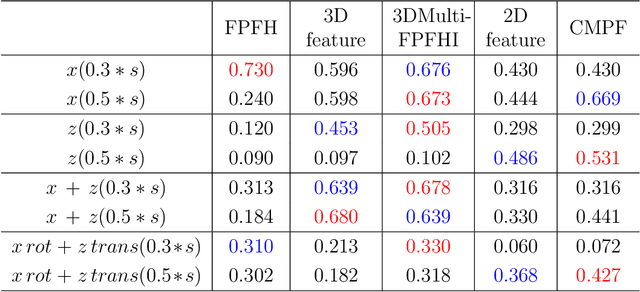
Ageing structures require periodic inspections to identify structural defects. Previous work has used geometric distortions to locate cracks in synthetic masonry bridge point clouds but has struggled to detect small cracks. To address this limitation, this study proposes a novel 3D multimodal feature, 3DMulti-FPFHI, that combines a customized Fast Point Feature Histogram (FPFH) with an intensity feature. This feature is integrated into the PatchCore anomaly detection algorithm and evaluated through statistical and parametric analyses. The method is further evaluated using point clouds of a real masonry arch bridge and a full-scale experimental model of a concrete tunnel. Results show that the 3D intensity feature enhances inspection quality by improving crack detection; it also enables the identification of water ingress which introduces intensity anomalies. The 3DMulti-FPFHI outperforms FPFH and a state-of-the-art multimodal anomaly detection method. The potential of the method to address diverse infrastructure anomaly detection scenarios is highlighted by the minimal requirements for data compared to learning-based methods. The code and related point cloud dataset are available at https://github.com/Jingyixiong/3D-Multi-FPFHI.