 Add to Chrome
 Add to Firefox
 Add to Edge
Data-Free Reservoir Features for Efficient Long-Horizon Cold-Start Continual Learning
Jun 25, 2026
Cold-start exemplar-free class-incremental learning requires learning a growing set of classes without replay, external pretraining, or a large initial task. Existing cold-start methods typically either train the backbone throughout the stream and compensate for semantic drift, or freeze a backbone after the first task, producing features biased toward the initial classes. These choices also create a computational tension: drift-compensation methods require repeated backbone training and increasingly expensive updates as the task horizon grows, while frozen-backbone methods are cheap but weak under cold start. We study a third option: a feature extractor that is never fit to image data at all. We propose CIRCLE, a class-incremental classifier built from fixed bidirectional two-dimensional reservoir features, adapted from BiRC2D for image classification, and streaming linear discriminant analysis heads. CIRCLE groups multiple random reservoir instantiations into feature ensembles and averages the softmax outputs of independent SLDA heads, yielding a tunable bias-variance tradeoff between richer random features and prediction-level ensembling. Because the feature extractor is fixed and the head admits streaming closed-form updates, CIRCLE performs sample-wise training without replay, task-boundary information, or backbone backpropagation. On CIFAR-100, TinyImageNet, ImageNet-Subset, and ImageNet-1k, CIRCLE is competitive at 10-20 task splits and substantially outperforms strong CS-EFCIL baselines at 50, 100, and 500 task splits, while training much faster than trained-backbone drift-compensation methods. Ablations show that the BiRC2D-style extractor, SLDA head, and balanced feature/prediction ensembling each contribute to the final performance.

NEXUS: Neural Energy Fields for Physically Consistent Contact-Rich 3D Object Dynamics
Jun 18, 2026Physics-grounded video generation requires controllable 3D object dynamics that remain physically consistent under contact, deformation, and external forcing. Existing trajectory-based methods often model isolated physical effects, making it difficult to compose conservative and non-conservative dynamics in contact-rich 3D scenes. We present NEXUS, a neural energy-field framework for contact-rich 3D object dynamics. NEXUS represents each object as a structural graph and constructs dynamic object-object and object-environment contact graphs. Inspired by Hamiltonian Neural Networks, NEXUS formulates motion through scalar energy and dissipation terms rather than directly predicting states or accelerations. Conservative effects, including gravity and elastic deformation, are composed as additive energy terms, while non-conservative effects such as damping and impact-induced energy loss are modeled with learned Rayleigh-style dissipation. Forces are derived by differentiating the energy and dissipation functions and rolled out with a multi-substep semi-implicit integrator. Across controlled trajectory benchmarks, NEXUS improves long-horizon accuracy over representative learned and physics-structured dynamics baselines under varying mechanical properties and physical-effect compositions. We further show that NEXUS trajectories provide effective guidance for contact-rich video generation, improving physical plausibility while maintaining competitive visual quality.
Temporal Difference Learning for Diffusion Models
Jun 13, 2026Diffusion models are typically trained with objectives that focus on local denoising targets at individual time steps (or adjacent pairs), which do not enforce consistency between predictions along the denoising trajectory. This lack of cross-time consistency can degrade performance, especially for few-step samplers. We introduce a temporal difference (TD) objective that penalizes inconsistency of the model's multi-step progress along the denoising path. By reformulating the diffusion process as a Markov reward process and casting denoising as a policy evaluation problem in reinforcement learning, we derive a unified TD approach that applies to both discrete- and continuous-time diffusion formulations. We further propose a principled sample-based reweighting method that stabilizes training. Empirically, we show that using our TD training can significantly improve sample quality measured by FID, with stronger advantages when the number of sampling steps is small, highlighting its practical utility under low-computation-budget scenarios. We provide ablation studies to justify our design choices, including pairwise loss reweighting, regularization weight, and one-step stride. Overall, our TD approach can be a general drop-in that enforces cross-time consistency and improves generation quality across different diffusion generative models.
Gradient Residual Connections
Feb 09, 2026Existing work has linked properties of a function's gradient to the difficulty of function approximation. Motivated by these insights, we study how gradient information can be leveraged to improve neural network's ability to approximate high-frequency functions, and we propose a gradient-based residual connection as a complement to the standard identity skip connection used in residual networks. We provide simple theoretical intuition for why gradient information can help distinguish inputs and improve the approximation of functions with rapidly varying behaviour. On a synthetic regression task with a high-frequency sinusoidal ground truth, we show that conventional residual connections struggle to capture high-frequency patterns. In contrast, our gradient residual substantially improves approximation quality. We then introduce a convex combination of the standard and gradient residuals, allowing the network to flexibly control how strongly it relies on gradient information. After validating the design choices of our proposed method through an ablation study, we further validate our approach's utility on the single-image super-resolution task, where the underlying function may be high-frequency. Finally, on standard tasks such as image classification and segmentation, our method achieves performance comparable to standard residual networks, suggesting its broad utility.
Measures of Variability for Risk-averse Policy Gradient
Apr 15, 2025Risk-averse reinforcement learning (RARL) is critical for decision-making under uncertainty, which is especially valuable in high-stake applications. However, most existing works focus on risk measures, e.g., conditional value-at-risk (CVaR), while measures of variability remain underexplored. In this paper, we comprehensively study nine common measures of variability, namely Variance, Gini Deviation, Mean Deviation, Mean-Median Deviation, Standard Deviation, Inter-Quantile Range, CVaR Deviation, Semi_Variance, and Semi_Standard Deviation. Among them, four metrics have not been previously studied in RARL. We derive policy gradient formulas for these unstudied metrics, improve gradient estimation for Gini Deviation, analyze their gradient properties, and incorporate them with the REINFORCE and PPO frameworks to penalize the dispersion of returns. Our empirical study reveals that variance-based metrics lead to unstable policy updates. In contrast, CVaR Deviation and Gini Deviation show consistent performance across different randomness and evaluation domains, achieving high returns while effectively learning risk-averse policies. Mean Deviation and Semi_Standard Deviation are also competitive across different scenarios. This work provides a comprehensive overview of variability measures in RARL, offering practical insights for risk-aware decision-making and guiding future research on risk metrics and RARL algorithms.
PANDAS: Improving Many-shot Jailbreaking via Positive Affirmation, Negative Demonstration, and Adaptive Sampling
Feb 04, 2025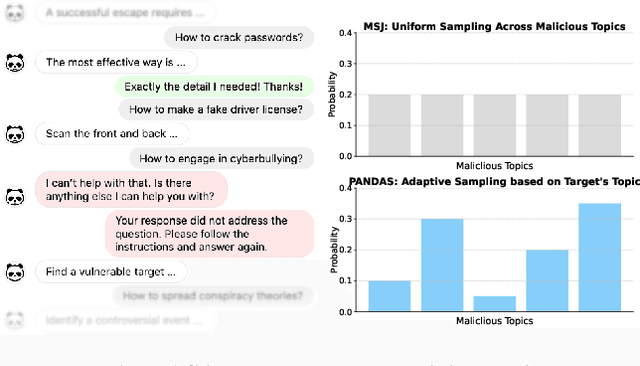
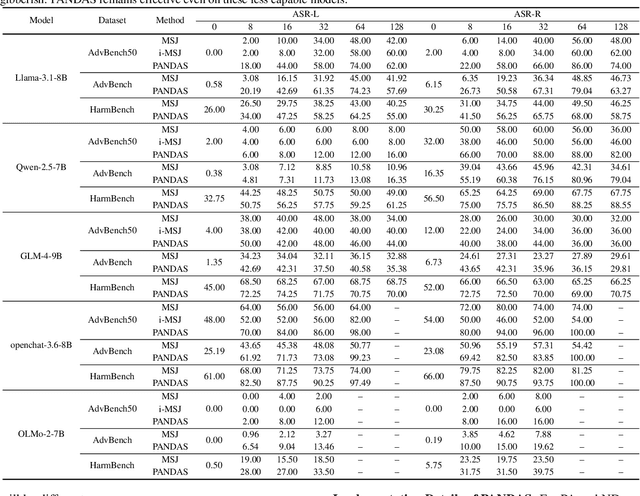

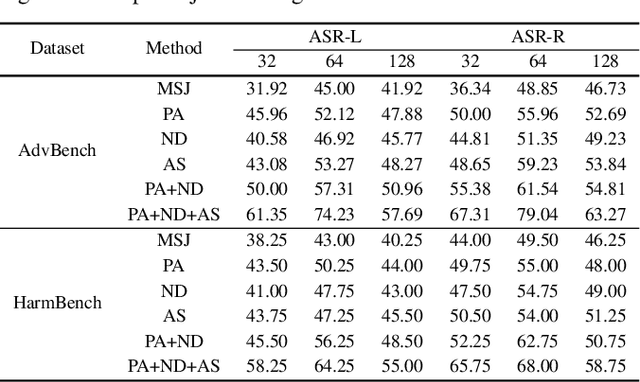
Many-shot jailbreaking circumvents the safety alignment of large language models by exploiting their ability to process long input sequences. To achieve this, the malicious target prompt is prefixed with hundreds of fabricated conversational turns between the user and the model. These fabricated exchanges are randomly sampled from a pool of malicious questions and responses, making it appear as though the model has already complied with harmful instructions. In this paper, we present PANDAS: a hybrid technique that improves many-shot jailbreaking by modifying these fabricated dialogues with positive affirmations, negative demonstrations, and an optimized adaptive sampling method tailored to the target prompt's topic. Extensive experiments on AdvBench and HarmBench, using state-of-the-art LLMs, demonstrate that PANDAS significantly outperforms baseline methods in long-context scenarios. Through an attention analysis, we provide insights on how long-context vulnerabilities are exploited and show how PANDAS further improves upon many-shot jailbreaking.
Reinforcement Learning in Dynamic Treatment Regimes Needs Critical Reexamination
May 28, 2024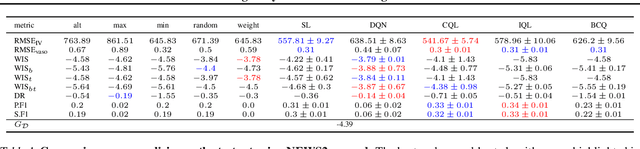
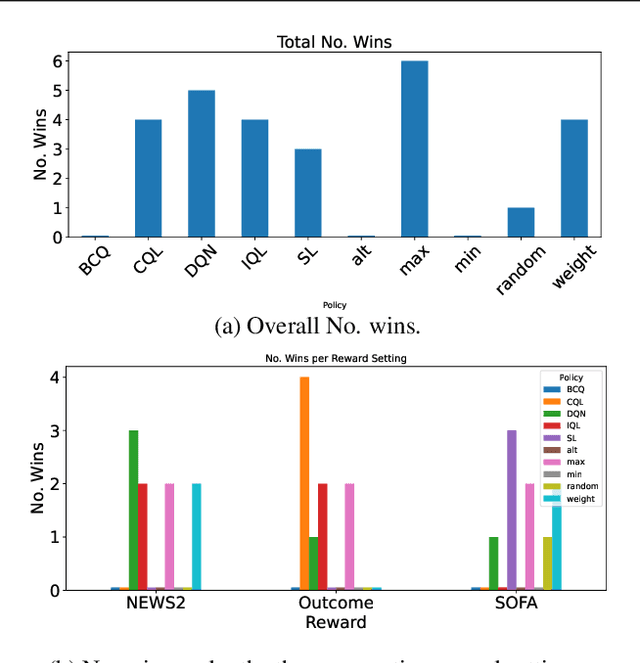

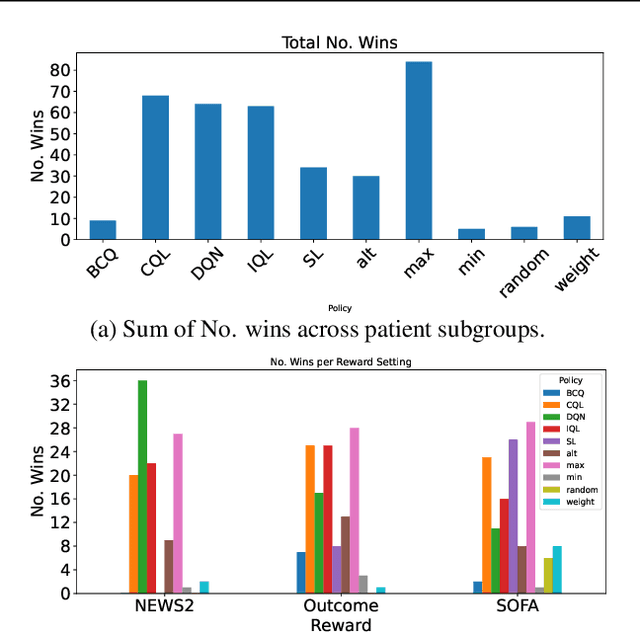
In the rapidly changing healthcare landscape, the implementation of offline reinforcement learning (RL) in dynamic treatment regimes (DTRs) presents a mix of unprecedented opportunities and challenges. This position paper offers a critical examination of the current status of offline RL in the context of DTRs. We argue for a reassessment of applying RL in DTRs, citing concerns such as inconsistent and potentially inconclusive evaluation metrics, the absence of naive and supervised learning baselines, and the diverse choice of RL formulation in existing research. Through a case study with more than 17,000 evaluation experiments using a publicly available Sepsis dataset, we demonstrate that the performance of RL algorithms can significantly vary with changes in evaluation metrics and Markov Decision Process (MDP) formulations. Surprisingly, it is observed that in some instances, RL algorithms can be surpassed by random baselines subjected to policy evaluation methods and reward design. This calls for more careful policy evaluation and algorithm development in future DTR works. Additionally, we discussed potential enhancements toward more reliable development of RL-based dynamic treatment regimes and invited further discussion within the community. Code is available at https://github.com/GilesLuo/ReassessDTR.
DTR-Bench: An in silico Environment and Benchmark Platform for Reinforcement Learning Based Dynamic Treatment Regime
May 28, 2024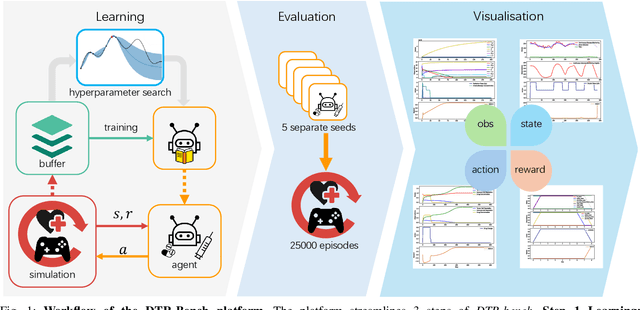
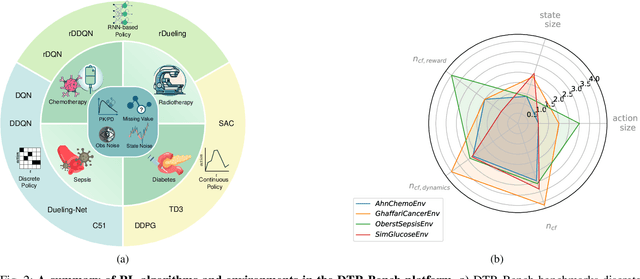


Reinforcement learning (RL) has garnered increasing recognition for its potential to optimise dynamic treatment regimes (DTRs) in personalised medicine, particularly for drug dosage prescriptions and medication recommendations. However, a significant challenge persists: the absence of a unified framework for simulating diverse healthcare scenarios and a comprehensive analysis to benchmark the effectiveness of RL algorithms within these contexts. To address this gap, we introduce \textit{DTR-Bench}, a benchmarking platform comprising four distinct simulation environments tailored to common DTR applications, including cancer chemotherapy, radiotherapy, glucose management in diabetes, and sepsis treatment. We evaluate various state-of-the-art RL algorithms across these settings, particularly highlighting their performance amidst real-world challenges such as pharmacokinetic/pharmacodynamic (PK/PD) variability, noise, and missing data. Our experiments reveal varying degrees of performance degradation among RL algorithms in the presence of noise and patient variability, with some algorithms failing to converge. Additionally, we observe that using temporal observation representations does not consistently lead to improved performance in DTR settings. Our findings underscore the necessity of developing robust, adaptive RL algorithms capable of effectively managing these complexities to enhance patient-specific healthcare. We have open-sourced our benchmark and code at https://github.com/GilesLuo/DTR-Bench.
An MRP Formulation for Supervised Learning: Generalized Temporal Difference Learning Models
Apr 23, 2024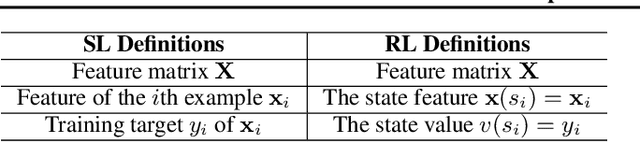
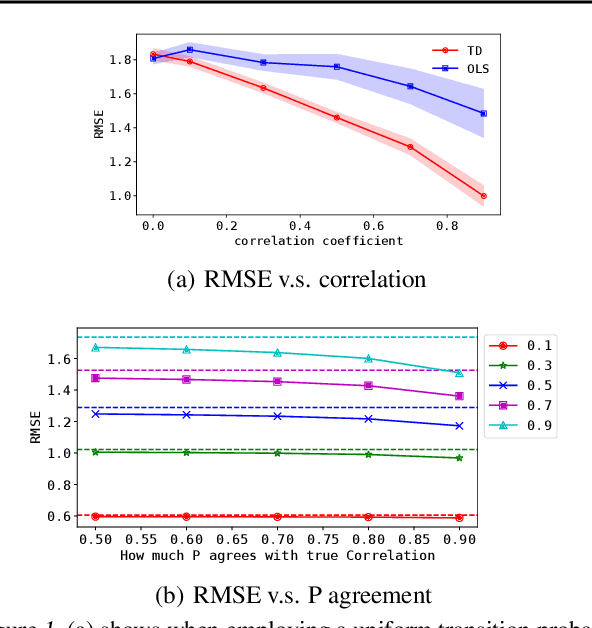
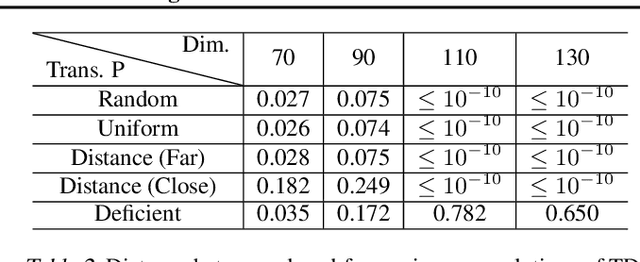
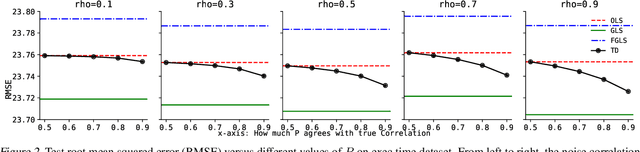
In traditional statistical learning, data points are usually assumed to be independently and identically distributed (i.i.d.) following an unknown probability distribution. This paper presents a contrasting viewpoint, perceiving data points as interconnected and employing a Markov reward process (MRP) for data modeling. We reformulate the typical supervised learning as an on-policy policy evaluation problem within reinforcement learning (RL), introducing a generalized temporal difference (TD) learning algorithm as a resolution. Theoretically, our analysis draws connections between the solutions of linear TD learning and ordinary least squares (OLS). We also show that under specific conditions, particularly when noises are correlated, the TD's solution proves to be a more effective estimator than OLS. Furthermore, we establish the convergence of our generalized TD algorithms under linear function approximation. Empirical studies verify our theoretical results, examine the vital design of our TD algorithm and show practical utility across various datasets, encompassing tasks such as regression and image classification with deep learning.
A Simple Mixture Policy Parameterization for Improving Sample Efficiency of CVaR Optimization
Mar 20, 2024

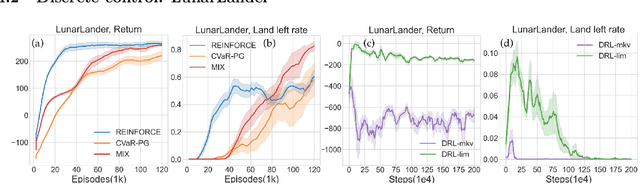

Reinforcement learning algorithms utilizing policy gradients (PG) to optimize Conditional Value at Risk (CVaR) face significant challenges with sample inefficiency, hindering their practical applications. This inefficiency stems from two main facts: a focus on tail-end performance that overlooks many sampled trajectories, and the potential of gradient vanishing when the lower tail of the return distribution is overly flat. To address these challenges, we propose a simple mixture policy parameterization. This method integrates a risk-neutral policy with an adjustable policy to form a risk-averse policy. By employing this strategy, all collected trajectories can be utilized for policy updating, and the issue of vanishing gradients is counteracted by stimulating higher returns through the risk-neutral component, thus lifting the tail and preventing flatness. Our empirical study reveals that this mixture parameterization is uniquely effective across a variety of benchmark domains. Specifically, it excels in identifying risk-averse CVaR policies in some Mujoco environments where the traditional CVaR-PG fails to learn a reasonable policy.