 Add to Chrome
 Add to Firefox
 Add to Edge
BendTwin: Robust Dense-to-Sparse Physical Reconstruction with Bending-Aware Differentiable Spring-Mass Models
Aug 06, 2026
Reconstructing objects with mechanical properties from video observations enables physically consistent dynamic prediction, benefiting robotics planning and interaction. Existing spring--mass based physical driven reconstruction approaches offer efficient and differentiable physical reconstruction, but they typically rely on axial springs alone. Such formulations oversimplify the underlying structural mechanics and can become mechanically under-constrained when the physical graph is coarsened, limiting their ability to preserve stable local deformation. We present BendTwin, a bending-aware differentiable spring--mass framework for video-based reconstruction and future prediction of deformable objects. BendTwin introduces bending stiffness and damping over local surface triplets, penalizing deviations from rest angles and regularizing higher-order deformation. These bending constraints improve mechanical stability while preserving the simplicity of spring--mass system. Experiments show that BendTwin consistently outperforms the axial-only PhysTwin baseline. Ablation studies further demonstrate that the bending constraints maintain system stability across different downsampling ratios and consistently improve upon the original PhysTwin formulation. Overall, BendTwin provides an effective approach for constructing mechanically faithful digital twins from sparse-view RGB-D videos.

PhysInOne: Visual Physics Learning and Reasoning in One Suite
Apr 10, 2026We present PhysInOne, a large-scale synthetic dataset addressing the critical scarcity of physically-grounded training data for AI systems. Unlike existing datasets limited to merely hundreds or thousands of examples, PhysInOne provides 2 million videos across 153,810 dynamic 3D scenes, covering 71 basic physical phenomena in mechanics, optics, fluid dynamics, and magnetism. Distinct from previous works, our scenes feature multiobject interactions against complex backgrounds, with comprehensive ground-truth annotations including 3D geometry, semantics, dynamic motion, physical properties, and text descriptions. We demonstrate PhysInOne's efficacy across four emerging applications: physics-aware video generation, long-/short-term future frame prediction, physical property estimation, and motion transfer. Experiments show that fine-tuning foundation models on PhysInOne significantly enhances physical plausibility, while also exposing critical gaps in modeling complex physical dynamics and estimating intrinsic properties. As the largest dataset of its kind, orders of magnitude beyond prior works, PhysInOne establishes a new benchmark for advancing physics-grounded world models in generation, simulation, and embodied AI.
CloudRCA: A Root Cause Analysis Framework for Cloud Computing Platforms
Nov 05, 2021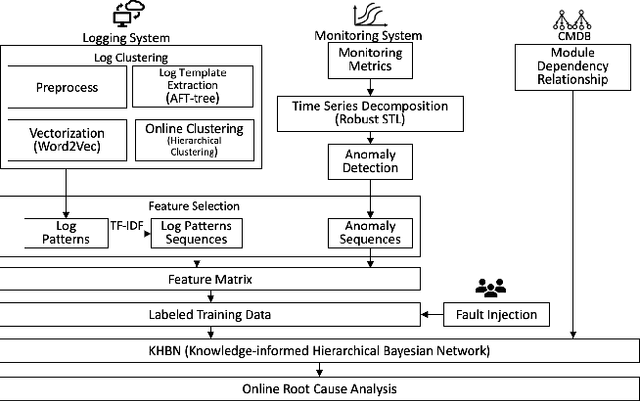
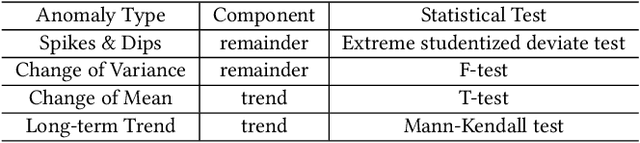
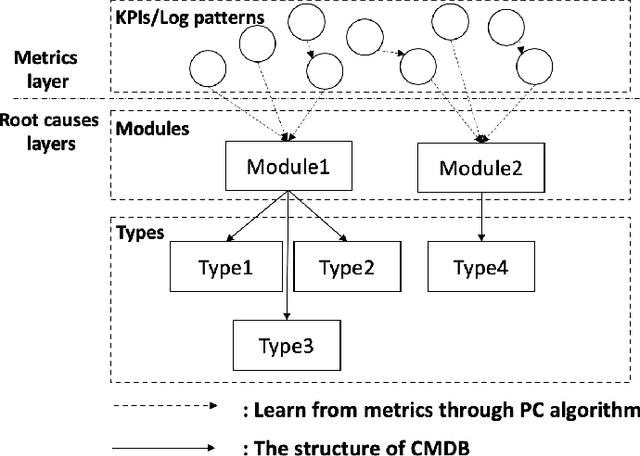
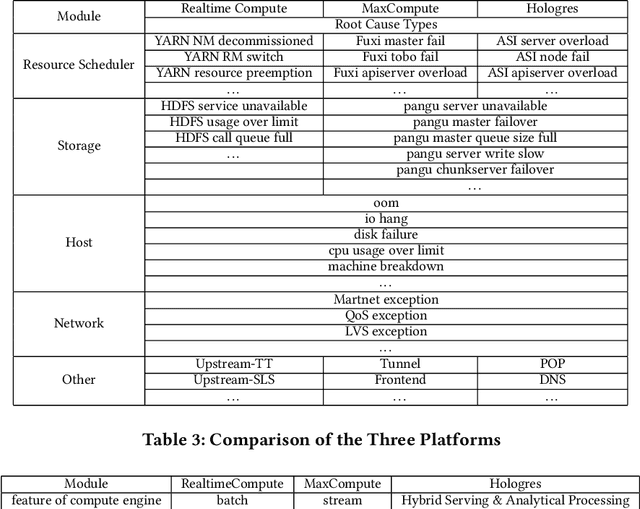
As business of Alibaba expands across the world among various industries, higher standards are imposed on the service quality and reliability of big data cloud computing platforms which constitute the infrastructure of Alibaba Cloud. However, root cause analysis in these platforms is non-trivial due to the complicated system architecture. In this paper, we propose a root cause analysis framework called CloudRCA which makes use of heterogeneous multi-source data including Key Performance Indicators (KPIs), logs, as well as topology, and extracts important features via state-of-the-art anomaly detection and log analysis techniques. The engineered features are then utilized in a Knowledge-informed Hierarchical Bayesian Network (KHBN) model to infer root causes with high accuracy and efficiency. Ablation study and comprehensive experimental comparisons demonstrate that, compared to existing frameworks, CloudRCA 1) consistently outperforms existing approaches in f1-score across different cloud systems; 2) can handle novel types of root causes thanks to the hierarchical structure of KHBN; 3) performs more robustly with respect to algorithmic configurations; and 4) scales more favorably in the data and feature sizes. Experiments also show that a cross-platform transfer learning mechanism can be adopted to further improve the accuracy by more than 10\%. CloudRCA has been integrated into the diagnosis system of Alibaba Cloud and employed in three typical cloud computing platforms including MaxCompute, Realtime Compute and Hologres. It saves Site Reliability Engineers (SREs) more than $20\%$ in the time spent on resolving failures in the past twelve months and improves service reliability significantly.
* Accepted by CIKM 2021; 10 pages, 3 figures, 12 tables